-
Iloilo: So Nice You Say It Twice

Museum of Philippine Maritime History near Plaza Libertad On the island of Panay in the Western Visayas

Soaring over the Western Visayas I’ll admit: Iloilo is such an enchanting name I decided I had to go there because of it. Even before I knew where it was or what was there. The Philippine Airlines flight from Manila soared over the Visayas, around the center of the Philippines, to get to Iloilo City, the water from the Sulu Sea and Panay Gulf radiating a magical golden luminescence.

Many ancestral homes in Iloilo Echoes of Macondo

Haunted Lizares Mansion Iloilo City is defined by ancestral homes whose magnificence is maintained despite relentless tropical wear and tear. Their atmospheric bedrooms and ballrooms, living rooms and lived-in rooms, reminded me of the mythical Macondo of Gabriel Garcia Marquez’s novel, 100 Years of Solitude.
Real-life haunted mansion

Spiral staircase at Lizares Mansion 
Faith-based coffee at Lizares Mansion The Lizares Mansion, built in 1937, has a tragic history. Don Emiliano Lizares built it as a sprawling family complex but had to surrender it to the Japanese during World War II, who turned it into their headquarters. A powerful sugar baron, Don Emiliano and his family escaped the Japanese just in time, using a secret passageway that I got to see on the tour. Their majestic Beaux-Arts home, with its 59 hardwood doors and a spiral staircase illuminated by multi-hued panes of glass, experienced horrors. Japanese soldiers tortured Filipinos and buried them on the grounds and in the basement. When the war neared its end, Japanese officers and soldiers committed seppuku. Understandably, locals believe it’s haunted. The home, designed by famous Philippine painter Juan Luna’s son, Andres Luna de Pedro, is now the tranquil Angelicum School Iloilo.
Mansion anchoring a lush garden

Lopez Mansion The Lopez Mansion with Nelly’s Garden is another example of the lavish lifestyle sugar barons had when the Philippines was an American colony. No photos were allowed inside during our tour because the family still stays here on occasion. The interior has massive chandeliers, wall frescoes, heirlooms, Chinese antiques with the patina of age and oozing karma, and polished tindalo wood floors.

Nelly’s Garden at Lopez Mansion Not just museums, restaurants too

Camina Balay Nga Bato Mansion 
Camino Balay Nga Bato Mansion filled with antiques 
Best hot chocolate ever at Balay Ngo Bato The 161-year-old mansion Camina Balay Nga Bato houses an Ilonggo restaurant. Built in 1865, it was passed from one family to another until the Caminas family acquired it and has kept it for four generations so far. Twenty-four tree trunks support the house, and the roof is made of Nipa and bamboo. The Ilonggo cuisine at its restaurant is fabulous in flavor and authenticity. I drank not one but three cups of the richest chocolate drink I’ve ever had, made from tsolate tablea (chocolate tablets).

Jalandoni-Montinola Ancestral Home dining room 
Halo-halo at Agatona 1927 Museum Cafe The Jalandoni-Montinola Ancestral Home has the lavish Agatona 1927 Museum Café. We toured the house before a cooling afternoon merienda of Guimaras Green Mango juice and Halo-halo. All the tables have a bell to ring for service. The café’s balcony has an atmospheric view of the imposing Jaro Metropolitan Cathedral. Built in 1874, it’s the seat of the Roman Catholic Archdiocese of Jaro. A steady stream of worshippers entered it, while others lingered outside.

Imposing Jaro Cathedral 
Jaro Cathedral Iloilo’s oldest home blessed by a Pope

Casa Mariquit living room with capiz windows 
Nook at Cara Mariquit The oldest ancestral home, Casa Mariquit, built in 1803, is also known as the Javellano-Lopez House. Always owned by one family, a descendant, Fernando Lopez Sr., was vice-president under two Philippine presidents. Pope John Paul II blessed the house during his February 1981 visit. This house reminded me the most of Macondo’s Buendía family compound. It exudes the spiritual weight of generations of the same family loving, living, laughing, and I’m sure fighting here. The capiz shell windows soften the light that enters the home. Maybe the memories too.
UNESCO World Heritage Church

UNESCO World Heritage Miagao Church Of the four UNESCO World Heritage churches in the Philippines, the Miagao Church, in Iloilo, is the only one outside of Luzon. A Baroque-Romanesque church completed in 1797 by the Spanish with forced labor, it was the center of the area’s Catholic faith. Its thick walls provided fortification against attacks by Moro pirates, reminding me of the fortified churches I saw in Transylvania in Romania.

Close-up of Miagao Church It’s formidable; its walls, made of limestone and coral, are 1.5 meters thick with foundations twenty feet deep. The façade features a coconut tree as a tree of life. Spanish, Muslim, Chinese, and indigenous cultures all contributed elements to the design. Saint Christopher is dressed like a medieval local, and the people of Miagao are depicted with papaya and palm trees.

Welcome to Guimbal Churches at the heart of Filipino History

Guimbal Church 
Guimbal Church interior 
Figure in nook of Guimbal Church A short drive from Miagao Church is the town of Guimbal, whose tagline is: “The town of the Rising Sun and Sons.” The austere beauty of Guimbal Church, completed in 1774, is the jewel in the town’s center.

Tigbauan Church 
Bas-relief of liberation of Panay during World War II with General Rapp Brush 
Mural in Tigabuan In the nearby town of Tigbauan, the Tigbauan Church, built in 1867, is filled with arresting mosaics depicting religious scenes. Across from the church is a huge bas-relief sculpture depicting the history of the town from Spanish colonial times to Panay’s liberation on March 18, 1945, by American forces led by General Rapp Brush, depicted as wearing MacArthur-esque sunglasses.

Santa Barbara Church 
Bats at Santa Barbara Church The Santa Barbara Church, built in 1845, is perhaps the most significant historically. From here, General Martin Delgado from the Visayan Revolutionary Government spread the revolution against the Spanish outside of Luzon in October 1898. A statue of him in the plaza depicts him with a revolver in one hand, a sword in the other. Inside the church, bats hang upside down from the ceiling. I sat awhile in its serene, silent cloister.

Statue of General Martin Delgado Contemporary art too

Territorial Dispute by Sid Natividad Art in Iloilo isn’t confined to religious art. The Iloilo Museum of Contemporary Art is the first museum in the Visayas focused solely on contemporary art. The work from Filipino artists has startling imagery. One painting in particular stayed with me. Territorial Dispute by Sid Nativdad showed young men holding their breath and struggling with each other while underwater. It’s clear they don’t have much time to resolve their differences. Unclear is whether they would.

Iloilo’s colorful streets UNESCO Creative City of Gastronomy

1920s builings decorate downtown Iloilo In 2023, Iloilo was named a UNESCO Creative City of Gastronomy, the first Philippine city so named. Exploring the city’s eats and treats led us to discover more of the city.

1920s buildings in downtown Iloilo Devour a Queen Siopao downtown

Roberto’s is located in a pillared corridor in downtown Iloilo 
Always packed at Roberto’s Our first stop was Roberto’s and its legendary Queen Siopao. Located in a shophouse downtown, it was surrounded by art deco-ish buildings from the 1920s and 30s. Packed and hot, ceiling fans wrestling with the humidity and losing, food here is served unceremoniously. Order at the counter and after a wait, it gets dropped abruptly on your table. I was reminded of the great New York delicatessens where food is the star, not the service.

Queen Siopao at Roberto’s The Queen Siopao is massive: bacon, Chinese sausage, chicken-pork adobo with an egg. This is a two-hander siopao. Roberto’s dishes, Lumpiang Shanghai or meatball among them, are so popular, it’s not surprising the restaurant has been open since 1978. The Yap Clan has promised that there will be no franchising of their business.

Harvesting fruti from a jackfruit Outside Roberto’s is Iloilo at its most traditional. A food center where fruit is being scraped from a colossal jackfruit, Filipino hotcakes are being made, peas and other food is sold in bulk.

Peas sold in bulk 
Filipino hotcakes in downtown Iloilo The sea beckons when eating seafood

Beach of Dreams at Villa in front of Breakthrough Restaurant Iloilo is called “The Seafood Capital of the Philippines,” so seafood is next. At Breakthrough Restaurant, on the beach in the Villa district, we had grilled managat, a local fish, steamed tangkong (a type of vegetable), and piquant dipping sauces to enhance the flavor. Open since 1986, it’s an institution in Iloilo.

Breakthrough Restaurant lunch 
Breakthrough Restaurant’s secret sauce Wanting to try Breakthrough Restaurant’s rival for Iloilo’s taste buds, we went to Tatoy’s restaurant, where we also got grilled managat. Frankly, I’d call it a draw, with both meals one of a kind in their own way.

Tatoy’s grilled managat Iloilo’s most iconic dishes

Molo Mansion 
Molo Church built in 1831 For Iloilo’s most iconic dishes, La Paz Batchoy and Pancit Molo, we made a beeline to Molo Mansion, near Molo Church. The Molo Mansion is the Yusay-Consing Ancestral House. Built in 1926 in an Art Deco, neo-classical design, it houses souvenir shops and is surrounded by cafes and restaurants. At Luna’s, we ordered both dishes.

Luna’s at Molo Mansion La Paz Batchoy’s thick, yellow egg noodles simmer in a chicken broth with sliced pork, liver, heart, and crushed chicharron. It’s a riot of flavors and as rich as it sounds —- and it tastes rich too— it’s under 500 calories. I felt comfortably full after eating it.

Pancit Molo and Batchoy La Paz at Luna’s Pancit Molo’s meat-filled wonton wrappers soak in a chicken broth with shredded chicken and shrimp, green onions, and toasted garlic floating on top. Invented in Iloilo’s Molo district, I felt good eating my first bowl of Pancit Molo at the source.

Iloilo River Esplanade Hot weather, warm people
Iloilo is hot: 31 to 33 C (88 to 91 F) during my March visit. But there’s always a beach, a hotel pool, shop, or mall to cool off in. While the temperature is hot, the people are warm and welcoming. That’s not true everywhere, but it’s true here. Iloilo isn’t just nice. It’s so nice. That’s why you say it twice.
Where to stay:
-We stayed at the Courtyard by Marriott Iloilo. Pleasant rooms, friendly staff.

Pancit Molo at Kap Ising’s Where to eat:

Quirky decor at Madge Cafe 
Chicken adobo at Madge Cafe 
Sound advice at Madge Cafe -Roberto’s, Breakthrough Restaurant, and Tatoy’s are institutions. The restaurants and cafes around the Molo Mansion serve wonderful local food. Balay Nga Bato serves traditional Ilonggo cuisine in an ancestral home. Kap Ising’s is famous for its Pancit Molo. For a truly quirky vibe and one of the best chicken adobo dishes I’ve ever had, try Madge Café. Agatona 1927 Museum Café and Kurukape are chilled stops for an afternoon merienda. For biscuits, a popular stop is the Original Biscocho Haus, which has been open since 1975.

Kurukape at Molo Mansion 
Biscuits at Orignal Biscocho Haus How to get around:

Have faith in Iloilo taxis -Taxis are plentiful and reasonably priced. And of course, there are jeepneys. Even three-wheelers are available.

New York fans run this jeepney 
Three-wheeler -
Does Guimaras have the World’s Best Mangoes? Yes!

Guimaras Provincial Capital The first Philippine product to receive a Geographical Indication seal

Best mangoes in the world If you want to sip the best champagne in the world, you might go to Reims in the Champagne province of France. Same with sipping a Bordeaux in Bordeaux city. Or downing a tequila in Tequila, Mexico. Kampot Pepper is a great way to flavor your food in Kampot, Cambodia. Or how about sipping a morning Darjeeling Tea in Darjeeling, India? All of these products have a Geographic Indication seal. The GI seal can only go on products from a certain geographic location. It’s like an Intellectual Property and Quality Assurance stamp for producers from a certain region.
In the Philippines, only the Carabao mangoes from the island of Guimaras have a GI seal. Its mangoes have a sweetness level of 16-Brix and higher. They’re even served at state functions at Buckingham Palace. That good? No, that great!
My search for the world’s sweetest mangoes
Guimaras Island is in the Western Visayas of the Philippines. It’s in the Panay Gulf between the islands of Panay and Negros. With a population of around 192,000 living within 604 square kilometers, it’s not a big island.

Our ferry to Guimaras Since mangoes are among my favorite fruits, traveling to taste the world’s best mangoes at the source made sense to me. As I was already in Iloilo on Panay Island, a short boat ride away, I couldn’t – and didn’t – resist the chance to visit Guimaras Island.

Ferry to Guimaras My wife and I, along with our car and driver, took a 15-minute ferry ride from Iloilo’s port across the Ilo-Ilo Strait to Jordan Port in Guimaras. Guimaras isn’t just an island. It’s a province too.
Not just Mangoes

Dr. Jose Rizal statue at smallest plaza in the Philippines 
Yes, it’s really called the Smallest Plaza While mangoes got us here, we wanted to see more than mangoes! First stop, the appropriately named “Smallest Plaza,” which was…small. In fact, at 200 to 300 square meters or so, it’s the smallest plaza in the Philippines. The statue at the center of it is of Philippine national hero Dr. Jose Rizal. I wasn’t sure of the significance of the mannequins wearing Roman centurion gear at the plaza.

Island transport 
Windmills powering the island 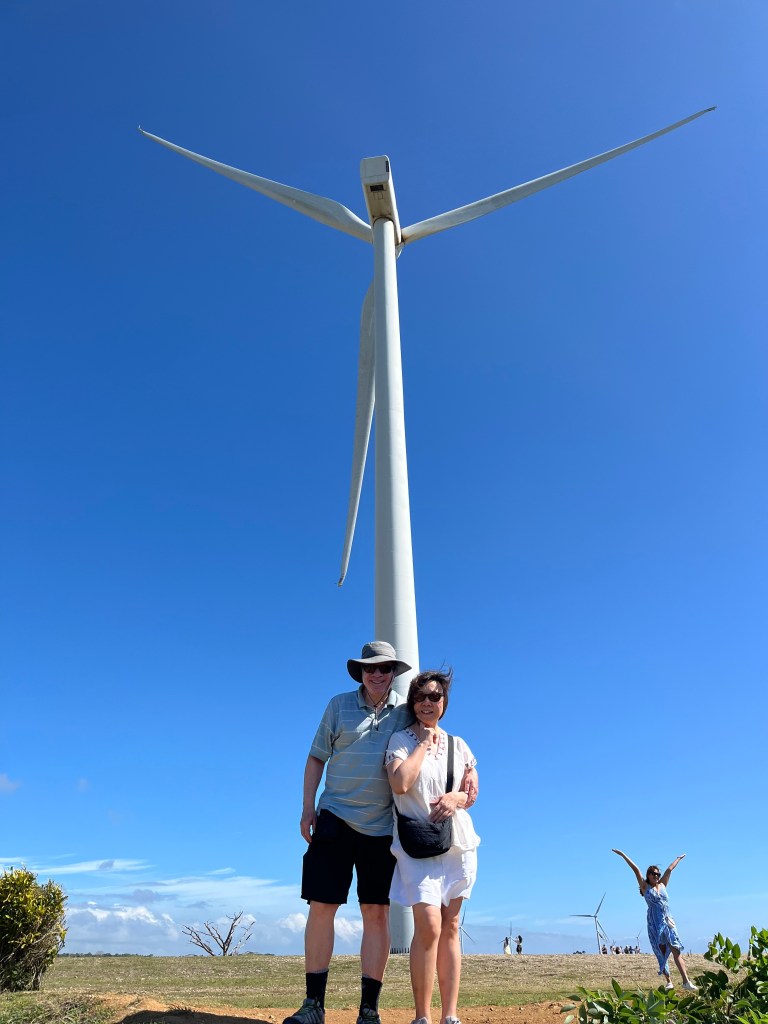
Colossal windmill We visited massive wind turbines at the top of the highest hill on the island, which were impressive in size and in their delivery of pollution-free energy. And we stopped to see the serene Our Lady of the Philippines Trappist Monastery and bought some cookies at their gift shop.

Our Lady of the Philppines Trappist Monastery But Mangoes were what we were here for

Oro Verde 
Oro Verde Orchard As mangoes were what we were here for, we visited the expansive Oro Verde mango orchard. From saplings to mature trees, the orchard had it all.

Guimaras National Crop Research Development and Production Support Center 
Guimaras National Crop Research and Development Center We then stopped at the Guimaras National Crop Research Development and Production Support Center. We strolled past buildings that housed research facilities and a nursery of young mango trees and crates filled with mangoes. It was clear that they were taking great care of their mangoes. At another stop nearby, we saw mangoes individually wrapped in paper on trees to make sure they were just right when they were harvested, just ripe.

Nursery at the Guimaras National Crop Research Development and Production Support Center 
Mangoes at the Guimaras National Crop Research Development and Production Support Center 
Individually wrapped mangoes California Resort and Luscious Water Everywhere

Fish lunch at Raymen’s restaurant 
Eggplant at Raymen’s restaurant After a morning spent sightseeing, we then went to Raymen’s Restaurant for a fresh-from-the-boat fish lunch with eggplant and green beans and a Mango Shake. We then spent the rest of the afternoon islet hopping from one stunningly beautiful small island to another, with stops in between to enjoy the tiny, soft sand beaches and water at a perfect temperature. Idyllic doesn’t begin to describe it. At Natago Beach Resort, I spent some time soaking in the lusciously pristine water. I’ve been to the Philippines more than two dozen times, and this was one of the most tranquil experiences that I’ve had in the country.

California Resort 
Idyllic beach at California Resort 
Malachite green waters at Natago Beach Resort 
Our boat to visit the islets 
At Natago Beach Resort 
Fishing boat Mango Cheesecake before leaving the island
Before leaving the island, and it was time for a merienda, my wife and I indulged in Mango Cheesecake and a Mango Latte at the cozy Mango Island Café.

Mango latte at The Mango Island Cafe So how did the mangoes taste?
For dinner that night, my wife and I had two mangoes apiece. That was all. Sweet, filling, flavor jumping from every bite onto every taste bud. Yes, Guimaras mangoes are the Champagne of Mangoes. And they made for a great dinner too.

Stunning islet on the Panay Gulf 
Loving the water -
Passing through LAX during FIFA or afterwards? Here’s a shortcut for getting to your Uber or Lyft quicker

Theme Building at LAX Last year, my wife and I stepped off a 26-hour gate-to-gate flight from Kazakhstan and emerged from Tom Bradley Terminal tired and jet-lagged. We looked for the pillar where the LAX-it shuttle buses stop to take passengers to the LAX-it (pronounced LAX exit) rideshare and taxi zone. A crowd of angsty passengers was already there. One shuttle bus stopped, but as it was full already, it could only take a few passengers. Moans went up from those who couldn’t get on — including us. Another LAX-it shuttle bus, empty this time, inexplicably drove right past. More moans. A third shuttle bus arrived, but was packed and couldn’t stop for more passengers. The number of people waiting for the LAX-it shuttle bus increased, making the odds of getting on one look worse by the moment.
At this point, my wife and I had been waiting for more than 30 minutes and were frustrated. I found an LAX employee nearby and asked her if there was another way to get to the rideshare area. She said, “Just walk to the left of Bradley terminal, past terminals 3, 2, and 1, cross the street and you’ll be there. Just 10 minutes away.” “Are there crosswalks and stoplights so that the walk is safe?” “Yes,” she said cheerfully, “there’s no need to wait for the LAX-it shuttle bus.”
So we walked 10 minutes and sure enough we were there at the rideshare and taxi zone and got a Lyft home. On subsequent trips to LAX, we’ve walked the 10 or so minutes to the LAX-it rideshare zone from wherever we were in LAX, and it was easy, stress-free, no lifting of heavy bags onto and off of buses. No dealing with crowds of tired, jet-lagged passengers who understandably want to get home or to their hotel. And best of all, it’s nice to stretch your legs after a long flight on cramped seats.
There are no signs showing you how to walk to the LAX-it rideshare area, but you can always ask an LAX employee. (It would be helpful if the airport would provide signage for walkers.) It’s just across the street after Terminal 1 at the beginning of the airport.
-
Lahaina languishes three years after the August 2023 wildfires

Beach near historic Lahaina still beautiful In the first week of June, I visited historic Lahaina in Maui, nearly 3 years after the wildfire that destroyed the town and killed more than a hundred people. I was told by the security guard sitting near the banyan tree that it had only been open since May.

Tropical courtyard of Pioneer Inn pre-fire I last visited historic downtown Lahaina in June 2023. My wife and I had a leisurely, delicious fish lunch in the luscious courtyard of the Pioneer Inn. First opened in 1901, it housed such luminaries as Mark Twain, Jack London, Frank Sinatra, Katherine Hepburn, Spencer Tracy, Hawaii’s last reigning monarch, Queen Lili’uokalani, and Sun Yat-Sen. While the plan is to rebuild the iconic hotel, construction has not started yet.

Front Street once designated a great American street 
Front Street shoreline pre-fire 
Former shops on Front Street 
Historic Lahaina’s fire destroyed shoreline today Historic Lahaina, until 2023, was a town that wore its years well. Vibrant and crowded with tourists and locals, it was the thriving center of West Maui. Its historic buildings weren’t artifacts but reminders of a bustling history. The Old Lahaina Courthouse, built in 1859, dominated the wharf area and served as a customs house for the Hawaiian monarchy and the seat of government. When I last visited in June 2023, it was a heritage museum and art gallery.

Old Lahaina Courthouse pre-fire 
Old Lahaina Courthouse today The banyan tree was so colossal it practically made the Old Lahaina Courthouse look lilliputian. 60 feet high and spanning an acre, it was the spiritual heart of the town. Miraculously, it survived the fire. Although with many damaged limbs removed, it is now a much smaller tree than before. When I visited, I was told that it was being treated for a fungus.

Banyan Tree pre-fire 
A smaller Banyan Tree still dwarfs the Old Courthouse Further down Front Street, the Wo Hing Temple, built in 1912, and the Baldwin Home Museum, built in 1835, were both destroyed, as were the buildings that housed shops and restaurants that once lined the shoreline. The gatehouse and jail cells of the Old Lahaina Prison were burned in the fire. The perimeter walls did survive and are being restored.

Old Lahaina Prison pre-fire 
Wo Hing Temple pre-fire 
Baldwin Home Museum pre-fire 
Baldwin Home Museum today 
What’s left of Baldwin Home Museum At the other end of historic Lahaina, the Jodo Lahaina Mission’s main temple and pagoda, built in 1970, were destroyed by the fire. The big bronze Buddha miraculously survived.

Lahaina Jodo Mission today 
Lahaina Jodo Mission Buddha A woman I spoke with at the beach in Lahaina said, “Makes you want to cry.” It did. And it made me wonder: When will the town be rebuilt?

Much of historic Lahaina is restricted 
Signs indicate where you can walk 
No Trespassing signs show what is off-limits -
Maui Ocean Center: See Sealife from the World’s Most Remote Archipelago

Maui Ocean Center The most remote populated place on earth
As anyone who has visited Hawaii can attest, the scenery here is otherworldly in its beauty. They can also attest that Hawaii is a long way away. California is the nearest landmass, 2,400 miles away; Tahiti, to the south, is 2,500 miles away; and Tokyo is 4,000 miles away.

Colorful fish and coral That isolation means that Hawaii, with its 1.4 million people, is the most remote populated place on earth. 90% of its endemic land species are found nowhere else on Earth. That uniqueness extends underwater too, where up to 50% of its sealife is found nowhere else.

Sharks circling in tank See sealife you can’t see anywhere else

Cascade of color and shapes A visit to the Maui Ocean Center in Wailuku isn’t like a visit to a mainland aquarium — or any aquarium in the world. This one is focused on the unique Hawaiian sealife — a one-of-a-kind aquarium to see one-of-a-kind species.
Subterranean sealife that glows in the dark

Jellyfish tank Visits to aquariums are always about seeing a sort of nocturnal underwater world, where it’s always dusk, a halfway light permeating the tanks and the exhibition areas. Turn a corner, and suddenly I’d see huge glowing tanks of coral and fish of such vivid color that it’s almost as if Gauguin or Van Gogh created the arresting patterns. A translucent green tank houses translucent jellyfish, gently rising and falling. Another house invasive species in the Hawaiian waters. If you’re looking to zone out and de-stress, the jellyfish tank is a good stopping point.

Tank with invasive species If you want a little adrenaline, the nearby shark tank and shark tunnel have predators that are near but safely distant, with plexiglass between them and you.

Shark tunnel The human factor matters

Staff in scuba gear cleaning a tank While aquariums I’ve been to invariably have someone in scuba gear interact with the fish — and you see that here too — Maui Ocean Center goes a stride or two further. One gentleman showed me how he weaves nets in a traditional Hawaiian fashion. Nearby are descriptions of the numerous ways Hawaiians have fished the bounty of their remote waters. From torch fishing to gathering by hand, to trapping fish, to the use of fishponds. Ancient Hawaiian aquaculture is explained in depth.

Creating nets the traditional Hawaiian way Observing and understanding sealife has progressed with technology, of course. On display is an exotic undersea research submarine called the Makali’i. This submarine was operated by the Hawaii Undersea Research Laboratory at the University of Hawaii in the 1980’s.

Makalii Research submarine Learning about the sacred, off-limits Kahoʻolawe Island
When you visit Kihei, Wailea and other points in Southwest Maui, you can’t help but see Kahoʻolawe Island, which overshadows nearby Molokini, famous for its snorkelling.

Kahoʻolawe Island exhibition The Maui Ocean Center has rightly devoted a big exhibition to this mysterious sacred island and its tragic history. At 45 square miles, Kaho’olawe Island is the smallest of the main Hawaiian Islands. Its location made it a key navigation point for the Polynesian explorers who first discovered the Hawaiian Islands. The basalt quarry, the second largest in the archipelago, was used by ancient Hawaiians to create stone tools. The island has over 3,000 archaeological sites, from petroglyphs to heiaus, to fishing shrines,
In the 18th century, Captain Vancouver introduced goats, which, along with the cattle introduced later on, stripped the island of its native flora. The Hawaiian monarchy turned it into a penal colony between 1832 and 1853. And most devastating of all, the US military turned the island into a live-fire training and firing range after World War II started in 1941 and kept it that way for nearly 50 years.

Informative exhibits on Kahoʻolawe Island The modern grassroots Aloha ‘Aina movement and the Protect Kahoʻolawe ʻOhana (PKO) led first to the cessation of bombing on the island in 1990 and then to the return of the island to the State of Hawaii in 1994. Since then, the Kahoʻolawe Island Reserve Commission (KIRC) has led the arduous path to removing the unexploded ordnance and restoring the island to its former grandeur.
I loved and learned a lot in this section of the Maui Ocean Center and spent close to an hour here.
Immersive Cinema to take you underwater (without getting wet)

3D Humpback movie at the Sphere A highlight of my visit was watching, with special glasses, a 3-D film of Hawaii’s Humpback whales. The 15-or-so-minute film in the Sphere was as immersive as you can get, with gargantuan humpback whales gliding right towards you in your seat, complete with the eerie and memorable sounds that they make.

Humpback whale sculpture Prior to seeing this film at the Sphere, I saw another which showed an aerial view of Lahaina, devastated by the August 2023 wildfires.

Lucious grounds Outdoor exhibits and scenery keep you anchored in Maui

View of Haleakala Most aquariums everywhere are primarily indoor experiences with a couple of outdoor exhibits. The uniqueness of Maui Ocean Center is its extensive outdoor exhibits and the breathtaking view of Haleakala from the ocean-facing back of the center’s grounds. The tide pool is a treat for those with young children. What better way to experience sea animals than to safely touch them? There’s also the turtle lagoon to see what are my favorite sea creatures.

Tide Pool for a hands on experience Maui Ocean Center is anchored to its location. Located right next door is the Mā‘alaea Ebisu Kotohira Jinsha, an historic Shinto fishing shrine that was built in 1914. It’s the only such Shinto fishing shrine in the world that is located outside of Japan. The Ma’alaea Harbor has plenty of boats that take people fishing or snorkeling or whale watching. The Expeditions Passenger Ferry has multiple daily crossings to Lanai from here. (They moved here after the August 2023 fire.)

Mā‘alaea Ebisu Kotohira Jinsha After an eye-opening visit to Maui Ocean Center, I felt lucky to find my favorite shave ice, Ululani’s, which I could enjoy while listening to two musicians playing soothing music. At that moment, I realized again how Hawaii’s remoteness is integral to its appeal. For humans as well as sea animals, Maui Ocean Center reminded me how one-of-a-kind Hawaii is.

Musical entertainment 
Ululani’s Shave Ice Tips for the trip:
-Parking isn’t free:
You need to pay for parking in the lot outside of the Maui Ocean Center. It is $3 an hour when I was there. If you can get parking at the Ma’alaea Harbor, it will be less.
-How much time should you spend:
Plan on at least two hours for the aquarium and one hour to eat and explore the Ma’alaea Harbor area.
–Where can you eat:
There is a restaurant, Seascape, and the Reef Café at the Maui Ocean Center and restaurants at the Ma’alaea Harbor (outside of the Maui Ocean Center).
-Things to buy:
There is a large gift shop and Hawaiian crafts are sold on the grounds.

Hawaiian crafts available to buy -
The Future of the Steppes Starts with Astana’s Futuristic Architecture

Baiterek There was symmetry to the moment: I was standing near the towering Baiterek while looking down Nurzhol Blvd. at the Khan Shatyr Entertainment Center in the distance. The meanings of the two buildings couldn’t be more different, yet appropriate, for the symbolism they convey about today’s Astana, Kazakhstan, and the Steppes.

Khan Shatyr 
Khan Shatyr Interior The Baiterek represents a magical bird of happiness, Samruk, who lays a large golden egg in the branches of a mythical tree of life. The Norman Foster-designed Khan Shatyr Entertainment Center, at 150 meters high, the largest tent in the world, is also about happiness of a different kind. The Baiterek represents a foundational myth for Kazakhstan, while the Khan Shatyr building is firmly anchored in the 21st century, even as it is inspired by the nomadic tribes of the Steppes.

Marina Bay Sands This juxtaposition of buildings representing different eras of a nation is true for other successful emerging countries. In Singapore, I stood on the balcony of Singapore’s colonial-era iconic building, the Supreme Court, while taking a photo of its 21st-century one, the Marina Bay Sands. While the Supreme Court stood for the rule of law in an unruly part of the world in the 1930s, the triple-towered Marina Bay Sands, designed by Moshe Safdie, with its colossal boat-shaped SkyPark, stands for fun in a country that recognizes the economic value of “the pursuit of happiness.” As beacons drawing attention to their respective messages and the future in their time periods, they work.

Library of the First President of Kazakhstan at day 
Library of the First President of Kazakhstan at night Iconic buildings have been central to humanity since Stonehenge. Norman Foster said, “Since Stonehenge, architects have always been on the cutting edge of technology. And you can’t separate technology from the humanistic and spiritual content of a building.” Architecture has always been about context. “As an architect,” Norman Foster said, “you design for the present, with an awareness of the past, for a future that is essentially unknown.”

Nur Alem Museum of Future Energy Moshe Safdie speaks of buildings on his website as “shaping the public realm.” The purpose of iconic buildings in ancient times was either to foster religion or generate fear and respect for the governing body. Whether it was the Parthenon on the Acropolis or the pyramids of Egypt, rulers created iconic buildings to secure their hold on the populace.

The Palace of Peace and Reconciliation But now it is different. Culture and business, today’s soft power drivers, are the reason these buildings are created. Government involvement is frequently more backseat: from encouraging the development through zoning laws, approvals, or tax and other incentives.

Petronas Towers Frank Gehry’s Guggenheim Museum in Bilbao kicked off this wave of iconic buildings as brand beacons. The Petronas Towers in Kuala Lumpur, opened in 1998, signaled the emergence of Malaysia as more than a country of rubber and palm oil plantations. Architect Cesar Antonio Pelli said, “I tried to express what I thought were the essences of Malaysia, its richness in culture and extraordinary vision for the future.” And Taipei 101, from 2003 until 2010, the world’s tallest building, reminded people that Taiwan still mattered as a business hub.

Ishim River Amphitheatre Iconic buildings can create a buzz that translates to perceptual and economic benefits. When the Burj-al-Arab opened in 1999, it put Dubai on the map as the ultimate luxury destination. Like Singapore’s Marina Bay Sands, it communicated fun in a part of the world that is usually more associated with oil and conflict. The term “seven-star hotel” was invented to describe the hotel. Looking like a gargantuan butterfly chrysalis, it has attracted celebrity guests and incalculable positive PR.

Atyrau Bridge Ishim River 
Atyrau Bridge Dubai followed up with the can’t top this Burj-al-Khaifa. As Christopher Davidson, a University of Durham professor, said, “The tower was conceived as a monument to Dubai’s place on the international stage.” The world’s tallest building, it is a litany of superlatives: 828 meters high, 160 floors, world’s fastest elevators at 64 kilometers per hour. It is nearly double the height of the next highest building in Dubai, truly a Great Pyramid of Giza for our time. While its opening in 2010 was colored by the collapse of Dubai’s economy, it has delivered on its promise to transform the city’s image. Scenes from Tom Cruise’s “Mission: Impossible” movie featured the building, creating buzz for Dubai.

Kazakhstan Central Concert Hall Sister Gulf State, Qatar, has the iconic Museum of Islamic Art, which opened in 2008. The I.M. Pei-designed building showcases a stunning collection of Islamic Art to remind the international community of the richness — not just riches – of the Arab world. Like the Guggenheim Museum in Bilbao, it’s a transformative, culturally oriented building, making Doha a destination in its own right. Perched pyramid-like on the edge of Doha Bay, it is a visual anchor of the city.

National Archive of the Republic of Kazakhstan And of course, China has many iconic buildings to flesh out its cutting-edge 21st-century image. I remember standing on the Oriental Pearl building in Shanghai, that 1990s Flash Gordon-inspired image of the future with its spheres and pointy spire, and looking down on the iconic buildings of the 1920s on the Bund with their colonial-era stolidness, projecting wealth and power with fluted columns and granite. And I looked up at the Shanghai World Financial Center building, opened in 2008, which at one angle looks like a giant bottle opener overshadowing the nearby Jin Miao tower. Shanghai seeks to emulate and overtake both New York and Hong Kong as a city of iconic buildings.

David Geffen Galleries LACMA When will this latest wave of building competition end? Not anytime soon. The recent opening of the David Geffen Galleries at LACMA in Los Angeles by architect Peter Zumthor and the September opening in LA of the Lucas Museum of Narrative Art, by Beijing-based MAD Architects, will showcase a post-fire revitalized Los Angeles ready to welcome the global FIFA and Olympics events.

Kazakh National University of the Arts If you want to understand the power of iconic buildings to attract attention to a city and nation, trying to compete in this globalized economy, then think of the cities that don’t have them. Mumbai perhaps. Or Jakarta. Or Manila. You’ll discover that the negative clichés about these metropolises tend to define them. In a world where a positive image translates to economic advantage, iconic buildings give just that much more of a winning edge.

ALZHIR Memorial outside of Astana Astana is clearly aiming to define the future of the Steppes with its architecture. You only need to take another look at some of the city’s striking structures: Baiterek, Khan Shatyr Entertainment Center, Library of the First President of Kazakhstan, Palace of Peace and Reconciliation, Kazakhstan Central Concert Hall, Nur Alem Museum of Future Energy, National Archives of Kazakhstan, Atyrau Bridge, Ishim River Amphitheatre, Kazakh National University of the Arts, and the ALZHIR Memorial. As British archaeologist Jacquetta Hawkes said, “every generation gets the Stonehenge it deserves – and desires.”

Baiterek towering over Astana -
LACMA Lights Up LA
$724 million spent on the new David Geffen Galleries and worth every penny!

Colossal David Geffen Galleries I’m a museum buff, so I was really looking forward to the opening of the David Geffen Galleries at LACMA (the Los Angeles County Museum of Art). Their addition makes LACMA one of the greatest museums in the world. It is truly a treasure for LA. And it took a treasure to build them: $724 million. For a place where you’re meant to find inspiration, it was inspiring to look at.

Monumental art on the exterior wall of the Geffen Galleries Like a gargantuan amoeba getting ready to replicate

The Geffen Galleries extend over Wilshire Blvd The design by Swiss architect Peter Zumthor looks like a gargantuan amoeba getting ready to replicate. One photo from ground level can’t capture the entire sprawling, captivating building. At 347,000 square feet, it’s so big it even extends over Wilshire Blvd.

Long, expansive galleries The layout of the museum is non-linear, wavy, whereby African art and Picasso paintings might be side by side because African art inspired Picasso. Or pottery from Mesoamerica, ancient Greece, and Japan might be displayed next to each other to show the influence of one on the other. Or ancient Egyptian art with contemporary African American art. It’s a different type of layout, along with undulating galleries, and I think it works. In the description of the museum’s philosophy that’s included in the gallery map given to everyone entering, it says: “Works of art accrue meaning through exchange, transit, time, and translation. Considering art and history as a dynamic, oceanic flow can prompt deeper understandings of cultural intersections, differences, and continuities.” In short, you’re meant to wander through the museum, not mentally tick off each exhibit like a task you have to complete.

Smoke by Tony Smith $142 Francis Bacon triptych and Performance art too

Francis Bacon triptych Three Sudies of Lucian Freud One of the many highlights at the museum is the $142 million Francis Bacon triptych, “Three Studies of Lucian Freud,” that Elaine Wynn donated to the museum. It’s spectacular and thankfully, there are benches placed in front of it where you can admire the work while resting your legs.

Performance Art The Geffen Galleries didn’t just have art, they have performance art too. It’s very cool to look at paintings and suddenly see performance art. When I visited, four performers captivated the audience. One played on a violin, another rode a bicycle on its handlebars, another juggled a ball on his knees and balanced it on his head, another sang and danced.
Jeff Koons’ monumental artwork, then the BCAM (Broad Contemporary)

Jeff Koons’ Split-Rocker Another amazing piece located just off Wilshire Blvd. is Jeff Koons’ artwork called Split-Rocker. It’s 37 feet tall and has 50,000 live blooming plants. But don’t stop after you’ve seen the David Geffen Galleries, even if you are tired.

BCAM’s artistic staircare steps away from the Geffen Galleries 
Band by Richard Serra At the BCAM (Broad Contemporary), also within LACMA. is the monumental Richard Serra artwork Band, which is about 12 feet high, 70 feet long, and 2 inches thick. This colossal ribbon of steel is 183 tons. It’s so big it’s hard to fathom how it was created. One of my favorite paintings at the BCAM is Mulholland Drive by David Hockney. I grew up near there so the painting resonated with me on different levels.

Mulholland Drive by David Hockney Also in the BCAM is an exhibit where Mexican director Alejandro Inarrito took fragments from his film Amores Perros and projected the clips in a disjointed way on different screens in a huge space. The images were on film, not digital, and they were scratched and imperfect. It was hypnotic.

Alejando Innarito clips from his film Amores Perros Don’t miss the Resnick Pavilion

Joseph McElheny’s Island Universe A visit to the Resnick Pavilion, across the way from the BCAM, is equally enthralling with artwork that spans millennia, from ancient Egyptian and Greek art to contemporary art. Joseph McElheny’s Island Universe is displayed there.
Largest art museum collection in the Western United States
LACMA is the largest art museum in the western United States. It has 155,000 art pieces that span 6,000 years of human history. Hard to get your head around that. A visit here is sensory overload in the best possible way. Just climb a flight of stairs to elevate your perspective on humanity.

Steps or elevator to the second floor David Geffen Galieries How much time should you spend:
I spent 5 hours here and could have easily have spent more. Allow a day.
How much does it cost:
$30 for adult tickets, $26 for seniors, and $15 for children and tweens.
If you reside in LA County, it’s free after 3 pm during the weekdays.

Roni Horn piece titled The satisfaction of having outstared a baby How to get there:
The Wilshire/Fairfax Metro Station (on Line D) is right across the street from the museum. I took the Metro to the museum and I loved the convenience of it.

Cabbage chair by Oki Sato Where can you eat:
Erewhon at LACMA is a casual place to eat for now. More cafes and restaurants will be opening up.

The Futiilty of Conquest by Liz Glynn -
Inside and Outside Treats at INNSiDE by Melia Bangkok Sukhumvit

Towering retreat from the heat Towering Retreat from the Heat

Ground floor lobby April in Bangkok is hot. Really hot. Hottest month of the year. Average temperatures range from 35 degrees to much higher. During my Easter weekend visit to Bangkok, I started sweating as soon as I stepped outdoors.
When it’s this hot, a Bangkok hotel isn’t just a retreat. It’s a retreat from the heat. INNSiDE by Melia Bangkok Sukhumvit is certainly that.

Bangkok’s iconic skyline represented behind reception Soothing grey and white décor enlivens both bold and tiny touches
It wasn’t just the air conditioning that was cool. So was INNSiDE by Melia’s seemingly heat-reducing grey and white color scheme with art and design elements that featured different parts of Bangkok life, from the spires of its temples to its dragon boats to the iconic Wat Arun. Even the stairs took center stage in the hotel’s visual palette, caterpillar-like coils that transported you from one all-encompassing space to another.

Staircases coiled like caterpillars The compact INNSiDE rooms feature an innovative design with the sink in the center of the room, an island to refresh yourself after a long day, and refine yourself before going out.

Sink in center of INNSiDE room The larger Townhouse rooms offer a tub to soak away the heat with a rubber ducky to set afloat on your bath.

Townhouse room 
Bathtub with rubber ducky What lifts any hotel experience is attention to the smallest details. Bathrobes are folded like origami with cloth. Towels look almost zen-like in the way that they are stacked. Feeling thirsty after your foray into the heat? All the drinks in the minibar are complimentary.

Bathrobes folded like origami 
Folded towels look almost Zen-like 
Complimentary mini-bar Embrace Bangkok while the hotel embraces you

The Open Living Lobby Feeling cool finally, I sank into a soft sofa to enjoy The Open Living Lobby while sipping an exquisitely prepared cappuccino. The glass walls invited reams of light and Bangkok’s organized chaos to enter the spacious, airy area. I could see the snaking Chao Phraya River continue its journey to the Gulf of Thailand. The hotel virtually hovers above the BTS Sukhumvit line, trains sliding to and fro.

On Nut BTS station nearby A meeting room right off the lobby seemed perfect for inspirational offsite sessions. Bright ideas emanate from bright spaces.

The Kites Eatery A floor below the lobby is the all-day The Kites Eatery with two-story high windows and a wraparound view of Bangkok.
Bangkok’s only Spanish Tapas Skybar

Luz Bangkok Tapas Bar Bangkok is famous for its skybars. Tropical weather and panoramic city views lend themselves to drinks atop tall buildings. INNSiDE by Melia’s Luz Bangkok Tapas Bar belongs in that esteemed skybar list and is the only one focused on authentic Spanish tapas.

Luz Bangkok Tapas Bar glowing blue counter From a corner table on the outdoor terrace, not far from the surreal-looking glowing blue bar counter, I started my long, leisurely culinary journey around Spain. I kicked off the meal with a Tinto Sour. Bourbon, red wine, lemon, Sea-Buckthorn-Rooibos honey, egg white, and Angostura bitters. A concoction that you would practically need a PhD to create certainly lifted my mood.

Corner table at Luz outdoor terrace The warm breeze wafting across the bar, tinkling lights below, certainly offered an experience that was very much Bangkok but also not unlike summer in southern Spain.

Tinto Sour The parade of Spanish tapas from the kitchen of Chef Juan Ignacio Garcia was one delectable treat after another.

Inside Luz, view of Chao Phraya River in the distance The Salmorejo y Burrata from Cordoba combined creamy burrata with slices of avocado and anchovies, in a cold tomato soup with toasted bread to dip into it. The right cool delight for a hot night.

Las Croquetas with Iberian Ham Las Croquetas with Iberian Ham is a classic Spanish tapas, the ham atop crispy, creamy fritters containing béchamel sauce, onions, flour, and milk. So rich and indulgent, I literally couldn’t finish all of it.

Tacos de Rabo de Toro Tacos de Rabo de Toro, from Andalusia, had braised Australian oxtail in red wine with Idiazabal cheese served in soft tortillas with onions and cilantro.

Gambas Al Ajillo One of my favorite tapas was served next: Gambas Al Ajillo, a classic dish with shrimp cooked with chili and garlic olive oil.

Cachopo The last of the dishes was Cachopo, from Asturias. Tenderloin steak stuffed with Cecina and cheese and coated in flour, eggs, and breadcrumbs. Piquillo peppers and French fries were on the side. At this point, I was so full, I couldn’t finish all of it.

Tarta de Queso Dessert was an indulgent Tarta de Queso, a Basque cheesecake with Biscoff.
After finishing most of the meal, I stared out at Bangkok, the city’s manic vibrancy subdued by the time it reached the bar on the 33rd floor.
Plunge into a Cool Blue Pool

Pool with transparent walls When it’s hot, really hot, I’ve always felt a night swim beats a day swim. You don’t start sweating the moment you depart the pool. INNSiDE by Melia’s pool lends itself to a refreshing night swim. Located on the 34th floor, you can linger in the infinity pool with its transparent walls while gazing upon the sparkling city lights below. Hovering above the pool is a design interpretation of The Giant Swing that frames it and the city.

Giant swing framing cool blue pool Bangkok’s best shopping, sites, sips, and savors are easy to get to
Your location in Bangkok can make the difference between enjoying the city or not. INNSiDE by Melia is a mere five-minute walk from the On Nut BTS Station. It’s just two stops away from one of Bangkok’s trendiest neighborhoods, Ekkamai, filled with upscale bars and restaurants. The rest of the city is an easy BTS ride away. Phrom Phong and Siam stations are linked to some of Bangkok’s and Asia’s most luxurious malls. You can also visit downtown Bangkok and its fabulous sites via the MRT Sukhumvit Station, which is connected to the Asok BTS station.
Award-winning hotel to treat yourself to a cool retreat
INNSiDE by Melia has received many accolades. 2025’s Trip.Com’s Instagrammable Hotel and 2024’s Agoda Gold Circle Winner. In the 2025 Conde Nast Traveler Readers’ Choice Awards, it was ranked 4th best in Thailand. Plus, it received awards from the National Geographic Traveler, Destination Deluxe, Luxury Lifestyle Magazine, and Luxury Lifestyle Awards. Treating yourself to a cool retreat at the award-winning INNSiDE by Melia Bangkok Sukhumvit hotel is a chill way to beat the heat.

Trip.com award -
Belltown: A full-day walking tour to savor Seattle’s coolest neighborhood

View of Belltown from the Seattle Great Wheel Between the Space Needle and Pike Place Market, on the edge of Elliot Bay and the Puget Sound, is Belltown. Cultural and countercultural, cosmopolitan and cuisine-rich, it is Seattle’s coolest neighborhood and worth spending a day savoring, sipping, exploring, and experiencing. It competes with Capitol Hill for having the most vibrant nightlife district in Seattle.

Holocaust Center for Humanity Holocaust Center for Humanity: An 8-minute walk from the center of Pike Place market takes you past locally famous Gallery Mack and Steinbrueck Native Gallery to The Seattle Times winner of the Best Museum of 2025, the Holocaust Center for Humanity. What you learn at this museum is very sobering and eye-opening. Admission required except on the first Thursday of every month. (www.holocaustcenterseattle.org)

Cannonball Arts Cannonball Arts: It’s a 4-minute walk from the Holocaust Center of Humanity to Cannonball Arts, a cavernous two-story contemporary arts center. The artwork is quirky and quixotic. On the first floor, you can take a ride on a sculpture called “Toxic Beauty.” (You have to sign a release form first.) On the second floor, there is a virtual reality ride and an enormous floating sculpture of a whale called “Leviathan,” along with art that causes you to awe and guffaw. Even the restrooms are filled with art. Admission required. (https://cannonballarts.com/)

Taz Matcha One of my favorite refreshing drink stops in Seattle is a few minutes’ walk away, Taz Matcha. (https://tazseattle.com/)

Belltown mural with a riot of colors Belltown art isn’t only in museums. Many exterior walls in this neighborhood are adorned with murals that brighten up the urban landscape, even on overcast days. There’s also the Belltown Art Walk on the second Friday of every month.

Chief Seattle statue Tilikum Place Chief Seattle statue at Tilikum Place: It’s a 14-minute walk from Cannonball Arts to Tilikum Place, where you can view the statue of Chief Seattle with the Space Needle visible behind him. It’s a provocative juxtaposition of Seattle’s beginnings and its iconic symbol of the future.

La Parisienne French Bakery A Seattle culinary stop and one of the city’s best-known restaurants is the Tilikum Place Café. (https://www.tilikumplacecafe.com/). But save dessert for nearby La Parisienne French Bakery, which has among the best French pastries in Seattle. (https://www.laparisienneseattle.com/)

Olympic Sculpture Park Olympic Sculpture Park: Just a 9-minute walk away from Tilikum Place is one of the most awe-inspiring museum spaces in Seattle. The Olympic Sculpture Park is a nine-acre free-admission park displaying massive sculptures from the Seattle Art Museum collection. Some of the world’s greatest sculptors have art displayed here: Alexander Calder, Richard Serra, Louise Bourgeois, and Claes Oldenburg. Ai Weiwei’s “Circle of Animals/Zodiac Heads” has just been installed. With a view of the Puget Sound and the Olympic Mountains, it is one of the most magnificent fusions of art and nature in a US city. Admission free. (https://www.seattleartmuseum.org/visit/olympic-sculpture-park/)

Elliot Bay Connections Path at base of Olympic Sculpture Park For a delightful detour, you can stroll on the new Elliott Bay Connections (EBC) project. At the base of Olympic Sculpture Park, along the Puget Sound, this new project is backed by Melinda French Gates and Mackenzie Scott. Defunct street rail lines have been replaced with a bike and foot path that connects a new waterfront park with the Olympic Sculpture Park and Myrtle Edwards Park. (https://downtownseattle.org/programs-services/parks-and-public-spaces/elliott-bay-connections/)

Edgewater Hotel Edgewater Hotel: Take a 9-minute walk from the Olympic Sculpture Park to the iconic Edgewater Hotel, where rock legends have slept and not slept at all. Located on the Seattle Wharf, this hotel has been named by Conde Nast Traveler as a top 10 hotel in the Pacific Northwest. The Seattle Times named it for having the best hotel view in Seattle. In 2024, Travel + Leisure named it the 2nd best hotel in Seattle. It’s the only Seattle hotel that is not only right on the Puget Sound — it’s right over it too! But its real claim to fame is the amazing rock acts that have stayed here. The Beatles, Rolling Stones, Led Zeppelin, Elvis, Stevie Wonder, Blondie, David Bowie, The Monkees, Black Sabbath. Kurt Cobain, Pearl Jam, Jerry Lee Lewis, Roy Orbison, The Mamas and the Papas, Neil Young, and Rod Stewart. To name just a few! (https://www.edgewaterhotel.com/)
The Brim Coffee Shop at the Edgewater Hotel is a great stopping point where you can stare at the shimmering Puget Sound while sipping your coffee.

The OBAMA has some very bad art Seattle’s Official Bad Art Museum of Art (aka OBAMA). A 9-minute walk from the Edgewater Hotel up Wall Street to 1st Avenue takes you to the irreverent and decidedly tacky (in a good way) Seattle’s Official Bad Art Museum of Art. Located in the back of Juniors, a vintage store, you see art that can be best described as truly awful. It’s a lot of fun and browsing Juniors store afterwards with its offbeat gift items and collectables make this a fun stop. Admission free. (https://seattledreamhomes.com/official-bad-art-museum-of-art-in-seattle/)

Mountain Rose Herbs Mercantile Nearby is the Mountain Rose Herbs Mercantile, practically the widest variety of spices and herbs I’ve seen outside of the Spice Bazaar in Istanbul. (https://mountainroseherbs.com/visit-our-stores/mercantile-seattle/)

The Crocodile music club The Crocodile: Just a one-minute walk from the OBAMA and you’re at The Crocodile. If Rock History is your thing, then a visit to Seattle’s most famous music club is a must. Originally opened in 1991, the music club at 2501 1st Avenue is legendary. In 2013, The Rolling Stone named it the seventh best music club in the US. VH1 named it the 7th most legendary rock club of all time. Kurt Cobain and Nirvana added to the club’s mystique by playing a secret show at the club on October 4th, 1992. In addition to music acts, The Crocodile also has a comedy club, a movie theatre, and a hotel. After a full day exploring Belltown, why not watch a show here? (https://www.thecrocodile.com/)

Lenox Restaurant Before catching a show, there are some great restaurant options nearby: Lenox for Afro-Latin cuisine, Karaage Setsuna for Japanese-Hawaiian cuisine, and Kalabaw Bar and Kitchen for its Southeast Asian offerings. (https://www.lenoxwa.com/) (https://karaagesetsuna.com/) (https://kalabaw-usa.com/)

Japanese curry at Karaage Setsuna restaurant Belltown is Seattle’s beating heart with its vibrant cuisines, clubs, cafes, and shops. A day here will give you a sound perspective of the city on Puget Sound.
-
GPSmyCity app: a great way to lose yourself in a city (and yet not get lost)
During my recent trip to Seattle, I used a travel app that I really liked called GPSmyCity. Because my two kids live in Seattle, I go up there often and explore the city and the surrounding areas in Washington State with them. Yet, even I — and they — learned new things and things to do in Seattle from the app.

GPSmyCity app While I’ve only used the app for Seattle — so far — it has walking tours in a staggering 630+ cities around the world. So I’ll definitely use it in other cities.
The app only costs $14.99 for a one-year subscription, giving you access to literally hundreds of walking tours for one low price. Yet, a typical walking tour will cost more than that in most cities. Plus, the app gives you the flexibility to take a walking tour when you want, making it a perfect fit for your schedule. And even better, it allows you to create your own walk to the sites that you want to see, a personalization feature that’s really easy to use.
If you are going to Seattle, I’ve created a walking tour for Belltown on the GPSmyCity app that might interest you. Belltown is my favorite neighborhood in Seattle, yet it’s often overlooked by tourists to Seattle.
Below is the link to the GPSmyCityapp:
