-
Bella Belltown: Seattle’s Coolest Neighborhood
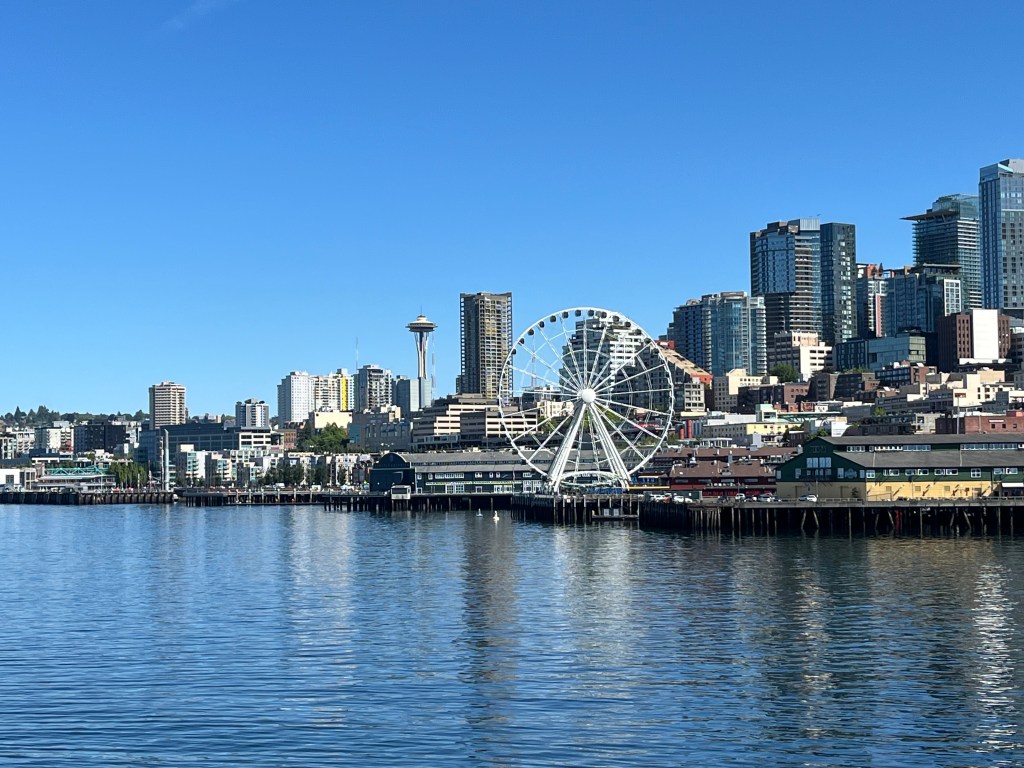
Between the Space Needle and the Ferris Wheel is Belltown 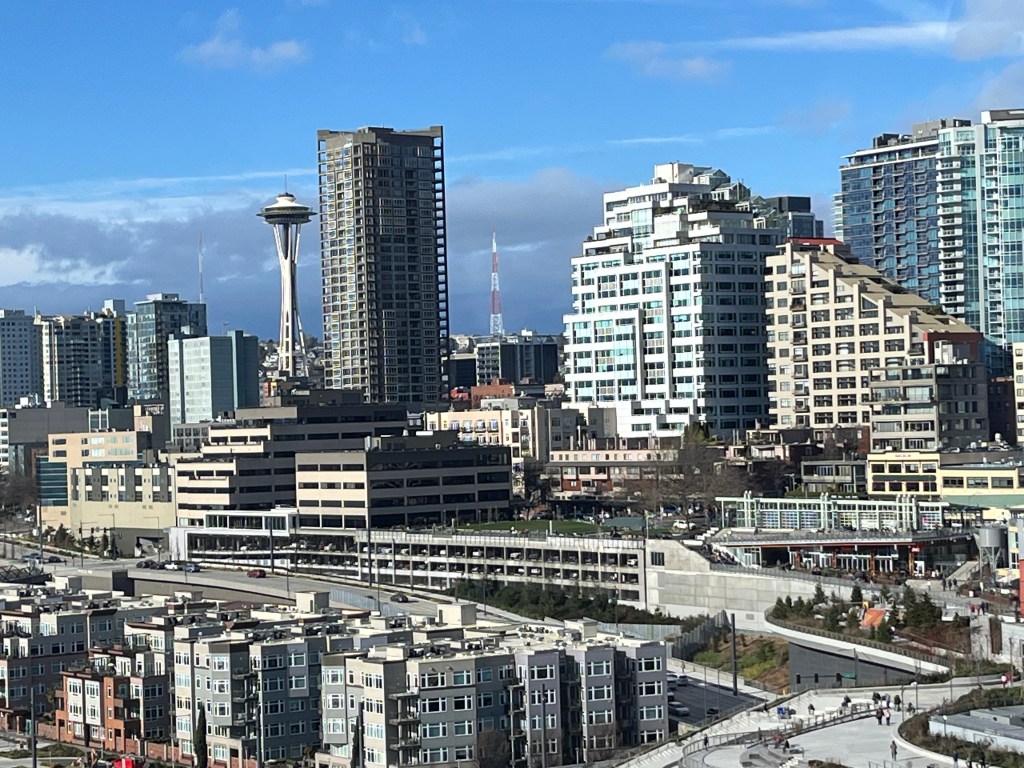
Belltown from the Seattle Wheel Between the Space Needle and Pike Place Market
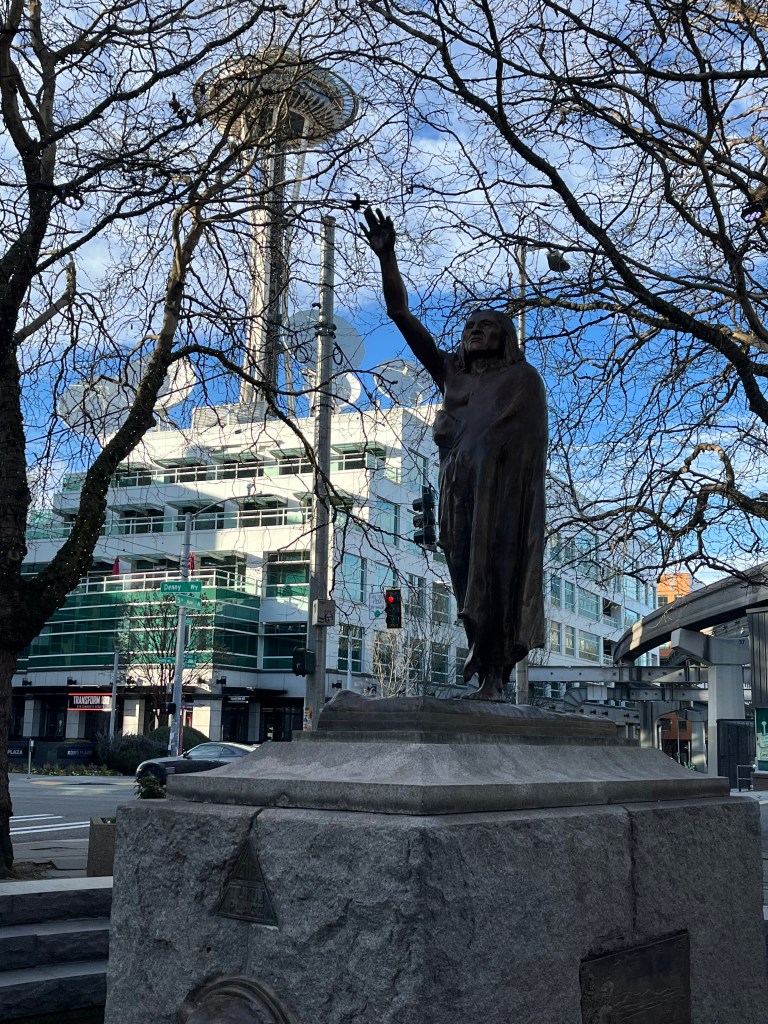
Statue of Chief Seattle at Tilikum Place 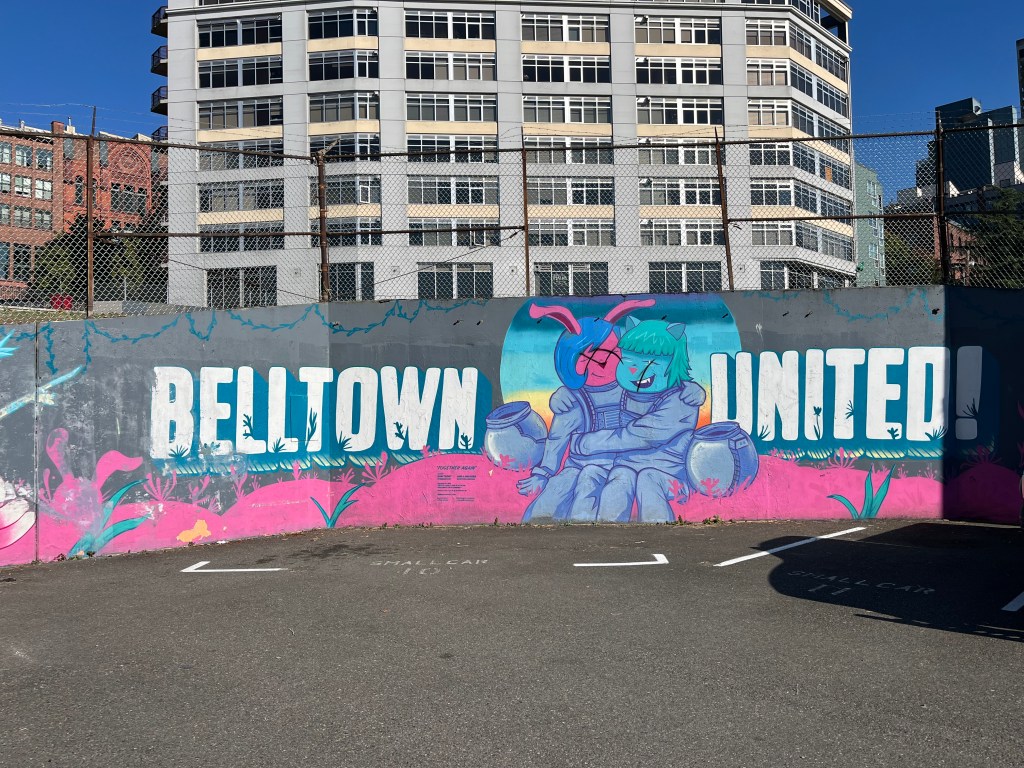
Belltown spirit reflected in mural Between the Space Needle and Pike Place Market and at the heart of Seattle’s rock history, sits Belltown. I call it bella Belltown because the Italian word for “pretty” describes it well. Just an easy 26-minute walk separates the two tourist attractions, but you shouldn’t rush it because Belltown is a neighborhood worth lingering in.
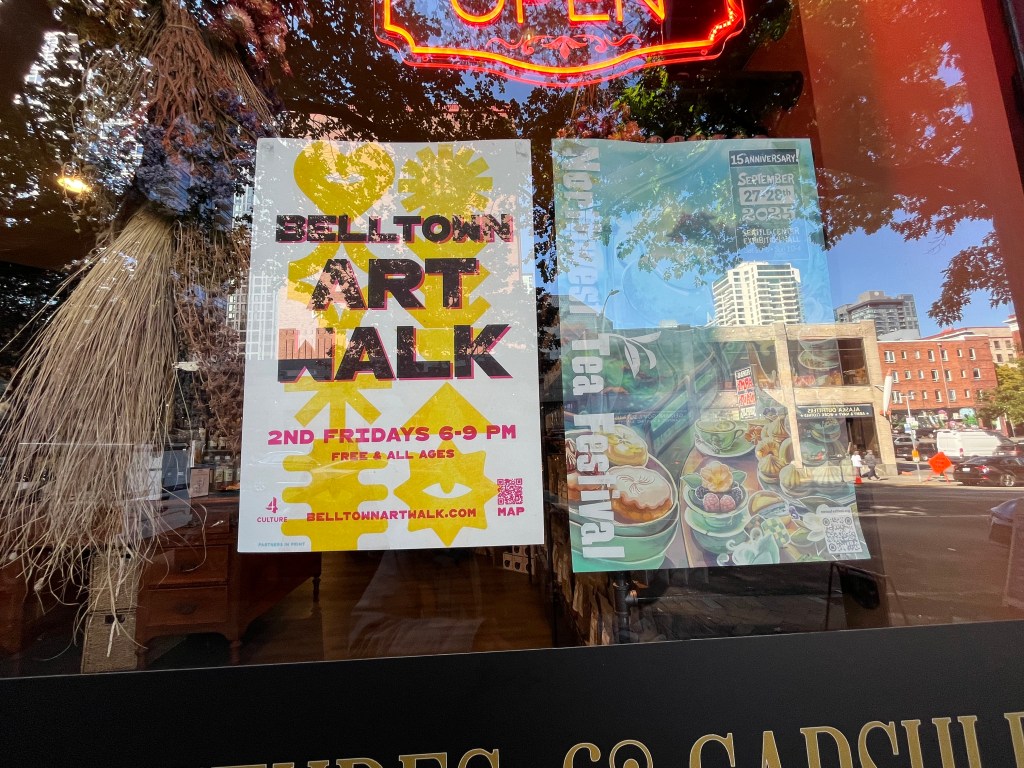
Belltown Art Walk Belltown’s streets are filled with restaurants, cafes, bars, shops, and galleries, making this a place to browse. On the second Friday of every month is the Belltown Art Walk, where the galleries are open until 9 pm. Easily two dozen venues are involved in this regular event.
From where rock bands play to where they stay
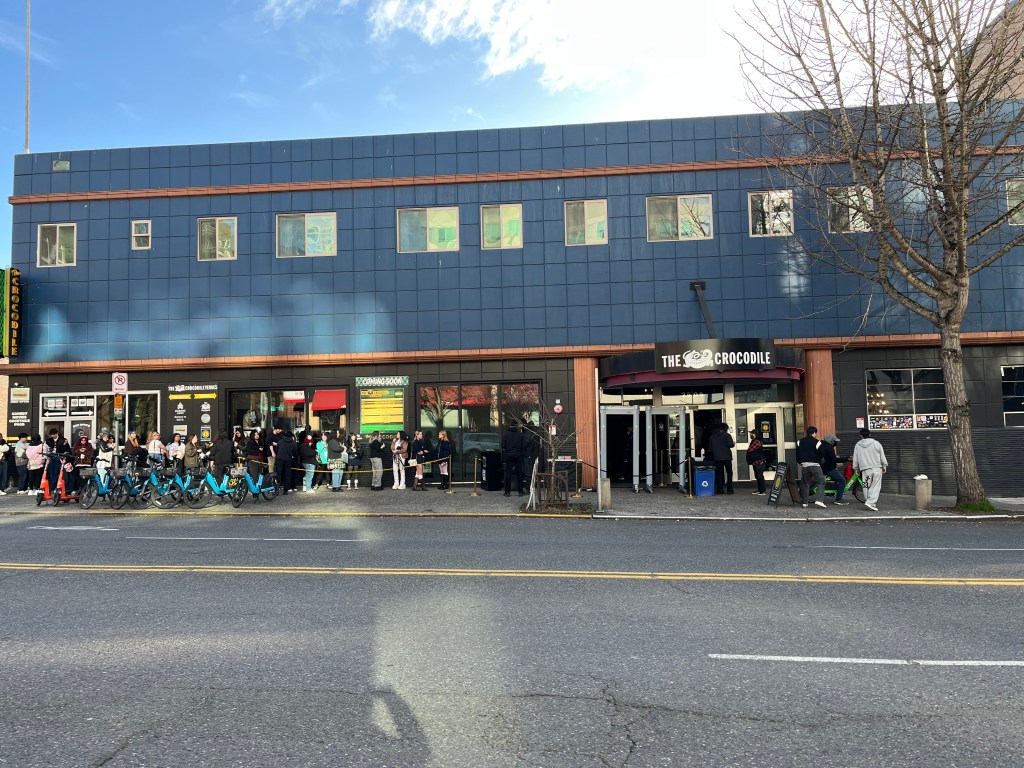
Line at 4 pm for 8 pm show at the Crocodile 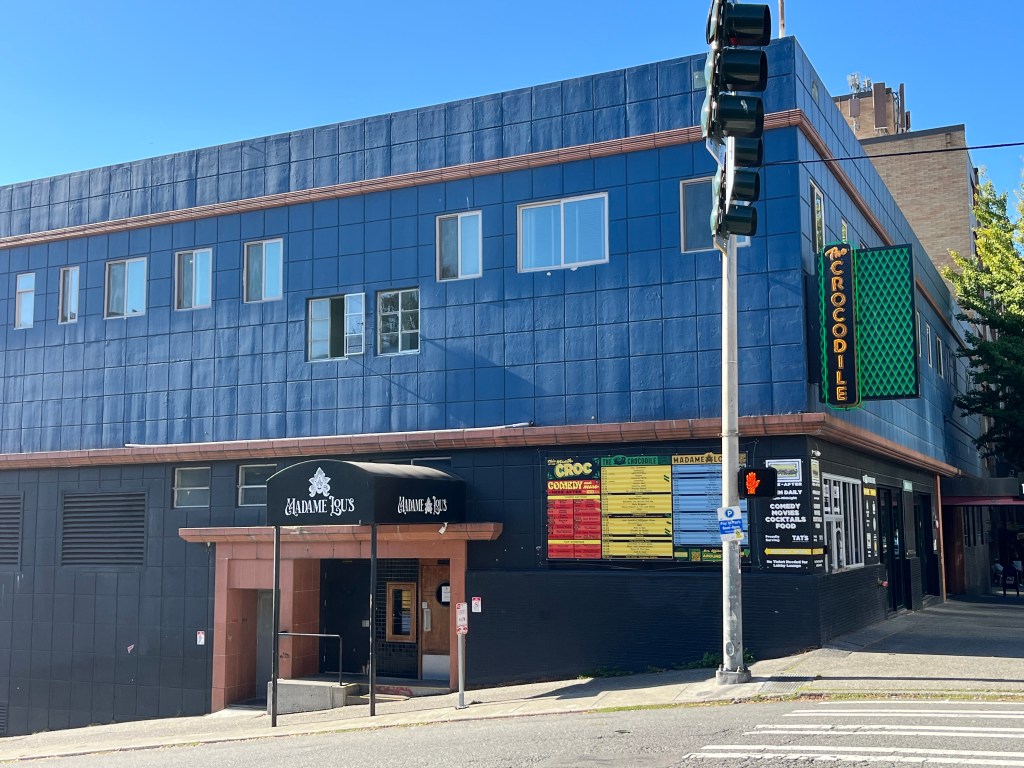
The Crocodile is a famed music club If Rock History is your thing, then a visit to The Crocodile, Seattle’s most famous music club, is a must. Originally opened in 1991, the music club at 2501 1st Avenue is legendary. In 2013, The Rolling Stone named it the seventh best music club in the US. VH1 named it the 7th most legendary rock club of all time. Kurt Cobain and Nirvana added to the club’s mystique by playing a secret show at the club on October 4th, 1992. In addition to music acts, the Crocodile also has a comedy club, movie theatre, and a hotel.
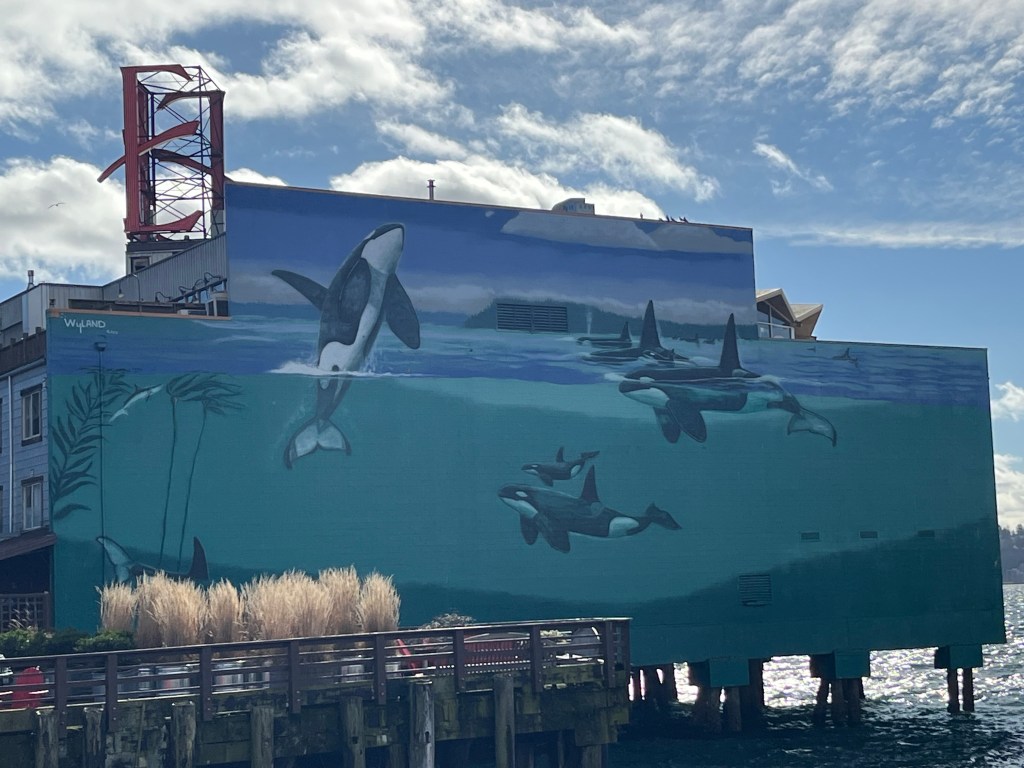
Edgewater Hotel is right over the Puget Sound 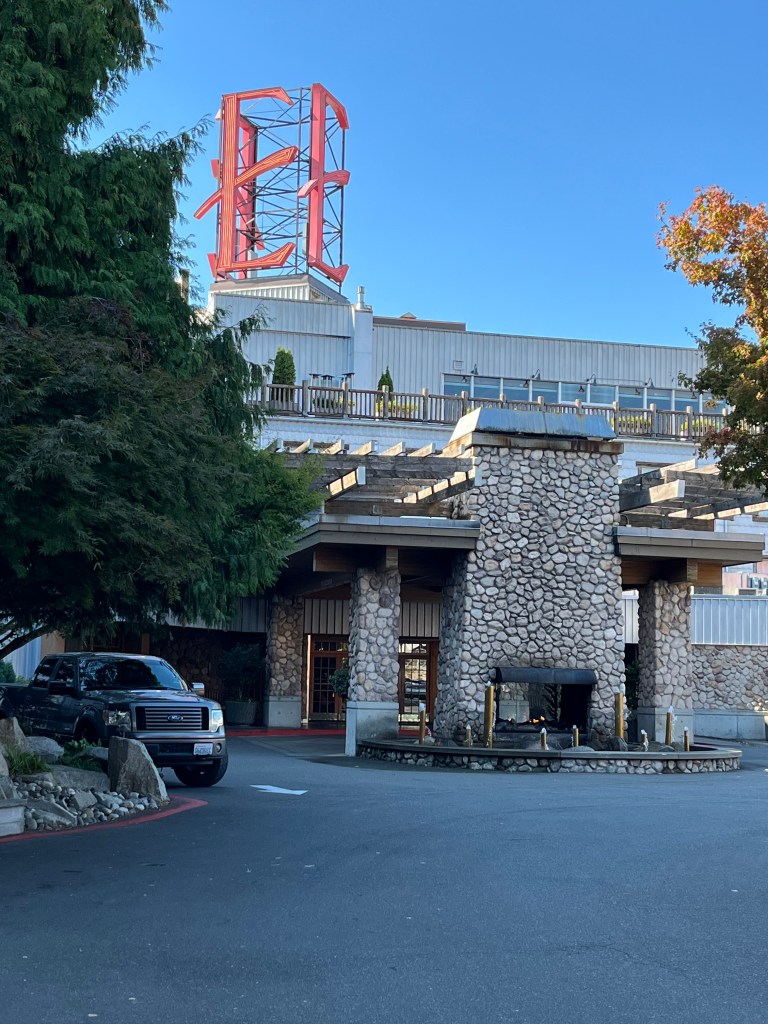
E=Edgewater Hotel Iconic Edgewater Hotel where legends have slept and not slept at all
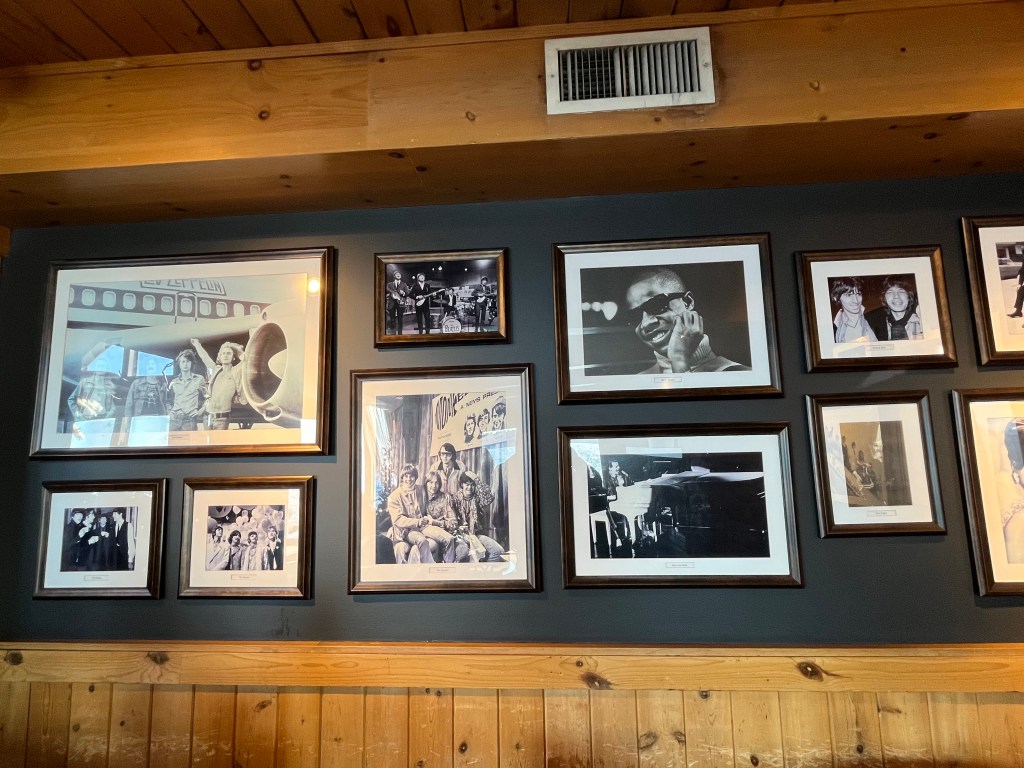
Wall of fame, Edgewater Hotel Not even a ten-minute walk down the hill from The Crocodile is the iconic Edgewater Hotel at the Seattle Wharf. Conde Nast Traveler named it as a top 10 hotel in the Pacific Northwest. The Seattle Times named it for having the best hotel view in Seattle. In 2024, Travel + Leisure named it the 2nd best hotel in Seattle. It’s the only Seattle hotel that is not only right on the Puget Sound — it’s right over it too! But its real claim to fame is the amazing rock acts that have stayed here. The Beatles, Rolling Stones, Led Zeppelin, Elvis, Stevie Wonder, Blondie, David Bowie, The Monkees, Black Sabbath. Kurt Cobain, Pearl Jam, Jerry Lee Lewis, Roy Orbison, The Mamas and the Papas, Neil Young, and Rod Stewart. To name just a few! And I’m sure I’ve left out names. I love having a black coffee here at The Brim Coffee Shop and staring out at the shimmering Puget Sound, framed by the Olympics. I’ve also enjoyed some delicious meals at the Six Seven Restaurant and their happy hour, too.
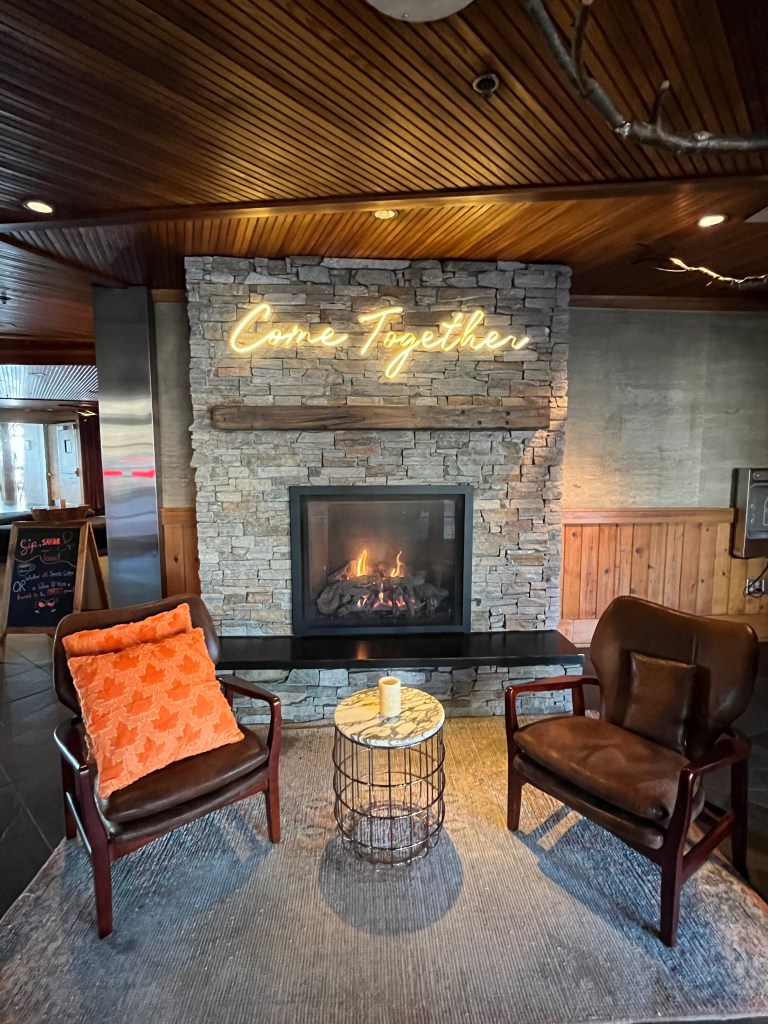
Famous lyrics from Edgewater’s most famous guests 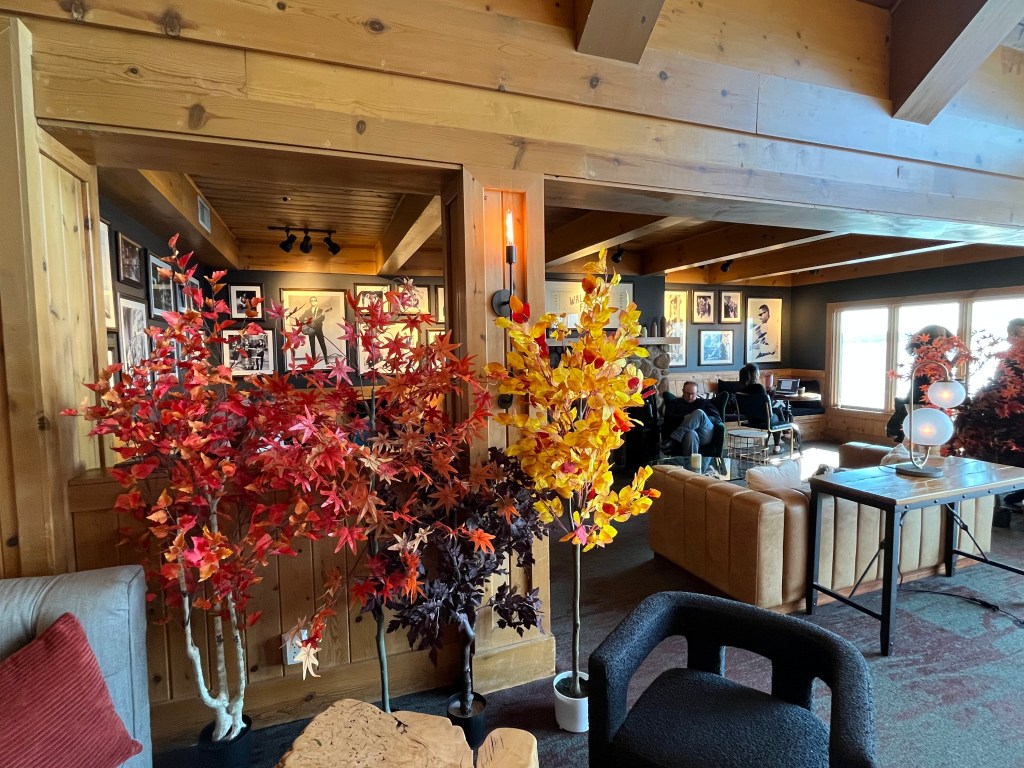
Edgewater Hotel lobby is a cozy place for a coffee with a view of the Puget Sound Restaurants, cafes, and bars galore
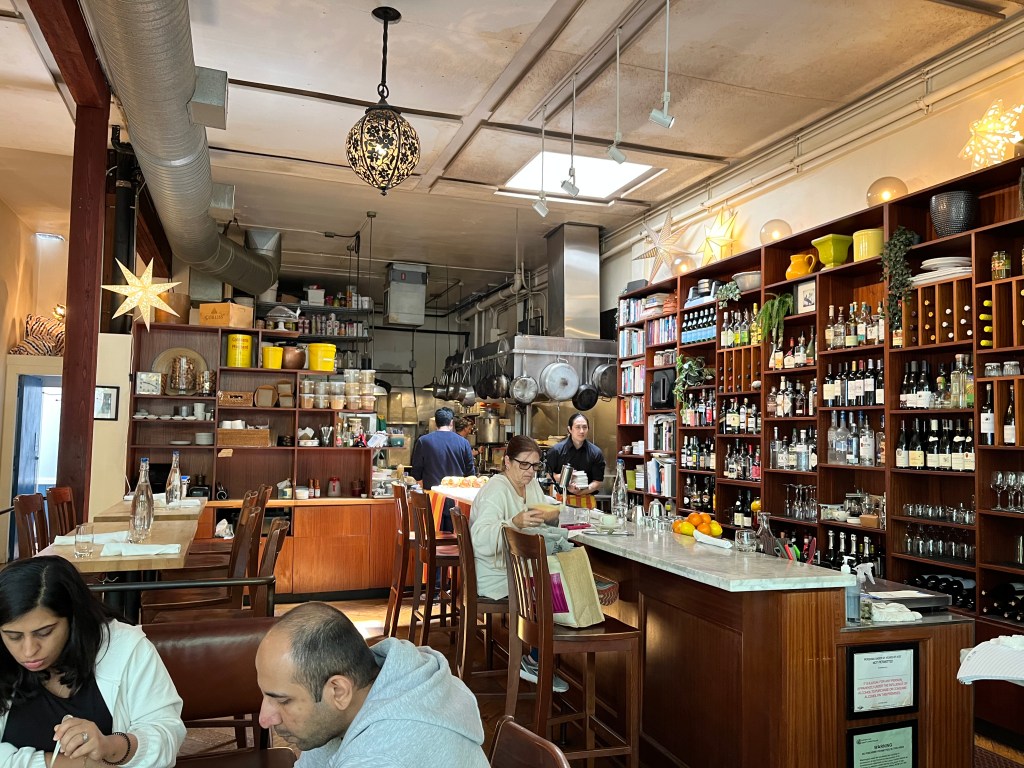
Cozy ambiance, Tillikum Place Cafe Belltown has a wealth of restaurants, cafes, and bars, covering a smorgasbord of cuisines. One of my favorite restaurants in Seattle is the cozy, captivating Tilikum Place Café, where I had one of the best egg benedicts I’ve ever had. At Afro-Latin restaurant Lenox, my family celebrated three birthdays and shared dishes with a cacophony of tastes. At the stylish Kalabaw Bar and Kitchen, I love their Southeast Asia offerings, from lumpiang rolls from the Philippines, larb isaarn salad from Laos, and soft shell crab dried curry from Thailand. As I lived in Southeast Asia for over twenty years, I was happy that they got the tastes and heat level right.
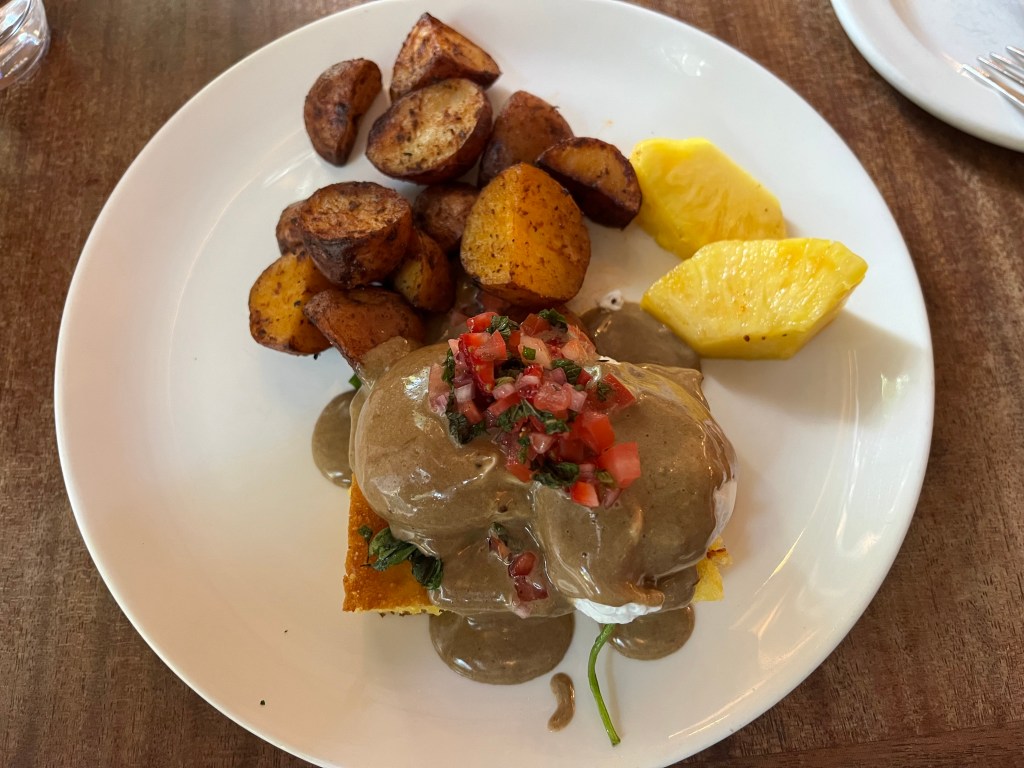
Eggs Benedict Tillikum Place Cafe For breakfast, I can’t resist Biscuit Bitch. Better to eat here on a pleasant day, though, as seating is all outdoors. The biscuit sandwiches, called Bitchwiches, have sausage, egg, and cheese and are irresistibly indulgent.
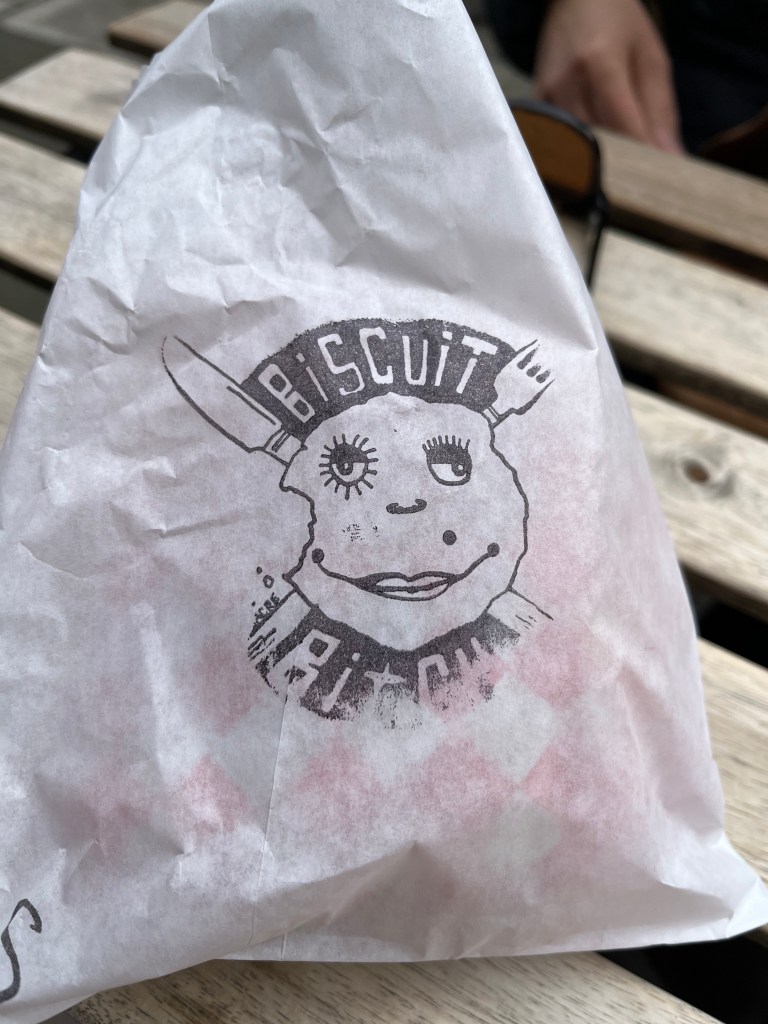
Biscuit Bitch 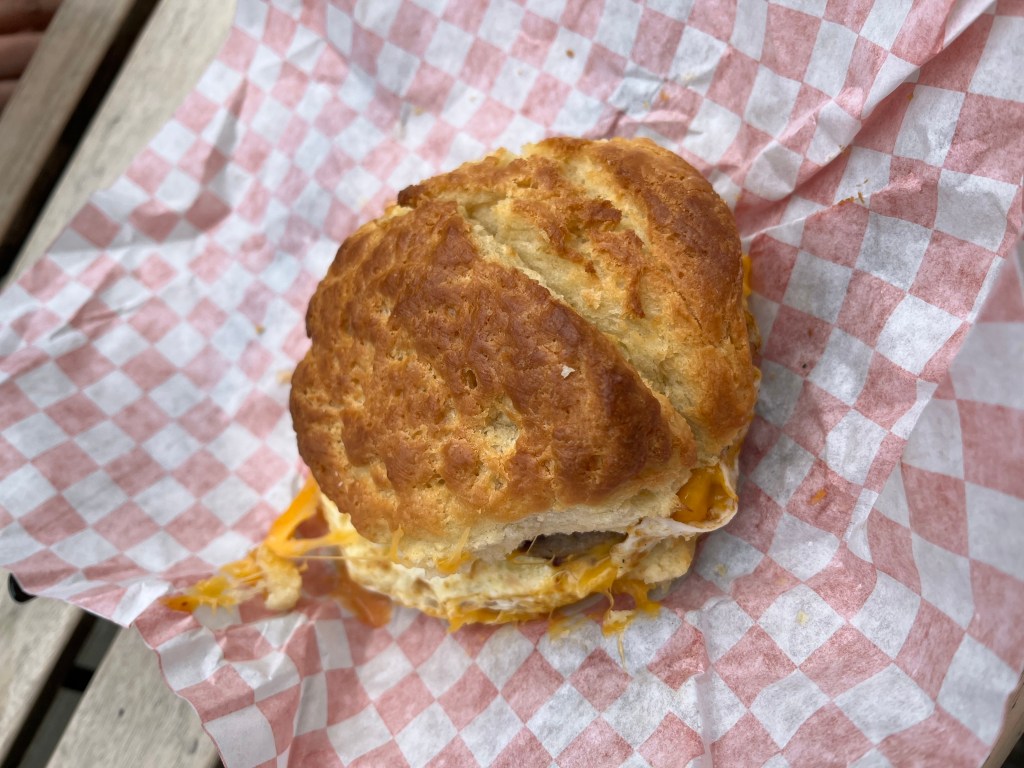
Biscuit Bitch Bitchwitch Cafes that I especially like are La Parisienne French Bakery, with what I believe are the best French pastries in Seattle. They’re phenomenally good. Bang Bang Café has a great, chilled vibe with solid, filling dishes. I love the vibe and space at Uptown Espresso Cafe. Coffee Tab’s mission, in addition to being a chilled place for a coffee, is to “help underserved youth achieve a higher quality of life.” On their website, they describe themselves as “Coffee Tab: where a coffee shop becomes a tabernacle.” Not sure exactly what that means, but it sounds noble. You can sip for a cause here.
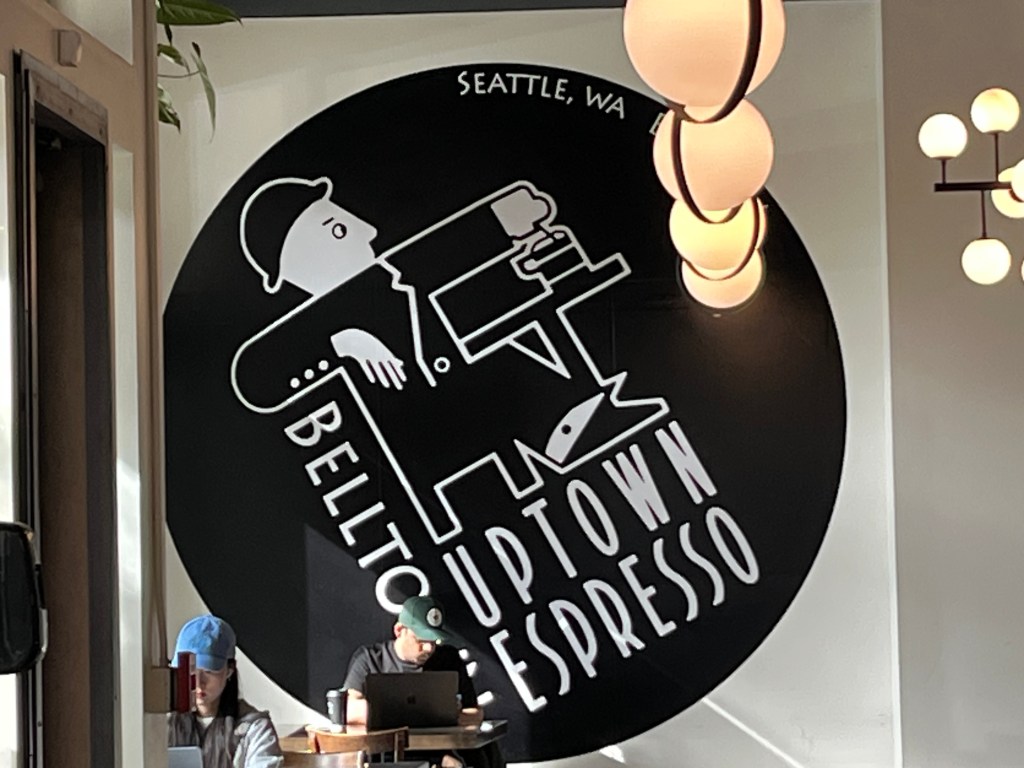
Uptown Espresso Cafe 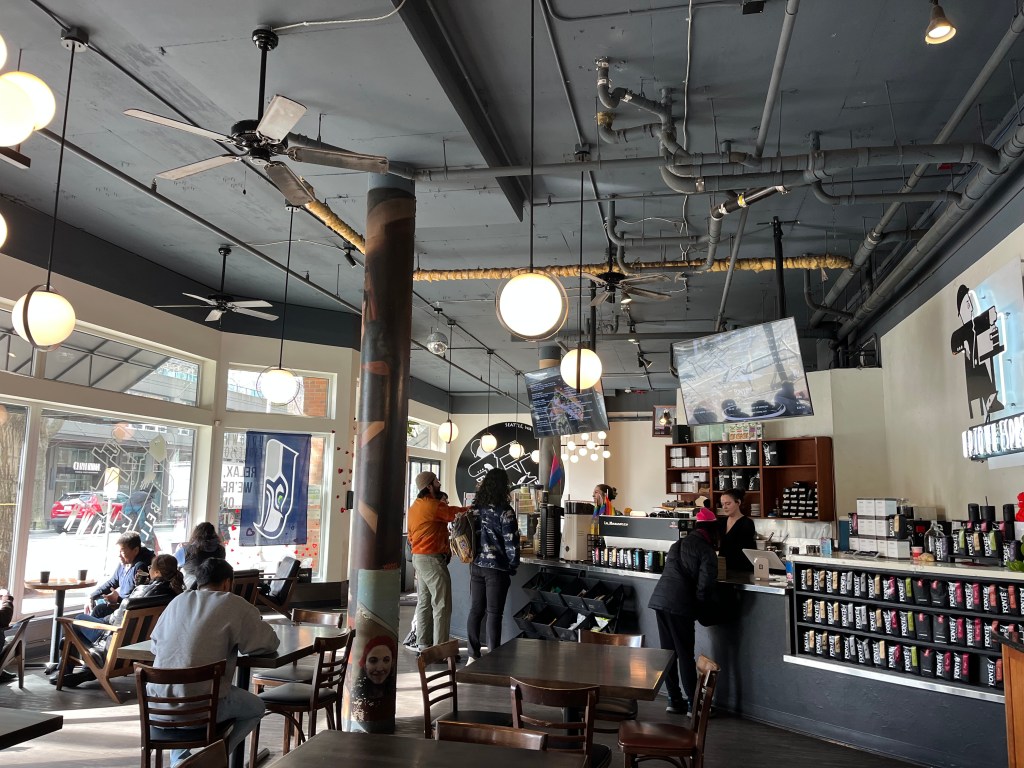
Uptown Espresso Cafe has a lot of space 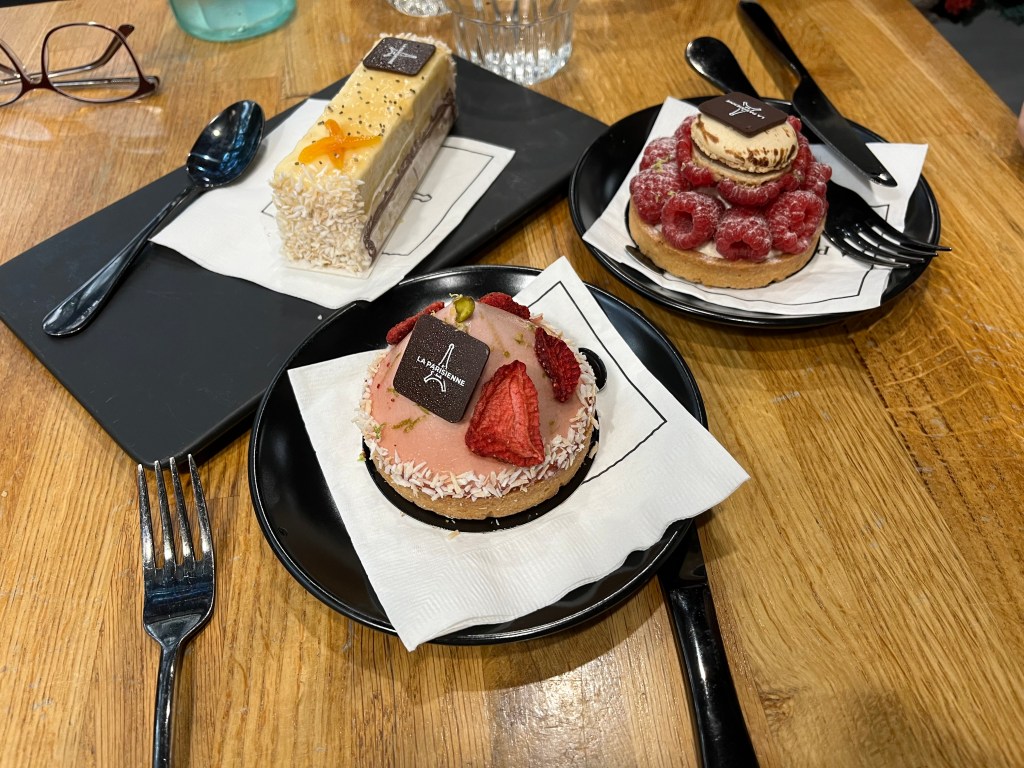
Pastries from La Parisienne French Bakery 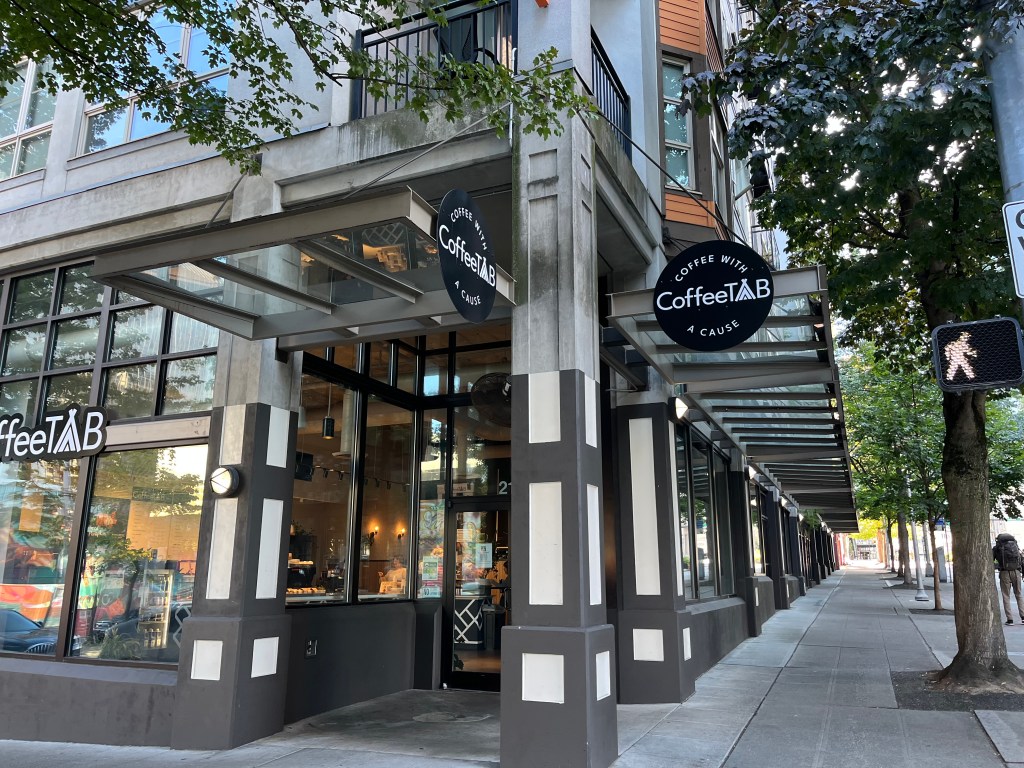
Coffee Tab is Coffee with a Cause For bars, Roquette, Some Random Bar, and Provisions are some great places for a beer (my usual drink) or a cocktail.
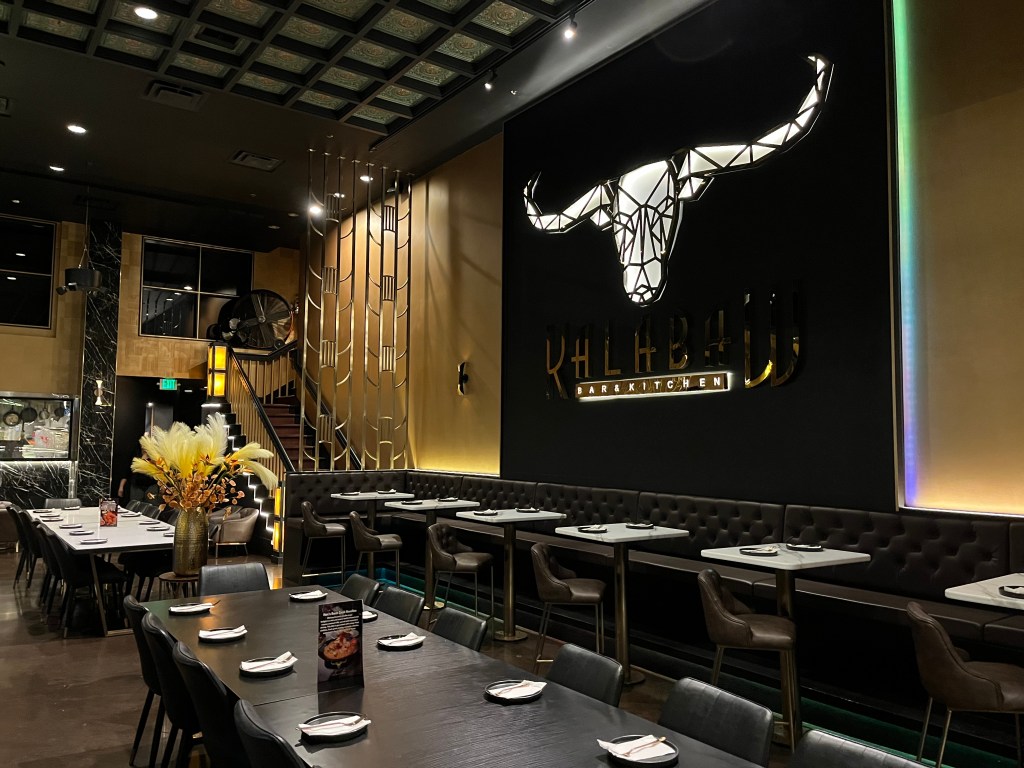
Kalabaw Bar and Kitchen for eye-watering SE Asia From morning to night, happiness is exploring the food and drink offerings in what is one of Seattle’s best culinary destinations.
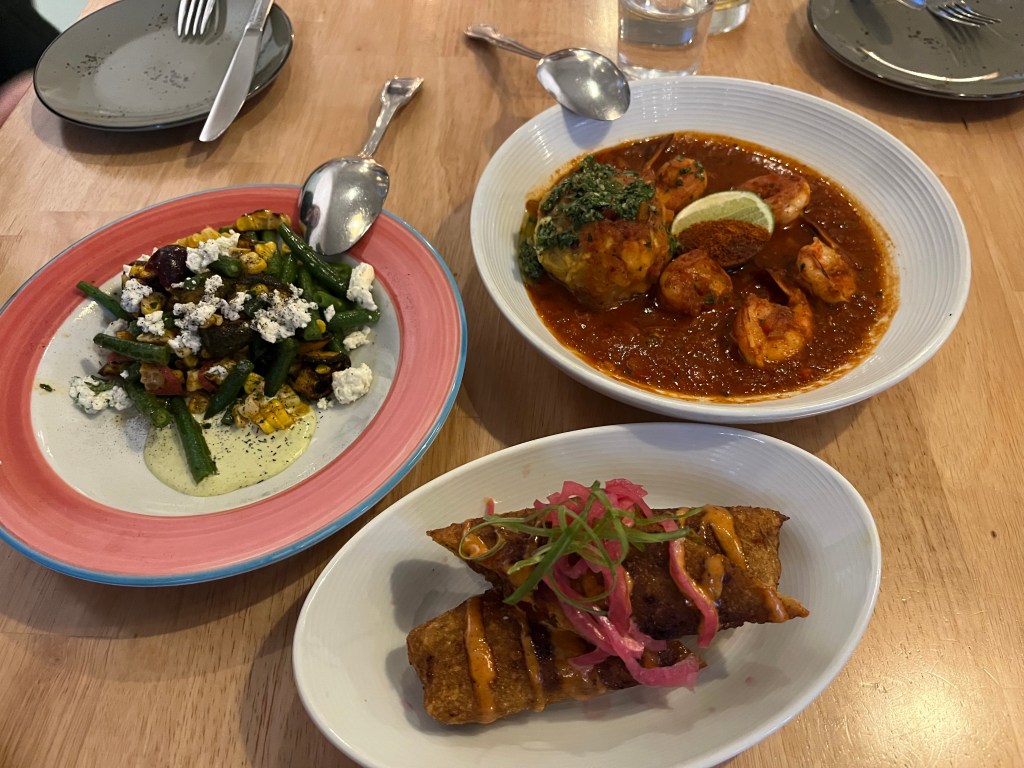
Lenox restaurant Afro-Latin dishes Shop at shops and galleries you don’t see elsewhere
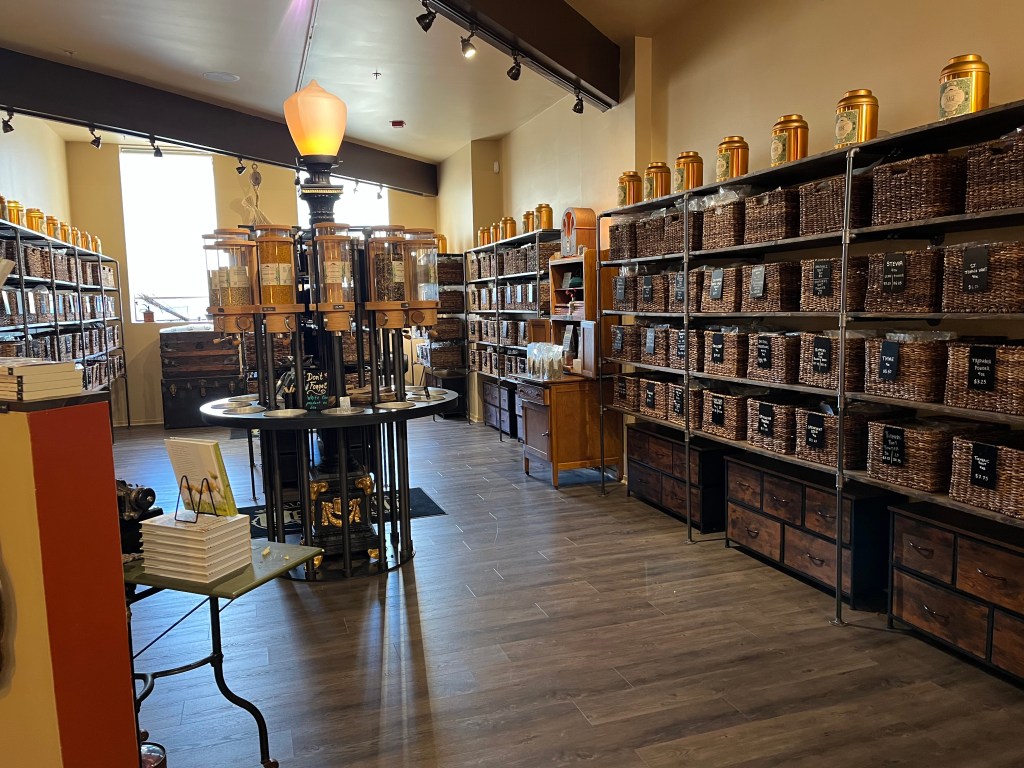
Mountain Rose Herbs Mercantile Belltown shopping takes you from the quirky to the serendipitous and surprising. For the widest variety of spices and herbs I’ve ever seen outside of the Spice Bazaar in Istanbul, stop by Mountain Rose Herbs Mercantile. Patagonia has a store where you can buy their high-quality clothing for the chilly Pacific Northwest winters — and tinned fish too. Ghost Vintage has funky, unexpected offerings. Juniors not only has great quirky offerings of vintage items and gifts (check out their cocktail napkins!), they also host the OBAMA (Official Bad Art Museum of Art).
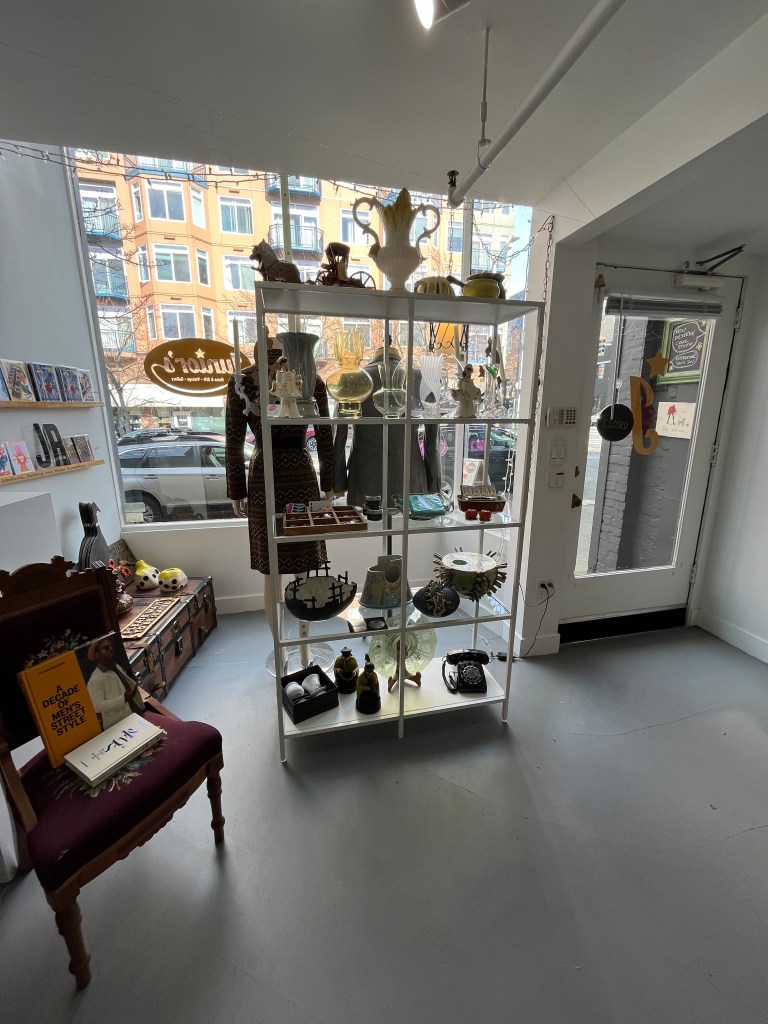
Juniors for vintage and quirky gifts 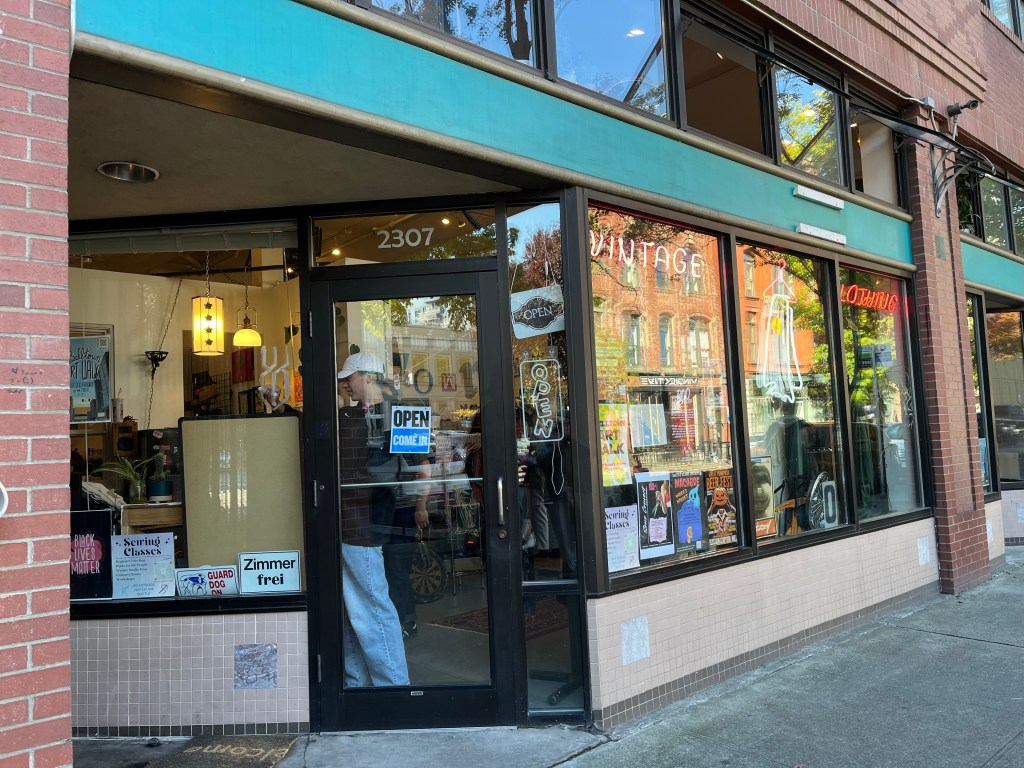
Ghost vintage to browse for treasures For art galleries, Base Camp Galleries, Slip Gallery, Gallery Mack, Steinbrueck Native Gallery are worth browsing for art to enlighten or to simply lighten your living space.
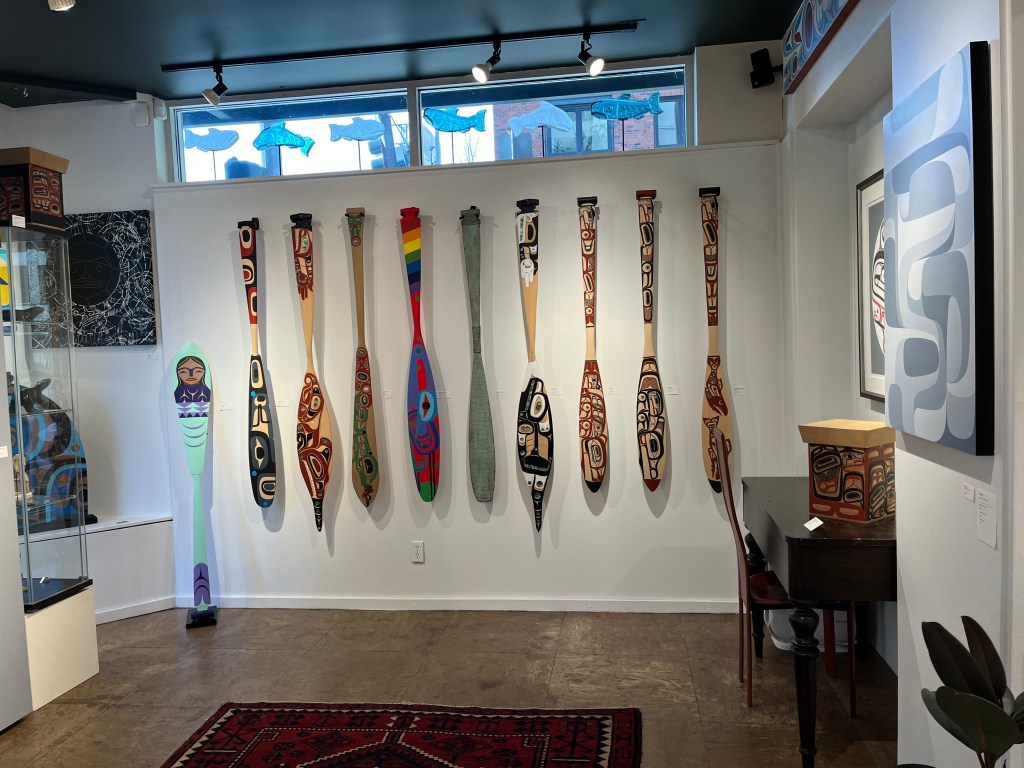
Steinbrueck Native Gallery 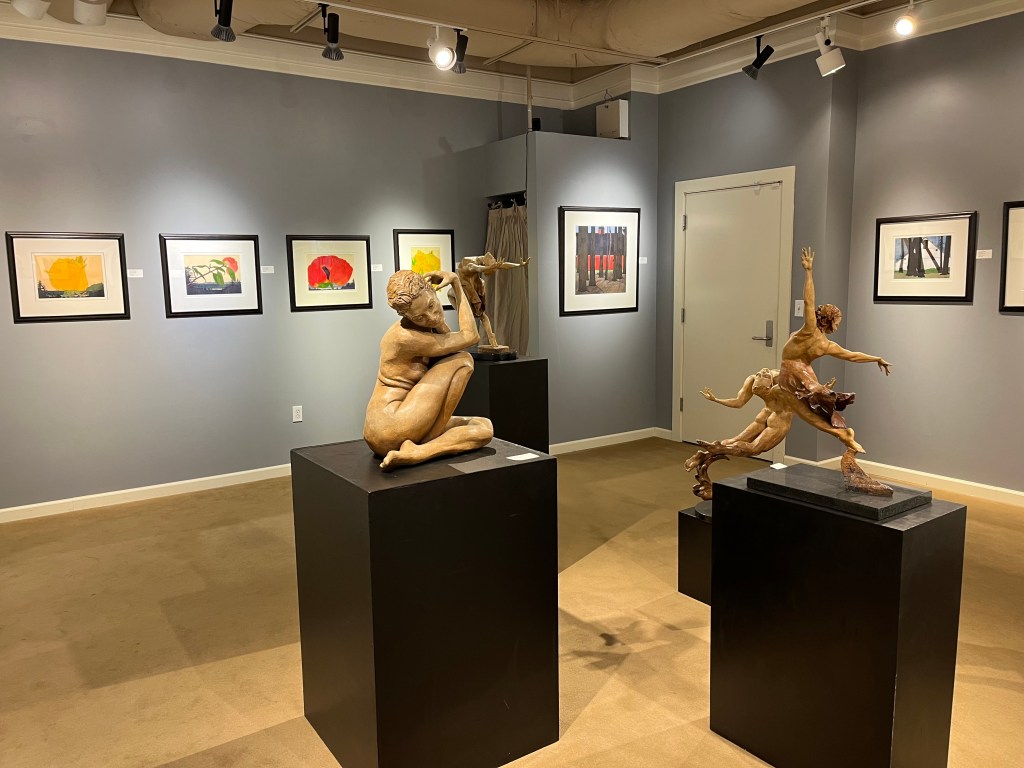
Gallery Mack 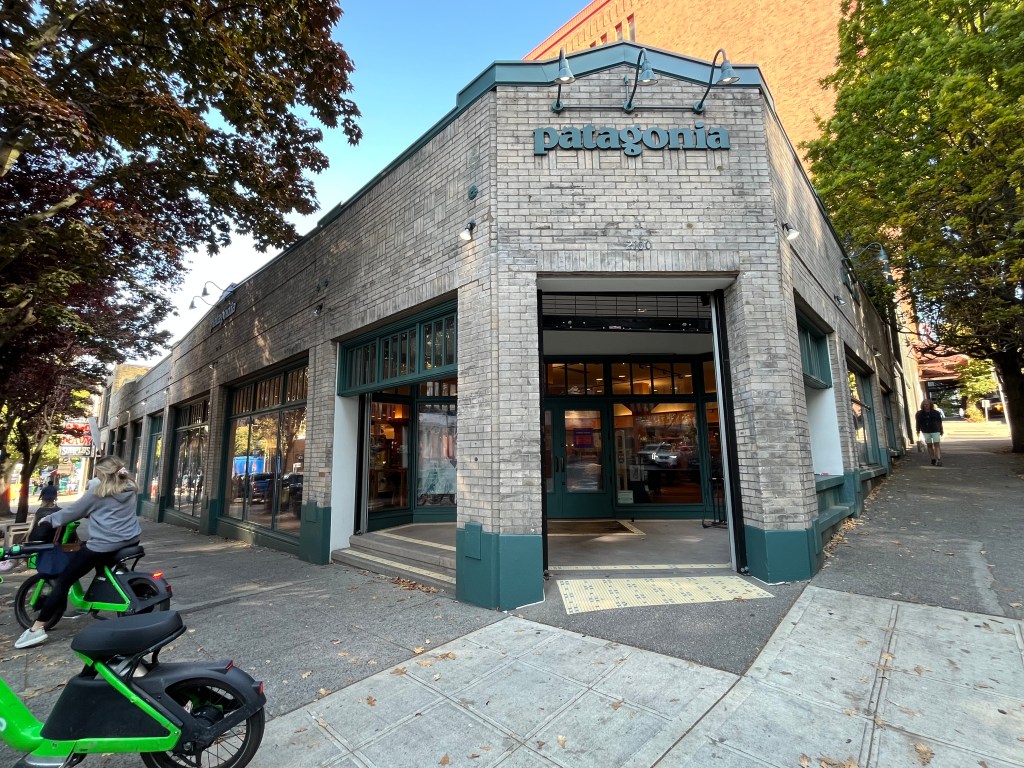
Patagonia store to suit up for Seattle winters Museums where you awe and guffaw
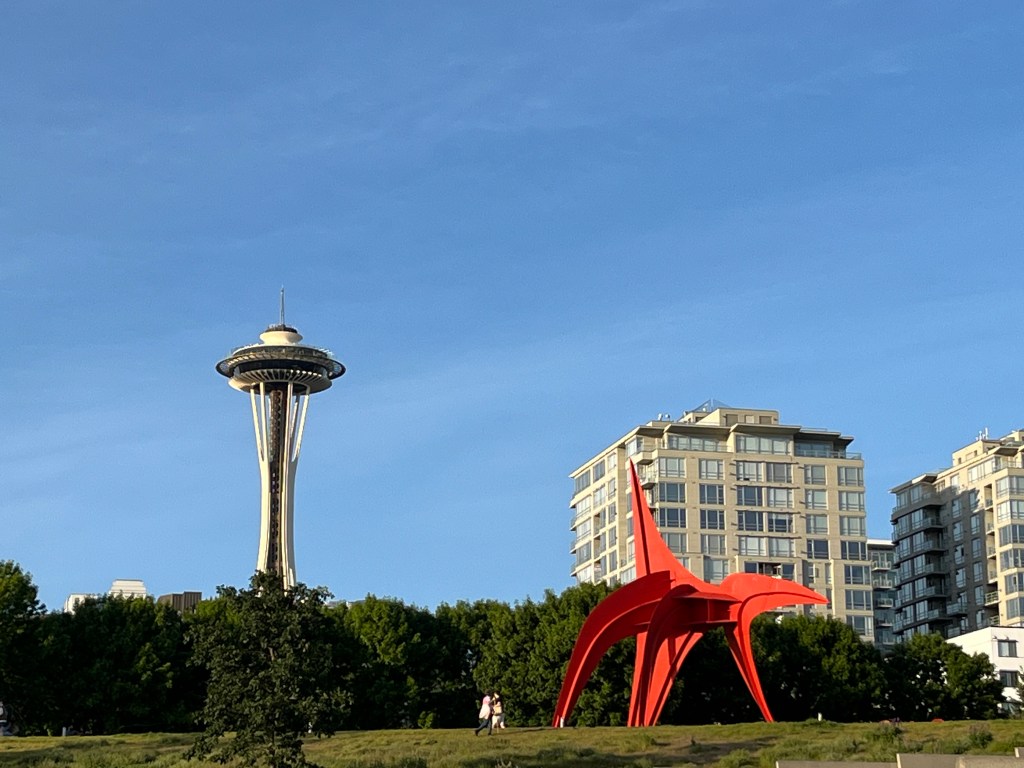
Space Needle from Olympic Sculpture Park One of the most awe-inspiring museum spaces in Seattle is the Olympic Sculpture Park, a nine-acre free-admission park displaying massive sculptures from the Seattle Art Museum collection. Some of the world’s greatest sculptors have art displayed here: Alexander Calder, Richard Serra, Louise Bourgeois, and Claes Oldenburg. With a view of the Puget Sound and the Olympics, it is one of the most magnificent fusions of art and nature in a cityscape in the US.
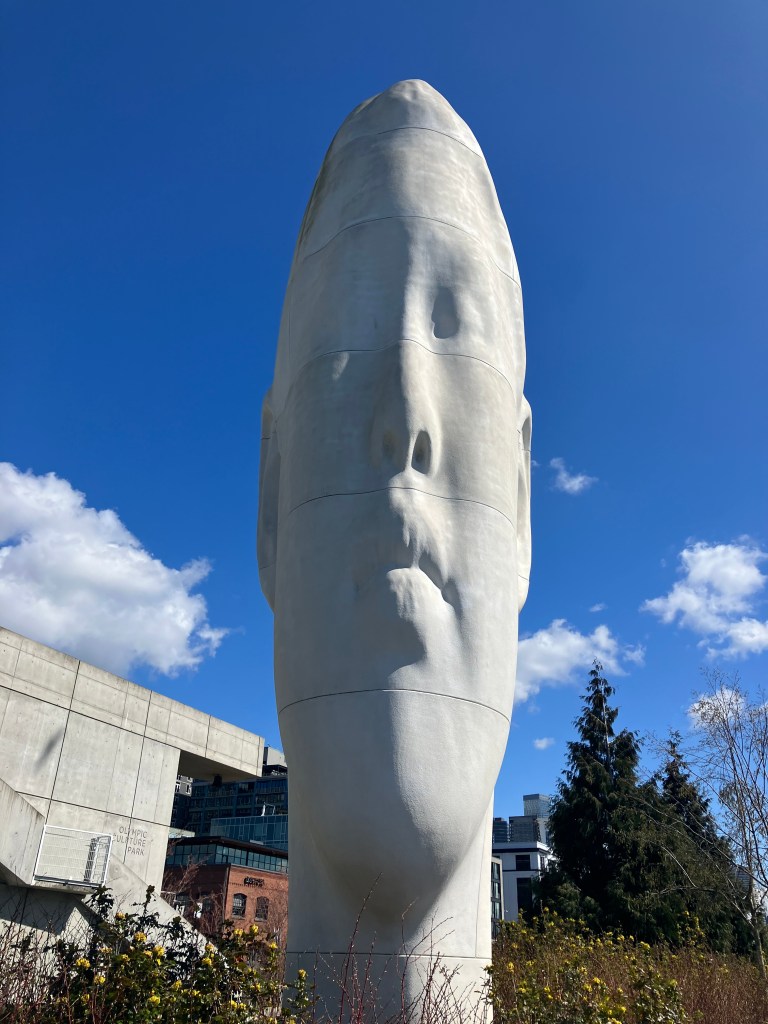
Echo by artist Jaume Plensa at Olympic Sculpture Park On the other side of the equation is the irreverent and decidedly tacky (in a good way) Official Bad Art Museum of Art (OBAMA), which is at Juniors Vintage in Belltown.
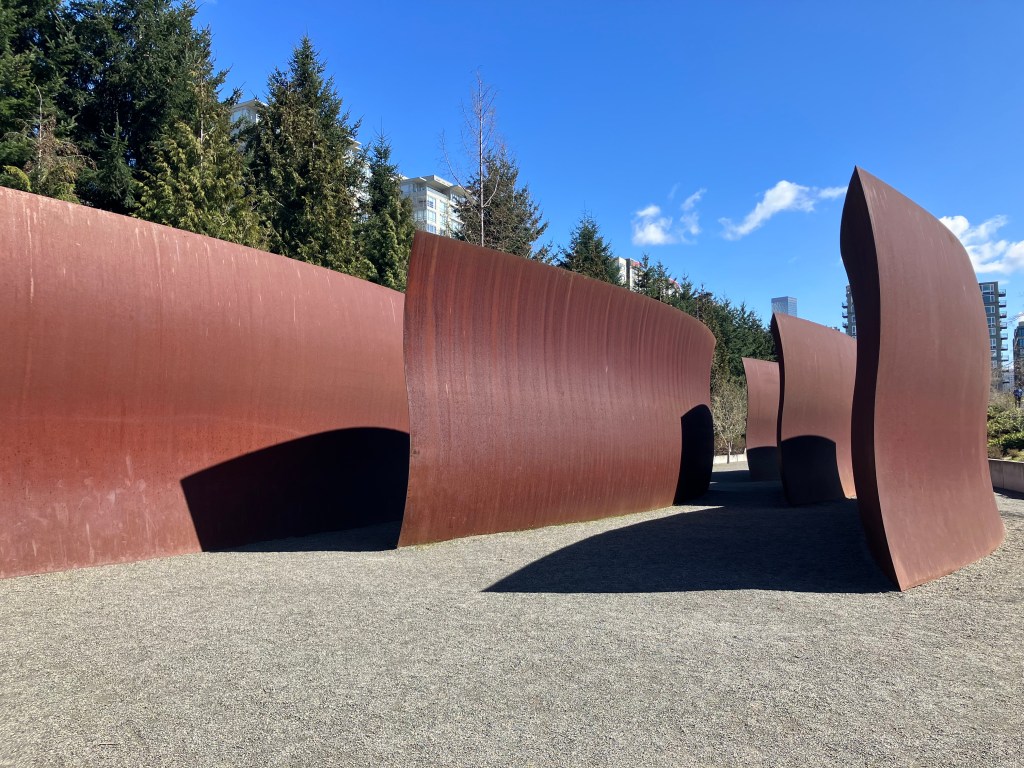
Richard Serra sculptures at Olympic Sculpture Park 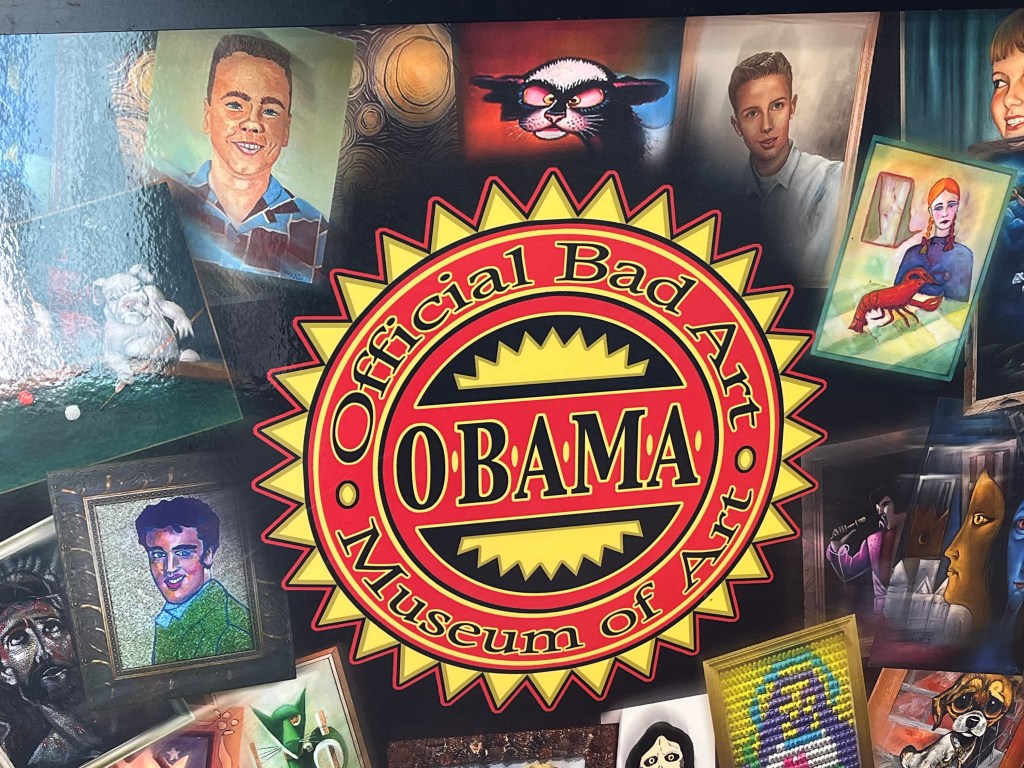
The Obama 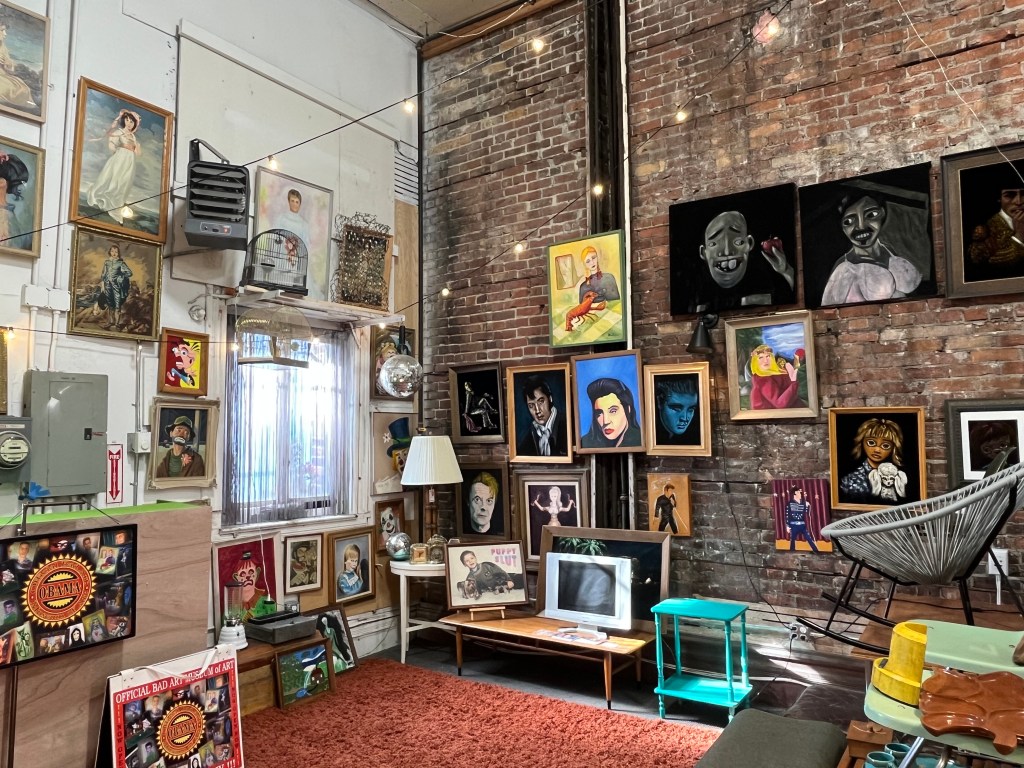
The art at The Obama really is bad Murals give Belltown a bright look, even on cloudy days
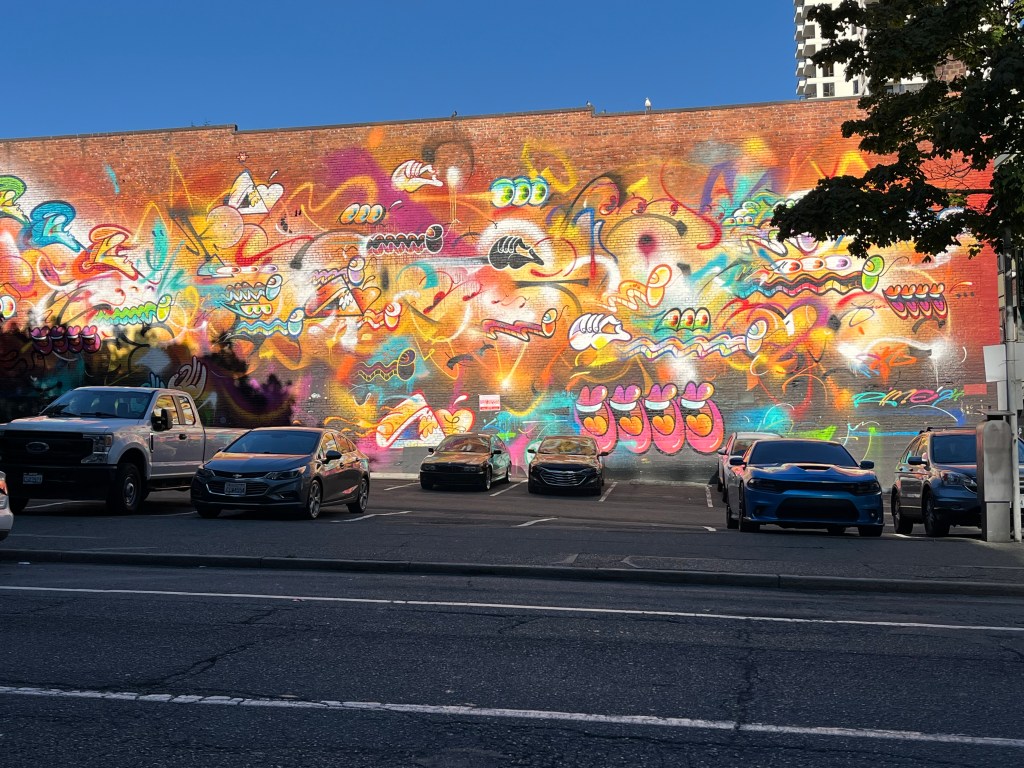
Belltown mural with a riot of colors 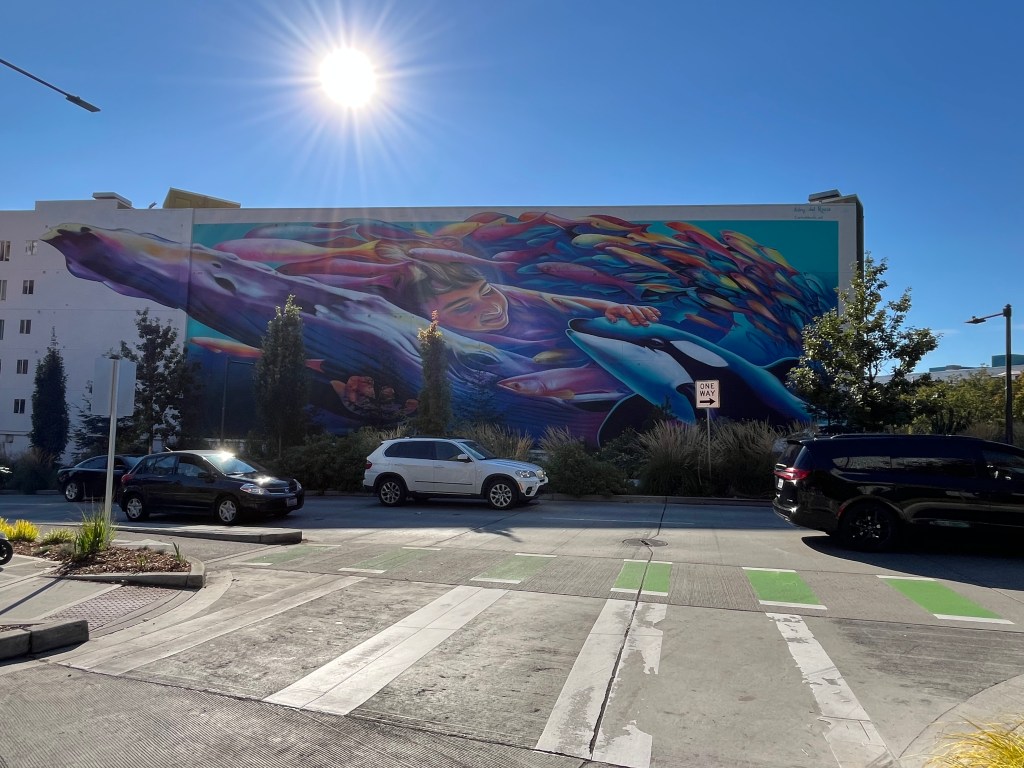
Murals brighten up Bellown In a city known for its cloudy days, there’s nothing like a mural to provide a bright spark of light, inspiration, and introspection. Just turn a corner, and suddenly, a once-barren building wall is filled with a mural. There’s even an empty lot with cardboard cut-outs of human figures. Not sure what they mean. But that’s the charm of Belltown. Always a surprise.
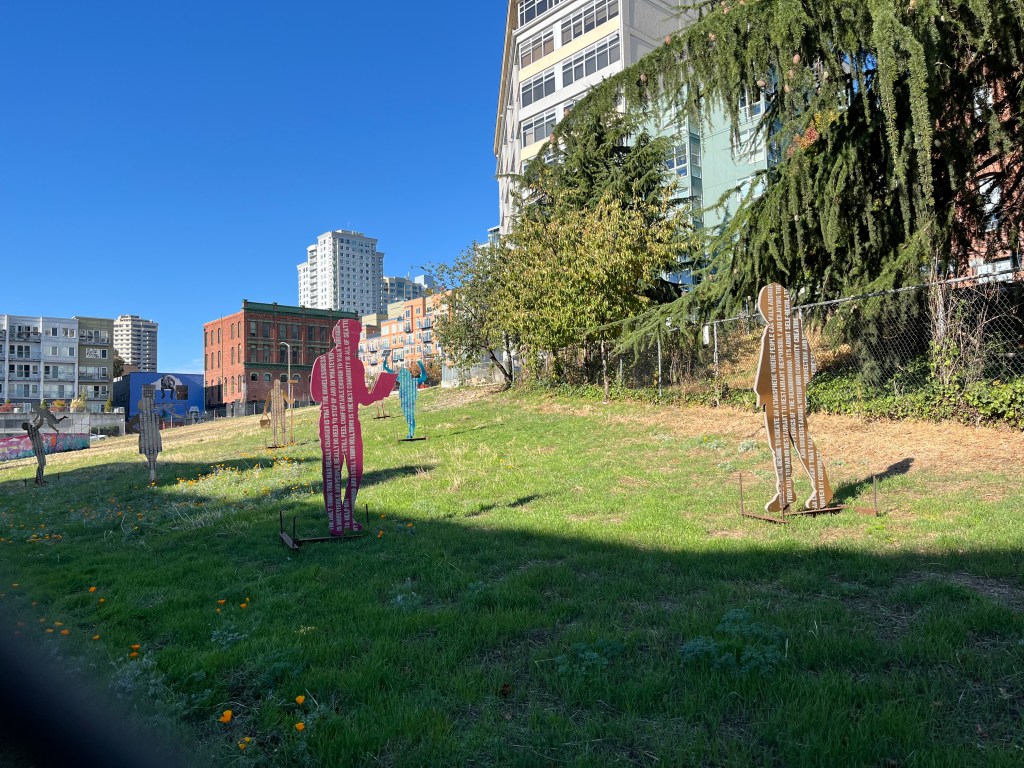
Cut-outs of people. What does this art mean? Belltown connects you to the rest of Seattle, too — on foot and by bike
With the Elliott Bay Connections (EBC) project, backed by Melinda French Gates and Mackenzie Scott, defunct street rail lines have been replaced with a bike and foot path that connects a new waterfront park with the Olympic Sculpture Park and Myrtle Edwards Park. A stroll on this path gives you a spectacular view of the light dancing off the water of the Puget Sound and the majesty of the distant Olympics as you pass through Belltown on your way to the revitalized waterfront. By now, the magic of Seattle and its coolest neighborhood has revitalized you, too.
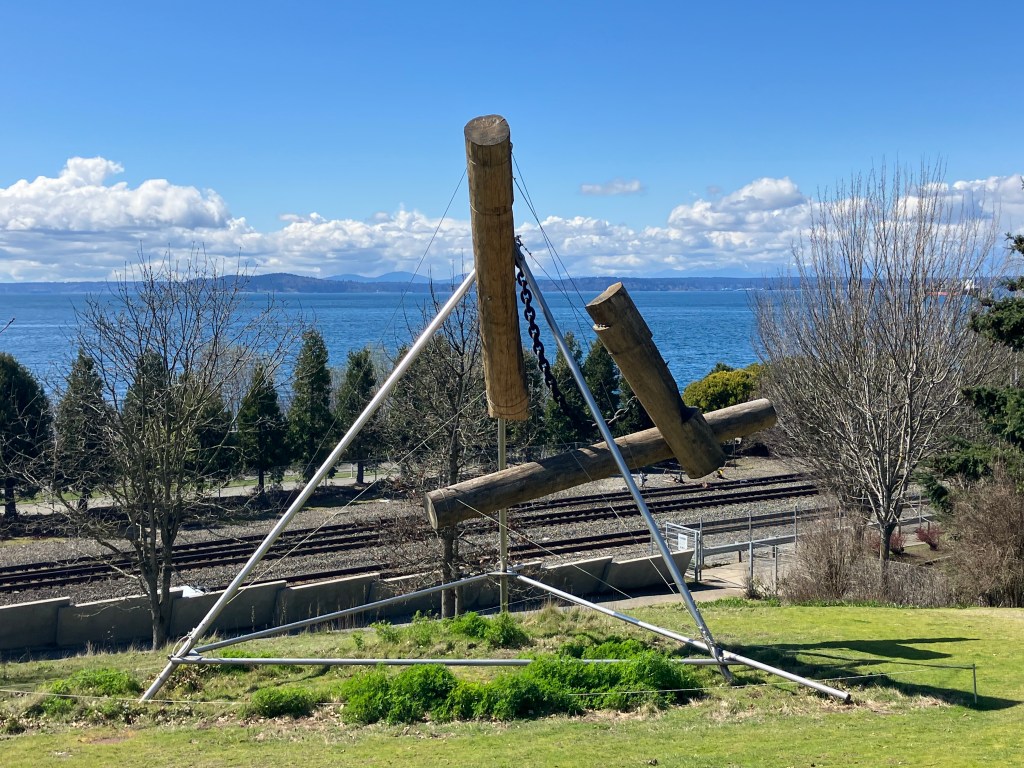
View of the Puget Sound and Olympics from Olympic Sculpture Park -
Flashback: When I saw a Voodoo Ceremony in Haiti
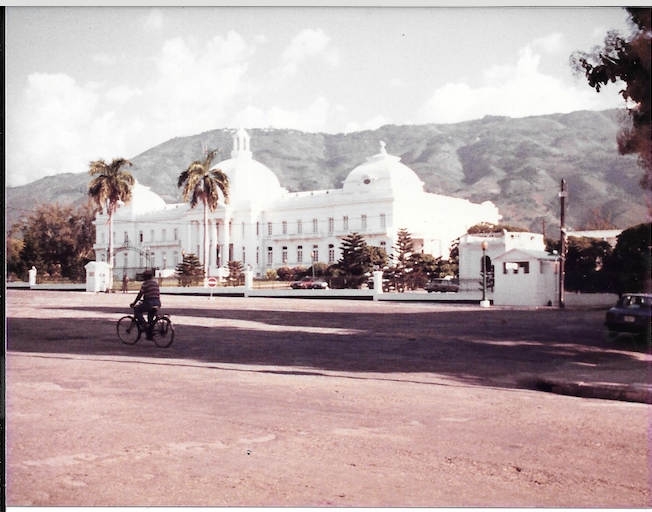
Presidential Palace, Port-au-Prince During beers with friends, we started telling travel stories. As one story topped another, I described the time I attended a voodoo ceremony in Haiti. That story topped them all. No one goes to Haiti anymore because of its political instability. Likewise, no outsiders go to voodoo ceremonies there. Not that many went when I visited. Haiti was never high on tourist destination lists — although the country it shares the island of Hispaniola with, the Dominican Republic, is very popular. When I visited, the country was in a deep funk. Since then, it’s gotten worse.
Arrival in Port-au-Prince
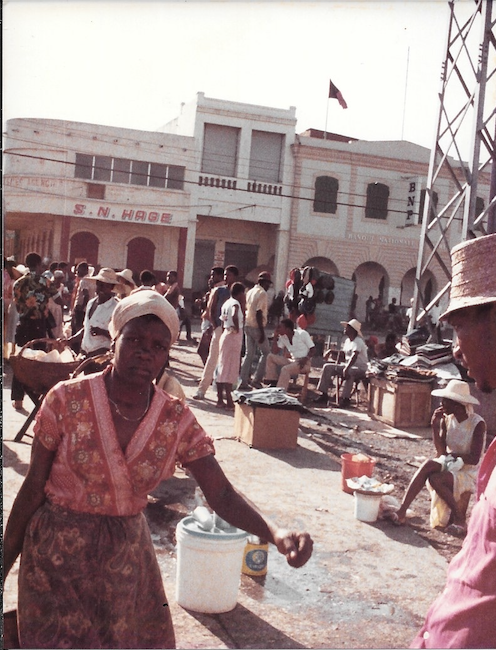
Cite Soleil Port-au-Prince I arrived in Port-au-Prince, capital of Haiti, on an American Airlines flight from New York in September 1984. Although long ago, the memories of my visit are as vivid as if they happened yesterday. Haiti can imprint its mark on a mind like that. When I departed the plane and stepped onto the tarmac, I saw Haitians crowded on the outside terrace of the terminal’s second floor. The terminal, a decrepit, boxy white building, was the main route out of the country. The Haitians gathered there looked sullenly at flights that would bring family members back or take them away.
An offer I should have refused

Mambo, chalk drawings behind her After clearing immigration and customs, I grabbed a taxi to my hotel in Petion-Ville, a suburb in the hills east of Port-au-Prince. It’s cooler, calmer, and above the din of the capital. I didn’t speak Creole or much French, but the taxi driver spoke broken English. He offered to be my tour guide of Haiti, which I turned down since I figured I could arrange trips through the hotel. But before he reached the hotel, he made an offer I didn’t refuse. Even if I should have.
“Would you like to see a voodoo ceremony? One is happening tonight in Port-au-Prince.”
“Sounds cool. What time?”
“I will pick you up at midnight.” Broken though his English was, it was precise.
I thought: wait a sec, a midnight taxi ride to a voodoo ceremony in Port-au-Prince? That’s crazy. This is Haiti, after all. Who knows where I was really going and if I would come back.
“See you then,” I said.
Midnight ride to a voodoo ceremony
At midnight, I walked down the hotel’s stairway and crossed the barren lobby. As I was about to exit outside, the receptionist called out to me, “Monsieur, where are you going?”
I turned and smiled. “To a voodoo ceremony.”
“Wait,” he said in alarm.
At that point, the taxi roared to the front of the hotel, the passenger door flying open. No sooner did I climb inside than the taxi roared off.
Past slums and palace in Port-au-Prince

Preparing for voodoo ceremony After half an hour, after a descent from the lush hills of Petion-Ville with its view of the shimmering moonlit Caribbean, the taxi was crawling through the patchwork dirt roads of Cite Soleil. While the words mean Sun City in English, it was Port-au-Prince’s most notorious slum.
At this point, I thought, “This might not be the smartest thing I’ve ever done.”
Soon, we drove by the colossal Presidential Palace, where Jean-Claude “Baby Doc” Duvalier, son of the vicious dictator Papa Doc Duvalier, ruled. A three-domed palace, it was surrounded by high iron gates, guard posts, and roving pairs of his notorious secret police, the Tonton Macoutes, who during the day were as infamous for their large, dark sunglasses as they were for their senseless and sudden brutality. Just two years later, in 1986, “Baby Doc” was overthrown by the Haitian people and sent into exile in Paris.
Past the palace, now about 45 minutes into the drive, I asked the taxi driver, “Are we almost there?”
He turned to me, his smile bright in a way that dimmed my mood: “Soon.”
In a neighborhood with lush foliage, we pulled into a long driveway with a darkened, colonial-looking home at the end of it. It looked like it belonged in a Graham Greene novel, which wouldn’t surprise me since he set his novel The Comedians in Haiti.
“We here,” he said.
Voodoo hounfor

Voodoo ceremony, Port-au-Prince I stepped tentatively out of the car. A woman wearing a white dress greeted me with a solemn expression and led me around the side of the house to the back. We stepped into an open-air area, a hounfor, a voodoo place of worship. There was just me and a couple who looked Latin American. I acknowledged them and they me, but we didn’t speak, nor did we stand near each other. We shared one thing in common, though: an uncomfortable feeling. By now, it was past 1 am, and the sticky heat of Port-au-Prince was making my skin sweat and my flesh crawl.
The Latin American couple and I sat down and continued to keep our distance from each other. We sat on the edge of a concrete circle and watched while the woman in white with a checkered bandana bent down to finish chalk markings on the ground and place lit candles near them. What the chalk markings meant, I had no idea. But I wish I did. Another woman, also dressed in white with a red bandana, confronted another woman who wore a red dress covered in white tropical flowers. They spoke to each other in a challenging way around a simple white step mound with a wooden stake rising from the center of it. A tall, gaunt man in a loose pink shirt and trousers banged the wooden stake with a rhythm that was off and not melodious. I wondered: was it ritual or theatre? Or is all ritual really a kind of theatre?
The voodoo ritual begins
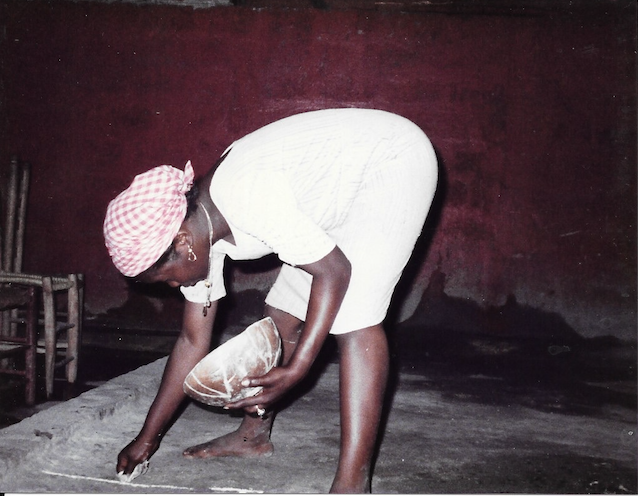
Creating the chalk drawings for the voodoo ceremony A few Haitians emerged from the shadows at the edge of the hounfor. There was a subdued and suppressed feeling in the air. But I was there now. I wanted to see how this played out. The woman with the red bandana was the mambo – a voodoo priestess. She started to chant. But her tone was more staccato, guttural, than melodic. I’ve attended an Apache Crown dance in a chaparral landscape and a Hopi Katchina dance in a kiva on an Arizona mesa — the chanting at those dances had a certain melodic, somewhat pleasing rhythm. This chanting didn’t.
Every now and then, I was able to sneak off a shot, but I received a sharp look from the tall man in pink when I did. The photos I took are surreptitious.
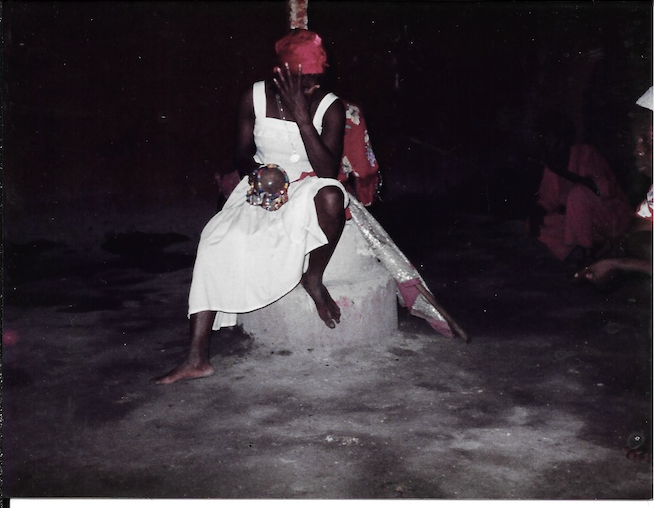
Mambo going into a trance The mambo with the red bandana sat on the mound and held her face in a kind of contemplation with one hand and a hollowed-out gourd threaded with beads in the other. Then she started to chant more insistently as she moved menacingly around the concrete circle. The first time she circled, she howled in my face. The second time she circled, she spat liquid from the gourd in my face. I wasn’t sure what the liquid was. It didn’t smell and wasn’t sticky. But it didn’t seem like water either. To this day, I wonder: did she do that because it was part of the ceremony or because she could? I wiped my face with my sleeve but otherwise didn’t react.

Voodoo ceremony participant deep in a trance The tempo of her movements increased as the other woman in the flowered dress started to writhe on the ground in a trance, first faced upwards, then on her belly as she put her face and body onto the chalk drawings. Her movements were spasmodic. The mambo set aside the gourd to give her a live, agitated chicken, its feathers ruffled. The woman on the ground clutched the chicken and, in an action that was sudden and savage, ripped its head off with her teeth, blood spurting across the concrete. A shriek split the air, followed by the thock,thock, thock sound of the wooden post being hit with a stick by the tall gaunt man. I was startled, but while my head moved backwards, my feet were planted, and I stayed where I was and didn’t step away from the concrete circle. Nor did the Latin American couple. The woman spat the chicken’s head onto the ground and its blood into the gourd. The ceremony had reached its crescendo. The woman collapsed near the mound. The mambo sat on the mound and stared down at her, almost as if she were a kind of victim. The thought that she might become a zombie — Haitian voodoo is known for turning people into them — crossed my mind. But it just as quickly left it too. I found out later that the sacrifice of the chicken was to appease the lwa, a primary voodoo spirit.
Back to the hotel for a restless rest
Drained, I was led away from the hounfor, along the side of the house to the front. The taxi was waiting for me and took me back to the hotel. The driver didn’t say anything on the drive back as we passed the Presidential Palace and drove through the Cite Soleil, pre-dawn life starting to emerge on its dirt alleys and broken asphalt lanes, from its zinc-roofed ramshackle dwellings.
At the hotel, I paid the driver and walked past the relieved receptionist to my room. It was around 4 am. I had spent most of the post-midnight night at the ceremony.
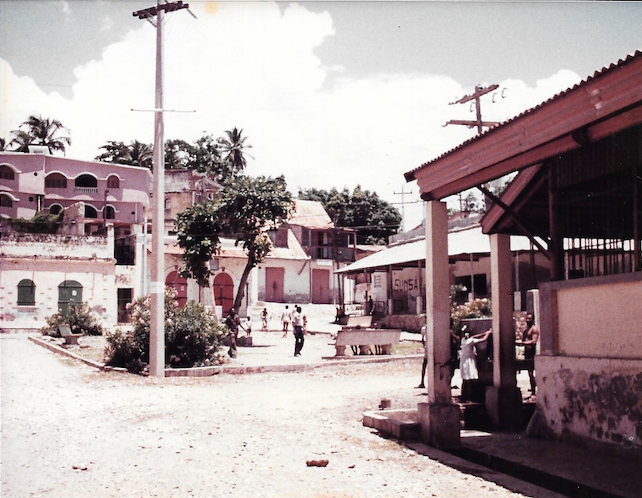
Jacmel, southern Haiti A visit to sun-dappled Jacmel

Bus to Jacmel 
Jacmel mansion As I lay on my bed in my hotel room, the images from the ceremony raced back into my head, hindering my ability to sleep. After dawn, I took a bus to Jacmel with its 19th-century gingerbread mansions supported by narrow, rusting iron pillars. Wraparound balconies provided the residents of these expansive homes with great vantage points to see what was happening in the town. Only, no one was on the balconies the day I visited. You could say that Jacmel’s architecture looked like New Orleans’. But that would be false: it was New Orleans architecture that was influenced by Jacmel’s in the late 19th century, when Jacmel was a wealthy coffee port. In the scalding sunlight of one of Haiti’s most peaceful towns, with its deserted art galleries, a tranquil waterfront, and sleepy streets, Jacmel was 50 miles by road from Port-au-Prince yet a million miles from the turbulent voodoo ceremony of the previous night. I bought a painting here, and it hangs above my bed, above my head, so that every night Haiti is influencing my dreams.
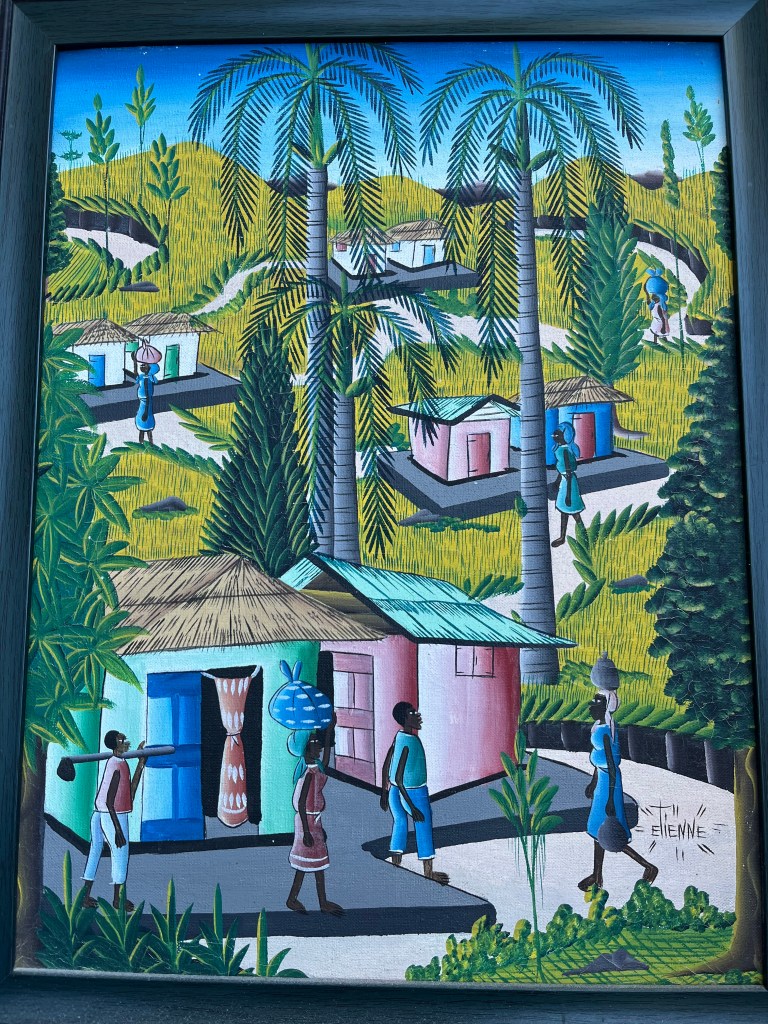
Haitian painting I bought in Jacmel -
Guatemala: from BC to B.E. (Before Easter)

Pre-Easter procession Antigua: Three volcanoes surrounding a UNESCO Heritage Site
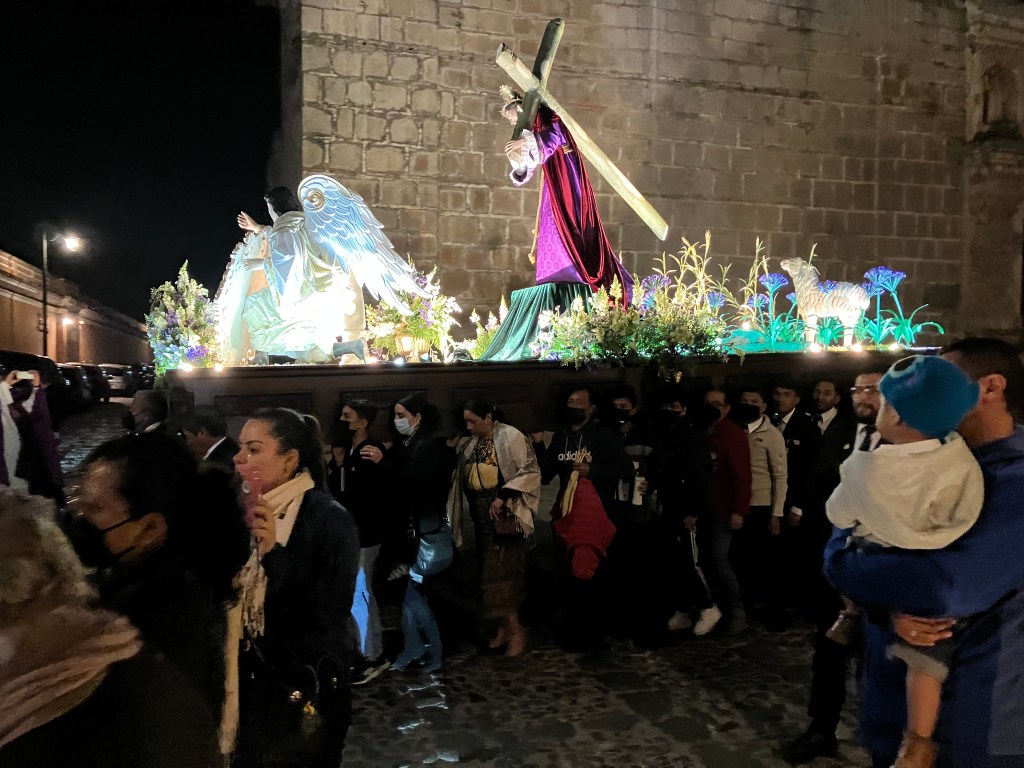
Sharing the burden Antigua struck me as the legendary town of Macondo come to life. Its streets seemed to embody the mythical town at the heart of Gabriel Garcia Marquez’s novel “100 Years of Solitude.” Yes, I know that Macondo is set in Gabriel Garcia Marquez’s native Colombia and Antigua is in Guatemala. But its mystical feel and magnetic pull made me feel this UNESCO Heritage Site was in a place like no other, one I wanted to linger in for a while.

Altar along pre-Easter procession 
Solemn pre-Easter wound through the streets At the Heart of Guatemala’s History
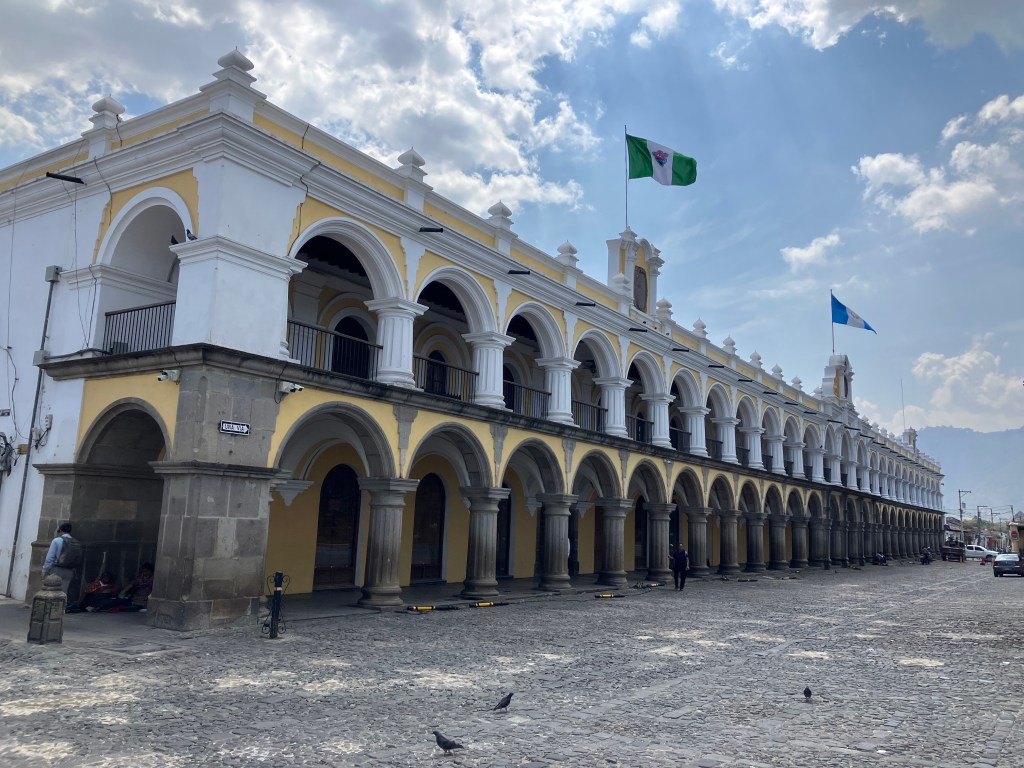
Palacio de los Capitaines de los Generales 
Palacio de los Capitaines de los Generales at night Antigua is at the heart of Guatemala’s history. Ruled by the Maya from 1000 BC to 1524 AD, Guatemala was conquered by the Spanish conquistador Pedro de Alvarado from 1523-24. Antigua was founded in 1543 to become the locus of Spanish colonial rule throughout Central America. A destructive earthquake hit in 1773 and many of its 38 churches as well as mansions, convents, and homes were badly damaged. While many weren’t repaired since then — those that were faced another deadly earthquake in 1976. The visible damage from the two earthquakes is one of the distinctive features of Antigua — a city that at its peak attracted the focus and funds of the unimaginably rich Spanish colonial power. Now, its candor is its charm, a city unafraid to reveal a few gray hairs and age spots that don’t detract from its glamor, even if its glitter is long gone.
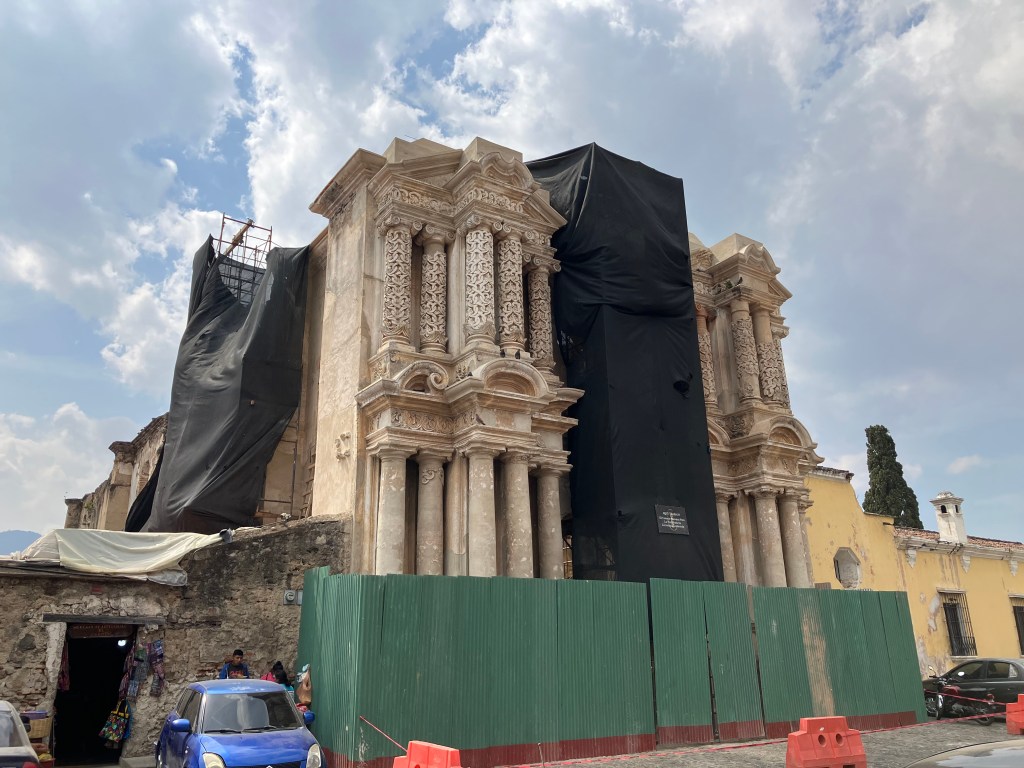
Repairing earthquake ruins Once a Backwater
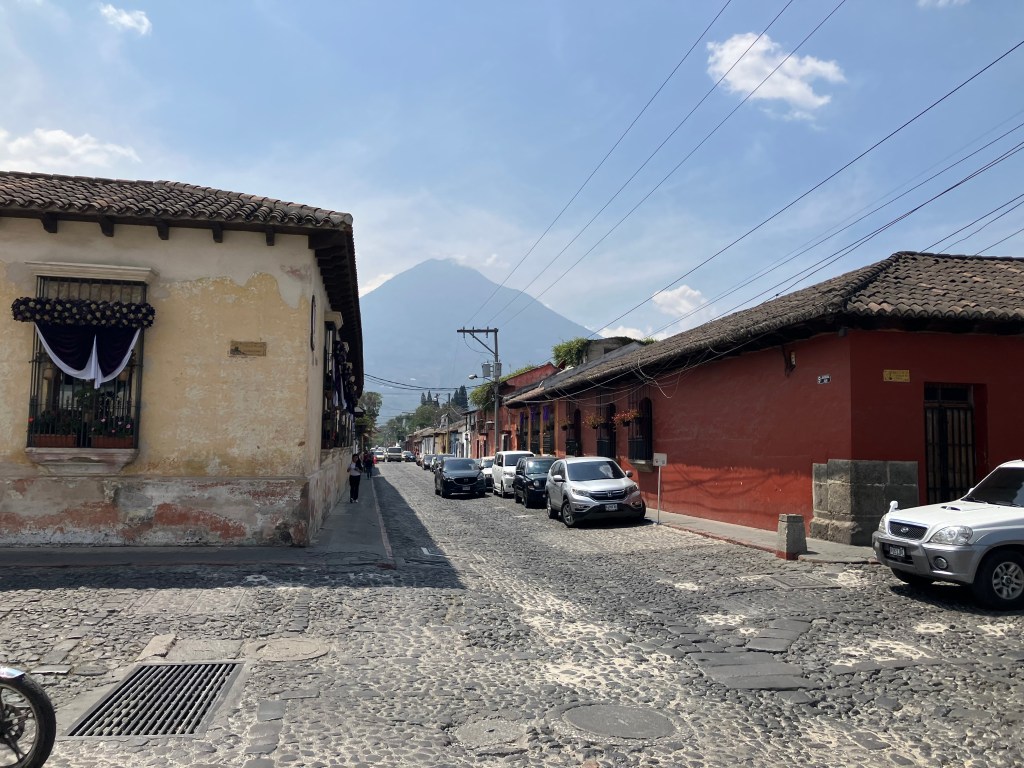
Surrounded by volcanoes Antigua became a backwater in 1775, when two years after the quake Spain moved the colonial capital to Guatemala City. And that’s where Guatemala’s history played out. Independence was achieved from Spain, then Mexico in 1823. A CIA coup against President Jacobo Arbenz happened in 1954. A deadly civil war occurred from 1960 to 1996 with a staggering 200,000 deaths. Now peaceful, Antigua is at the center of Guatemala’s efforts to attract tourists to a country that has been at the political center of Central American history for literally 3,000 years.

Elegant colonial courtyard Fireworks over Antigua
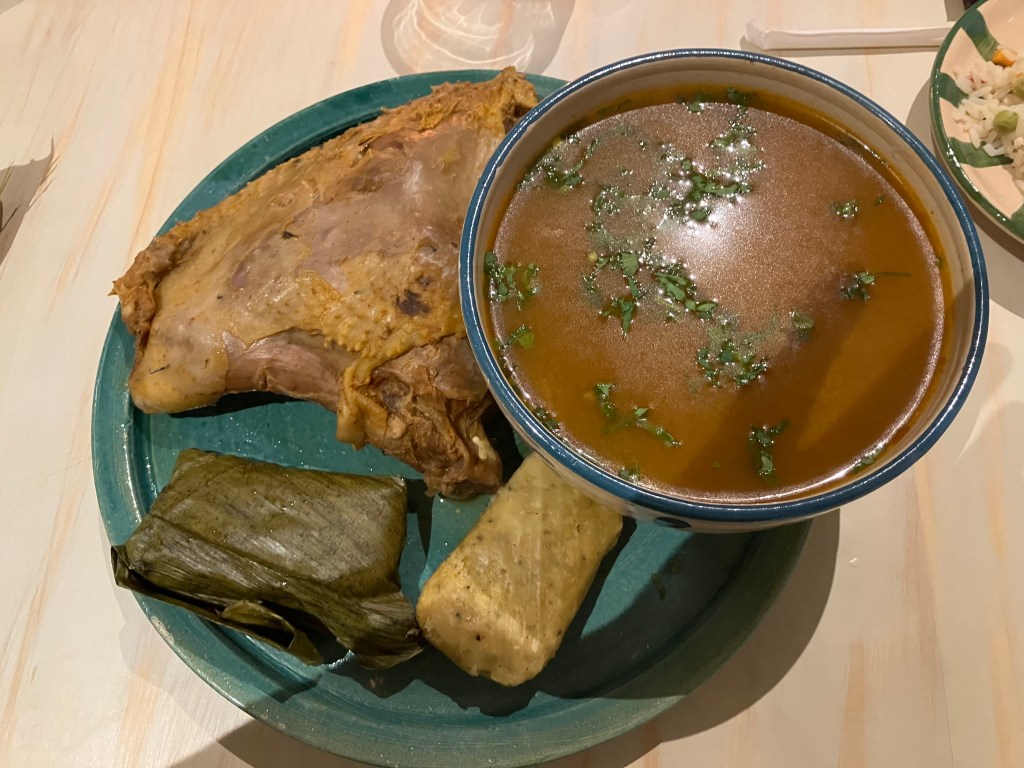
Kaq’ik I was eating Kaq’ik, a multi-layered spicy Maya soup from Coban at the charming El Adobe restaurant, the sound of a woman slapping tortillas onto a grill creating a soundtrack in the background. Explosive fireworks lit up the sky overhead. I went to the second floor to see the fireworks illuminate the night sky and the colonial skyline. Burst, crackle, and then descending colorful lights, fading in illumination as they approached the earth.

Cucurucho figure. They are part of Easter processions 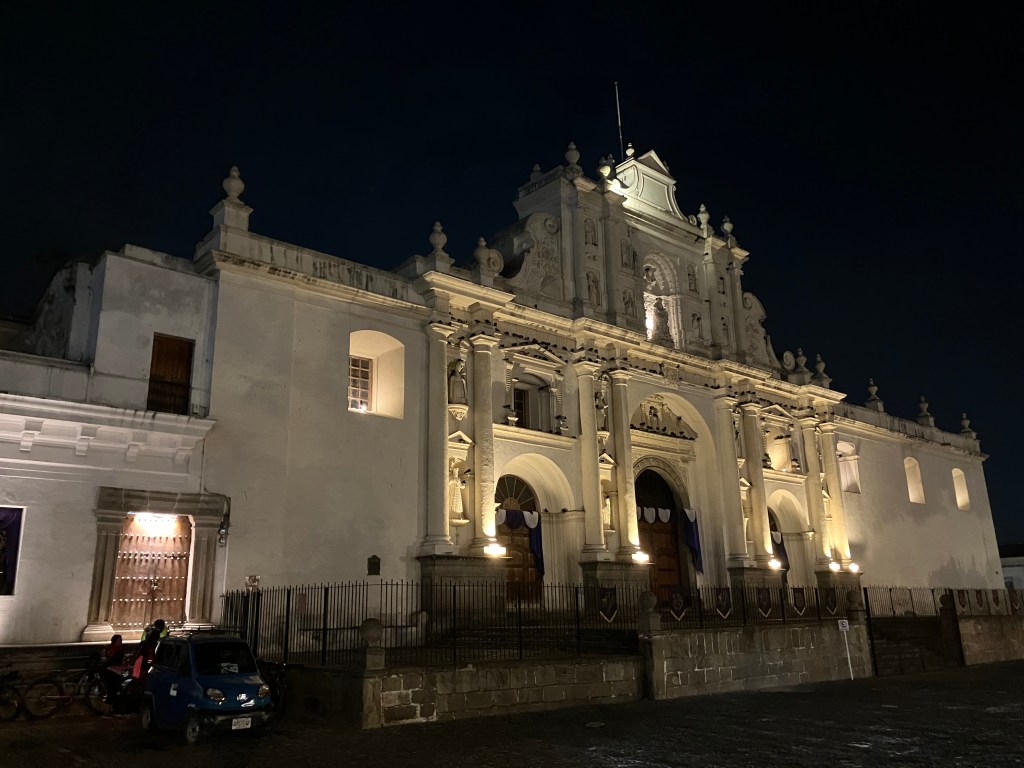
Catedral de Santiago Pre-Easter Procession

Easter decoration at San Jose church Outside, I followed a large procession as it moved through the glowing cobblestoned streets, flanked by colonial-era buildings, homes, and churches. A scarlet red banner with a gold crown was held high and proud. Three mask-wearing women wearing red robes and white aprons and carrying torches led the way. Several dozen people shouldered a large float, called an anda, as they swayed down the street. When a man or woman peeled off from carrying the float, they were immediately replaced, a sense of strong community with the burden shared by all. On top of the float was a statue of Jesus, in a purple cassock with a scarlet sash. Jesus is depicted as struggling beneath the weight of the cross. A sculpture of a winged angel was at the front of the float and a lamb at the back. A half dozen musicians with drums, cymbals, trombones, and horns announced their presence as they slowly walked and played while following the procession.
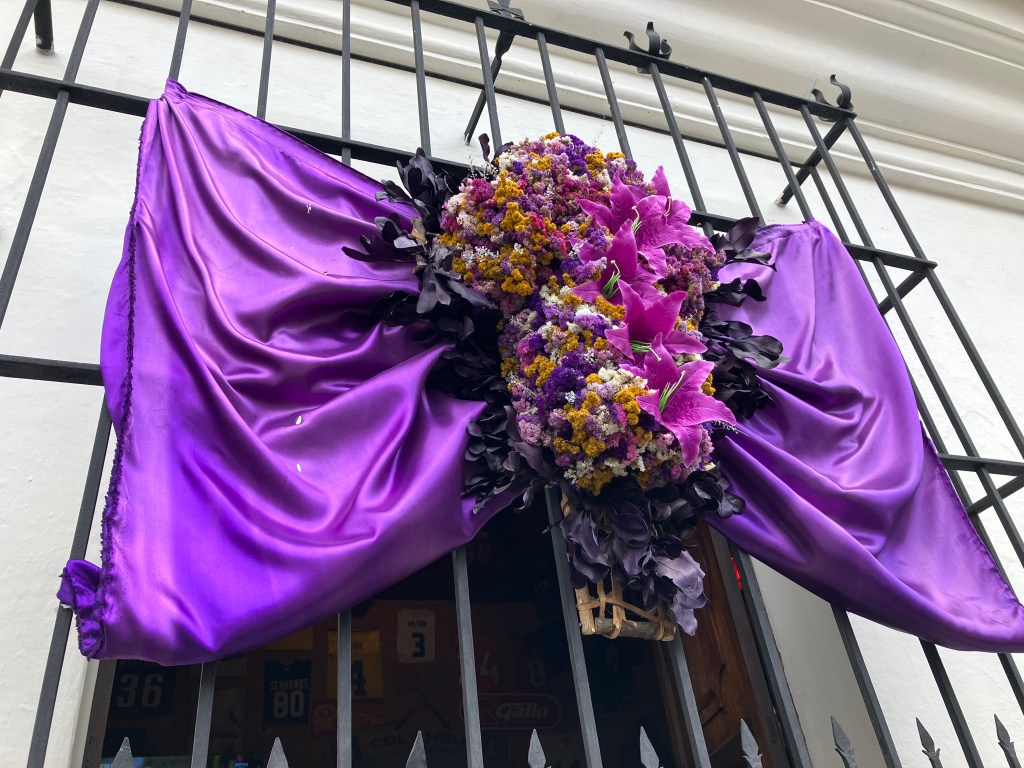
Easter decoration I trailed the procession to its endpoint, the Catedral de Santiago, built in 1545 and ruined in the earthquake of 1773. All that remains is the parish church of San Jose, in what used to be the front of the cathedral. At the entrance to the cathedral was an alfrombra, an elaborate carpet made of sawdust, pine needles, fruit, vegetables, and flowers. After the procession and the band entered the San Jose church, I looked at the ruins of the cathedral, pillars with no roof to hold anymore, carved angels that were meant to gaze down on congregations, looking at no one now, exposed to the elements.
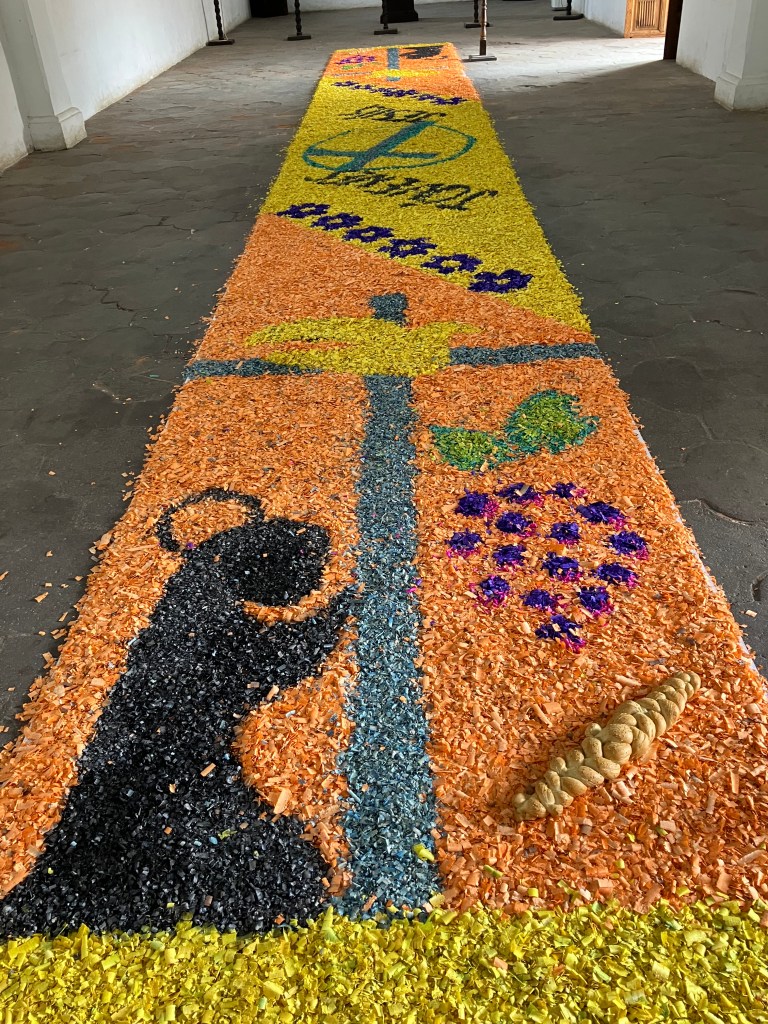
Decorative alfombra 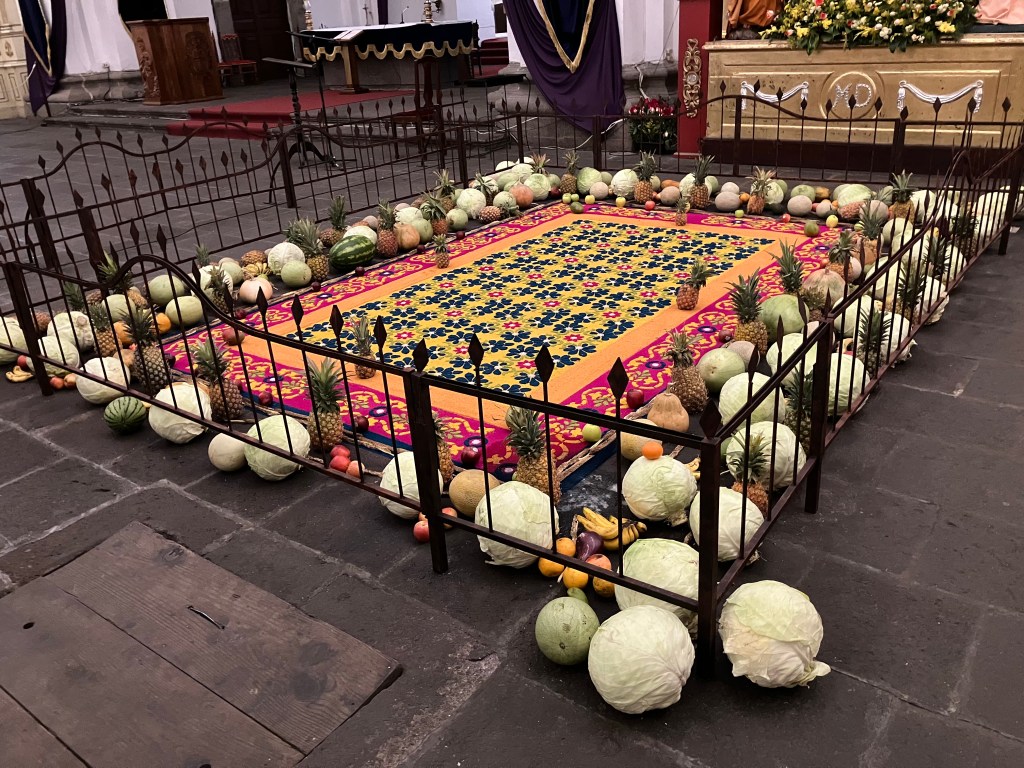
Alfombra Traditional Pastries from Antigua’s Oldest Pastry Shop

Dona Maria Gordillo pastries Pastries from Dona Maria Gordillo were a sweet way to start many of my days here. Founded in 1872, the traditional pastries it serves are astounding – light, nuanced flavors with varying levels of sweetness across the topography of each piece. I would get them packed in a box and devour them in the Parque Central.
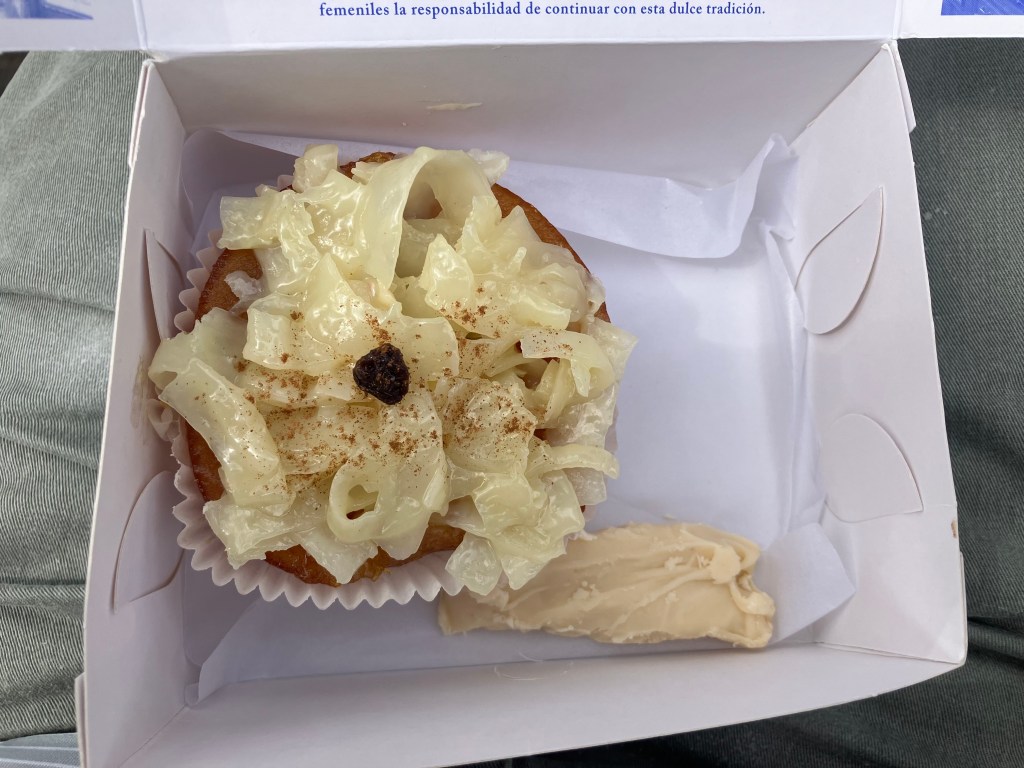
Delectable Dona Maria Gordillo pastry Parque Central – Social Nexus of Antigua

Jacaranda trees in bloom at Parque Central Jacaranda trees in bloom dropped purple petals onto the footpaths of Parque Central. Birds of Paradise with colorful, pointy beaks lined the flowerbeds. I sat near the central fountain where water streamed through the fingers and breasts of sculptural depictions of nymphs. Surrounding the plaza were some of Antigua’s finest colonial edifices. The Catedral de Santiago — the San Jose church part of it — was on one side, the elaborate white façade dotted with sculptures overlooking the plaza. The ruins weren’t visible from here.
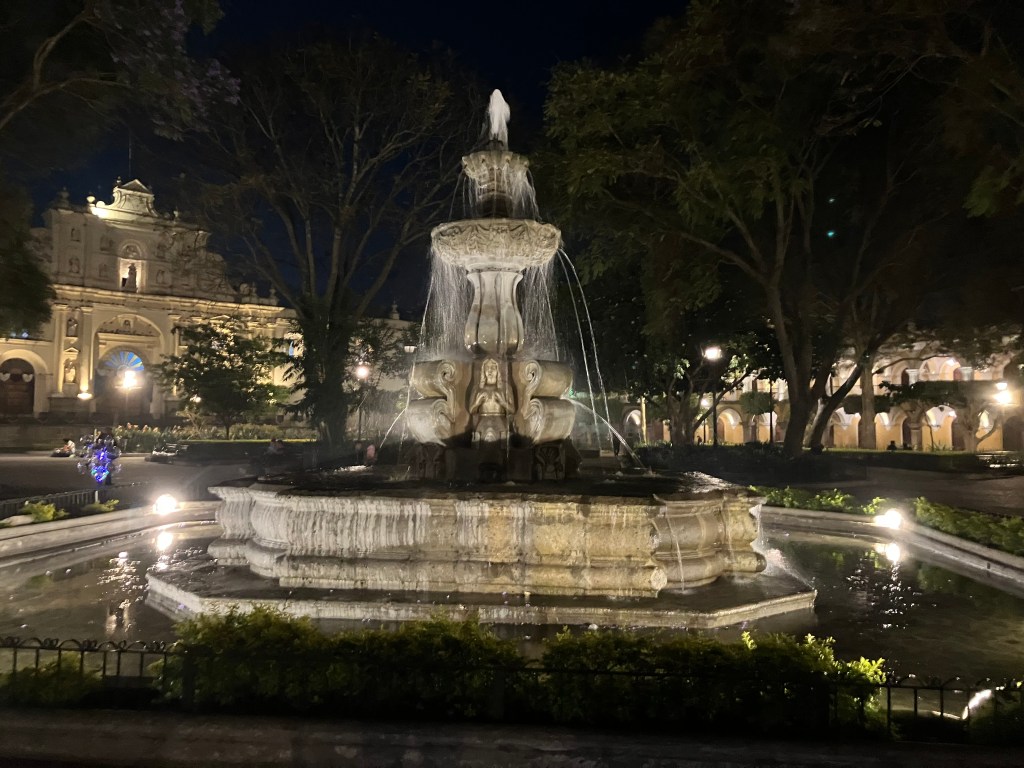
Parque Central during evening 
Water bearing nymphs The imposing Palacio de los Capitaines de los Generales was on another side. Built in 1549, it was once the capital of all of Central America. It is now a mind-blowing art museum known as MUNAG, Museo Nacional de Arte de Guatemala. The building itself is a UNESCO World Heritage Site. I spent several hours here seeing art from pre-colonial to the colonial era and to the Republican period. The stunning art pieces were beautifully displayed. I had a coffee at the Café Condesa at the Antiguo Colegio de la Compañía de Jesus, occupying another side of the plaza. I noticed that people at the café were more interested in each other and the people watching than their phones. The building was built in 1626 as a Jesuit monastery and college until the order was expelled in 1767. Six years later, the building was ruined in the 1773 earthquake. Now there are shops, cafes, and a cultural center.
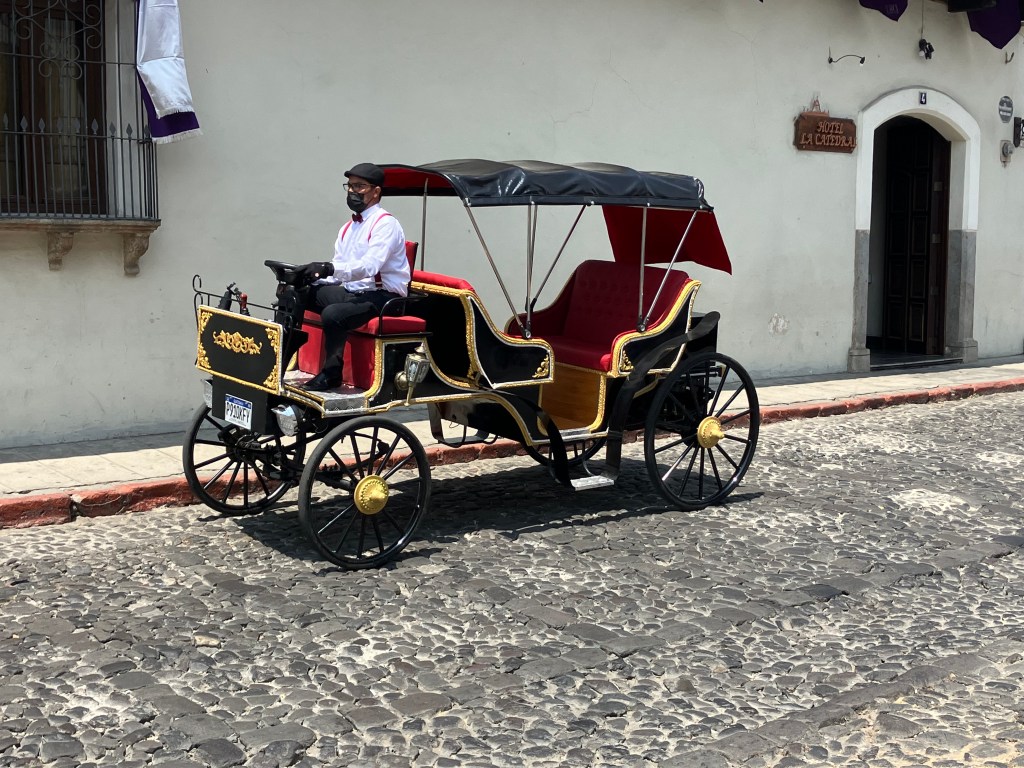
Nostalgic carriage ride 
Corridor along Parque Central I strolled past the 18th-century Palacio del Ayuntamiento to the Arco de Santa Catalina, built in 1694. This arch is perhaps Antigua’s most iconic monument. When you look through it, you can see one of the three volcanoes that surround Antigua, Volcan Agua. At any time of day, groups or individuals, from proud brides to friends proud of each other, are posing in front of it.
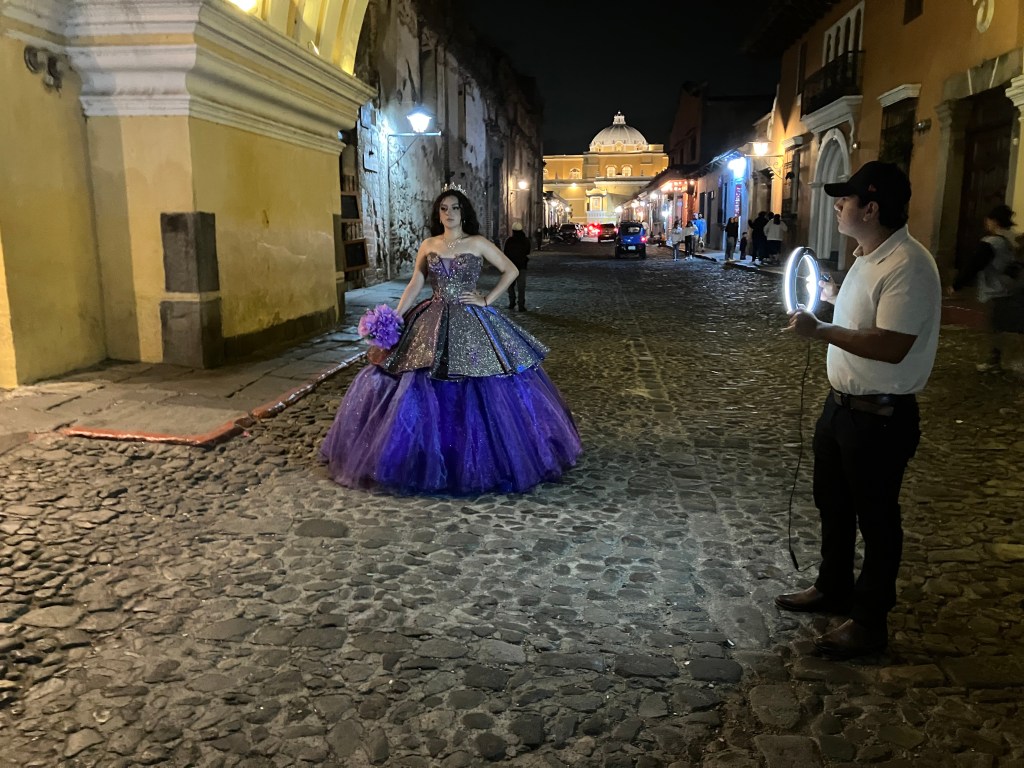

Arco de Santa Catalina Maya Stews from Ancient Recipes

La Cuevita de los Urquizo restaurant For lunch, I liked to eat Maya stews at La Cuevita de los Urquizu. Large earthenware pots contained Pepian Chicken (chicken and veggies in a piquant pumpkin seed sauce), jocon (green stew with herbs and chicken with tomatillos), kaq’ik (turkey stew), and other dishes I didn’t know the names of. It was a feast. And I was the only foreigner in the restaurant.

Breakfast at traditional restaurant 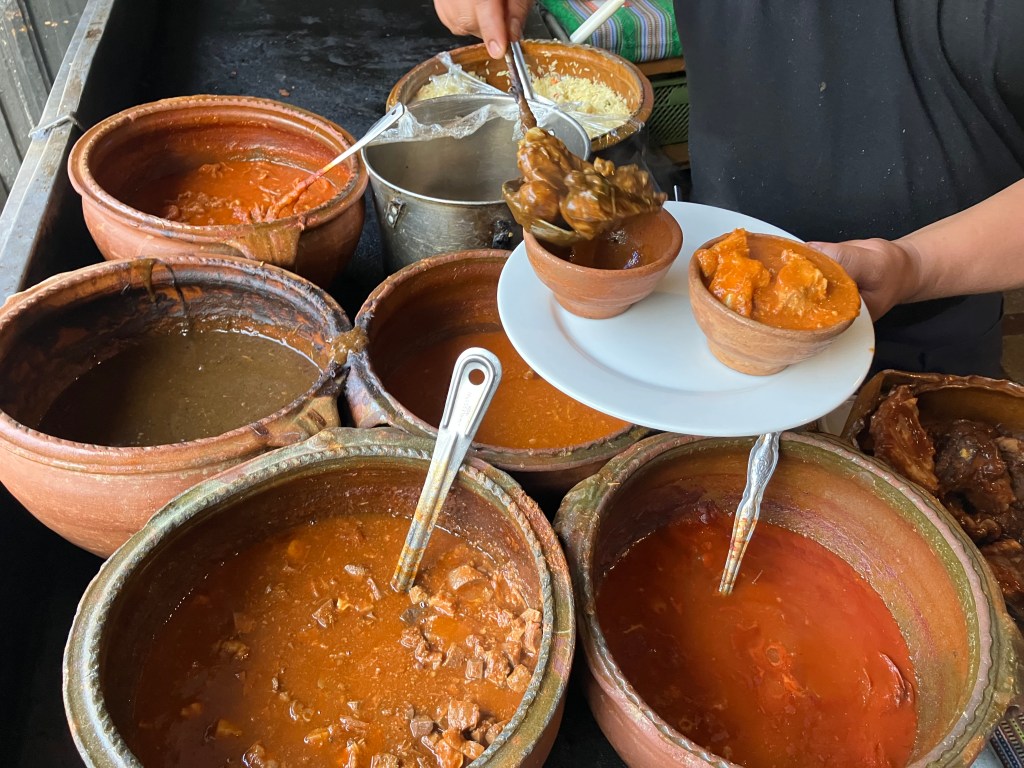
Maya stews Guatemala History, Art and Culture on Display in Museums
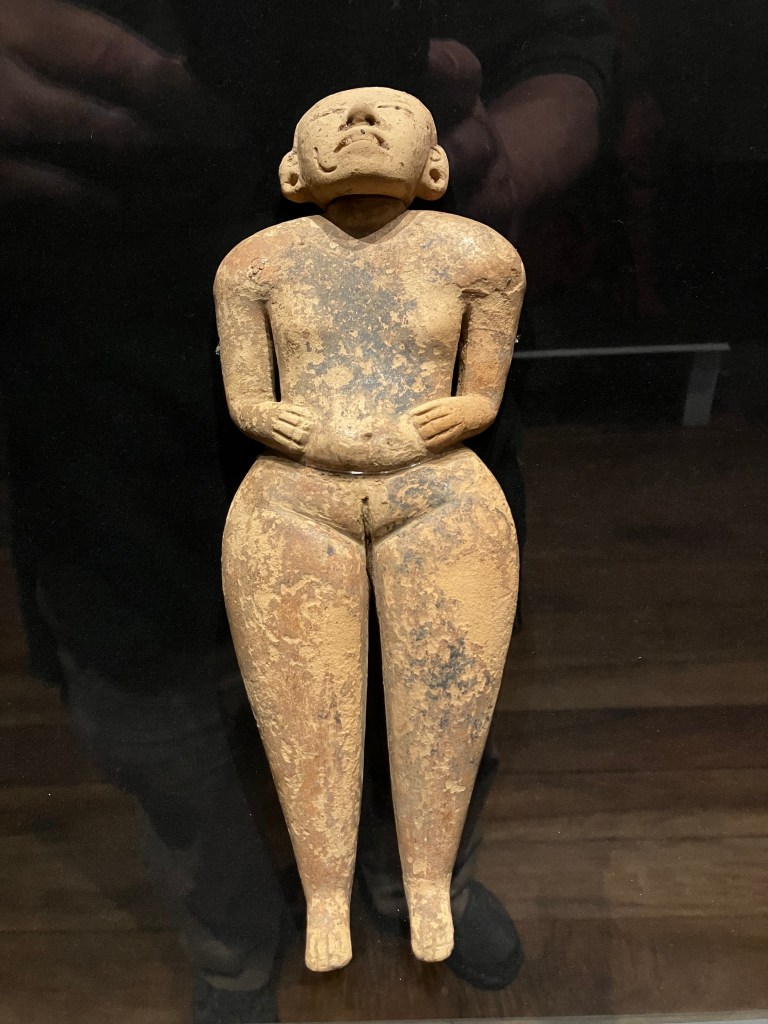
Maya art at MUNAG Antigua has some great museums. The Iglesia y Convento de Santo Domingo was a monastery founded by Dominican friars in 1542. Buildings on the site were rummaged for materials after the earthquake of 1773. The haunting ruins and restored buildings now house six museums: stunning silverwork at the Museo de Plateria; 16th-18th paintings and woodwork at the Museo Colonial; Maya stonework and ceramic at the Museo Arqueológico; Maya art juxtaposed with modern pieces at the Museo de Arte de Precolombino y Vidrio Moderno; traditional Antigua handicrafts at the Museo de Artes y Artesanias Populares de Sacatepequez; and a restored 19th apothecary shop at the Museo de la Farmacia. There’s also the ruins of the monastery’s church, candle and pottery maker workshops, and the Calvary Crypt, which houses a 1683 mural of the crucifixion. All of these museums and ruins are now part of the grounds of the atmospheric Casa Domingo Hotel, where I took well-needed breaks over coffee while working my way through the museums.
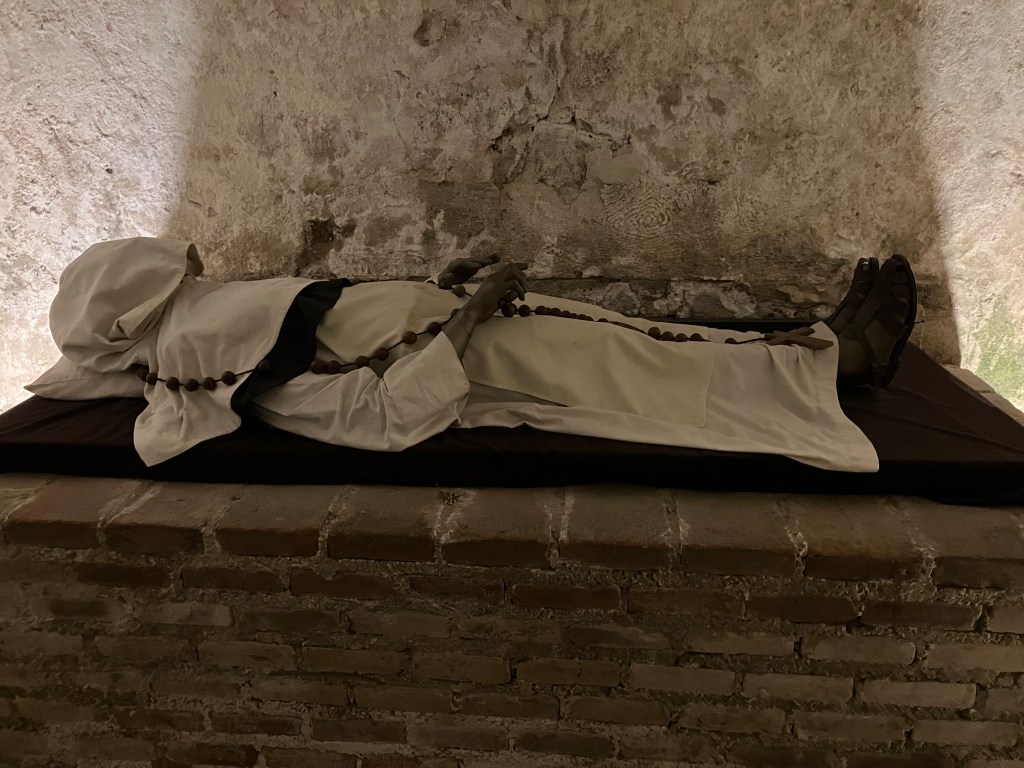
Crypt sculpture of monk being readied for burial Colonial-era Churches Provide Spiritual Depth
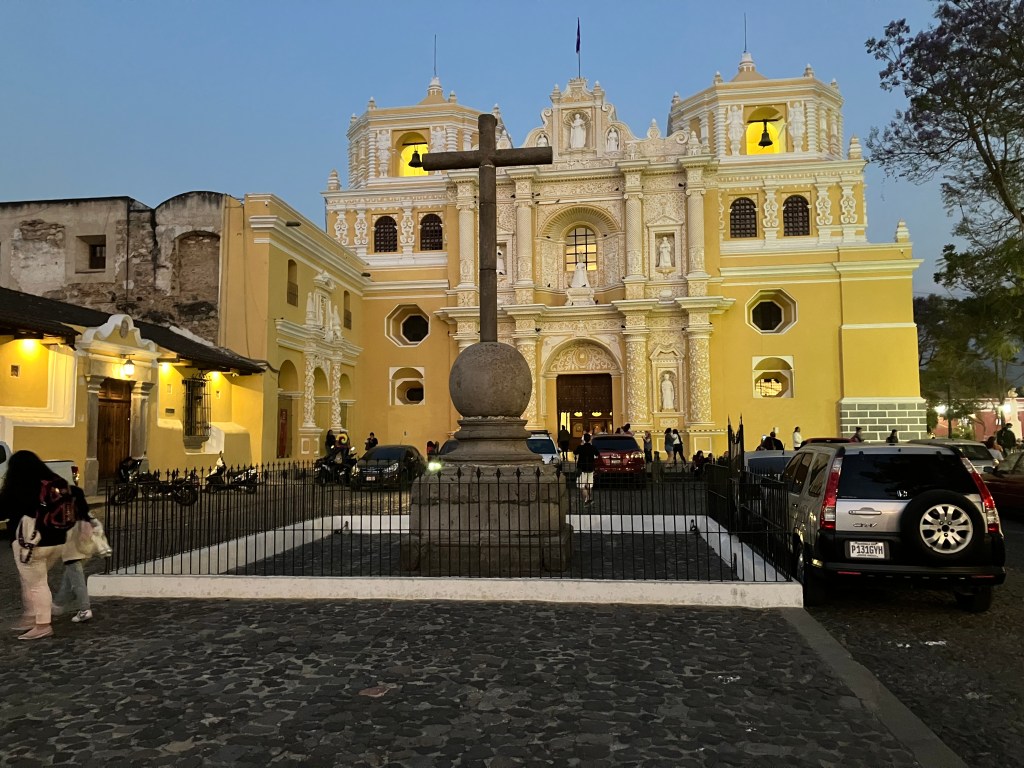
Iglesia Merced Antigua is of course, famous for its colonial-era churches — intact as well as ruined — that provide spiritual depth to the city. Iglesia Merced, built from 1749 to 1769, was built with the thick earthquake-proof walls similar to the baroque churches in the Philippines. It’s a vibrant religious destination in the city.

Convento de Capuchinas At the Convento de Capuchinas, renovated after the 1773 earthquake, I got a sense of how the nuns lived. I strolled past an indigenous woman wrapped in colorful fabrics, through the markets where fruits and vegetables shimmered in the bright, though opaque light. At nearly every turn, one of Antigua’s looming volcanoes – Agua, Fuego, and Acatenango – stood sentinel-like, serene, almost omniscient in their quiet force.
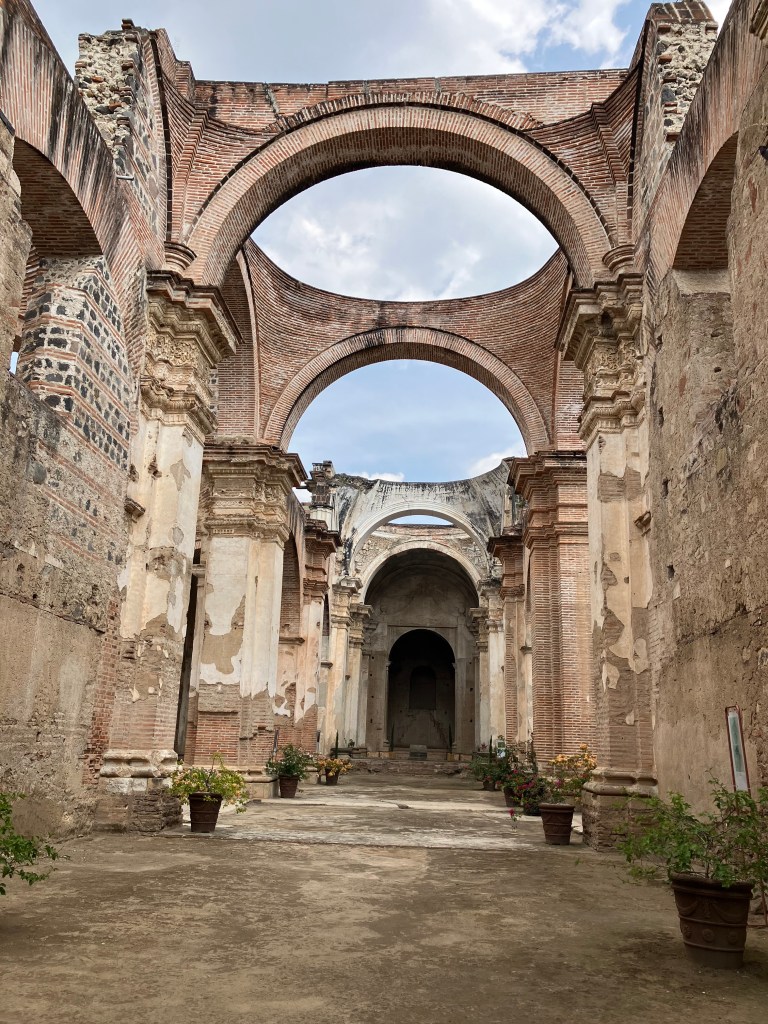
Ruins of Catedral de Santiago Ruins from the 1773 earthquake, combined with partial repairs and renovations such as those at the Colegio de San Jeronimo and Iglesia y Convento de la Recoleccion, gave Antigua a haunting beauty that is both timeless and stuck in time. It wasn’t the spic n’ span over-polished look that some colonial-era cities have.

Sculpture of angel at Catedral de Santiago A Vibrant Nightlife
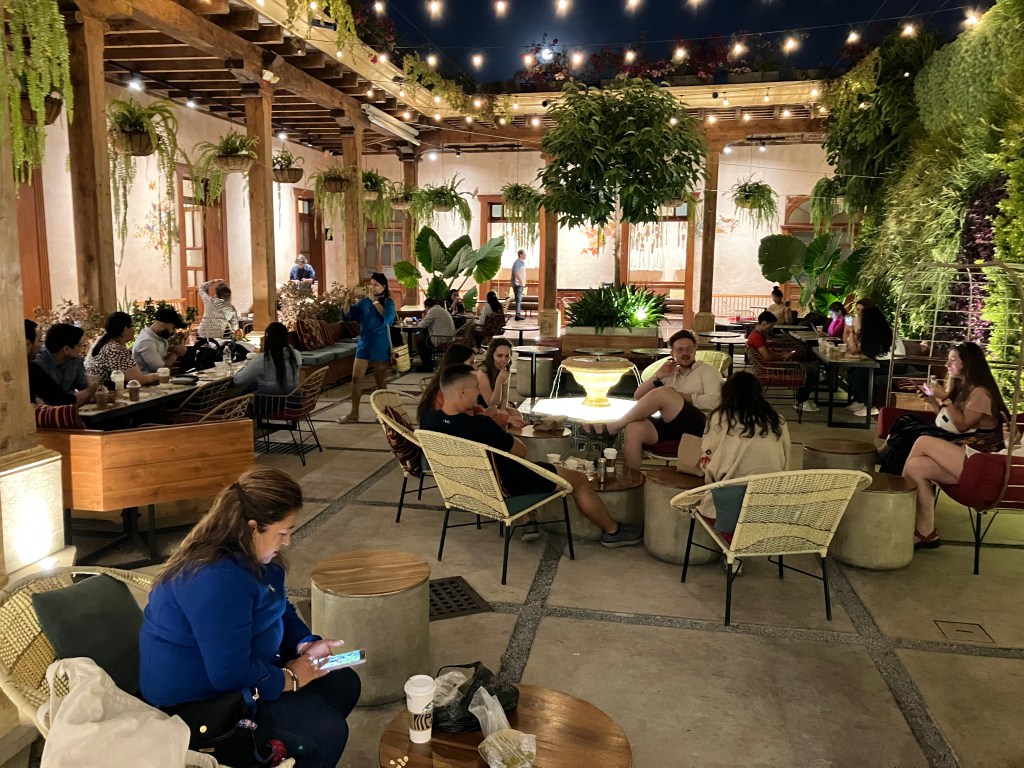
Best Starbucks ever Antigua surprised me by having a really lively nightlife. Even Starbucks was a truly stylish hangout here. On the weekend, partygoers from Guatemala City, just an hour or so away, crowded into the city — and then into the bars and nightclubs. The restaurants and bars were north of Parque Central. After a few bottles of Moza beer, I slipped off a stool and headed back for the night.
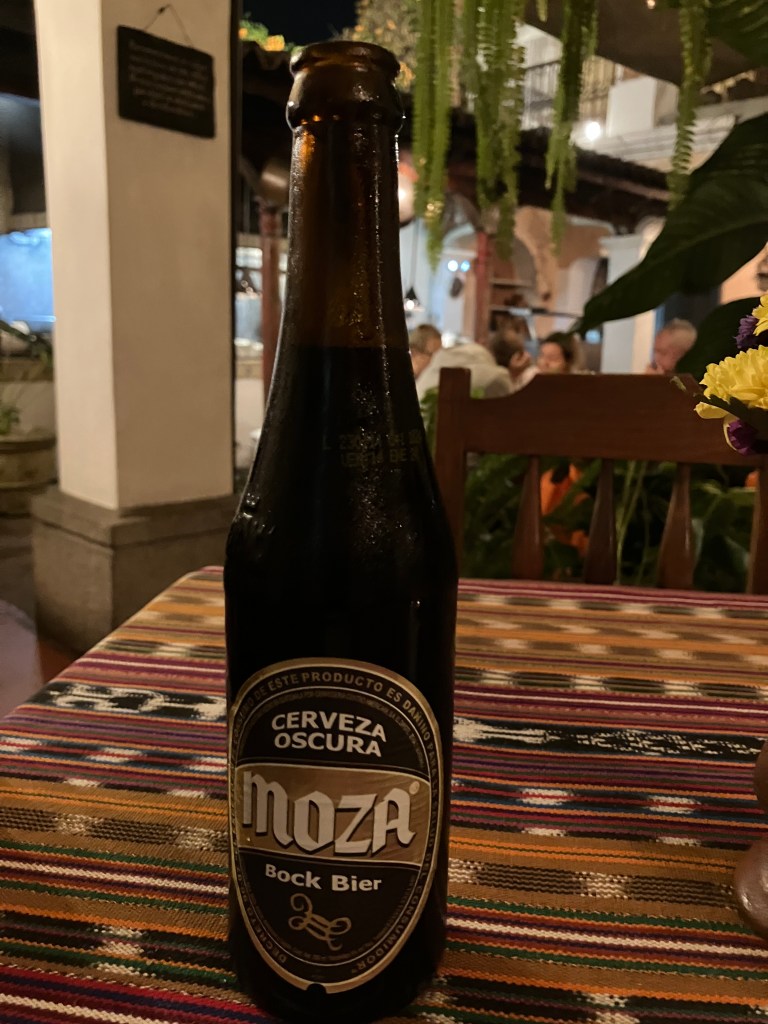
Cerveza Moza Post-Sunset Fairytale Ambiance
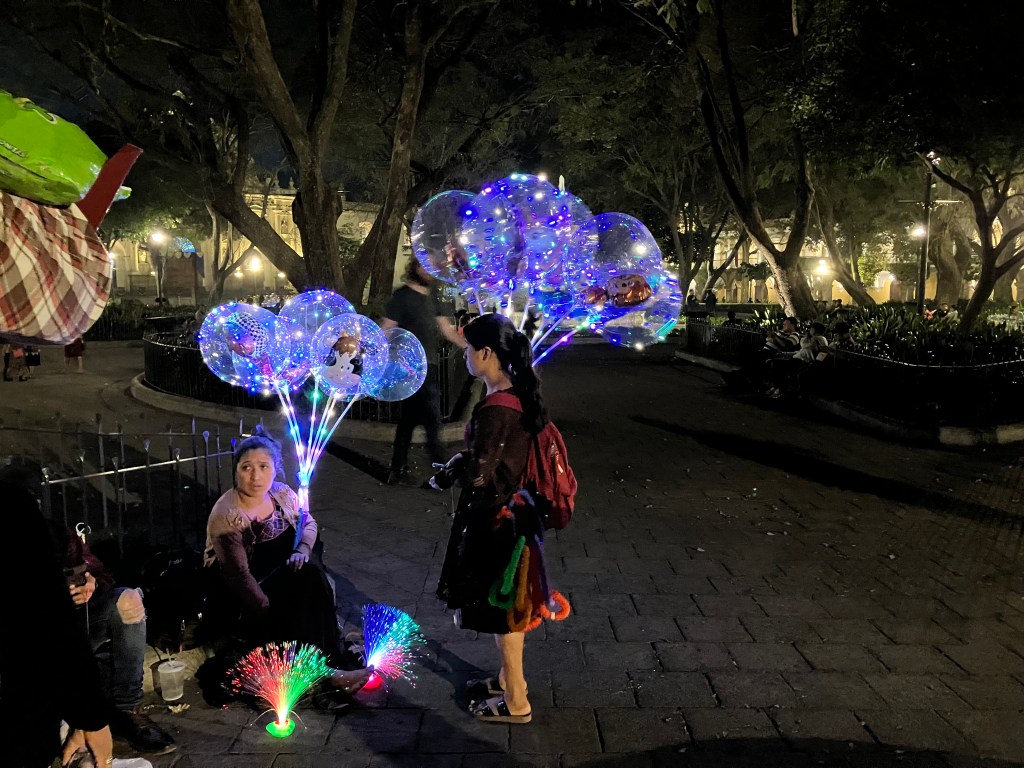
Selling fairytale balloons I passed a woman in Parque Central, selling sparkling purple balloons that provided a fairytale-like ambiance to the post-sunset city. On my walk down the empty cobblestoned streets, soft echoes trailed me at every step. At the simple, elegant Hotel San Jorge by Porta I knocked on the heavy wooden door and was let in by the receptionist. I sank into a chair by the courtyard and let the crisp mountain air envelop me. Antigua, I decided, wasn’t just a city to see but a city to help you see yourself — ruminations via ruins.

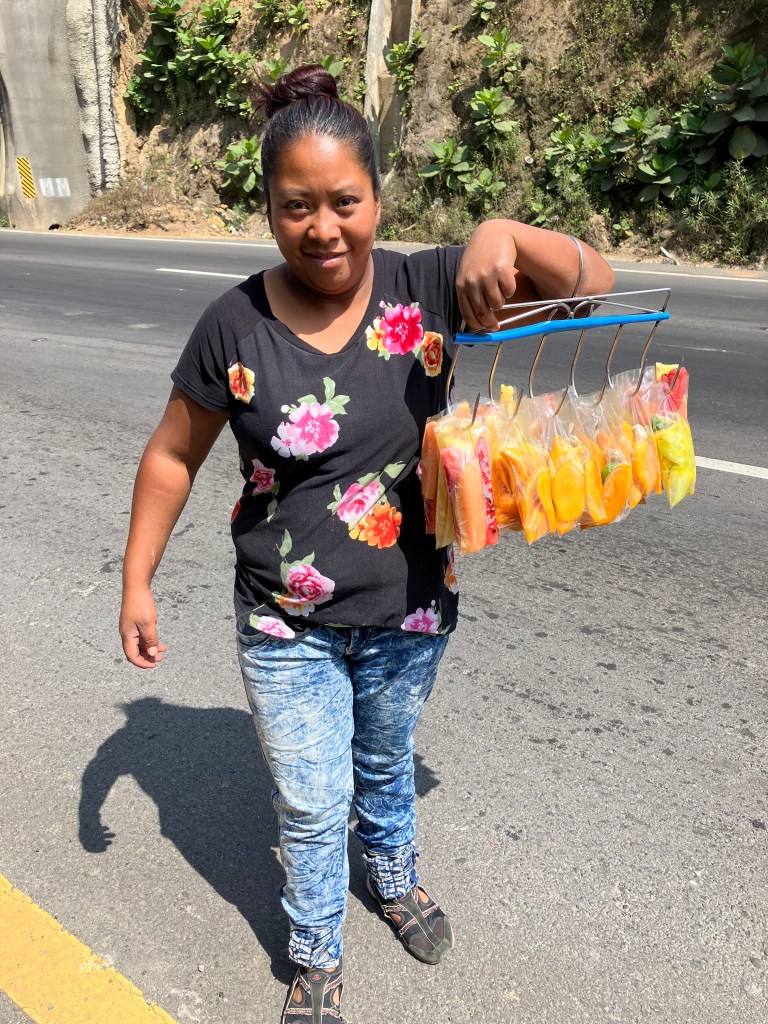
Fruit seller on Pan American Highway 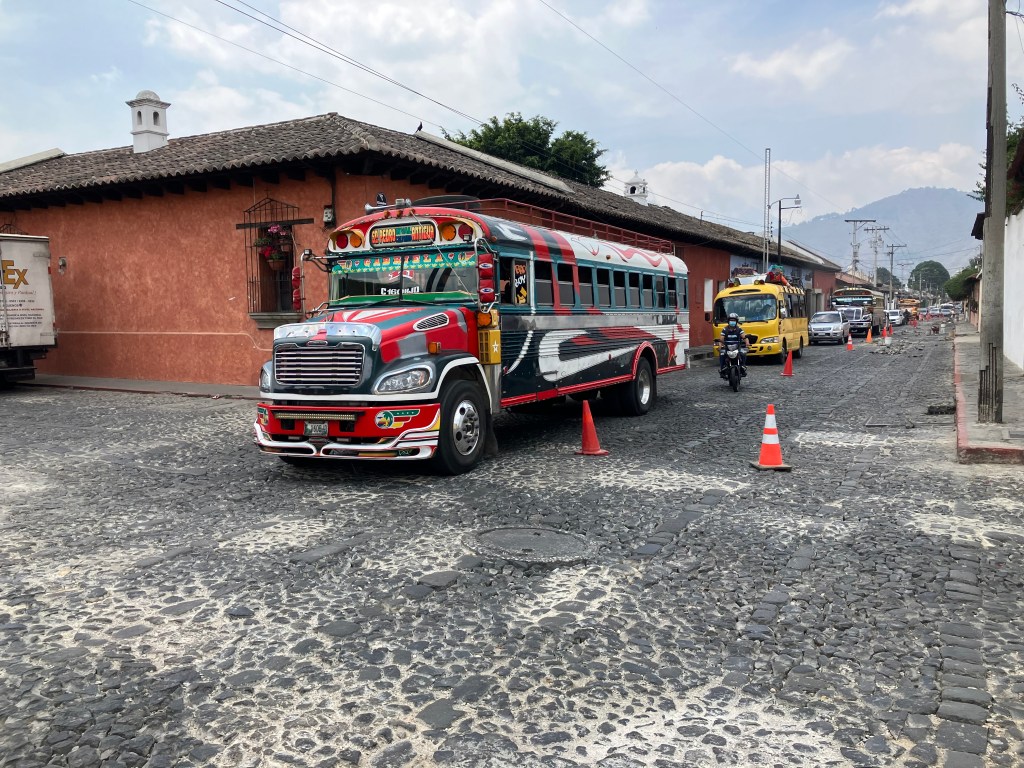
Colorful bus 
Tiny taxis -
Guatemala: from BC to B.E. (Before Easter)(con’t)
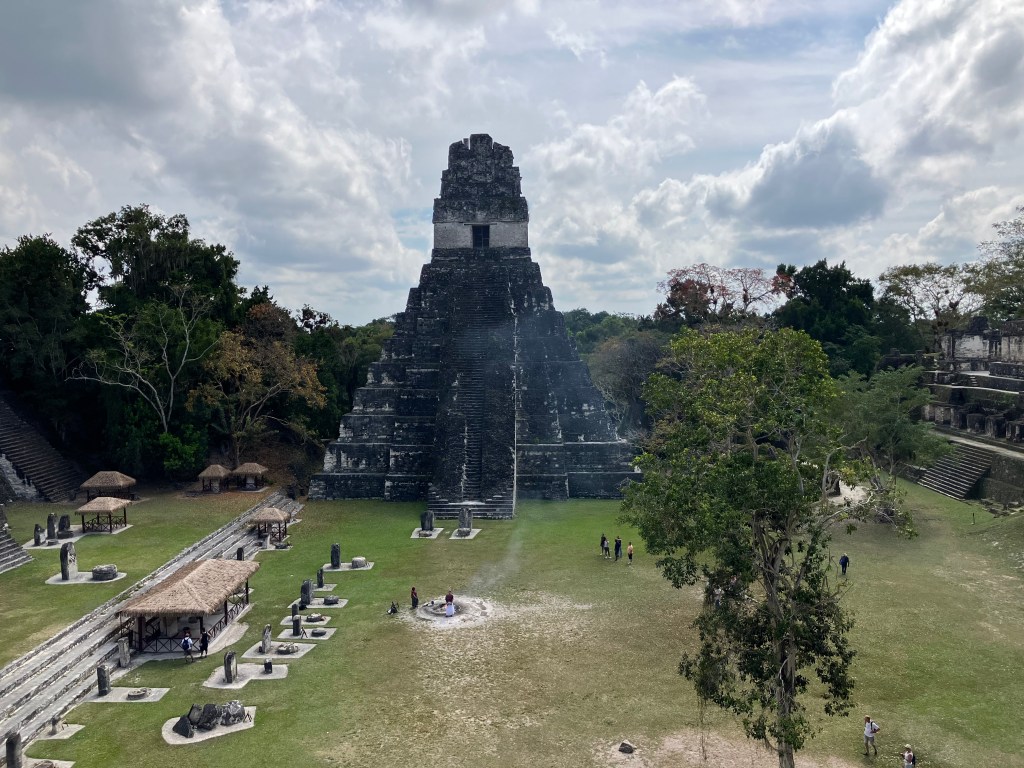
Gran Plaza from Templo II Tikal: Ruins of an ancient Maya kingdom

Templo II at Gran Plaza I’ve wanted to visit Tikal for decades. When I lived in Asia for 27 years, it was always too far away — until I moved back to this hemisphere. The city started its journey in 700 BC and built its monumental temple complex, Acropolis del Norte, by 200 BC. By 250 AD, Tikal was the center of power in the Maya world, which was spread throughout Central America into Mexico. Its population peaked at 100,000 in the mid-6th century before its mysterious collapse around 900 AD. The 10,000 buildings over 30 square kilometers on the site started to succumb to the jungle and decay until a Guatemalan government expedition discovered the site in 1848. Even today, much of it remains untouched, buried, and covered in jungle. If the mystery and magic of ancient ruins are your thing, this site will send chills down your spine.
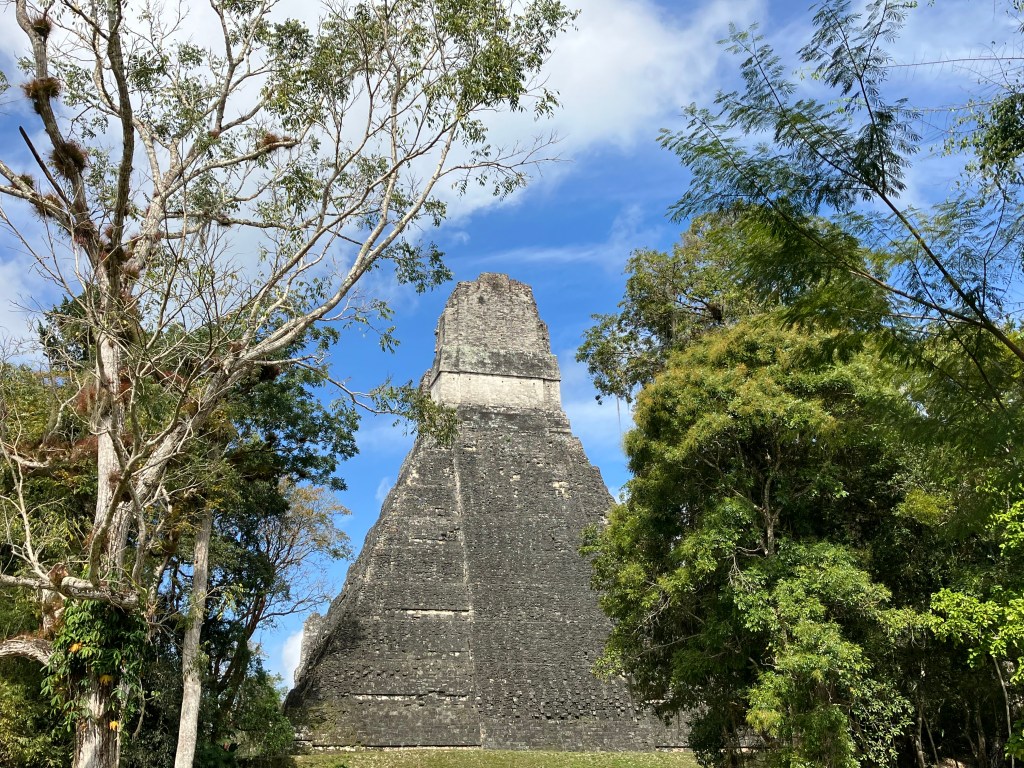
The back of Templo I Screams of Howler Monkeys

Elusive howler monkey When our van drove through the gates of the park, we were greeted by the piercing screams and grunts of howler monkeys. Howler monkeys can make sounds that travel miles, at up to 140 decibels. It’s a piercing and unnerving sound. It’s also a little like entering a Jurassic Park movie.
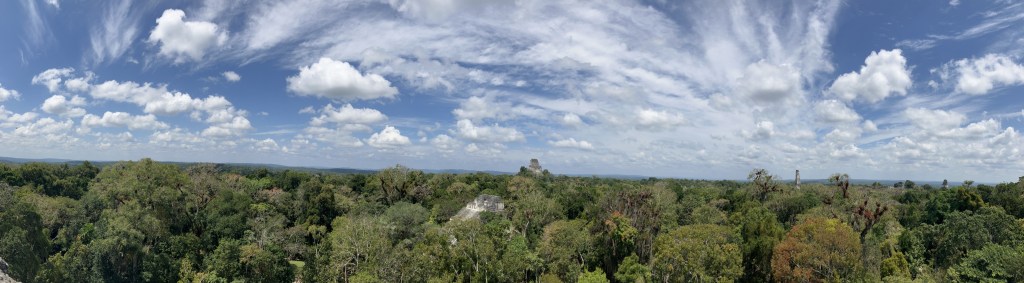
Jungle still rules at Tikal Because of the relative lack of tourists, it’s easy to soak in the atmosphere of this UNESCO Heritage Site, explore the ruins without crowds at all, and in some places without people at all.

Pyramids emerging from jungle Gran Plaza at heart of UNESCO Heritage Site

Long way up Templo I I felt a sense of anticipation when I approached the towering pyramids of the Gran Plaza. The Temple of the Grand Jaguar (Templo I), where King Ah Cacao is supposedly buried beneath layers of the pyramid, faces the Temple of the Masks (Templo 2). I climbed the Temple of the Masks for a view of the Gran Plaza, the Temple of the Grand Jaguar, and the Acropolis Central, a warren of ruined palaces, courtyards. This complex was completed between 740 AD and 800 AD. Between the chirping of the birds, the distant screams of howler monkeys, a languid breeze drying my sweat, I settled in to absorb and observe. In the plaza, a local woman was performing a Maya ceremony at a fire pit with a Caucasian woman. Their solitary intensity permeated the scene.

Maya ceremony in Gran Plaza At the Acropolis Del Norte was a monumental carved stone mask that glowered from a wall. It was over three meters high. It provided a sense of the drive and ambition that fueled the growth of this civilization. I could easily see the citizens of this Maya city intimidated when they stood in front of it.
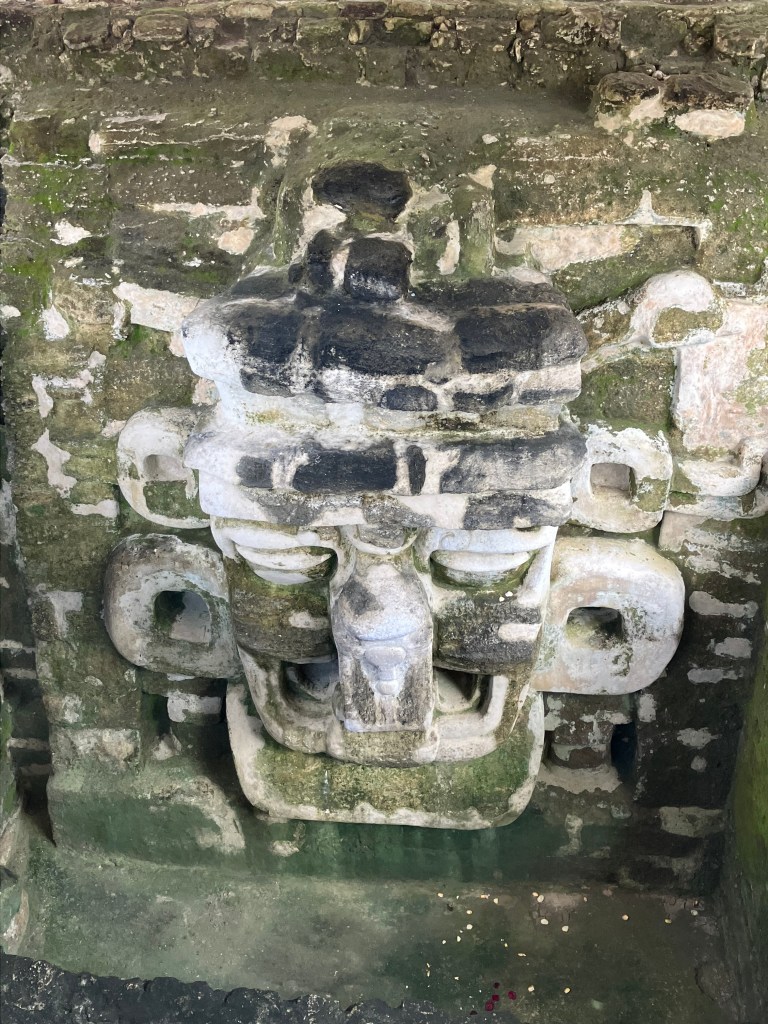
Monumental mask South of the Gran Plaza, I turned a corner on a forest path and saw Templo V emerge as a solitary temple, sentinel-like, dominating the foliage around it. It was built between the 7th and 8th centuries AD and is 57 meters high. The chance to see a structure without crowds gave me a chance to feel its majesty — and to wonder what it was like with crowds of the apex of the city’s power.

Templo V Entering the Mundo Perdido, the Lost World
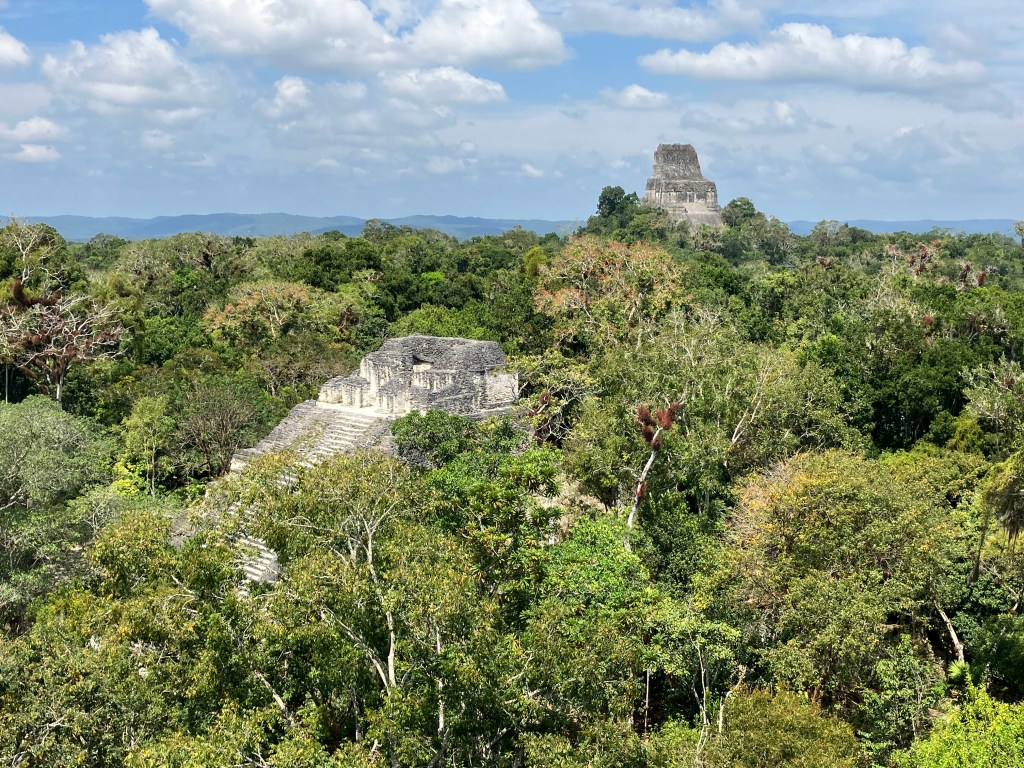
View from Mundo Perdido pyramid From there, I walked to the Mundo Perdido, the Lost World. A few dozen structures surrounded a huge pyramid, 32 meters high and 80 meters around the base. I climbed to the top for a stunning view of the ruins. Nearby was Templo IV, at 65 meters the highest temple in Tikal and the second highest pre-Columbian building the Western Hemisphere after La Danta in the ruins at El Mirador.
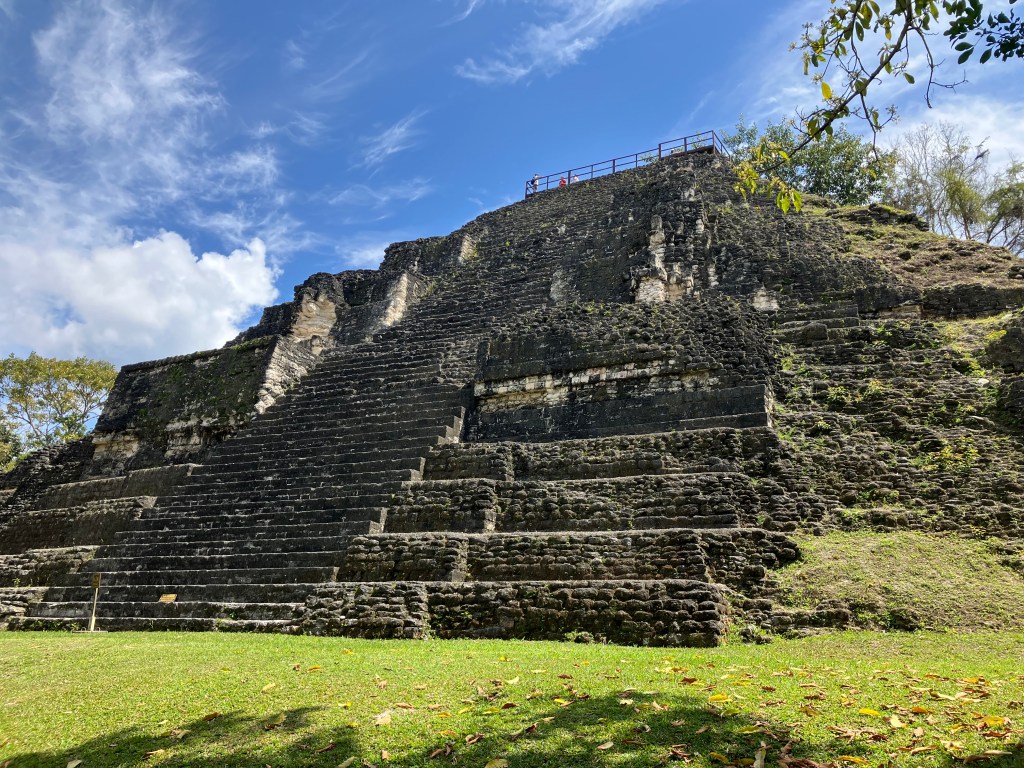
Mundo Perdido pyramid 
Vertigo at top of Mundo Perdido pyramid Tikal is well-explored, with widely visited ruins. But there are other Maya ruins in Guatemala, more remote, very difficult to reach. El Mirador, also located in the El Peten province of Guatemala, can be reached via a 5-day, 83-kilometer hike through jungle. Or, if money is no object via helicopter from Flores. El Mirador is more expansive than Tikal, across a larger area, with larger pyramids. Historically, it is considered the most important Preclassic period ruins. Tikal’s ruins, in contrast, span from the Preclassic to Classic to Postclassic periods.

Temple IV from Mundo Perdido 
Templo IV, Tikal’s highest pyramid emerges from foliage 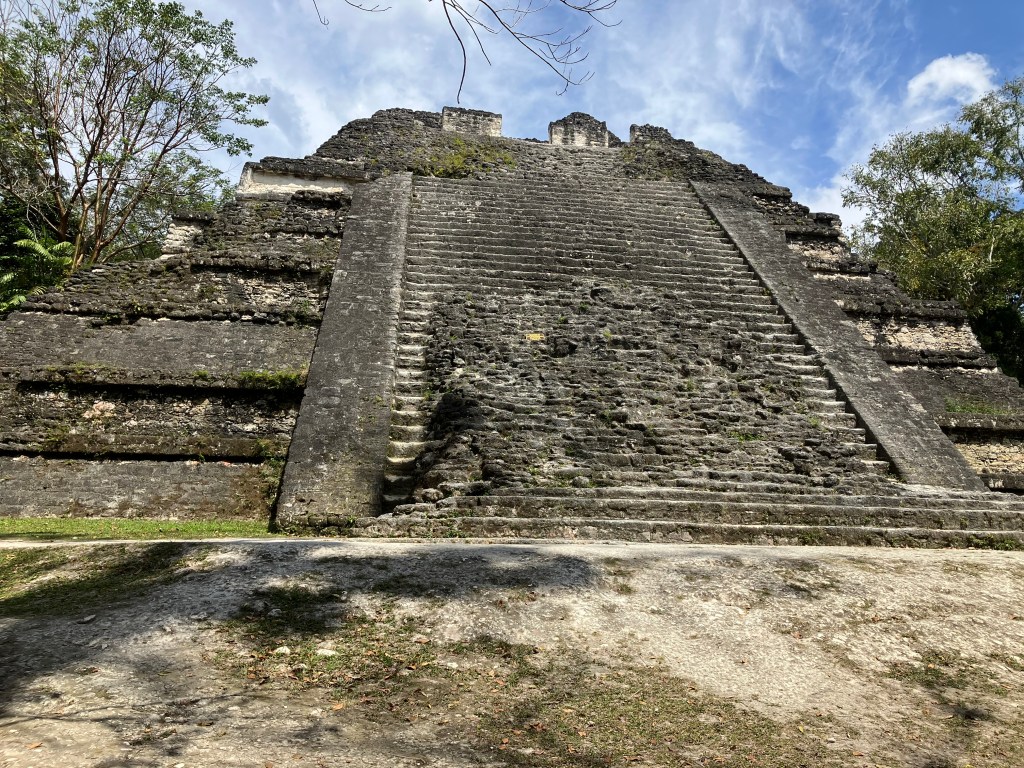
Tikal pyramid Mundo Perdido I came across a line of stone stela with indecipherable writing and reliefs that had been worn down with time. Above them loomed a ceiba tree, the Maya tree of life. But the life that was lived here has long since disappeared. The rulers that reigned here had fearsome names: Dark Sun, Moon Double Comb, Yax Kin to name a few. Their power was absolute until time and the tides of history swept their civilization away, where you needed machetes, shovels, and pickaxes to uncover it.
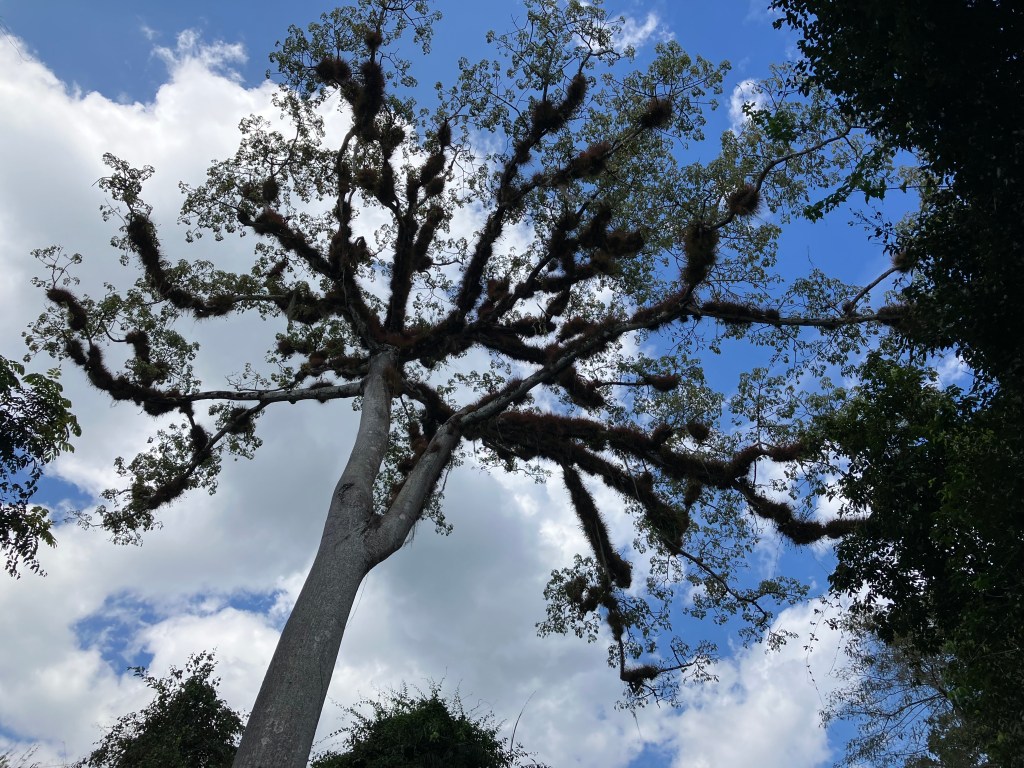
Ceiba tree 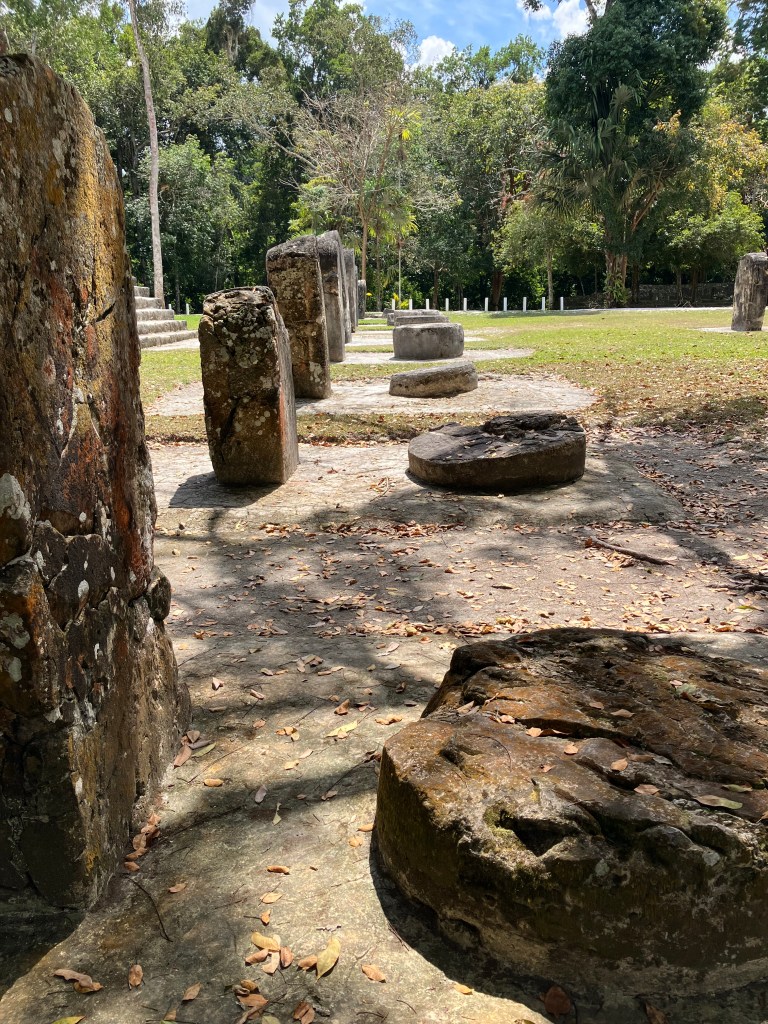
Stone stela Birdlife overtakes human civilization
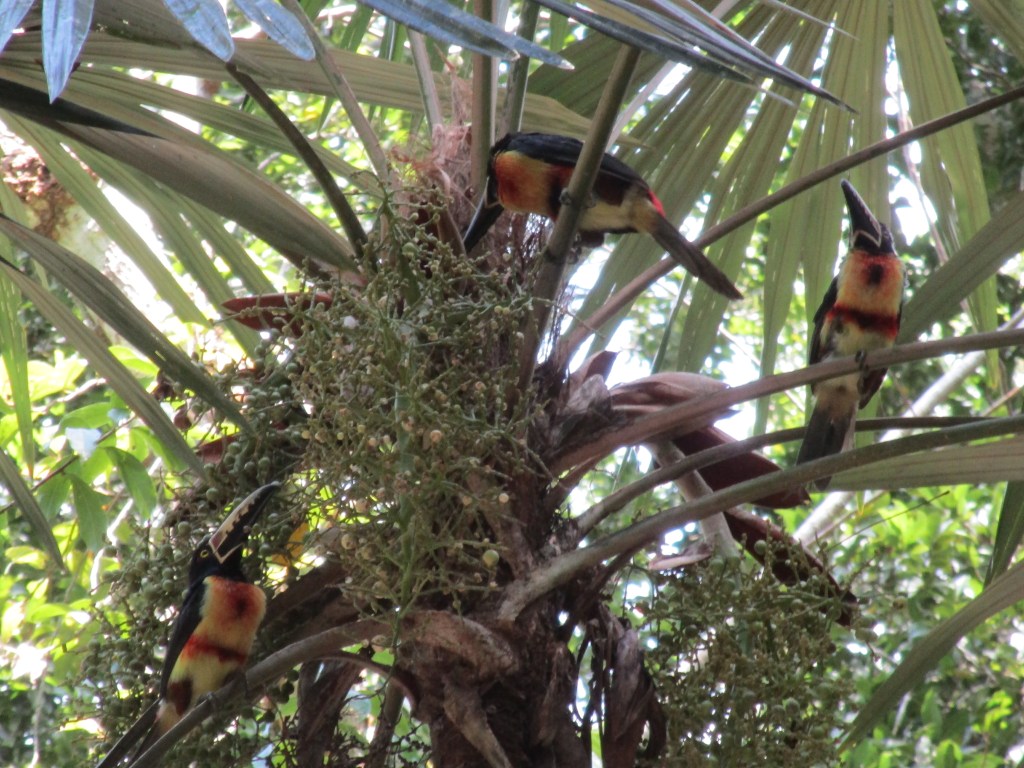
Toucans in a tree 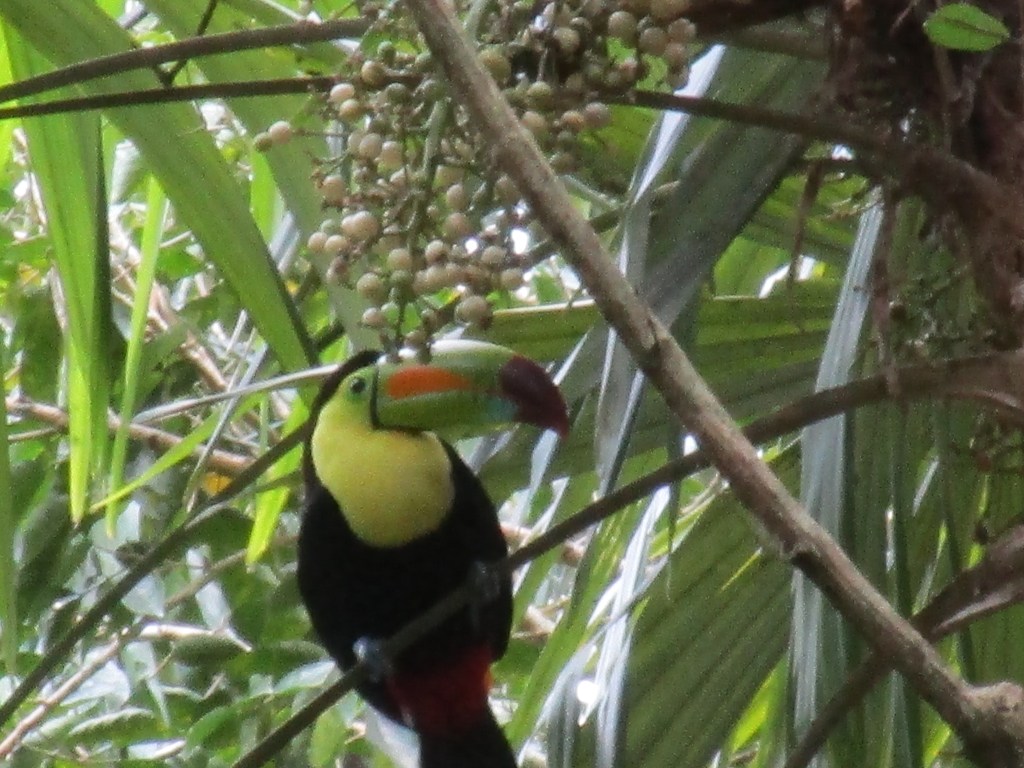
Toucan 
Tree ravaged by woodpeckers My visit ended by focusing on the rich birdlife and their incessant chirping amidst the distant screams of the howler monkeys. Toucans, Ocellated turkeys, parrots, shrikes, herons, and the woodpeckers who left ravaged trees and trunks in their wake. Underfoot, I watched to avoid streams of relentlessly marching army ants. Humanity might have been the dominant force here once, but nature was now. As I passed through the pyramid-shaped archway on my way out of the park, I brought with me thoughts of how Tikal stretched over 1,000 years with wars that were devilish and a civilization that reached a divine peak — for a time. Just a time.
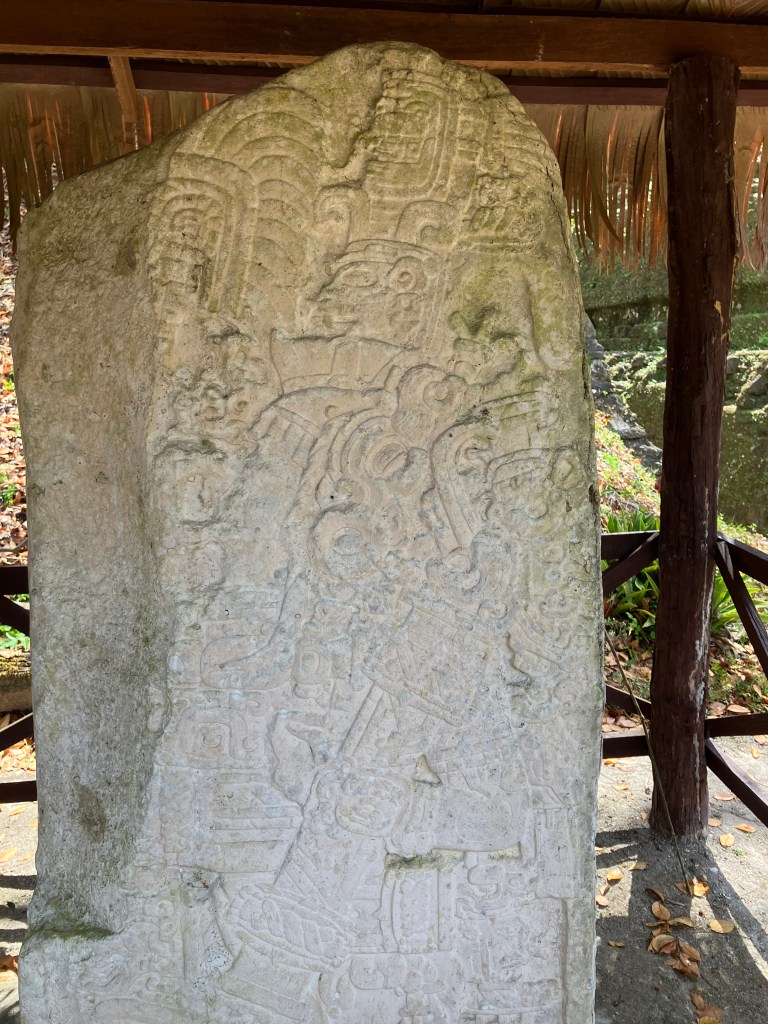
Maya king depicted on stele 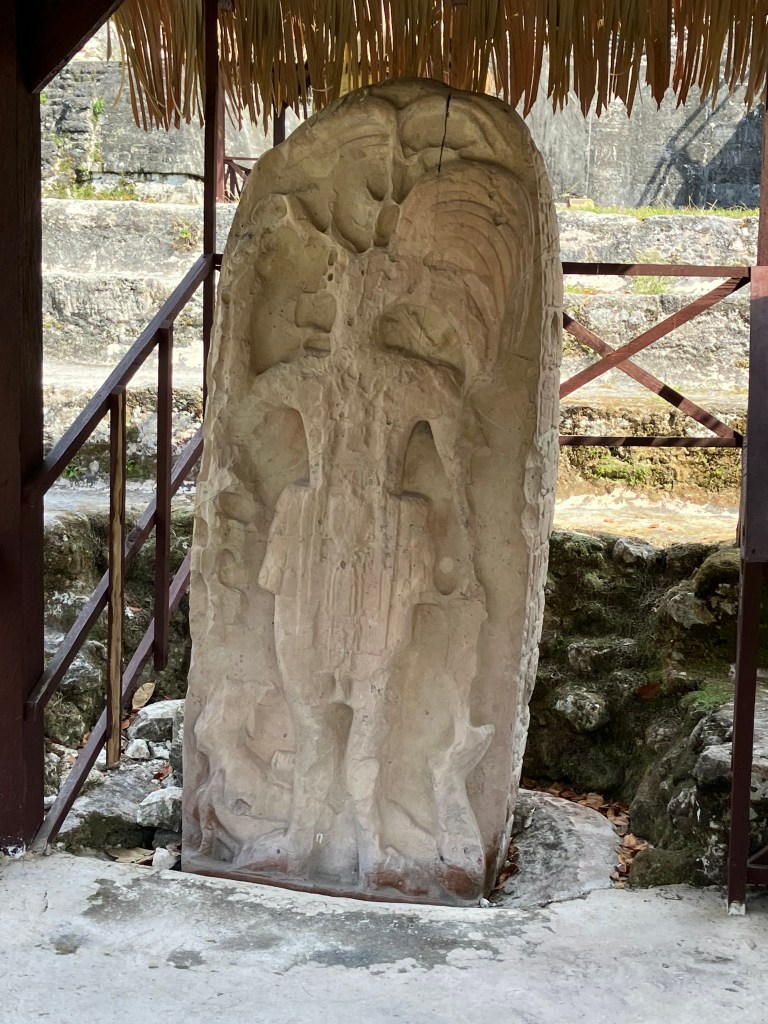
Depiction of Maya king on stone stele 
On Templo II 
Templo I 
Maya goddess of fertility, Ix Chel -
Guatemala: From BC to B.E. (Before Easter) (continued)
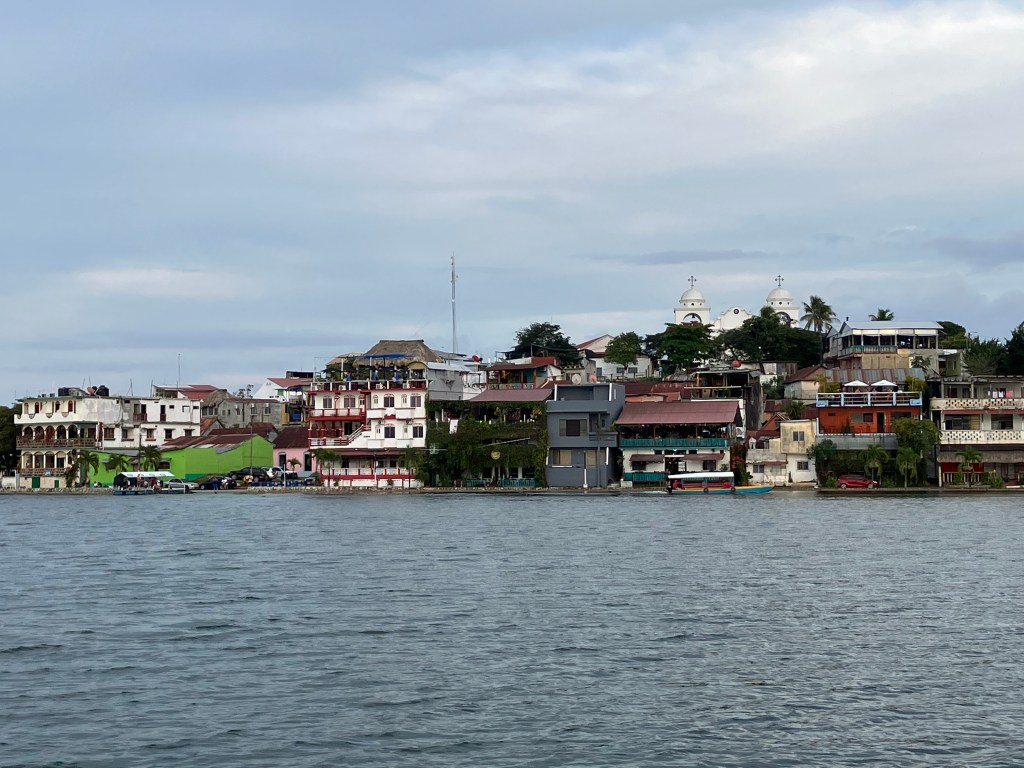
Flores Flooded Flores: Gateway to Ancient Maya Sites
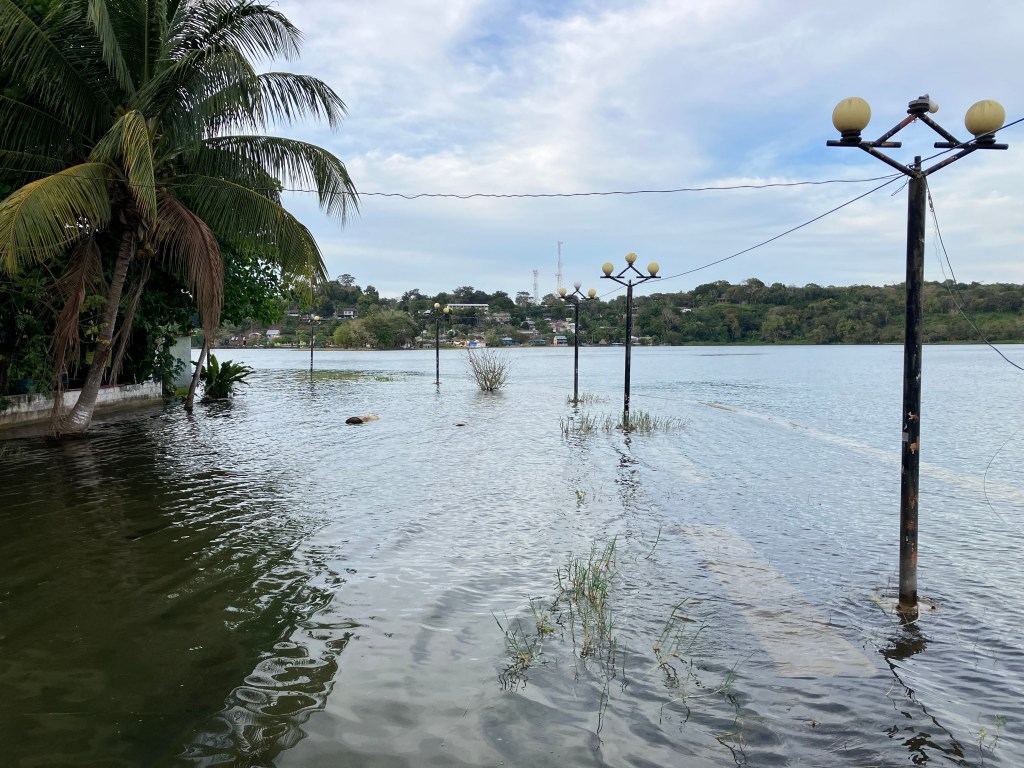
Flooded promenade Flores I’ve wanted to visit Tikal for as long as I can remember. I’ve visited ancient ruins at Machu Picchu, the Pyramids, Petra, Borobudur, Angkor Wat, and many others.

Stone lion in front National Museum of Archaeology and Ethnology But unlike those sites at various times in their history, Tikal has never been heavily visited. Certainly, the 1960-1996 Civil War affected traveler visits as well as a poor safety reputation. While exact figures aren’t available, on average Tikal gets around 200,000 visitors a year. For a 16 square kilometer park, that’s not a lot of visitors. Contrast that to the over a million visitors that Angkor Wat and Machu Picchu get every year, and visiting one of the great ancient sites in the world is an opportunity to experience its mystery and magic without the tourist hordes. And yes, it’s now safe to visit.

Tag Airlines But first, you have to get there. At the time I travelled there, only Tag Airlines flew to Flores from Guatemala City multiple times daily. Now Avianca does too. The competition has led to more time options and lower prices.
My hour-long Tag flight to Flores was comfortable — but also three hours delayed, even though the weather was perfect. I spoke with two American women in the boarding area and they said this was their second attempt at visiting Flores. Their first attempt, more than a year and a half earlier, had to be aborted after a more than 24-hour delay due to weather. The rainy season in Peten, where Tikal and Flores is located, is from May to October. And I’m told the rains are fierce.
To spend my time waiting for the flight from Guatemala City, I visited the nearby National Museum of Archaeology and Ethnology.

National Museum of Archaeology and Ethnology A day in Flores is a day well spent

Walking the Flores promenade Flores oozes with charm and flood waters, too. On an island connected to the mainland via a causeway, Flores is surrounded by the serene and ever-rising Lago de Peten Itza. As I tried to walk around the island on the waterfront promenade, I found myself making detours to avoid getting my feet wet. I didn’t mind — but if I lived there, I would.
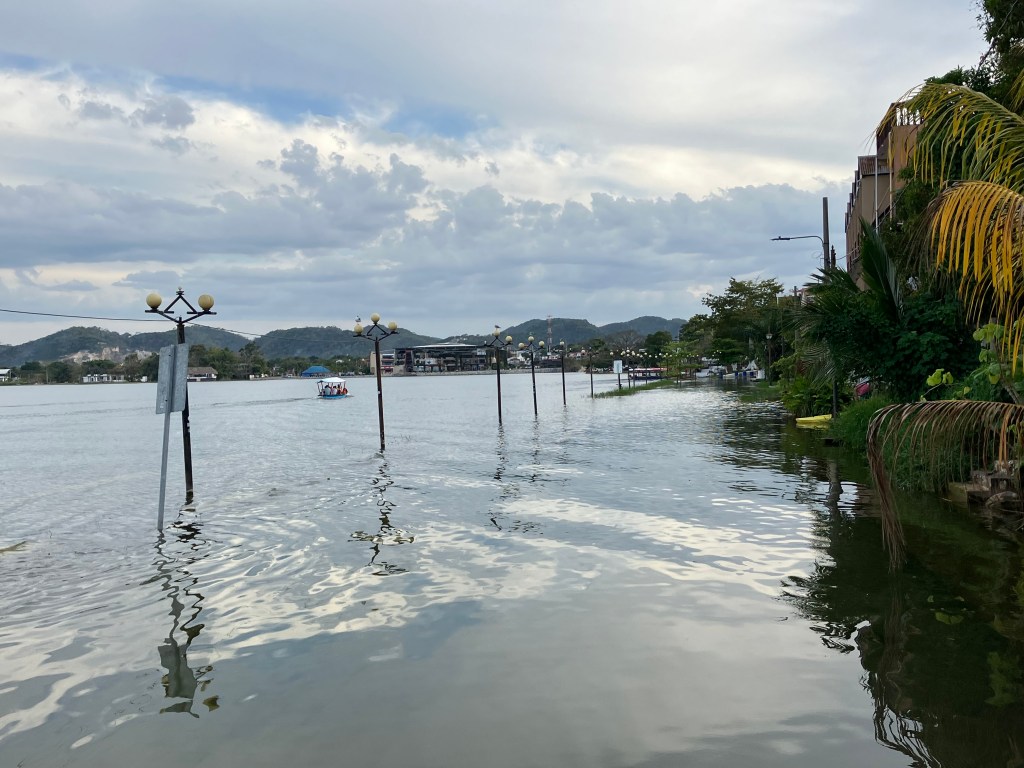
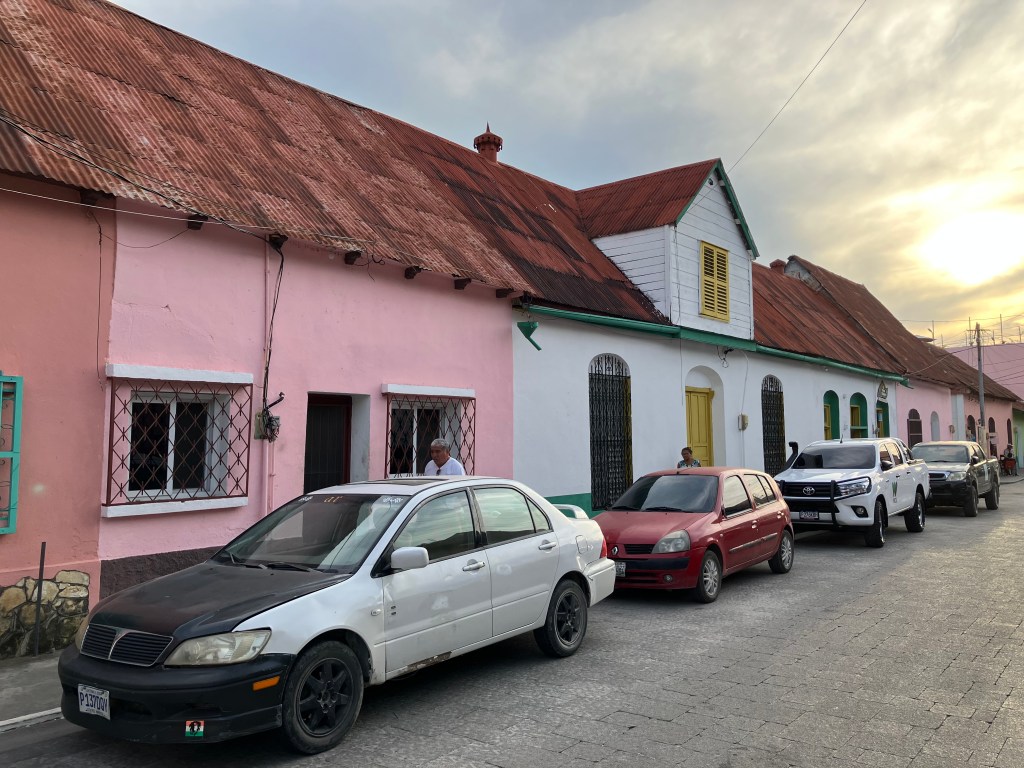
The lake and promenaade are one The town is filled with pastel-hued houses. Imagine a rainbow crashing out of the sky and spreading colors where it fell and you get an idea of the delight the town imbues on its visitors.


I didn’t go anywhere in particular and everywhere I could as the town is small. At sunset, I took a boat from Raices Restaurant’s pier to visit their sister restaurant across the lake. I was after ambiance and the restaurant delivered that in spades. The view of Flores and the lake as the fading sun, wreathed in clouds, covered the landscape in a diminishing yellow light, was just this side of angelic. The food was solid, the enchanting ambiance is what a visit here is about though.
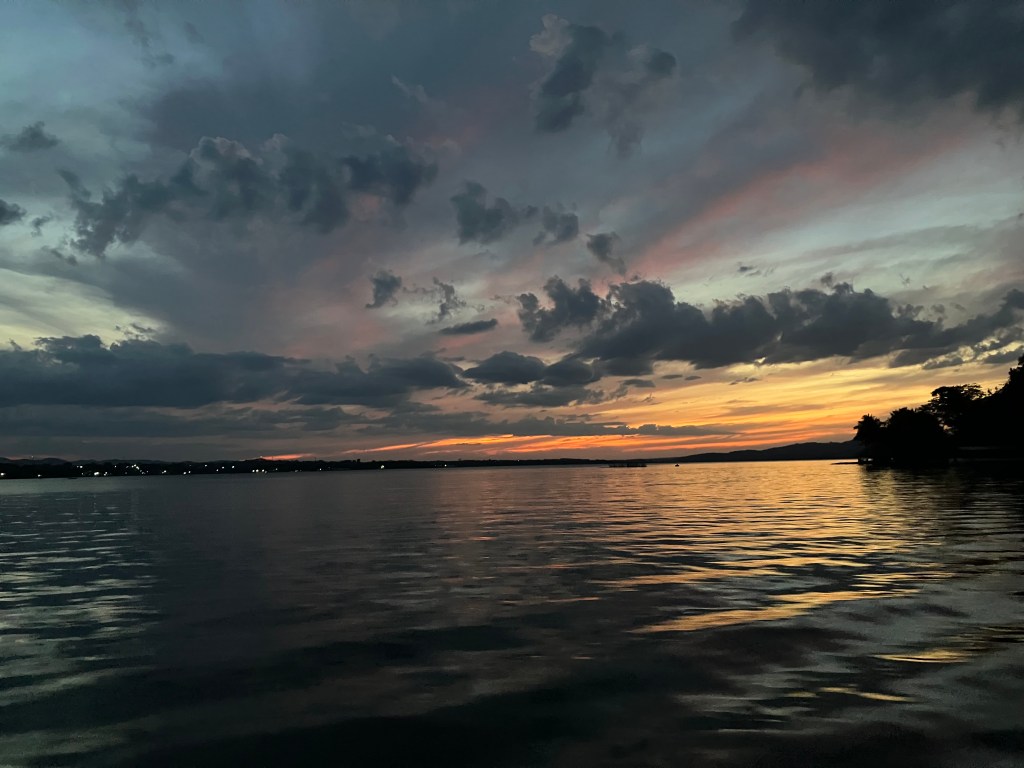
Sunset Lago Peten de Peten Itza 

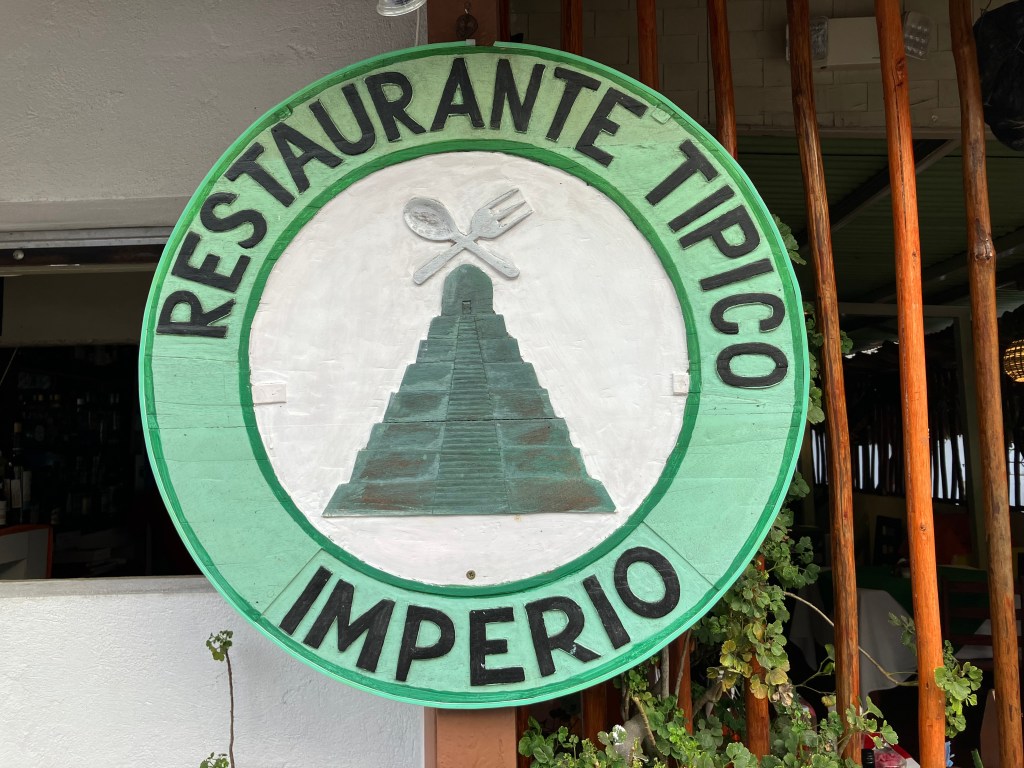
After I returned to Flores, I wandered around the city in the evening, the weather warm and pleasant, a light breeze drifting in from the lake.

Lago de Peten Itza As the town got ready for Easter, purple fabric was draped, folded, embellished from archways and window sills. At the highest point of the town, the twin cupolas of the Cathedral Nuestra Señora de los Remedios, dominated the skyline.
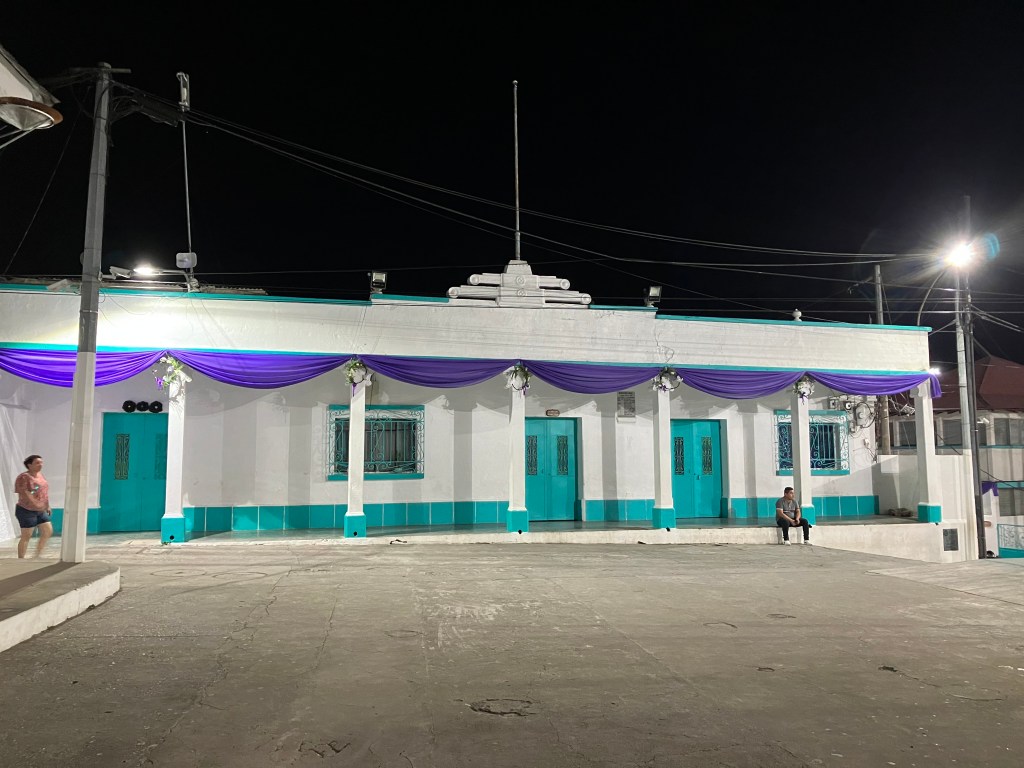
Easter decorations at Parque Central 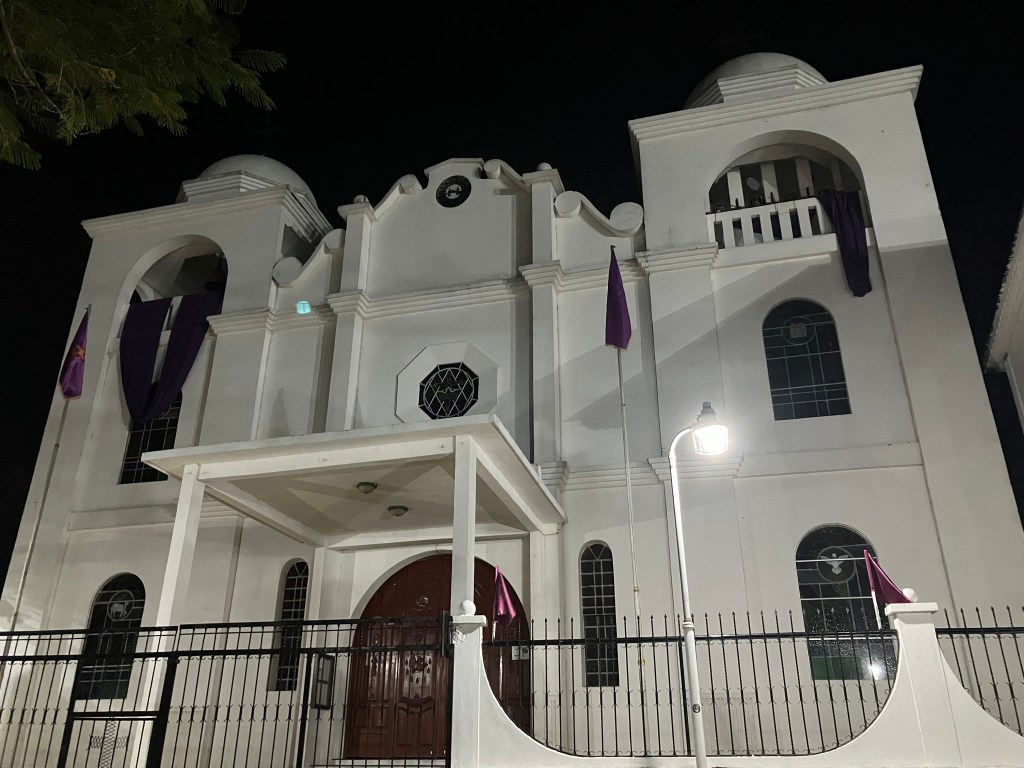
Cathedral Nuestra Senora de los Remedios 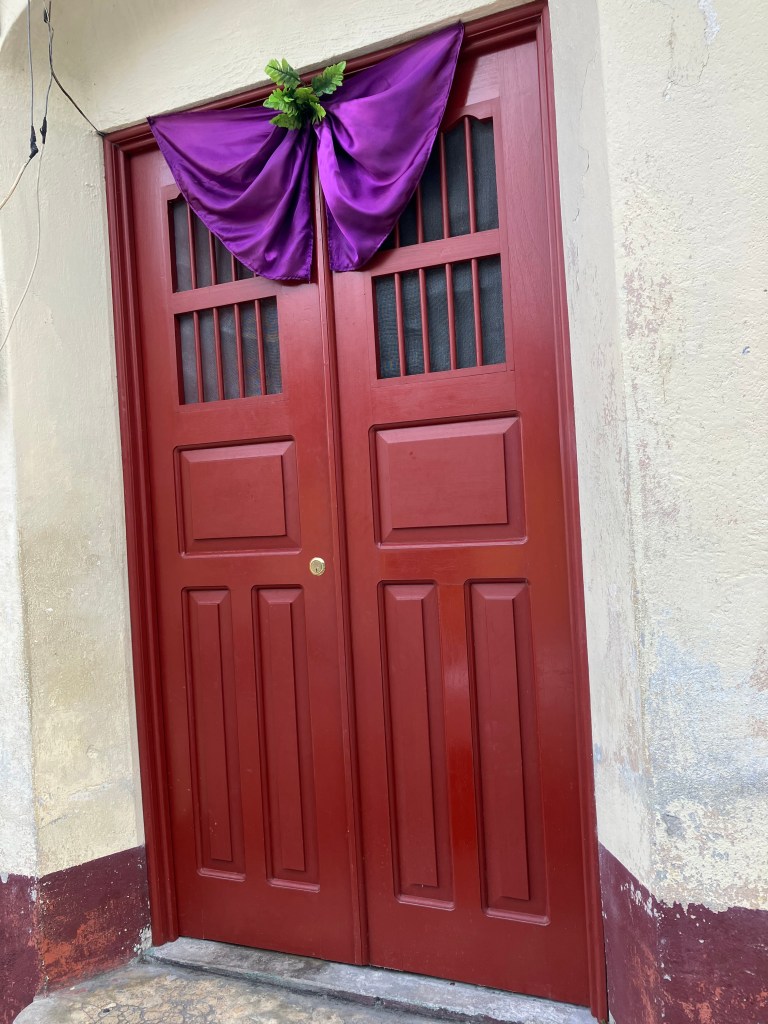
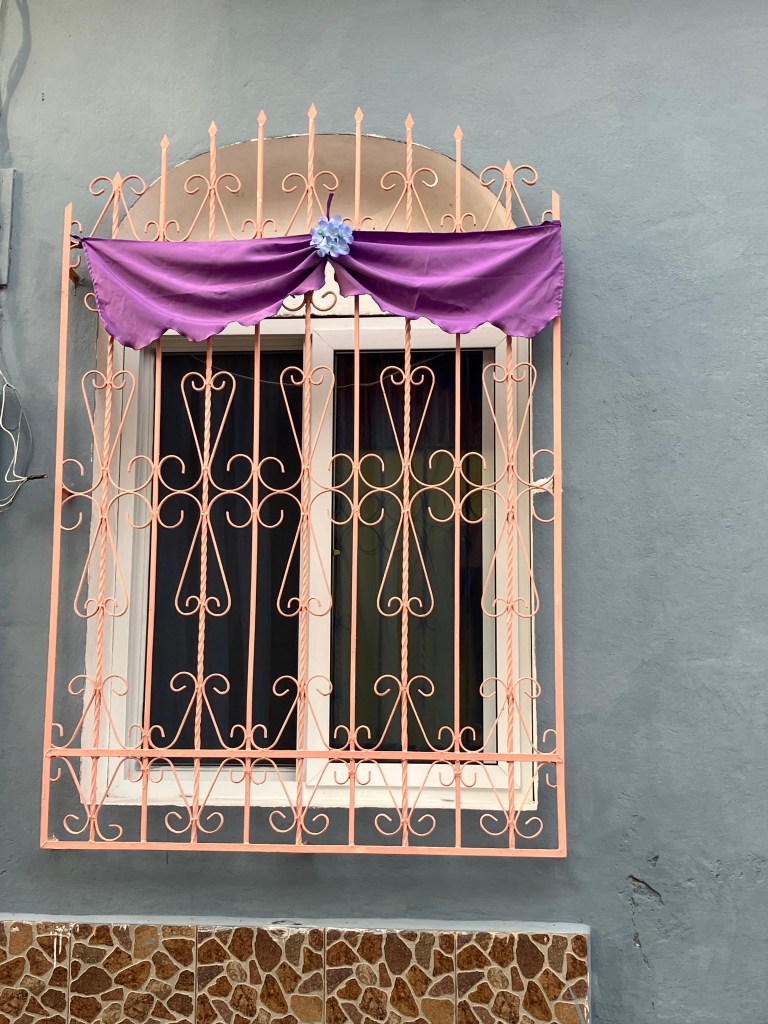

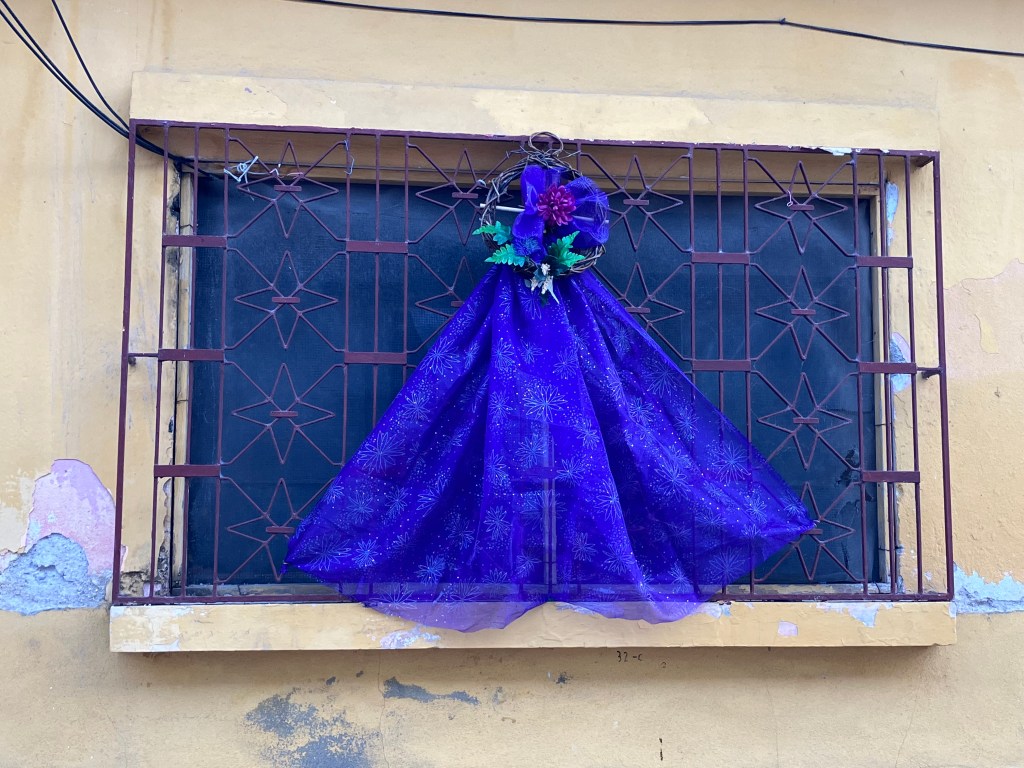
At the Parque Central, two teenage women’s sports teams played chamusca, a casual street version of soccer that’s played in Guatemala, floodlights animating their play.

Chamusca being played in Parque Central Nearby, beneath a simple shelter, was an ancient Maya carving. I knew that early the next morning, I would visit one of the most magnificent Maya ruins in the world.

Maya stone relief, Parque Central It was a short stroll to my simple and charming hotel, Hotel Isla de Flores, and sleep.

-
Guatemala: from BC to B.E. (Before Easter)

Mural at San Juan da Laguna Lake Atitlan: Three volcanoes and a deep, deep blue lake
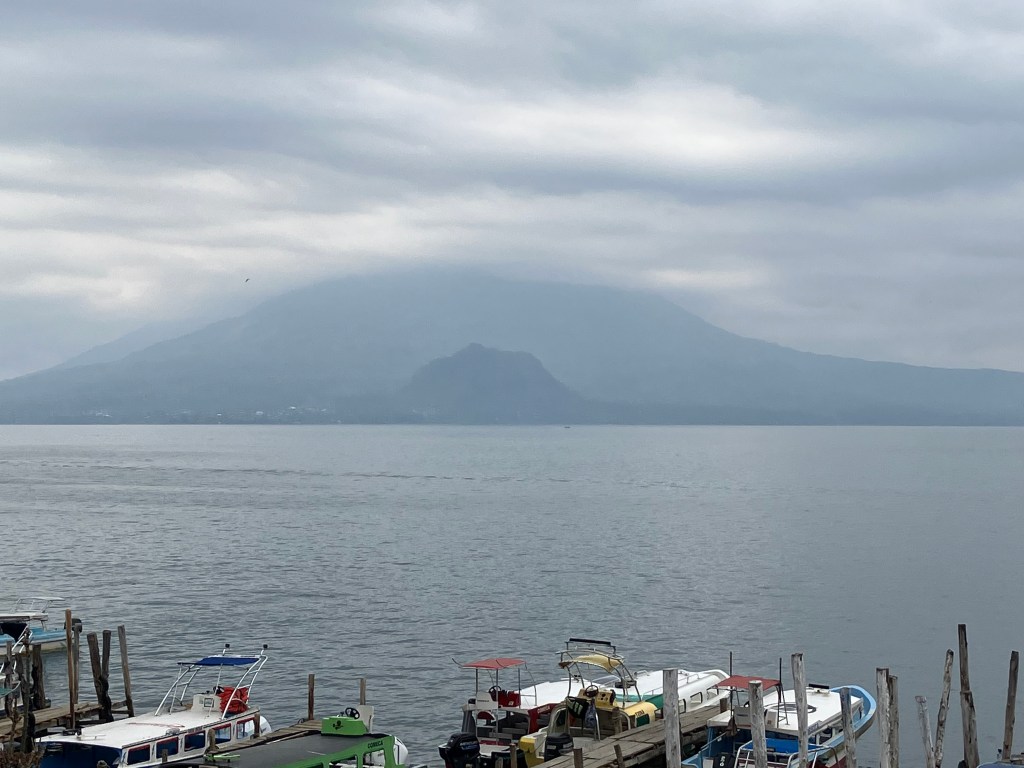
Lake Atitlan volcanoes Maya tradition alive today
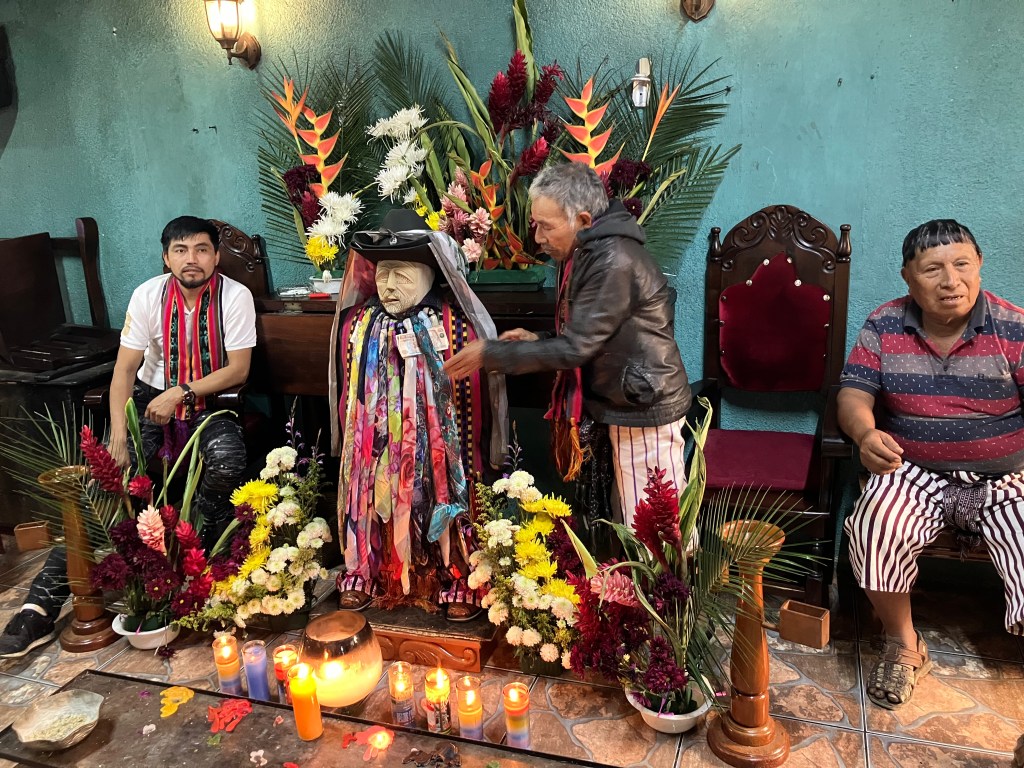
Maya deity Maximon In the town of Santiago Atitlan, the guide led me down steep, narrow streets, looking furtively to see if we were being followed. No, it wasn’t a secret assignation we were going to, but it was the location of a discrete brotherhood: the confradia of Maximon. The confradia, brotherhood, looks after the Maya deity, Maximon. We slipped unnoticed into a nondescript building and entered a long, narrow room on the right side.
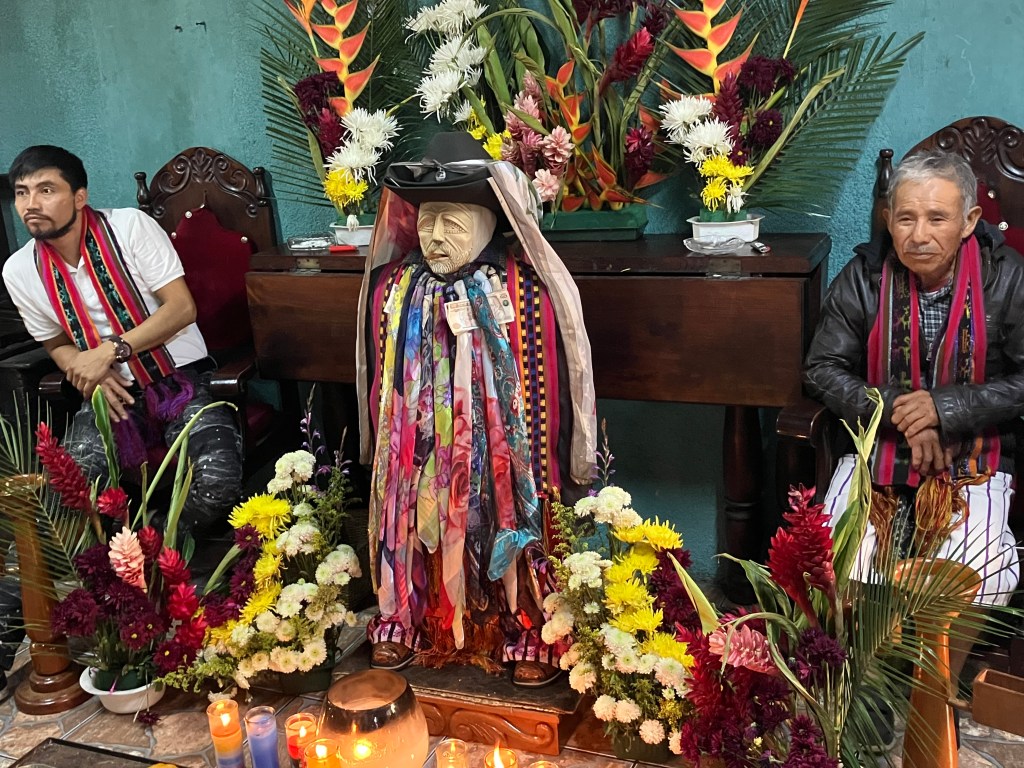
Confradia taking care of Maximon Inside, three men were tending to a nearly life-sized wooden effigy of Maximon, draped in layers of scarves, a hat with a scarf laying over it, and a cigarette butt gripped between his lips. The attendants from the confradia tended to him like a beloved uncle. Flowers flanked and were behind Maximon. A dozen lit candles were in front of him, melted and hardened wax staining the floor. I gave a donation, which was silently slipped beneath a scarf.
Syncretism is the amalgamation of different religions and Maximon is an example of this. He is a Maya deity who is the granter of all wishes — no matter what they are. As he is non-judgmental, disciples feel they can ask him anything. The Maya believe he is a descendant of a pre-Spanish God called Maam. The Catholics’ interpretation of him is a combination of the Catholic Saint Simon and maybe even Judas Iscariot.

Maximon in glass casket 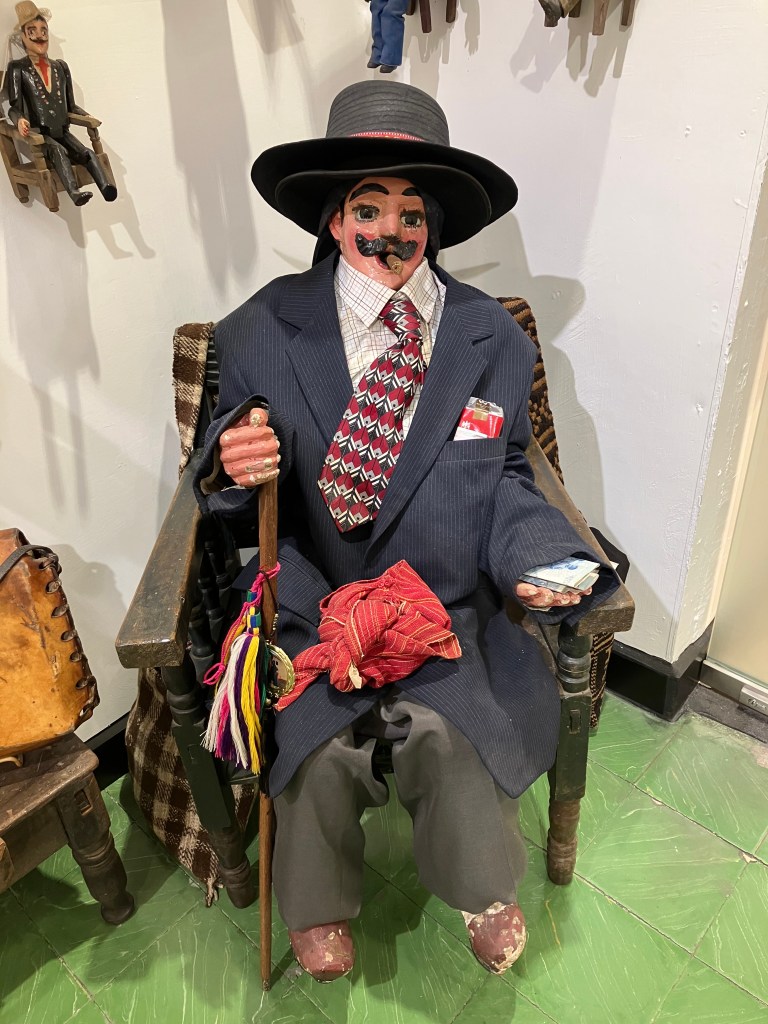
In antique shops, I saw depictions of Maximon for sale, wearing a suit, hat, sometimes sunglasses, and often a cigarette, sometimes a cigar, in his mouth.
In an adjoining room, I saw another effigy of Maximon laying in a brightly lit glass- enclosed casket with flowers in front of it. Well-wishers paid their solemn respects.

Every year the confradia secretly moves the effigy of Maximon to another location in the city. Visiting Maximon gave me an insight into the layers of spiritual belief in Guatemala.

Iglesia Parroquial Santiago Apostol At the nearby mid-16th-century Iglesia Parroquial Santiago Apostol, I saw more examples of syncretism. Jesus laboring beneath a huge cross on a flower-covered platform is dark-skinned, like the indigenous people of Lake Atitlan. A statue of a saint inside the church is draped with layers of scarves just like the Maximon effigy I saw earlier. Along the walls is a wooden carving of Maximon, the Maya deity clearly displayed inside this Catholic church. Despite its age, the church is the dynamic center of the community, the saints in the church having new clothes made for them every year by local women.
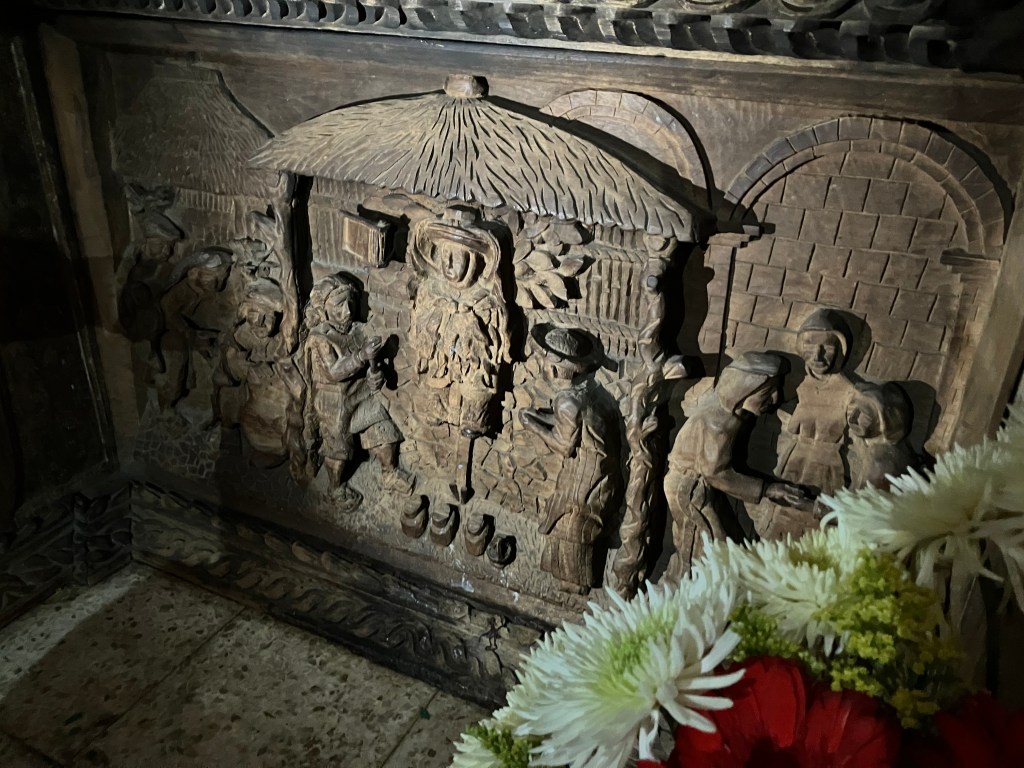
Maximon carving at Iglesia Parroquial Santiago Apostol 
Statue of Jesus 
Saint in Maya dress When I visited, the church was draped in luxuriant purple fabric as part of the decorations for Easter. Before I left, I paid my respects at the shrine in the church to Father Stanley Francis Rother from Oklahoma, who was murdered by ultra-rightists in 1981, the Civil War in full swing then.

Father Rother shrine 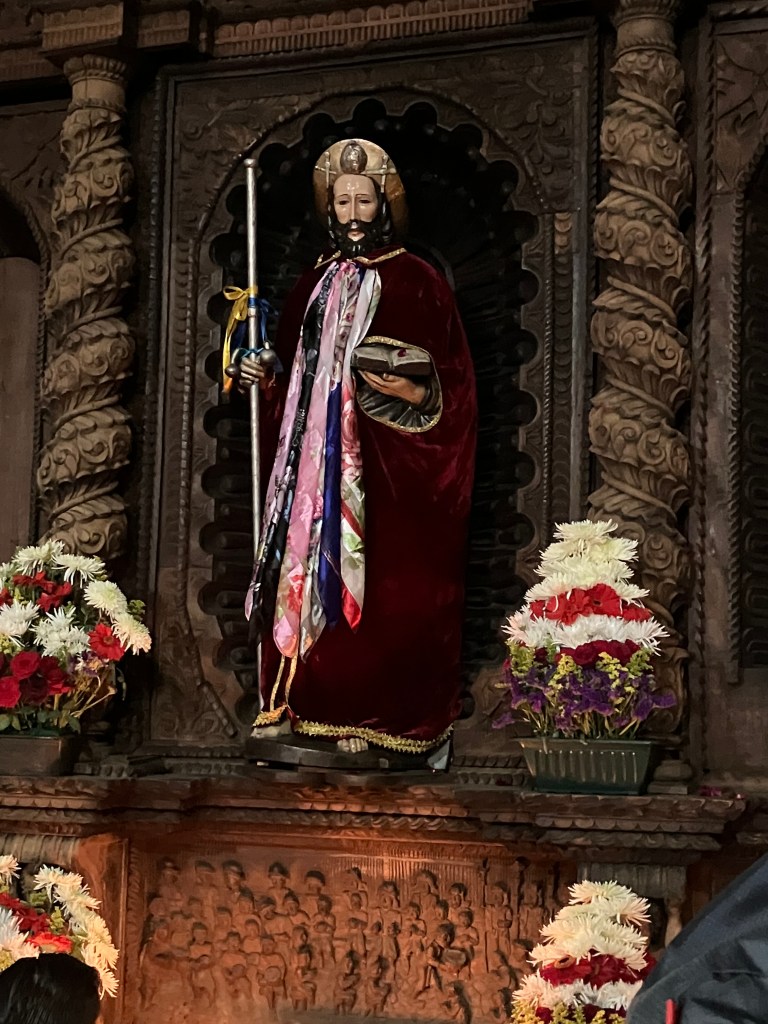
Saint in Maya dress 
Saint at Iglesia Parroquial Santiago Apostol 
Purple fabric decorating church in preparation for Easter 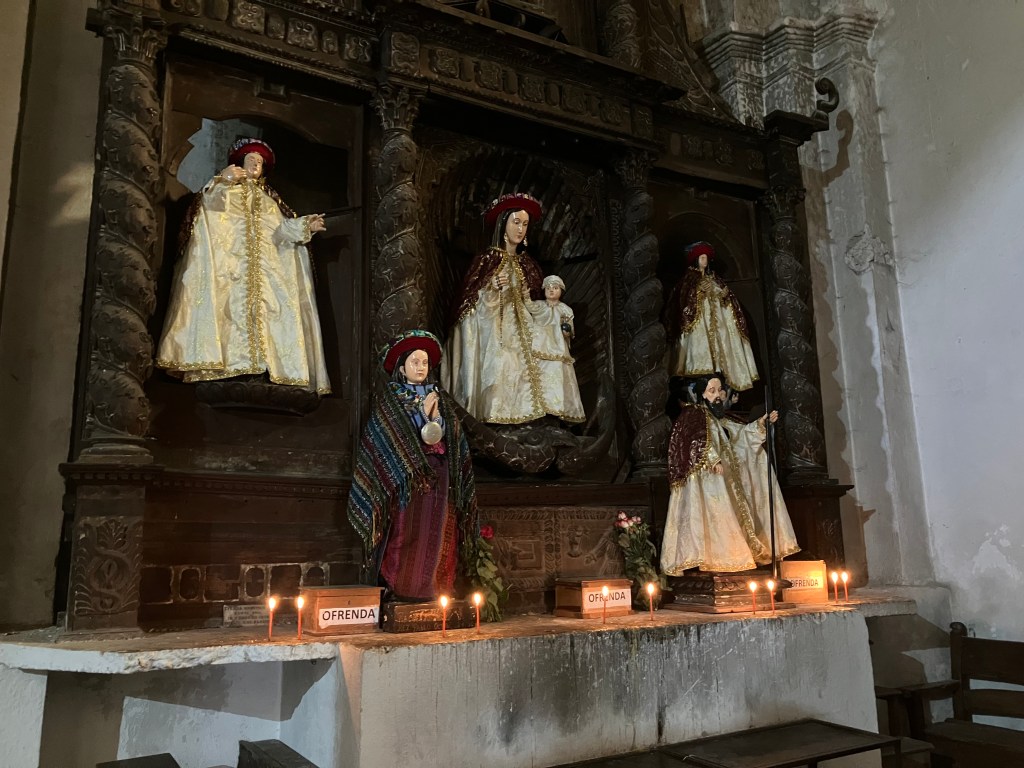
Saints dressed as Maya Digital nomad and party town

San Pedro La Laguna 
San Pedro La Laguna’s steep streets From Santiago Atitlan, I took a boat to San Pedro La Laguna. Lake Atitlan stretches 18 kilometers by 8 kilometers, drops as deep as 300 meters and is surrounded by three volcanoes: Volcan San Pedro, Volcan Atitlan, and Volcan Toliman. If Central America is the Earth’s ring finger, then Lake Atitlan is the polished sapphire that decorates it. The Spanish, under Pedro de Alvarado, colonized the area in 1524, allying with the Maya group Kaqchiquels against the Tz’utujils, then turning against Kaqchiquels in 1531 after they defeated the Tz’utujils. During the 1960-1996 Civil War, Lake Atitlan was a focus of the military as indigenous people comprised the majority of the rebels. It’s tragic, violent history is a startling contrast to the serene tranquility of today — and especially painful to comprehend after spending time with the warm, welcoming people of the lake.

San Pedro La Laguna from the lake 
On top of San Pedro La Laguna San Pedro La Laguna has a reputation as a digital nomad and backpacker haven and something of a party town. When I visited a Western traveler was sprawled face down along the side of the road. Given that I was there in the early afternoon he didn’t just have a rough night, he must have had a rough morning too. No one bothered him and he seemed to be sleeping off whatever he was on peacefully. Nearby, I got a jolt from an espresso at a simple café that wasn’t notably appealing to Western tourists. I took a three-wheeler, a Guatemalan tuk-tuk, up the steep streets to an IMAX-like view of Lake Atitlan. The clouds were moving in, enveloping the landscape in a veil that gave the environment a mysterious aura.

Lake Atitlan tuk tuk 
View from top of San Pedro la Laguna Maya craft traditions alive today

San Juan La Laguna A boat zipped me over to San Juan La Laguna next. This village takes pride and its Tz’utujil Maya crafts. Visitors here seem keen to learn and give back by supporting the trades that fuel its economy: painters, weavers, coffee growers, fishermen, farmers. This village is also popular for its Spanish schools. Looming over the village in the Cristalina Hill, with a profile of a man.
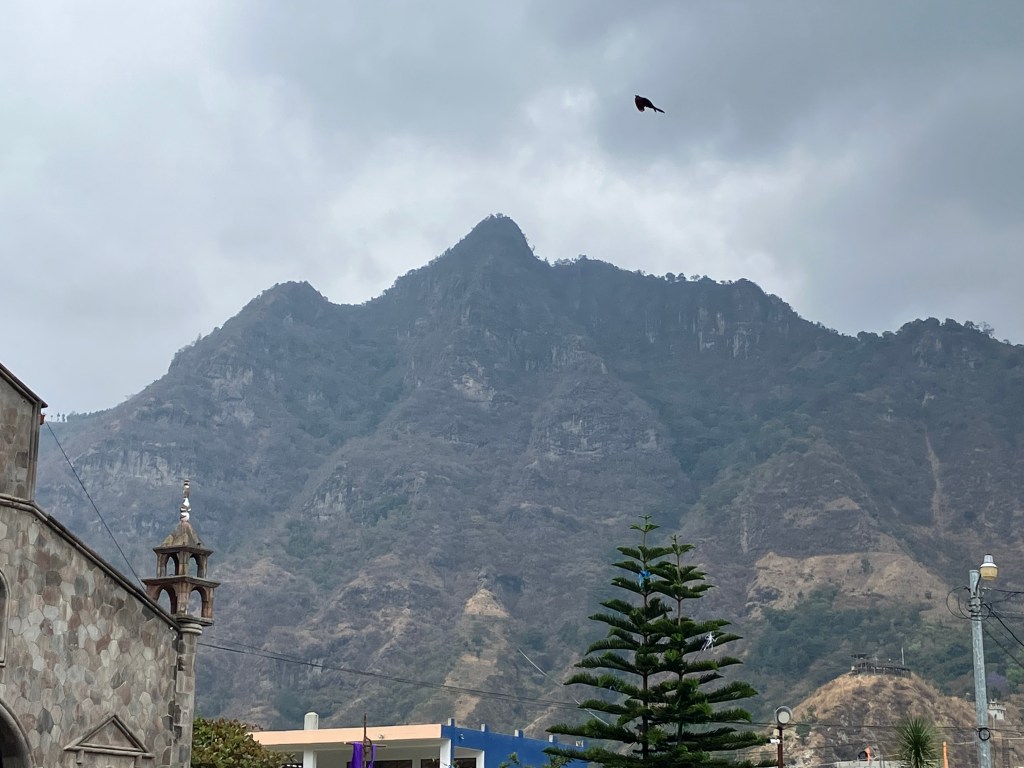
Cristalina Hill with man’s profile San Juan La Laguna 
Upon walking away from the dock, I was greeted by a marimba band, three men tapping out a tune on a large marimba, a type of xylophone made of palo de hormigo, a type of wood, and pumpkins. A fourth man shook maracas filled with seeds. It was a joyful entrance to a lively village.
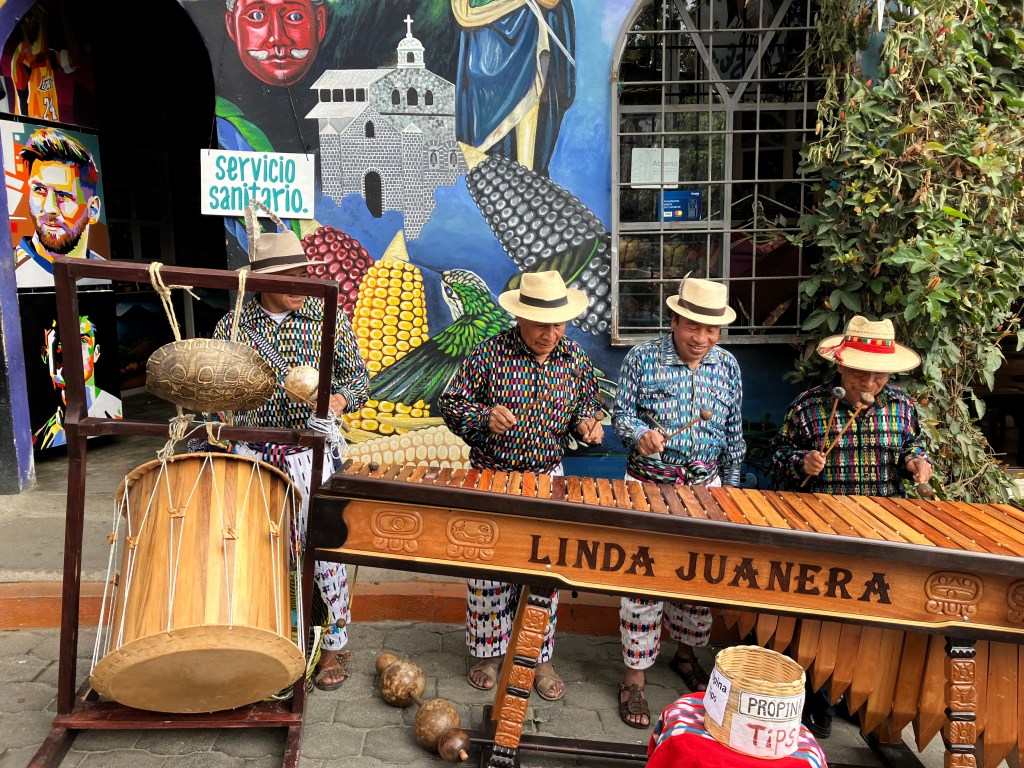
Mairmba band A decorative canopy of multi-colored umbrellas covered the street as it led upwards into the high reaches of the town. Walls were covered with bold murals depicting Tz’utujil Maya life: from Maya ancestors playing ball games to shamans to contemporary Tz’utujil playing music. There were even huge 3-D cut-outs of Maya at key junctures of the streets. The umbrellas give way to bowler hats and tassels overhead.

Umbrella canopy at San Juan da Laguna 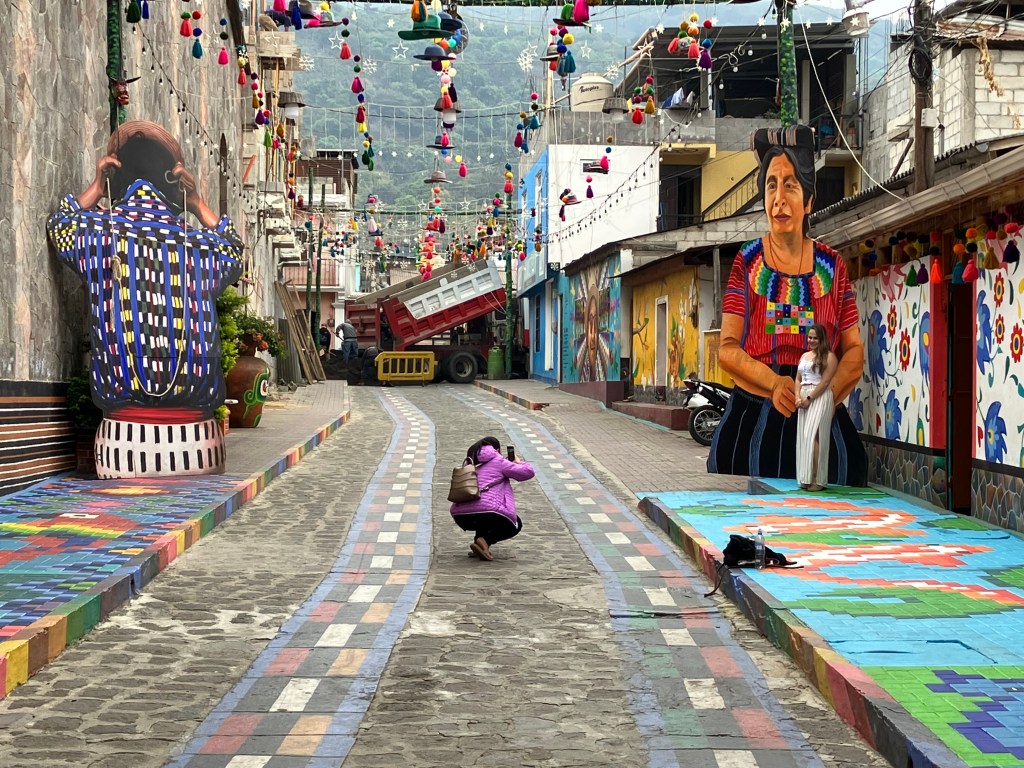
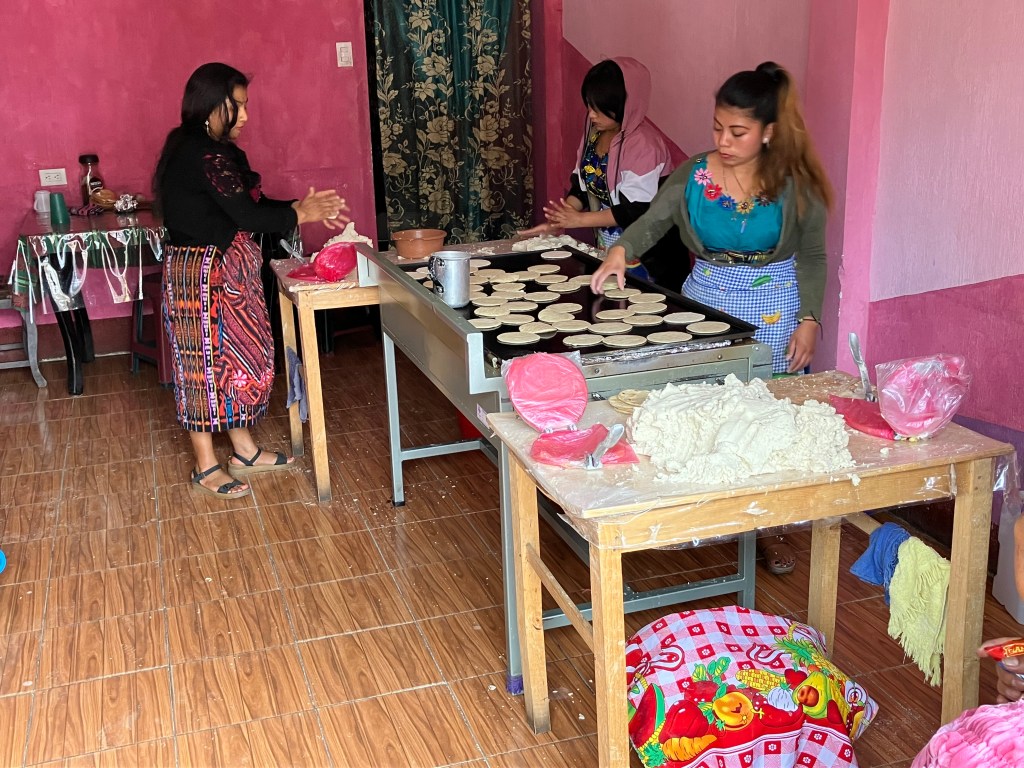
3-D cutouts at San Juan da Laguna I visited a weaving cooperative and saw a demonstration on how they dye fabric before buying a multi-hued scarf there. I spent time watching a shop harvest honey from their beehives before buying a bottle of robust-tasting honey. I also visited galleries featuring Tz’utujil oil paintings, a primitivist style depicting Maya life. And around nearly every curve and corner, I could see women slapping and grilling corn tortillas, the scent wafting out onto the street, the sound a rhythmic, ambient beat.


My next stop was back where I started my journey on Lago de Atitlan, Panajachel, the largest and busiest of the towns on the lake. It’s the jumping off point for visits to the lake. For most travelers, including me, it’s really a transit point.
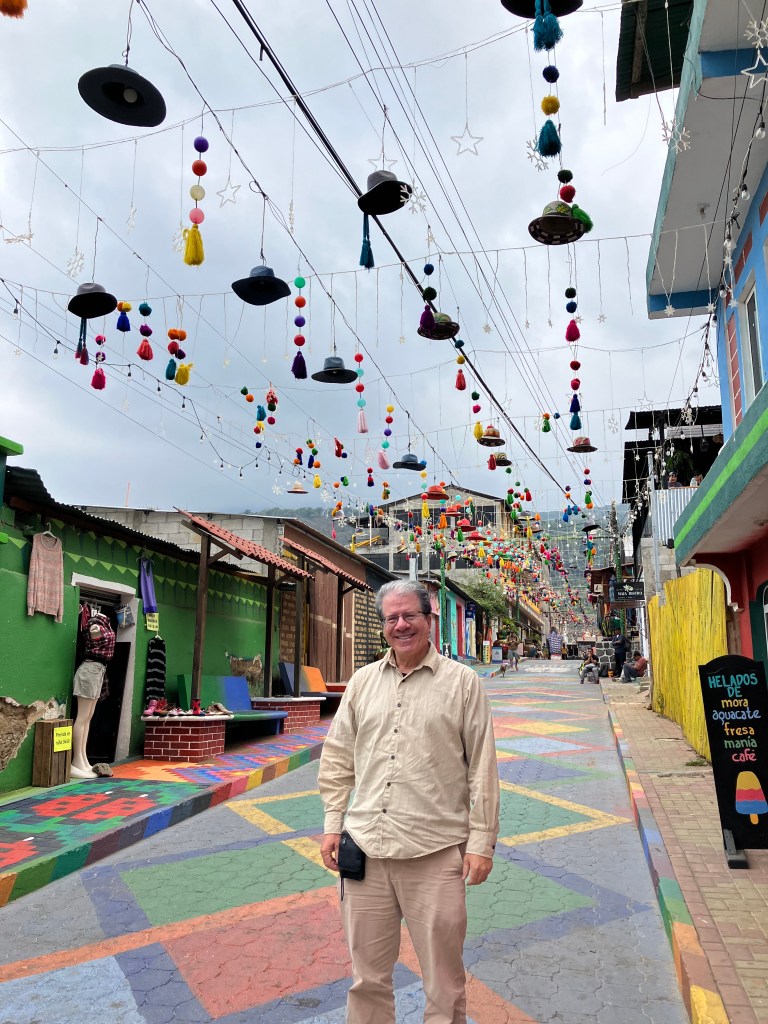
At San Juan da Laguna Lago de Atitlan is only around a 3-hour bus ride to Antigua, but it’s a journey to an indigenous Guatemala that is finally finding the peace it needs to provide a better future for its citizens and their centuries-old culture.
-
Timor-Leste (East Timor): Proposed Tourism Campaign
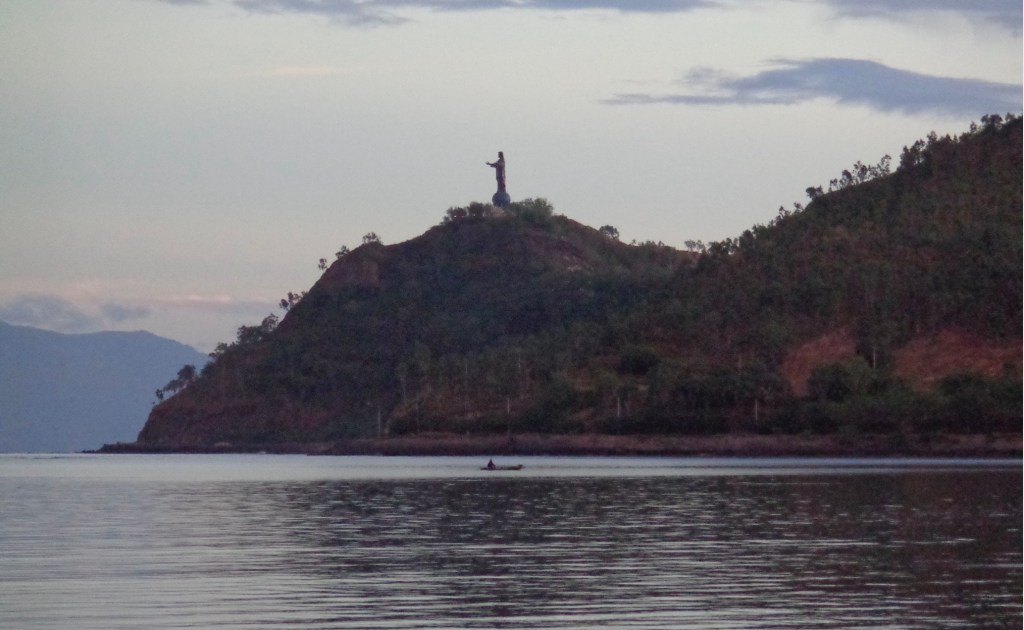
Cristo Rei of Dili statue on Cape Fatucama, Timor-Leste In the summer of 2013, my family and I visited Timor-Leste (also known as East Timor) to tour around the country. The country, whose long journey to independence was marked by tragic events, was peaceful and delightful, with a striking mountainous interior, stunning coastline, amazingly fresh seafood, and warm people. While dining at a restaurant in the capital of Dili, we were introduced to Jose Ramos-Horta who happened to be dining there at the same time as us. He is a Nobel Peace Prize laureate, a former and current president of the country as well as a former prime minister and foreign minister of Timor-Leste and a founder of the resistance movement, Fretilin. When he found out we were tourists, he was surprised as he didn’t know that tourists made it to his country. This was 2013 and we were one of the first. We told him how much we loved our visit to Timor-Leste. He was a very charming man.

Santa Cruz Massacre Memorial Monument, Dili When we returned to our home in Singapore, my daughter and I created a tourism campaign for Timor-Leste with the tagline, “Being first has its rewards.” My daughter also created the beautiful logo that goes with the advertising campaign. We shared it with Jose Ramos-Horta.

Jose Ramos-Horta with my family, my friend and his son at a Dili restaurant Here’s the proposed (but never run) tourism campaign and the proposed (but never run) logo.
Maybe it will inspire you to visit one day.


Proposed Timor Leste logo -
Shadow Emperor novel: Explore Tokyo through a thriller

Shadow Emperor by Jonathan Holburt One of the best ways to learn about a place is to read a novel set in that city or country. My novel, Shadow Emperor, is set in Tokyo for the most part and brings alive that great city.
The novel was optioned by Hollywood but unfortunately, wasn’t made into a movie.
It’s available on Amazon and Apple Books.
Below are quotes from reviews of Shadow Emperor:
-“(Shadow Emperor) weaves a tale of intrigue and suspense…the action begins in the first few pages.” The Star, Malaysia
-“Fast-paced, thoroughly absorbing, entertaining and enthralling. Holburt uses a rich historical background to inject power and excitement into his modern-day narrative. There’s an infusion of mysticism and the supernatural which injects an added aura of mystery to the already suspenseful tale. The last sentence imparts a final shock. Should not be missed by true thriller fans. A must-buy!” New Straits Times, Malaysia
-“The plot never stalls. The book is hard to put down because something might happen when you least expect it.” Bamboo Telegraph, Singapore
-“Imperial Japanese potboiler with Indiana Jones feel…in the vein of James Clavell and Clive Cussler. Moves at a brisk pace.” Straits Times, Singapore
-“A ripping yarn. Yakuza kingpin Yugao acts to restore what his ancestors lost 600 years ago in a civil war – the throne of Japan. Hiring ex-SAS commando Hugh Scott to steal the sacred regalia that would make any man emperor of Japan, Yugao triggers a chain of events that sends Japan spiralling into chaos. A great read.” The Expat Magazine, Singapore
-“The action, intrigue and suspense never stops. Holburt artfully contrasts the beauty and serenity of Japanese gardens and the exquisite order of the ancient tea ceremony with the squalor, noise and chaos of gambling dens, brothels and bars…International politics and tensions between Eastern and Western cultures add another dimension to the story. Made for the silver screen.” The Singapore American
-“A Robert Ludlum-esque thriller.” I-S Magazine, Singapore
-“One can imagine (Shadow Emperor) being turned into an action-packed film such as Black Rain.” Asiaweek, Hong Kong-based regional publication
-“For those who enjoy the likes of Mission Impossible.” Media Mail, Singapore
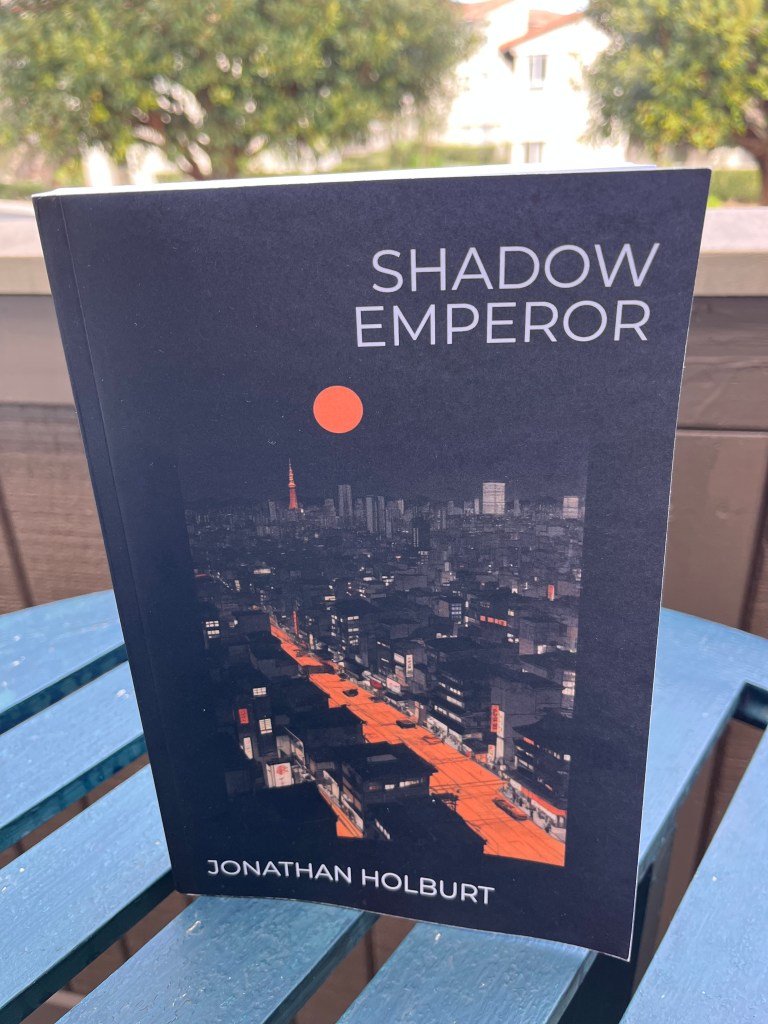
Shadow Emperor paperback -
Mesmerizing Mexico City is the New Capital of Cool
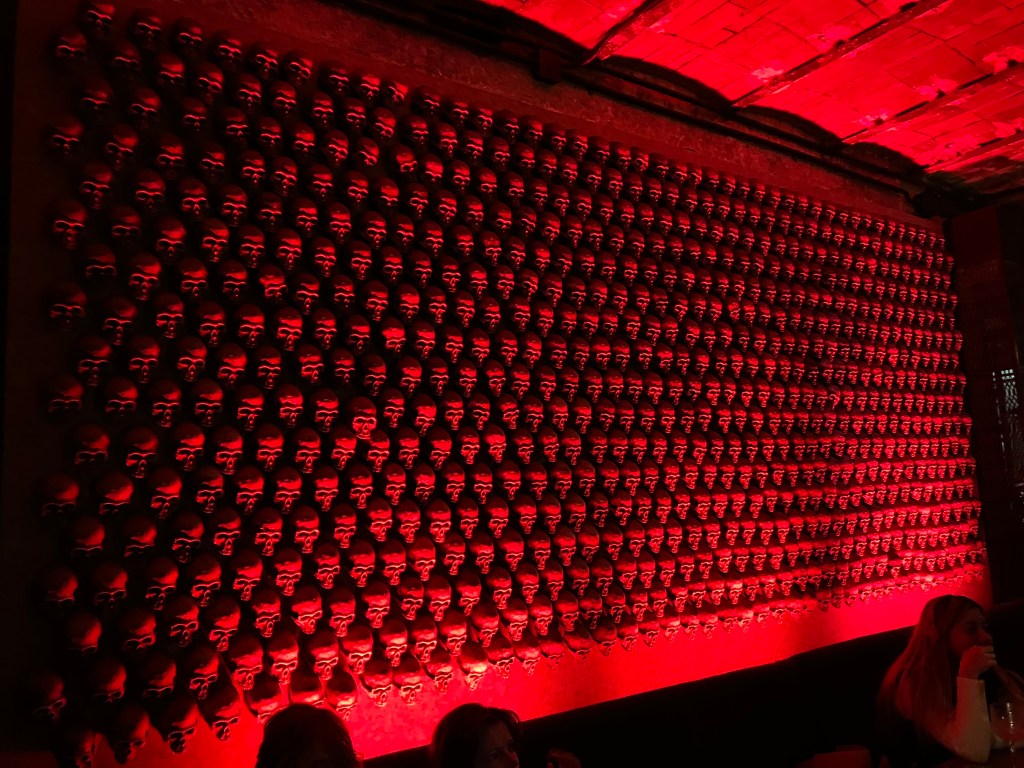
Wall of Skulls Gin Gin Bar Mexico City During a Taco Crawl in Mexico City’s Roma neighborhood, we came upon Carinita. Packed with the young, hip set that now defines the hood, Thai tacos were served in corn husks. Never heard of Thai tacos? Neither did I. But I’ll never forget them either, wolfing down a spicy one called Isaan. We had al pastor tacos at next stop Tacos los Alexis where the bill is provided in a miniature shopping card.
Roma, featured in the Oscar winning movie of the same name, is filled with restless humanity ebbing and flowing while scouting for restaurants, cafés, bars, and music clubs. A baroque mansion is converted into a bazaar. At Gin Gin, walls decorated with rows of skulls illuminated by red lighting, we downed mezcal spiked cocktails.
Pinnacle moment for the city
Mexico City is having its pinnacle moment. In November 2023 Time Out named it the number one city in the world for culture. Time Out also rated it the sixth best city in the world to visit in 2024. But it’s not just the foreign media that praise the city. Locals love it too, according to Time Out. 96% say they are happy living there. 94% say it’s easy to make friends. After my fourth visit there I’m a convert. Some cities are sonnets, other are short stories or a novel. Monumental, magical Mexico City is an all-engrossing trilogy.
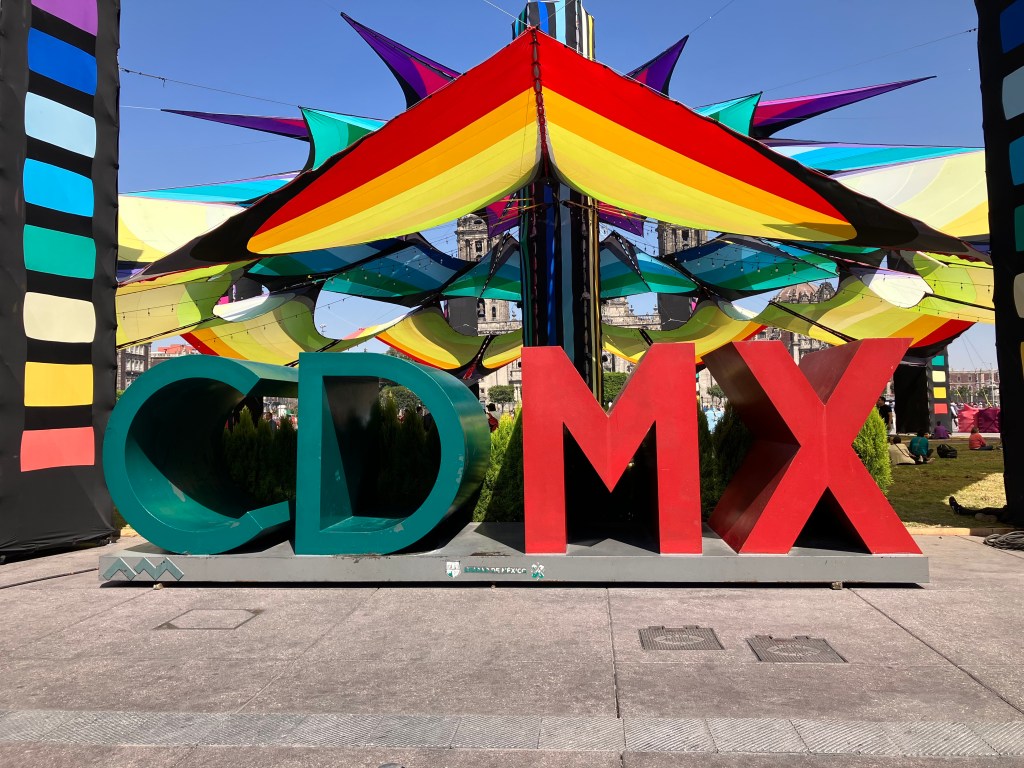
CDMX sign at Zocalo During the 1990s and early 2000s Mexico City was known for treacherous streets and unbreathable air. In 2001 the Washington Post ran an article titled, “A kidnapper around every corner.” Express kidnappings were common: tourists were grabbed and driven to ATMs around the city to withdraw cash or else. In 1992 the UN named it the world’s most polluted city. Now, according to Swiss company, IQAir, it’s ranked 917th. You may still be breathless here but because of the elevation. At 7,350 feet Mexico City, ringed by mountains and two volcanoes, is certainly high. Why did it improve so dramatically? Strong leadership by former mayor Claudia Sheinbaum and other civic leaders who transformed this maximum metropolis.
Colossus of the Americas
At 22.28 million people, second only to Sao Paulo in the Americas, the city is a colossus. The National Autonomous University of Mexico (UNAM) is the largest in the Americas with 373,000 students and 42,000 staff. Its public art work is also massive in scale, earning it a place on UNESCO’s World Heritage Sites in 2007. The ten-story high Biblioteca Central is a tapestry of mosaics depicting Aztec times and colonial history by artist Juan O’Gorman. Other colossal mosaic artworks on campus are from David Siqueiros and Francisco Eppens.
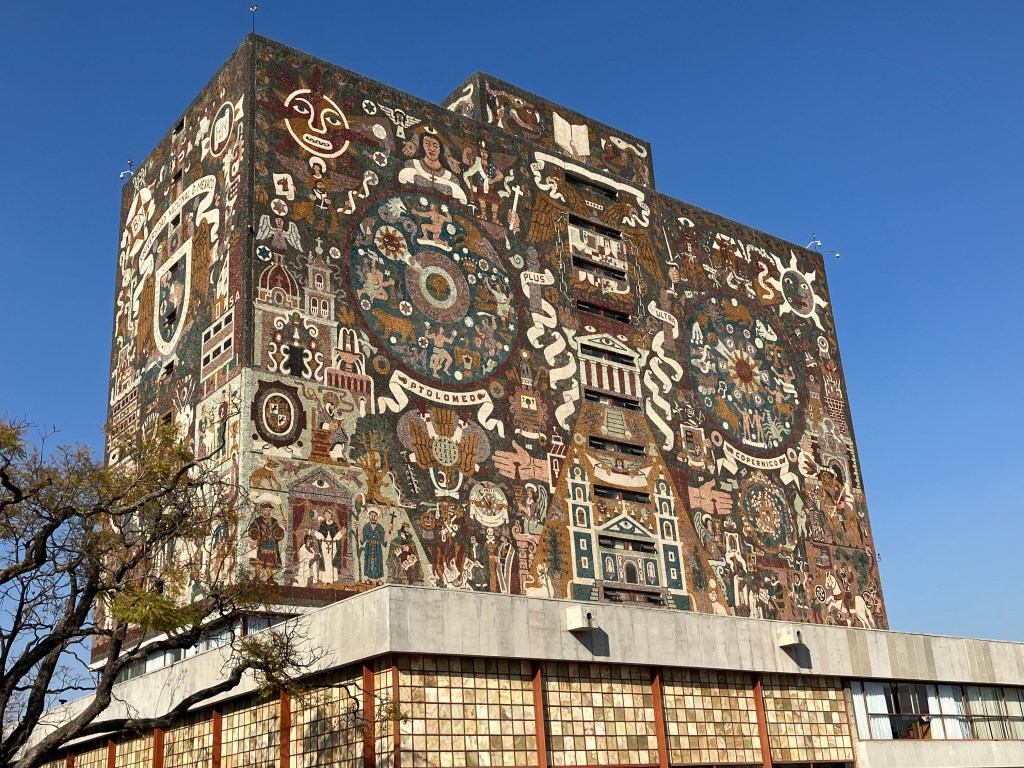
Bibloteca Central UNAM Altiplano Venice
Other great cities are built on a river, lake, or seashore. While Mexico City was built on the drained Lake Texcoco, water is not the city’s defining element. But there is an exception, the canals at Xochimilco, originally built by the Aztecs. Located at the southern edge of the city, this UNESCO World Heritage Site is where families and friends rent trajineras, gondolas, and glide along canals amongst floating islands call chinampas while passing boats of mariachi bands playing music, and others selling cervezas and tamales or a traditional alcoholic drink called pulque. Poinsettias and marigolds thrive here. A creepy feature of these Venice-like canals are the dolls that are strung up on shacks and trees These pay homage to the Isle of the Dolls where Don Julian Santana Berrera hung a multitude of children’s dolls from trees, time and the elements disfiguring them.
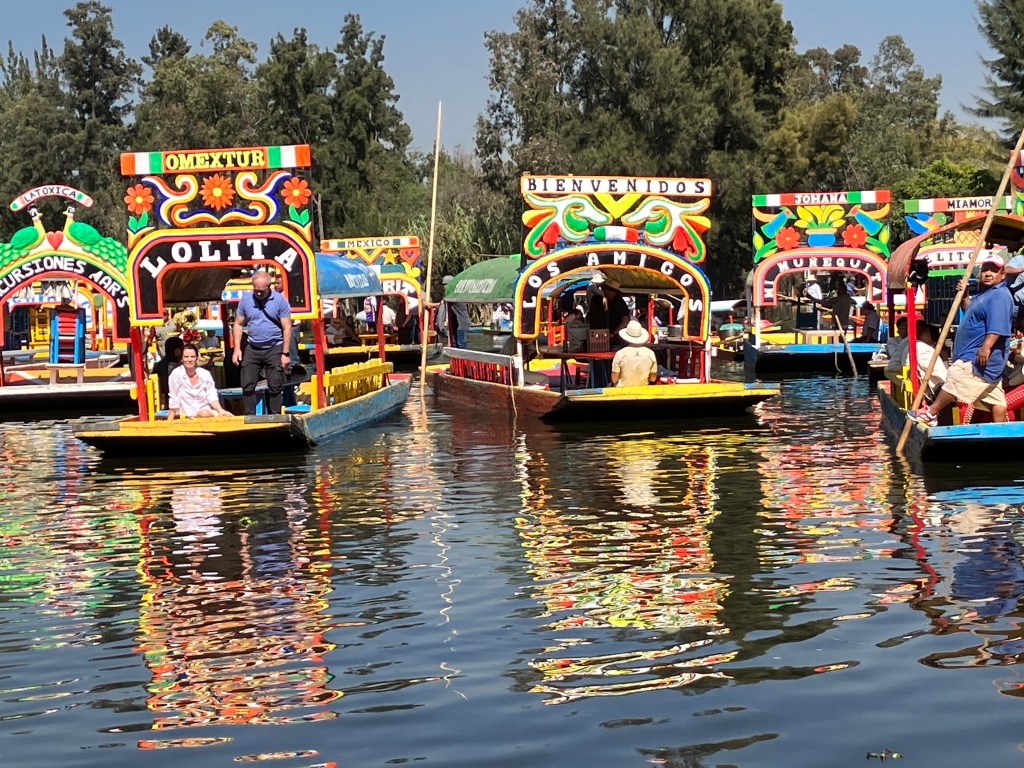
Gondolas at Xochimilco History going back thousands of years
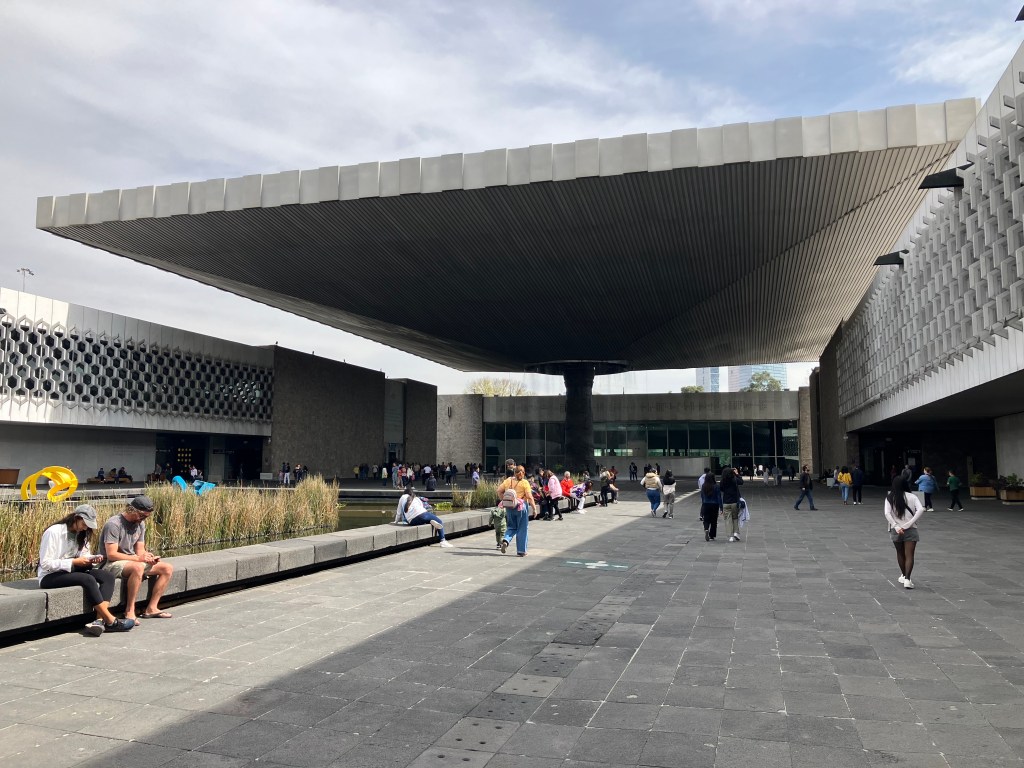
Museo de Antropologio At the summit of Mexico City’s cultural offerings is the world famous Museo Nacional de Antropologia. Designed by architect Pedro Ramirez Vazquez and opened in 1964 it depicts Mexico’s history from pre-Hispanic times. From colossal Olmec heads weighing 20 tons to the replica of King Pakal’s tomb to the Aztec Sun Stone that is the symbol of Mexico, the museum takes hours to absorb. The central plaza is dominated by a monumental sculptured column with a gushing fountain of water and a huge concrete canopy that acts as an umbrella. In front of the museum indigenous Totonac twirl in a flying pattern from the top of a 30-meter pole to the sound of rhythmic music. This ritual dance is known as the Voladores de Papantla ceremony.


Olmec head While the Museo Nacional de Antropologia depicts Mexico’s storied past, the Zocalo, also known as the Plaza de Constitucion has been the city’s and the country’s center of power since Aztec times. It is one of the world’s largest squares: 220 meters north to south, 240 meters east to west. The ceremonial center of the Aztec civilization was here: the Teocali of Tenochitlan. After defeating the Aztecs Cortes dismantled the Aztec pyramids and used the stones to pave the plaza and build the Metropolitan Cathedral. The baroque cathedral was built between 1573 and 1658, athough elements of the building were not completed until the end of the 18th century. Breathtaking in scale, it’s 109 meters long, 59 meters wide and 65 meters high. To get a sense of its majesty I went into the choir area and listened to its two massive organs being played during mass. The largest in the Americas, they were completed in 1736.
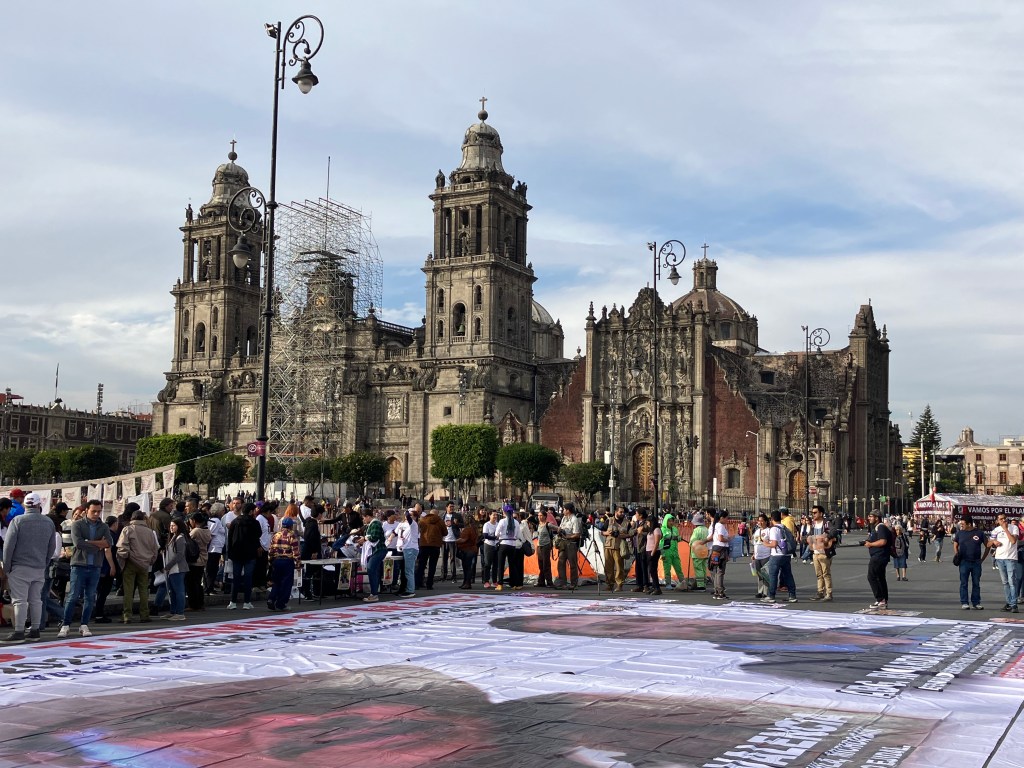
Protest in front of Metropolitan Cathedral Near the cathedral is a line of people wating to be spiritually cleansed by Aztec shamans. The ceremony, known as limpia, included being rubbed with herbs and having a silver cup of smoke blown into your face. It ended with the haunting sound of a conch shell being blown.

Aztec shaman performing cleansing ceremony Rivera’s murals depict Mexican history

Palacio Nacional The Palacio Nacional is opposite from the cathedral on the Zocalo. The Aztec emperor Moctezuma II occupied the first palace here, which Cortes replaced with a fortress. The Spanish crown took it over and transformed it into a palace the New Spain viceroys. After independence, the presidents of Mexico have lived here, including current the president. In the palace is a series of nine murals by Diego Rivera, painted between 1929 and 1951. The largest mural is The History of Mexico. Rivera commuted here from the Blue House, the home that he shared with Frida Kahlo in the Coyoacan neighborhood. Now a museum, it illustrates their life and trials together.
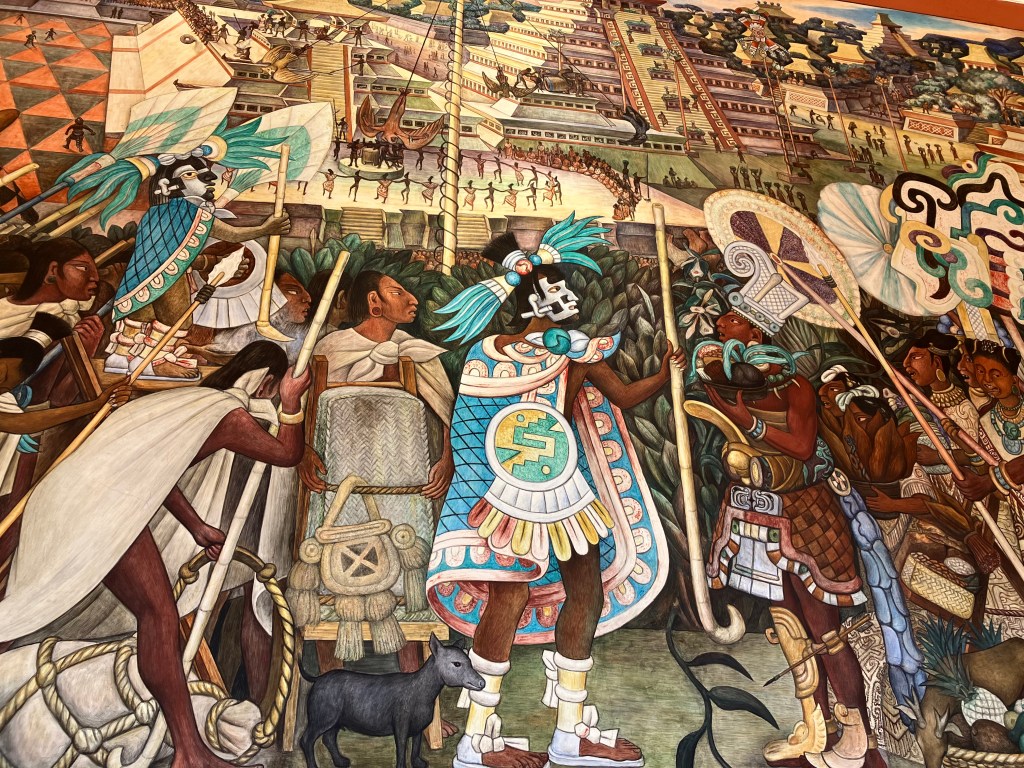
Detail from The History of Mexico mural In the palace I passed through a cactus garden representing northern Mexico and tropical garden representing its south. In the symmetrical palace’s courtyard I climbed stairs to reach the murals. On my left is the entrance to the president’s residence. The palace allows only 240 visitors a day on free guided tours. On most days, the military closes the palace completely to visitors.

Palacio Nacional courtyard Mexico’s mural masters
At the nearby Palacio de Bellas Artes, started in 1905 but only completed in 1934, a delay caused by the Mexican Revolution, the floors are dominated by murals by Mexico’s most famous muralists: Diego Rivero, Rufino Tamayo, David Alfaro Siqueiros and Jose Clemente Orozco. Rivera’s “Man at the Crossorads” was originally painted at the Rockefeller Center in New York until Nelson Rockefeller ordered it painted over because it included flattering images of Lenin and a Soviet May Day parade.

Palacio de Bellas Artes Culinary art and lively nightlife
Mexico City isn’t all about museums. Cafes and bars, restaurants and music serenade the senses. Opened in 1952 the Café La Habana with its sepia toned colour scheme, was a favorite haunt of Fidel Castro and Che Guevara as they planned the Cuban Revolution. Nobel prize winning writers Gabriel Garcia Marquez and Octavio Paz socialized here. My son and I soaked in the atmosphere over hot chocolates.
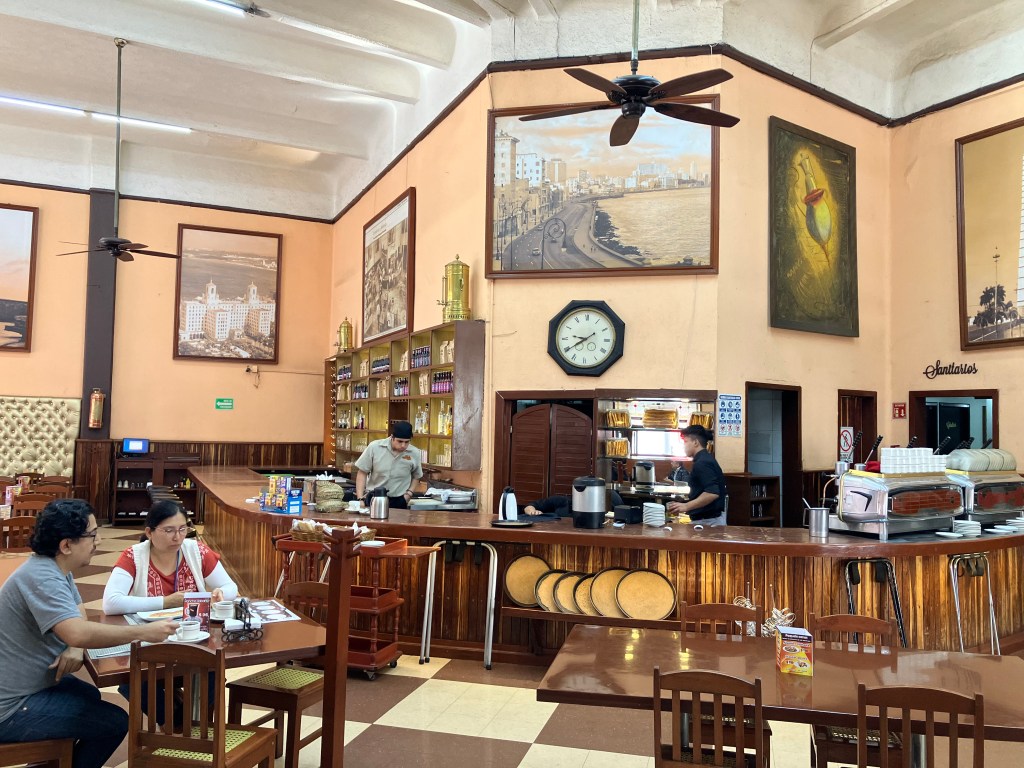
Cafe La Habana The storied La Opera has been serving drinks and food to Mexico’s richest and most powerful since 1876. Revolutionary Pancho Villa fired a bullet into the ceiling in protest against the plutocrats who congregated here. The dictator Porfirio Diaz was a regular here as was Gabriel Garcia Marquez who once refused to autograph napkins for fans but later returned with autographed books for all of them.
Haute cuisine

Quintonil restaurant, Polanco Lately, Mexico City has become a mecca for haute cuisine with three of the world’s top 50 restaurants. Our most memorable meal was at Quintonil, ranked 9th in the World’s 50 Best Restaurants list. They take Mexican cuisine to new levels by relying on traditional ingredients like insects. Yes, insects. During our ten course tasting menu, my wife and I had ant larvae, agave worms, stink bugs, and grasshoppers. In some Mexican customs, the stink bug, jumil, represents the souls of dead relatives so eating them while alive is a traditional custom. The stink bugs we ate were definitely dead and thank god for that! The restaurant was intimate — only eleven tables and eight counter seats — with muted colours that didn’t detract from the vibrantly coloured dishes.

Cactus and vegetables at Quintonil Our experience at the 49th ranked Rosetta was less sublime and more factory line. Given its fame, people crowded the entrance. Located in a magnificent mansion in the Roma neighborhood, they were eager to get a table, any table. At our meal I had white mole and fermented carrots as a starter and cacahuazintle corn cappellaci and brown butter as a main. The food was outstanding but the portions so miniscule, I felt like emulating Oliver Twist, “Please sir, can I have some more?” My family and I decided to finish our meal at Churreria El Moro, with abundant crispy churros dipped in chocolate sauce.

Rosetta restaurant mansion, Roma World’s Best Bars
When it comes to the top 50 bars in the world, Mexico City has four of them. Our experience with two of the bars was like the restaurants, hit and miss. Handshake Speakeasy made it to Number 3 on the World’s 50 Best Bars list. Its staff stand in front of the office building where it’s located in the Colonia Juarez neighborhood, dealing with a crowd of those who have reservations and those who want to get them. My family and I and were led down stairs to a hidden entrance in the basement. Inside was a slick bar, with black sofas and shiny black surfaces on tables and counters. There was no bar counter. My son-in-law and I ordered the same drink, Salt and Pepper. Lost Explorer Espadin mezcal was combined with strawberry and Yellow Pepper Habanero. Both of us had the same puzzled expression on our face when tried it: we couldn’t taste nor feel the mezcal. My wife had better luck with the Matcha Dame Blanche which had Bombay Sapphire Gin with Matcha Tea, Greek Yogurt, and White Chocolate.
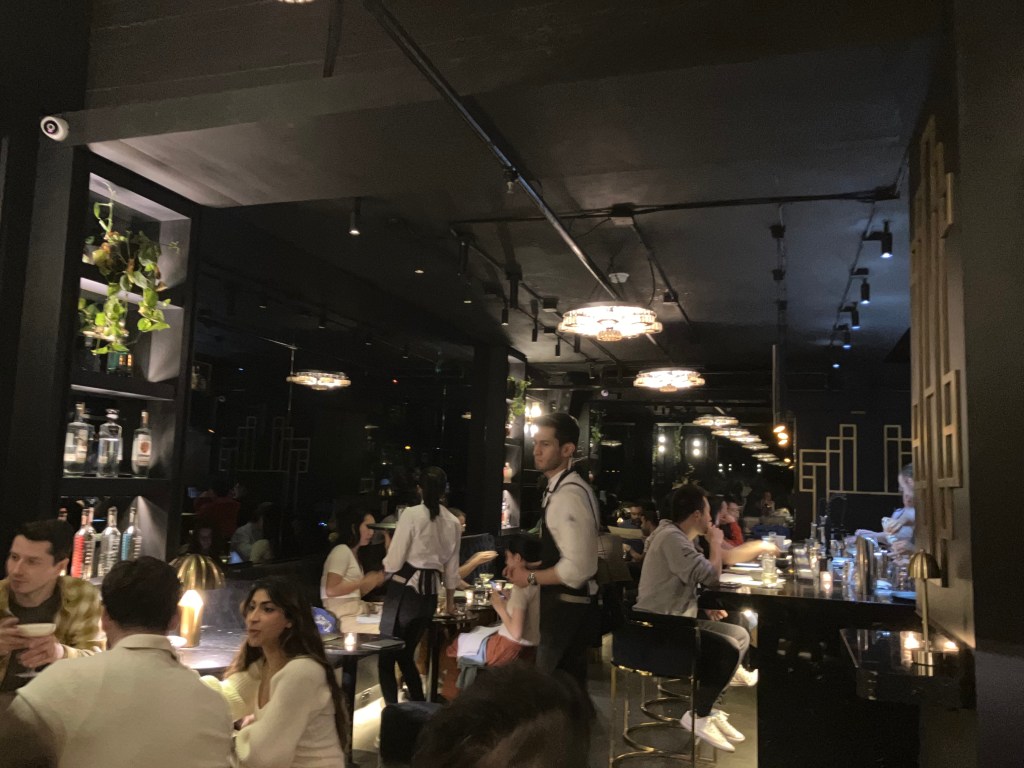
Handshake Speakeasy My wife and I also visited the 7th top ranked bar in the world, Licoreria Limantour — a boisterous bar in the Roma neighborhood with an outrageously tasty mezcal cocktail flavored with pineapple and bitters.
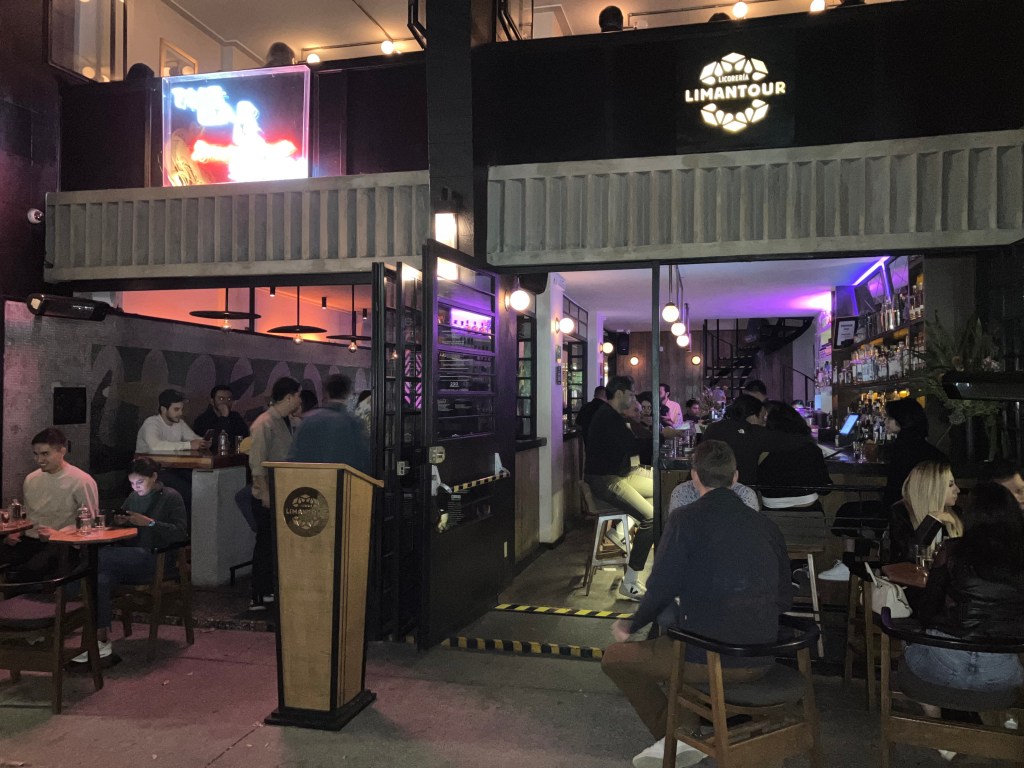
Licoreria Limantour Zesty street life
But Mexico City isn’t all about fine art, fine dining and cocktails with recipes that would intimidate a PhD in chemistry. When my wife and I returned to our hotel after a couple of strong drinks at Licoreria Limantour we saw a large crowd of people dancing to a street band at the Alameda Park across from our hotel, Hilton Reforma. Some were great dancers, some weren’t. All of them were having an marvelous time. So with my hand out and my two left feet my wife and I took a twirl — terrible dancers having a terrific dance. That’s the real magic of Mexico City.

Dancing at Alameda Park Where to stay:
Hilton Reforma for downtown’s buzz. AirBnbs in trendy Roma, La Condesa and Polanco neightborhoods.
Dining and bars:
Mux for Mexican cuisine in Roma; La Catrina churros in Centro Historico; El Morro Churerria in Roma; Baltra Bar in La Condesa.
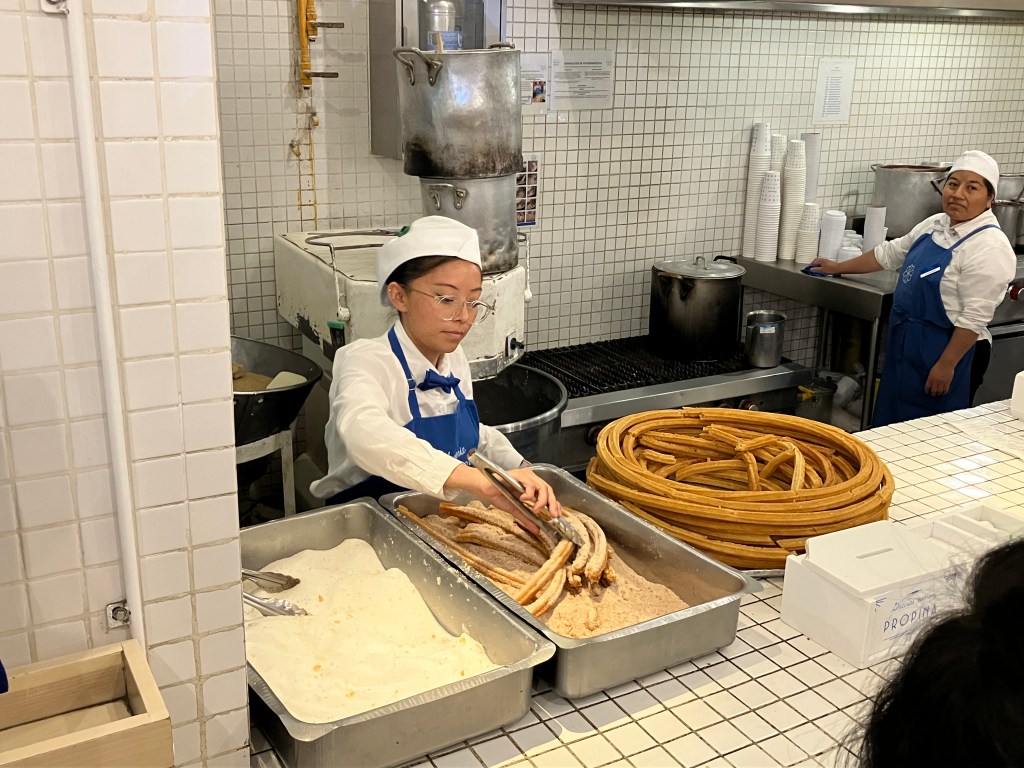
El Morro Churreria Museums and art buying:
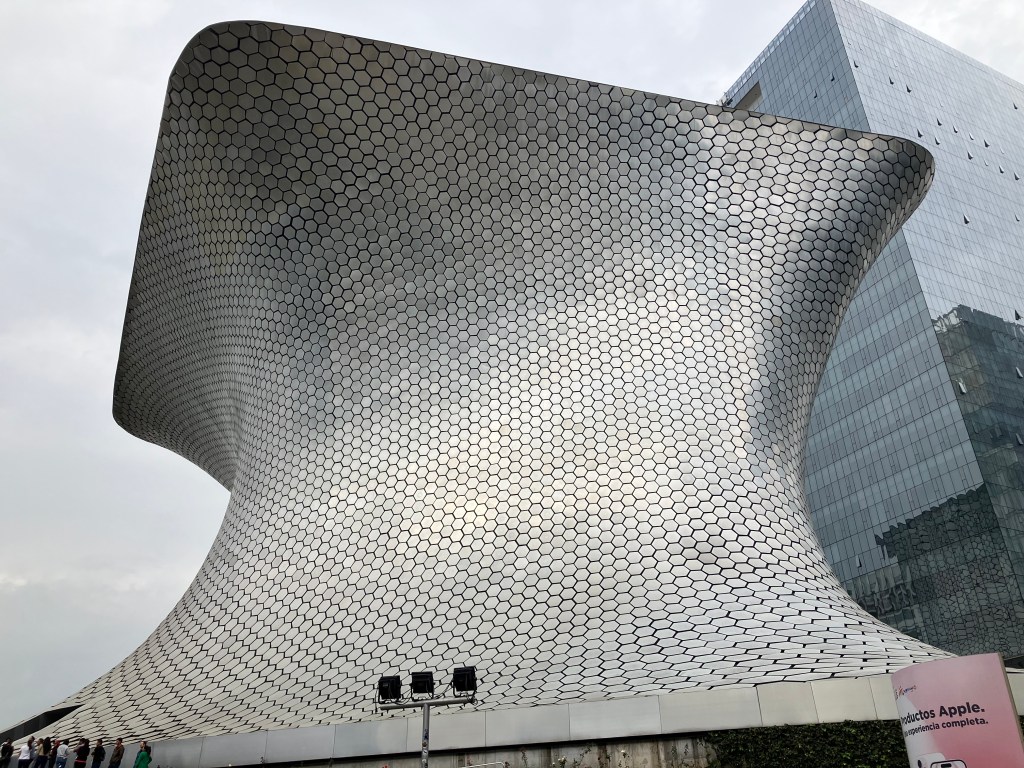
Soumaya Museum, Polanco Soumaya Museum in Polanco. Buy art directly from artists at Jardin del Arte Sullivan on Sundays and San Angel Saturday Bazaar and Art Fair.

Buying a painting at Jardin del Arte Sullivan Where to donate:
Salvation Army has staff playing organ grinders throughout the city.
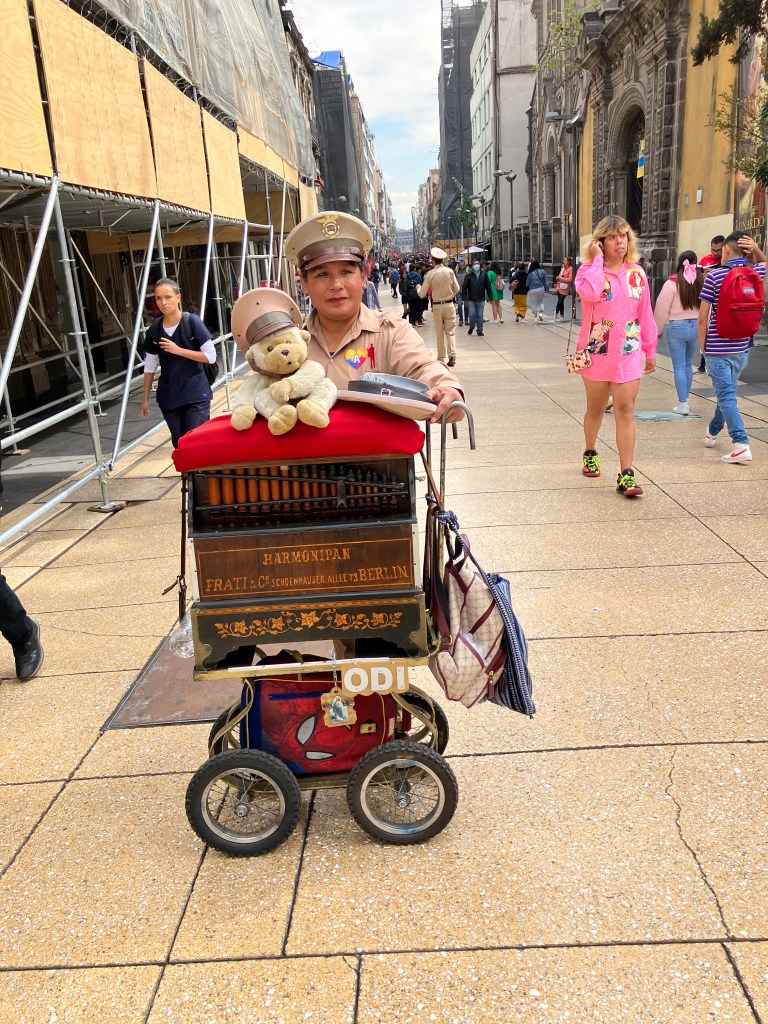
Salvation Army organ grinder Published in Asian Journeys magazine, April-May 2024
-
French Polynesia: A Perfect Paradise in an Imperfect World

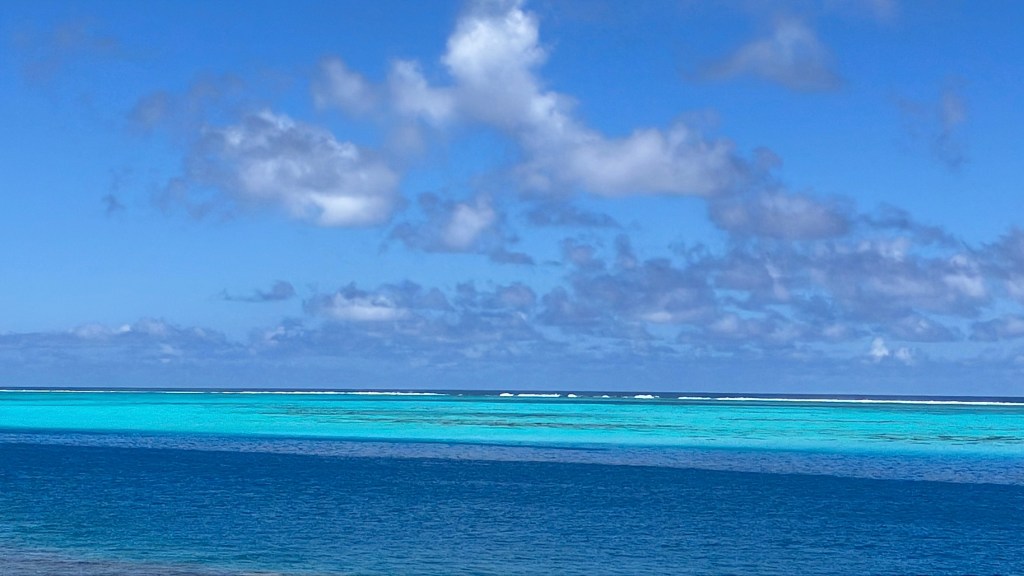
Moorea’s coastline In the Inuit languages of Canada, Alaska and Greenland there are some seventy words to describe ice and snow. There’s nowhere near that number to describe the captivating shades of blue in French Polynesia but perhaps there should be.
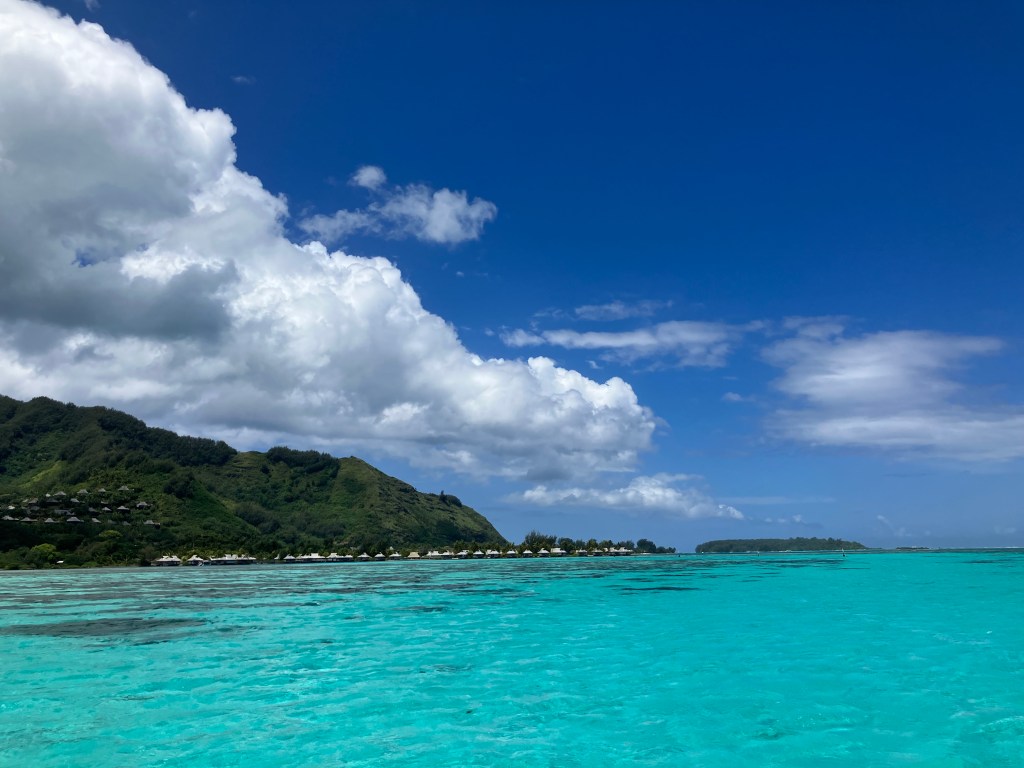
Moorea’s bluest of blue lagoons Paradise found
17th century poet John Milton wrote the poem Paradise Lost. Clearly, he hadn’t visited French Polynesia. On a snorkeling trip off the island of Moorea I sailed across an immense, placid lagoon of iridescent blue. Waves crash in frustration against the reef that protect the island from the ocean’s occasional fury. That sense of a tropical sanctuary has led to this part of the world being called, with justification, a paradise. While French Polynesia faces the same challenges as other modern societies, it’s certainly a paradise in many ways.
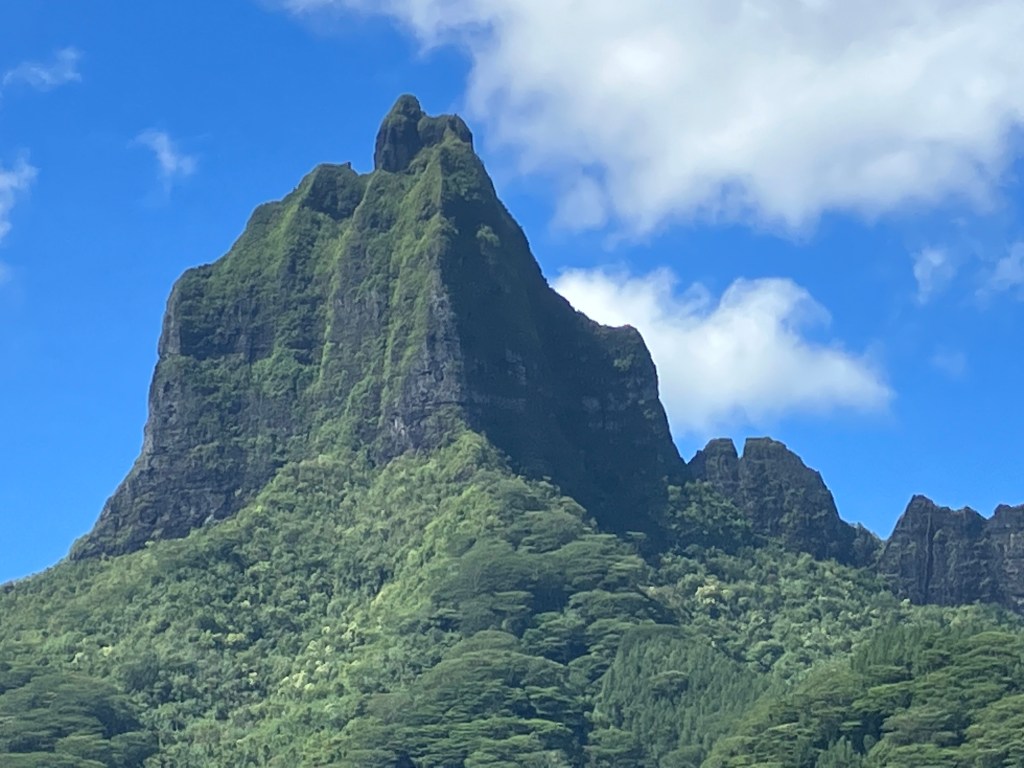
Mt. Tohivea Moorea For lunch, our guide set up a picnic table in the water where he and his wife serve an assortment of freshly prepared seafood and salads. Our small group isn’t alone though. Dining with us are stingrays who rub up against our legs and happily eat whatever we give them in a mouth that is, unusually, on the side of an eye. That sense of harmony with nature persists with a swim later on with reef sharks and stingrays in deeper, crystalline water.
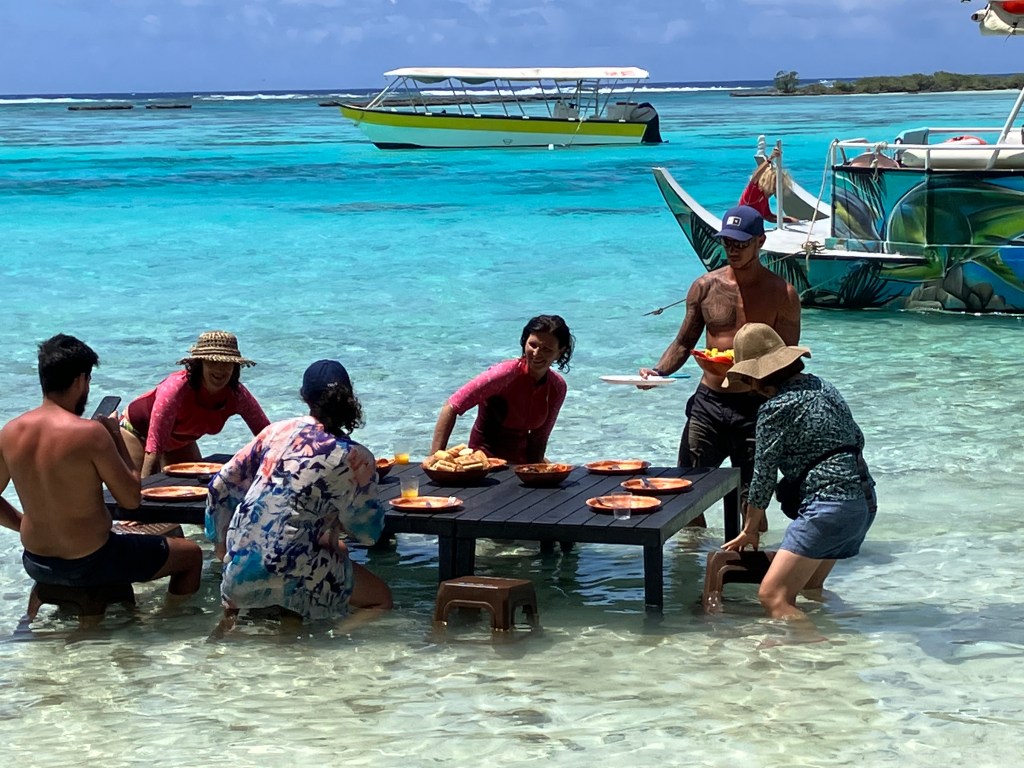
Lunch in the water On the boat ride back to my hotel there is a sense of untouched nature in Moorea, a painterly palette created by malachite green peaks and valleys and the lagoon’s tranquil blues. No wonder Gauguin was inspired by this landscape.
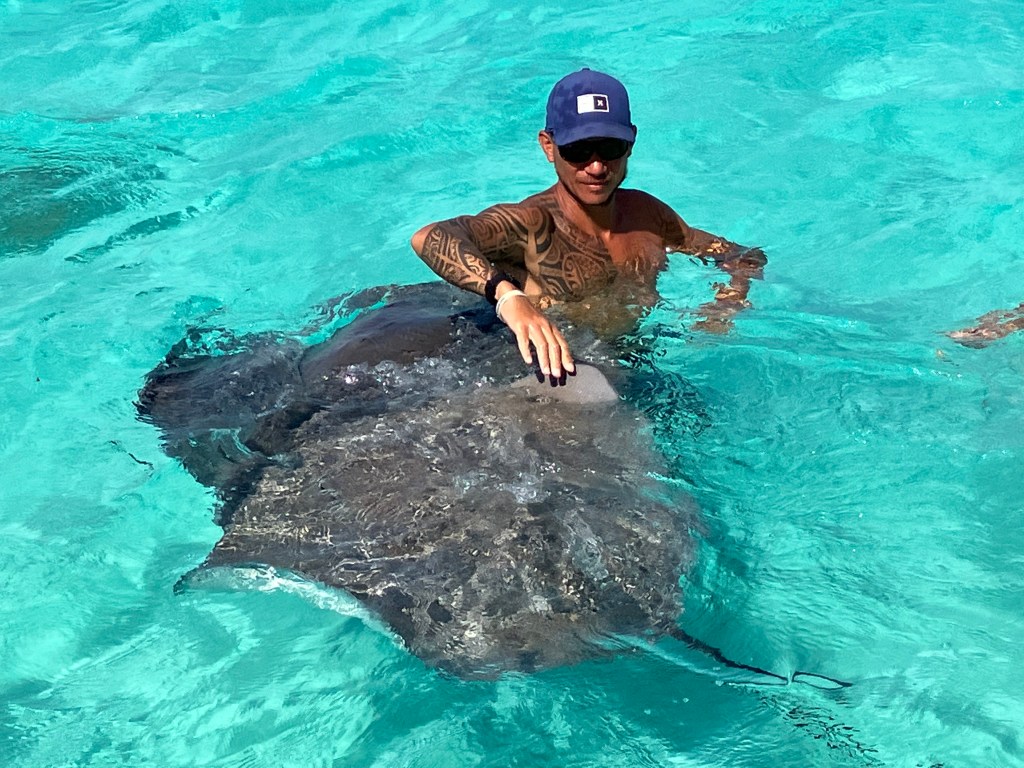
Friendly stingrays Moorea Moorea, an island of 14,000 spread over 134 square kilometers, is part of the Society Islands, named after the Royal Society, which sponsored Captain James Cook’s first expedition to the islands in 1769. It was only on his third expedition in 1777 that he visited Moorea and Cook’s Bay, now called Paopao Bay.

Paopao Bay Moorea 
Mt. Tohivea and pineapple plantations Moorea Our exploration the following day of Moorea’s inland reveals isolated villages and pineapple plantations abutting ragged peaks, the most striking of which are the 900- meter Mount Rotui and 1,200-meter Mount Tohiea. Workers, bent over, pluck ripe pineapples from the soil. A craftsman in the village of Maharepa demonstrates a nose flute and I promptly buy it – although whenever I try to play it, I sneeze. At the hotel that evening Polynesian dancers perform ancient island dances accompanied by musicians playing traditional instruments, the tunes somehow in sync with the waves lapping the nearby beach.

Polynesian dancers 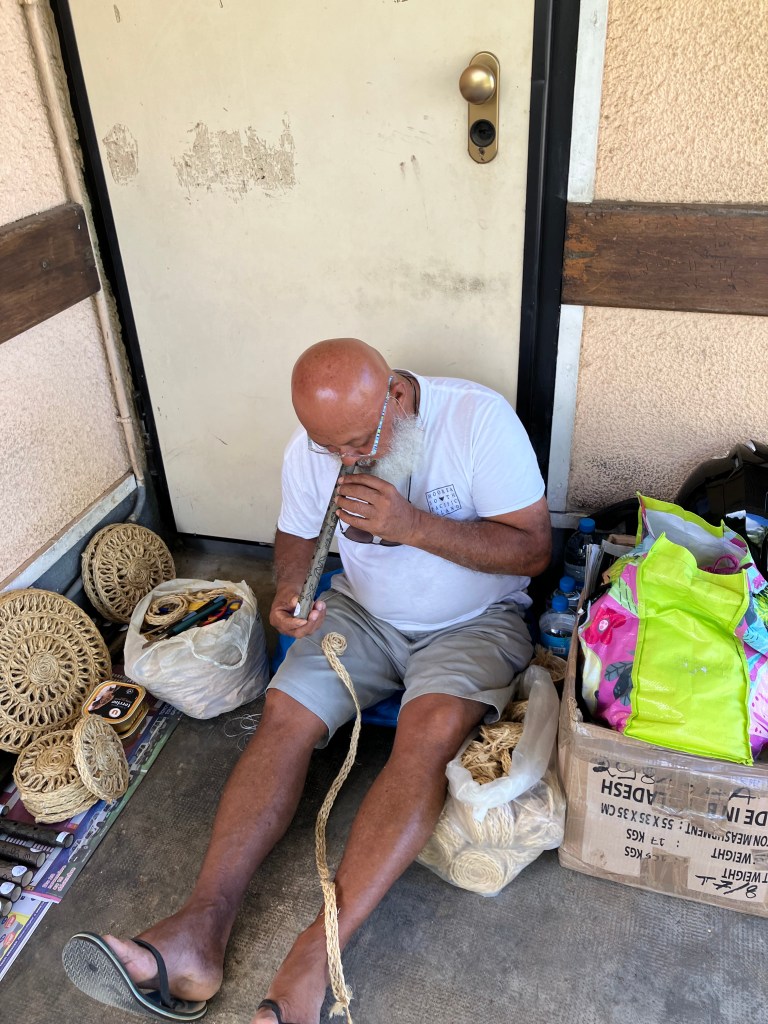
Playing a nose flute To return to Tahiti I take the almost hour long Aremiti ferry from Terevau village in Moorea to Papeete.

Mt. Rotui Moorea Territory’s capital fuses urban grit with colonial monuments and architecture
French Polynesia, a territory of France since 1880, is spread over 121 islands that cover an area, including ocean, of 5.3 million square kilometers, about the size of Europe. The population, though, is only about 280,000 people. It’s 6,000 kilometers from Australia; 7,500 from Chile; and 15,700 kilometers from Paris. The fastest way to fly to Tahiti from France is via Los Angeles.

Notre Dame cathedral Papeete Papeete, the capital, with a population of 137,000, has the only international airport. Despite its majestic South Seas location on the island of Tahiti, it drips with urban grit. French and Polynesia cultures mix both easily as well as uneasily in the city. The Notre Dame Cathedral, built in 1875, has a tall spire that towers over the city. Inside is a woodcarving of a Madonna and child with Polynesian features with the child holding a breadfruit. Bright murals enliven the city while buildings and monuments project French colonial rule. The streets are largely devoid of pedestrians.

At Place Tarahoi is the Assembly of French Polynesia, built in a style that pays homage to Polynesian architecture. The legislative arm of government, it has 57 members who are elected for 5 years. They, in turn, pass legislation and elect a President of French Polynesia for a four-year term.

Assembly of French Polynesia Across from the Assembly is a monument to Pouvanaa a Oopa, a Tahitian politician who led the independence movement while he served in the Assembly from 1949 to 1958. He was imprisoned for eight years on an arson charge and spent a further fifteen in exile in France before being exonerated in 2018, 41 years after his death.

Polynesia deity Papeete Just across from his monument are stone statues of Polynesian deities and the Residence of the High Commissioner of French Polynesia, the leading colonial official who is in charge of defence, foreign relations and justice.
On the main artery of Avenue Pouvanaa a Oopa is a simple stone monument to Charles de Gaulle and the residence of the President of French Polynesia. The gingerbread-style building, surrounded by palms and lush tropical landscaping, was formerly the French military’s Broche Barracks before being converted in 2000. Across the avenue is the War Memorial, built in 1928, honouring the Tahitian soldiers who died fighting for France in World War I.

Charles de Gualle monument Papeete Joie de Vivre in Papeete
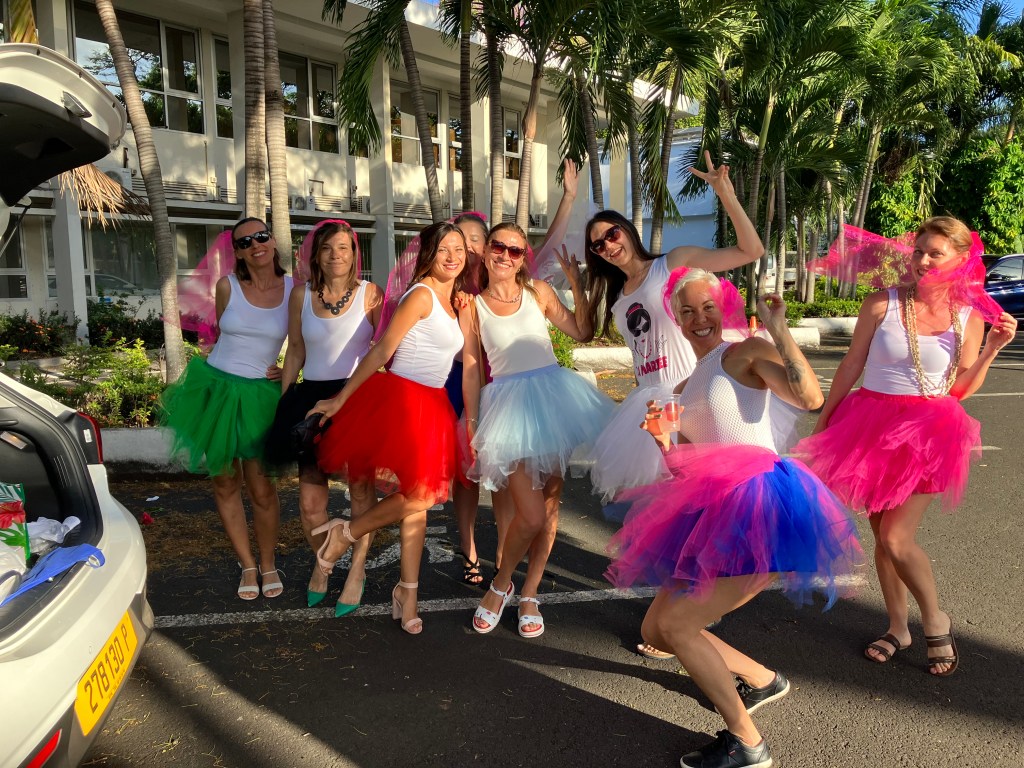
French bride and bridesmaids Papeete I stumbled upon a French bride and bridesmaids, bursting with energy, at the start of a big night out before the wedding the following day.. Along the pleasant waterfront promenade is a towering Christmas tree made from coconuts and shells and a reproduction of a huge double-hulled canoe that ancient Tahitians used to explore and populate the South Pacific, including Hawaii. The harbour is jammed with yachts of the ultrarich. Along the sidewalks downtown are sellers of flower leis, a fragrant kaleidoscope of colours to wear around your neck. Elsewhere are sellers of leis made of shells.

Leis made of shells For dinner, one of the best deals in French Polynesia are the roulettes at the Papeete wharf. These food trucks with outdoor tables sell huge plates of fresh fish and rice for $20 and plenty of other dishes. Both the massive cranes of the wharf and the mountains of Moorea are visible from where you eat. While the tourists love the roulettes, so do the locals. It gives me a chance to break away from the tourist path to experience the convivial warmth of Tahitians.

Roulettes Papeete wharf Bucket List island that isn’t just a tick on a checklist
While Papeete shows that the magnificence of nature in French Polynesia can be somewhat undercut by the ministrations of man, my last stop in the territory is perhaps its most famous destination: Bora Bora.
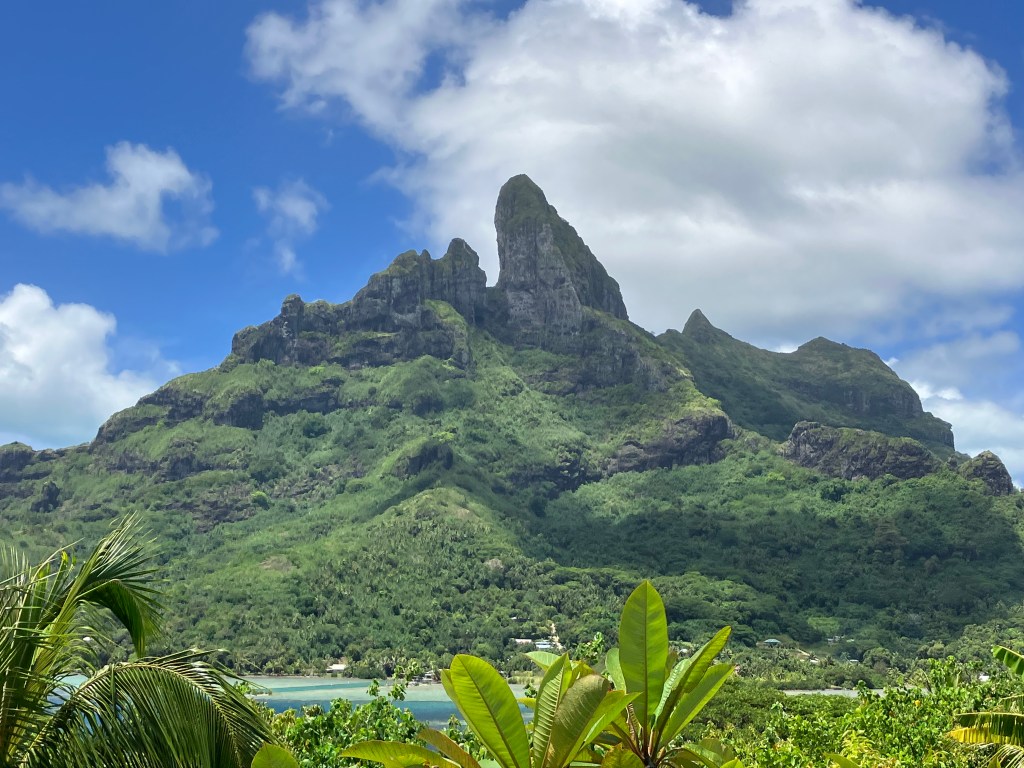
Mt. Otemanu Bora Bora French Polynesia is known as a ridiculously expensive travel destination. There are ways around it everywhere but as far I could tell not in Bora Bora. It’s a bucket list destination and knows it.
As I didn’t have time to take the seven hour ferry from Papeete to Bora Bora I took the 45 minute flight on an Air Tahiti ATR instead for around $400 round trip. At Bora Bora’s airport, a bag of Lay’s potato chips is about $9. A cheap hotel is easily more than $200 a night.
Made famous in James Michener’s novel Tales of the South Pacific, Bora Bora with a population of 10,000 is consistently rated as one of the top islands in the world to visit. During World War II, Bora Bora was a US military supply base known as Operation Bobcat, complete with an airfield and coastal batteries. The airfield is now the airport and the coastal guns are scattered around the island. The 6,000 American soldiers stationed here never saw action, dated Polynesian women and no doubt worked on their suntans while most of their comrades were fighting in brutal battles. When they returned home they spoke of their experiences and word of mouth made Bora Bora a catchphrase for an island paradise.

American coastal battery in front of Mt. Otemanu Bora Bora And it is. The 727-meter extinct volcano Mt. Otemanu at the center of the island has the shape of a sabretooth tiger fang from some angles. The lagoon wraps around the island like blanket of blue. The airport is on the islet of Motu Mute and from there I took a ferry ride to the main town of Vaitape.
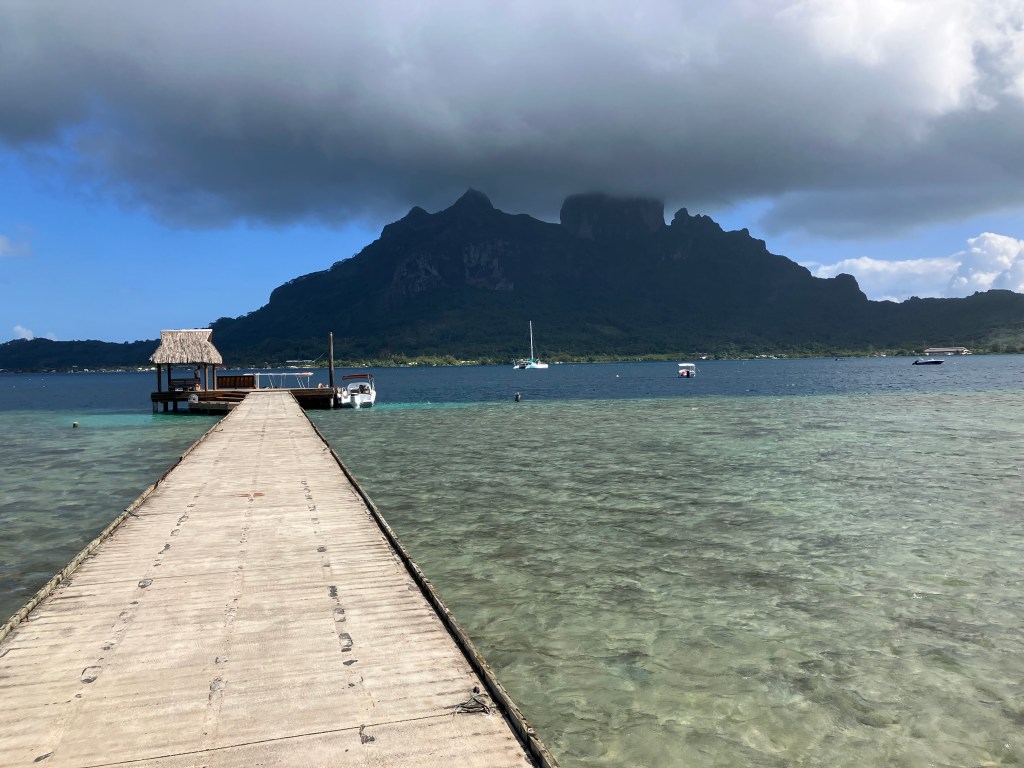
Mt. Otemanu Bora Bora Not doing much is as much as you should do

Polynesians chilling in Bora Bora Not doing much of anything is the whole point of visiting Bora Bora. I stroll on the boardwalks of hotels with overwater bungalows; gaze at a menagerie of fish while my feet sink into the silky sand; visit the celebrity restaurant hangout of Bloody Mary’s. No celebrities, but plenty of tourists drinking and dining there at inflated prices on the chance that they might see one. A wooden tiki with a red elongated tongue seems to be mocking them. Sunsets are spent stepping away from a chilled glass of Tahitian Hinano beer at the Bora Bora Beach Club and wading into the pristine blue waters of Matira Beach and waiting, just waiting patiently, for the sun to set. Somehow that never gets boring or repetitive. If Bora Bora is a musical ensemble it would be a string quartet.

Beer at Bora Bora Beach Club Matira Beach I realize by the end of my trip that unlike the Inuit peoples the Polynesians don’t need so many words to describe the overwhelming shades of blue that colour their seas and lands. After all, how can they invent so many words when the scenery leaves you speechless. French Polynesia is no perfect paradise but at times it comes close.
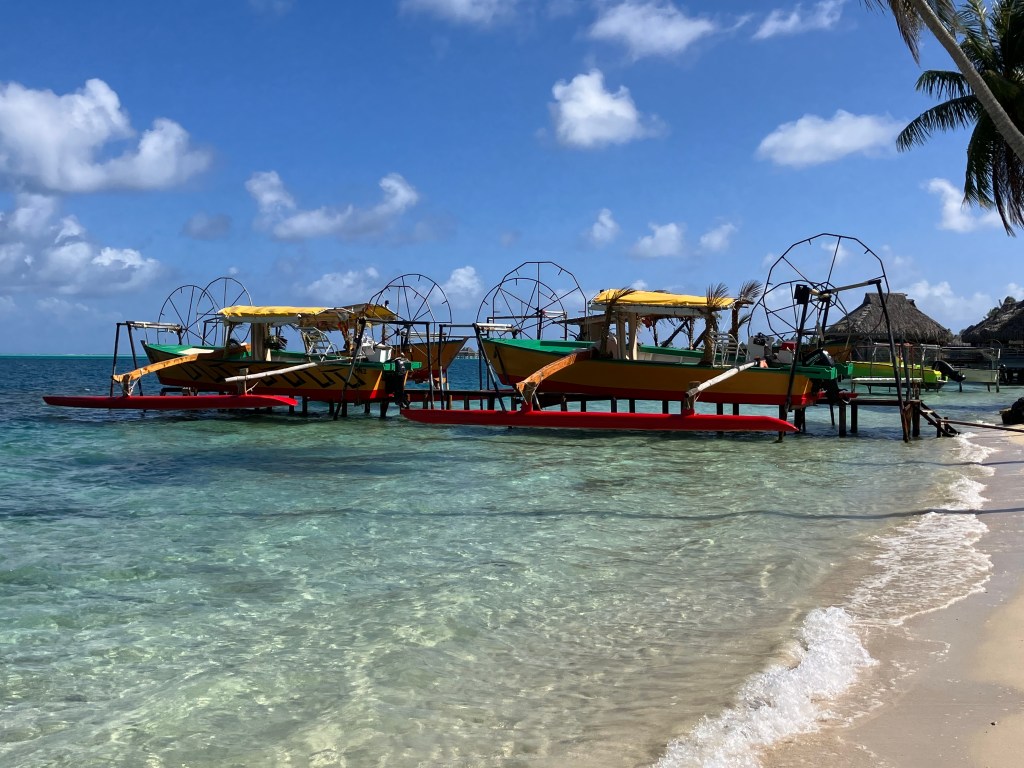
Fishing boats Bora Bora How to get there:
Air Tahiti Nui, a first rate airline, is the national carrier of French Polynesia. Its customer service staff are the friendliest and most helpful I’ve ever encountered.
Places to stay:
The hotels I stayed at are all excellent, though pricey. Hotel Maitai in Bora Bora is laid back and rustic with a great location near Matira Beach. Hotel Manava in Moorea is a polished French resort. Hotel Intercontinental in Tahiti has spectacular views of Moorea and its own lagoon.

Places to eat:
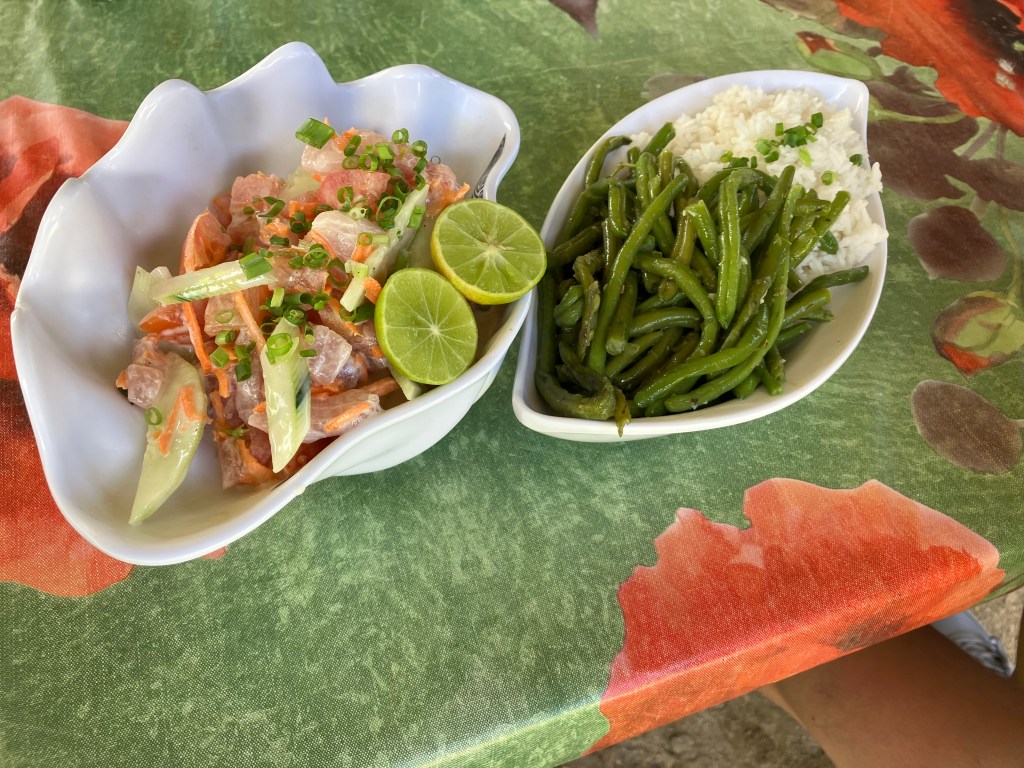
The roulettes at the Papeete wharf are affordable places to eat fresh food. Kaylakea Moz cafe in Moorea serves a huge portion of poisson cru for about $15. Bora Bora’s cafes serve pizzas and local fish at prices that don’t break the bank. Hotel restaurants are incredibly expensive. Unless you’re on a package tour it’s best to avoid them to stretch your dollars.
Tours:
Taxis and car rentals are very expensive. Tours are a more affordable way to see the sights. Moorea Seafari Cruises has an incredible full day snorkelling and boat tour. The captain is one of Tahiti’s leading singers.
Currency:
The currency is the French Pacific Franc. One USD is about 107 CFP.

Bora Bora Published in Asian Journeys magazine, August-September 2023
 Maybe Next Trip