After the September 11th hijackers carried out their evil deeds across America, the media and just about everyone else were left scratching their heads wondering what sickness could possibly drive young men to choose suicide as a way to prove their allegiance to an ideology. The same bafflement applies to the Tamil Tiger bombers blowing up politicians and themselves while conducting their war against the Sri Lankan government. And, of course, to the crazy legions of Palestinian terrorists turning themselves into human bombs at Tel Aviv discos or Jerusalem pizza parlors.
While I doubt we’ll ever fully understand the private motivation or personal confusion of the individual bombers, today’s suicides aren’t the first: they are all following in the doomed footsteps of the Japanese kamikaze pilots of World War II. Bizarrely enough, for those who interested to learn more about these infamous pilots and their mystique, there is a “Peace Museum” honoring kamikazes in the very peaceful village of Chiran.
Chiran is a beautiful little town an hour’s drive south of Kagoshima on the southern Japanese island of Kyushu. Terraced rice paddies and forested hills greet a traveler’s arrival in what is a gem of rural Japan. A narrow goldfish pond runs alongside one of the sidewalks that ribbons through the center of the town. Small shops sell purple yam chips glazed in sugar, a regional specialty. They even sell yam ice cream. Near the center of town are samurai houses from the 19th century. Tranquil gardens, hidden from the road by a high and lengthy stone wall, lounge behind each of the houses. Tourists drift in and out as they savor the delightful mixing of elements necessary for a Japanese garden – color and sound, texture and moisture. It is easy to imagine how the “perfect retreat for the spirit” can be achieved in some of these gardens, which are protected national monuments.
Those gardens and their past warrior occupants epitomize the dueling essence of the town. For the samurai citizens of the past surely were the inspiration for the kamikaze warriors of World War II. At the Chiran Peace Museum for Kamikaze Pilots, the heroic lives – and dramatic deaths – of the samurais are honored in great detail.
Chiran was the choice for the kamikaze museum because one of the airfields for the “special attack corps” (no kidding, that was their official military identification) was in the town’s vicinity. Their eerie motto was “a battleship for every aircraft,” and if they didn’t succeed in their mission there was no worry about military punishment because they all died trying.

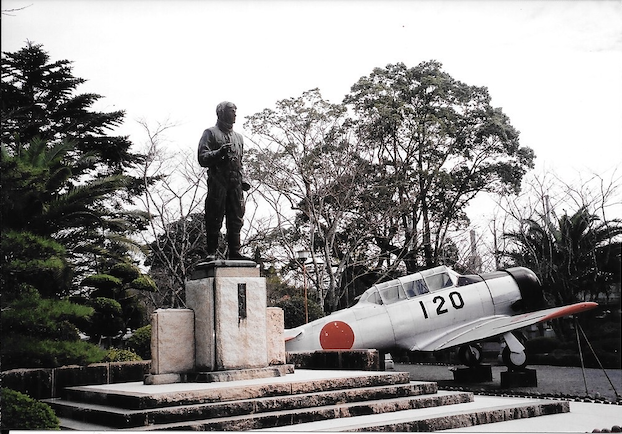
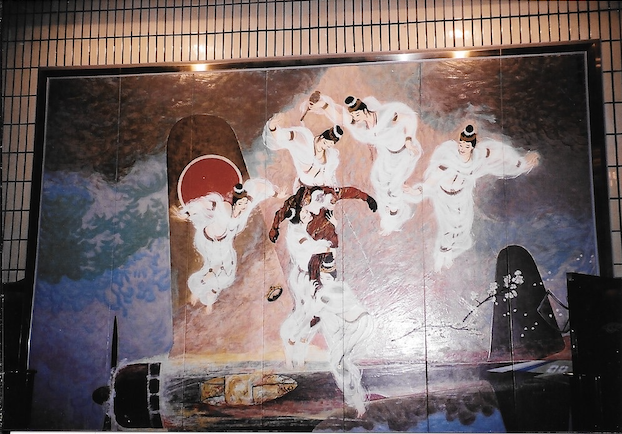
The museum was opened in 1975 as part of a complex. Next to it is the Heiwa-Kannon Temple containing the goddess Kannon, who appropriately enough in this case is symbolic of pity. The temple was opened in 1955. The museum is in the shape of a plane. In front of it is a bronze statue of a kamikaze pilot next to a Mitsubishi Zero. In the entrance hall is a huge lacquer-wood painting of a kamikaze pilot’s body being lifted from a burning plane and gently carried by a half-dozen angelic spirits to a better afterworld – his sacrifice supposedly not in vain.
On the day I dropped by for a visit, the museum was jam-packed with visitors. That surprised me a bit because I had visited a number of museums in Kagoshima and its vicinity and all of them were noticeably empty. Not this one. Perhaps interest and shock over the September 11th attack made the museum a more interesting and timely destination for Japanese trying to find historical references for a new crisis.
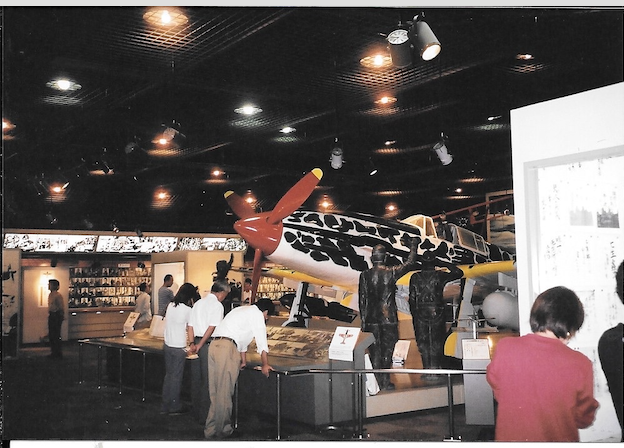
The museum’s main hall is dominated by a Mitsubishi Zero and a statue of a brave pilot saluting from the cockpit. His proud, stiff-armed salute is being returned by two other pilots bidding him farewell – from the base and no doubt from his life too. Surrounding the plane are exhibits featuring personal mementos from the actual pilots themselves: letters, watches, binoculars and photos, for example. In all of the snapshots, the would-be suicide bombers are smiling, arm-wresting, saluting, eating, drinking ceremonial cups of sake, and being waved off to duty by cooing girls with flowers in their hands.
The visual presentation is only the beginning. The voice on the audio guide describes all of the pilots’ love of life, adding the discreet caveat that their willingness to pay the supreme price is the result of a patriotic virtue to defend the homeland. The audio guide’s narrator, with her unusually sweet voice, describes how the pilots would cry into their pillows on the night before their missions, leaving the pillows soaking wet with tears. But seconds later she goes on to describe the kamikazes’ brave smiles as they flew off as just that – brave smiles. No comment is made about the opposing realities of suicide and bravery.
Kamikaze pilots entered World War II during the battle for Okinawa. In total, 1,036 pilots sacrificed themselves in explosives-filled planes in a desperate effort to try and stop the American invasion. Of course, the tactic and the kamikazes failed. In addition to Chiran, they flew from bases in Bansei, Miyakonojo, Kengun and Taiwan.
In the museum there was a video of the Battle of Okinawa. The benches in front of the video were full of people staring somberly as plane after plane was shown being destroyed by U.S. artillery before hitting a targeted battleship. Eventually, one kamikaze Zero did hit a ship, but the senseless loss comes through clearly in the video. At the moment of impact, the soundtrack changes from the battle sounds of exploding flak and fiery descents of planes to classical music – as if the whole situation were all a bad dream.
Outside of the museum’s theater, there is a room filled with uniforms. And another room with colorful funeral wreaths piled high on the walls. And still another with a crashed plane that had been recovered, cleaned up and put on display, minus half the fuselage. But it is outside the museum next to the Kannon Temple where a visitor gets the closest sense of the men in the photos: Rows of stone lanterns cover the grounds. On each one there is a relief carving of a kamikaze pilot with a small Mona Lisa smile on his face. Their enigmatic smiles direct you to the lone surviving barracks where some of the pilots spent their last night.

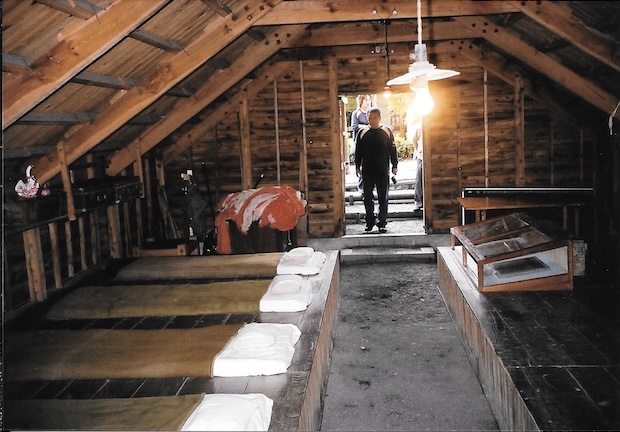
Decades after they were built, the kamikaze barracks remain just as they were when they housed their terminal residents: very spartan, and camouflaged by trees to protect them from American bombers. Naked light bulbs throw a harsh glare on the room, and lumpy futons covered with green blankets sit on raised wooden platforms. But it was those pillows that drew my attention, the pillows that supposedly were saturated with tears on the morning of the suicide pilots’ last day. It was on those pillows that the kamikazes left their fears and their futures behind to do their awful work.
Published in The Asian Wall Street Journal, November 16, 2001
 Maybe Next Trip
Leave a comment