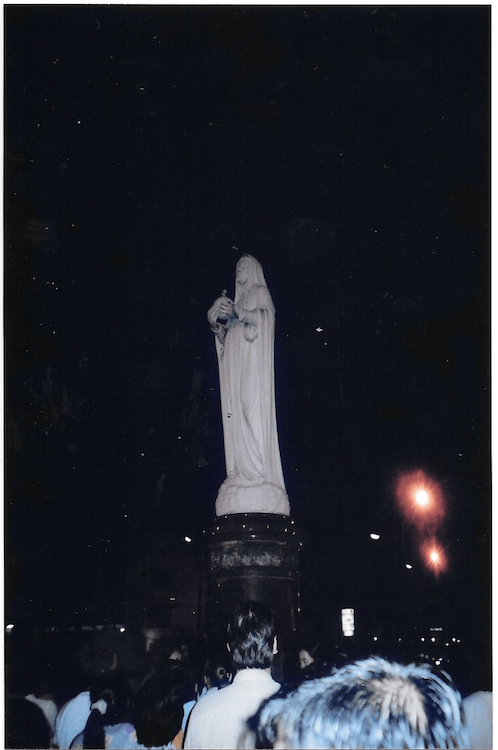
Dong Khoi Street is home to a Prada store and a brand new shopping mall. And for the past few weeks, Saigon’s upscale shopping district has been the site of what many Vietnamese Catholics believe to be a miracle.
After word spread that on Oct. 29 a tear streaked down the face of the Virgin Mary statue, staining it, several thousand people flocked to Saigon’s Notre Dame Cathedral to see it. Crowds, many with mobile phone cameras, gathered to record the sight. Initially only city dwellers came, but soon, visitors from the countryside came, too. Traffic around the cathedral slowed to a crawl, and the police arrived to maintain order.
More than a week later, there was still a mark on Mary’s face, and the phenomenon continued to attract hundreds of daily visitors. People took turns crowding on to the small traffic island that is the site of the four-meter high statue. City gardeners in orange jumpsuits busily repaired the damage caused by feet trampling the grass and shrubbery around the statue.
Vietnam’s government has been widely criticized for cracking down on religious groups. The U.S. Secretary of State this week again designated Vietnam as a “country of particular concern” in its annual report on international religious freedom.
Still, several religions, including Roman Catholic and Muslim religious organizations, among others, are officially recognized in Vietnam. There are an estimated five to eight million Roman Catholics in this country of around 80 million. From Phat Diem Cathedral in the north to Notre Dame Cathedral in Saigon, there are so many worshippers on Sundays that people spill out of churches.
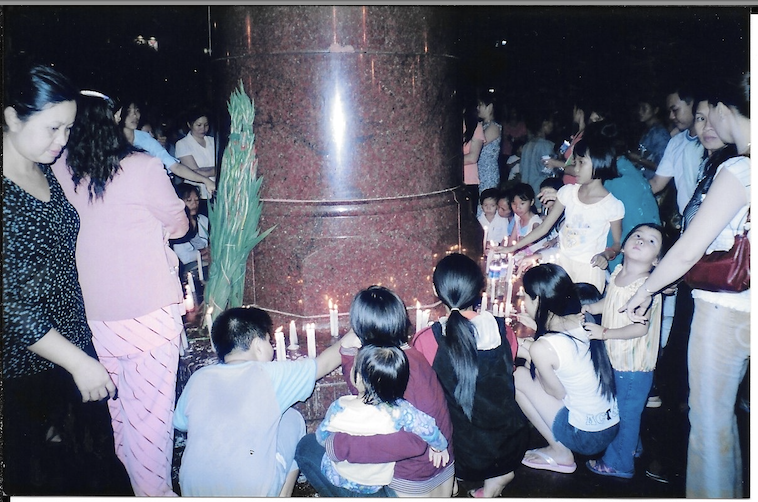
For the most part, the crowd around the Mary statue was orderly. During the day, a sea of umbrellas floated above the crowd as people protected themselves from Saigon’s blazing sun. At night, candles and flowers were placed around the statue, turning it into an outdoor shrine.
The mood wasn’t completely solemn, however. Children played around the statue. People sold drinks, ice cream, peanuts, prawn crackers — even cotton candy and balloons. Japanese, American and other foreign tourists have visited the site.
The event has been the talk of the town, and the subject of articles in local newspapers. Those keeping a vigil at the statue say it’s a miracle; others say it’s a warning. Some Vietnamese speculate that the tear is an omen about an impending bird-flu pandemic. Some even drew connections between Tuesday’s earthquake — centered in nearby Vung Tau but clearly felt in Saigon — to the weeping statue.
Other Vietnamese I spoke to were more skeptical, saying the streak was just a mark from the heavy rain that recently fell upon the city. Some speculated about mischief. An executive at a large manufacturing company told me: “I think a game is being played on people. A person put that mark on her face.” Others were simply unmoved by the event. One woman said: “In many countries Mary cries. So it’s not a big deal.”
The authorities appeared to be tolerant of this public act of faith. I didn’t notice any visible restrictions on who could visit the statue, just some traffic cops making sure people don’t spill out into the streets in front of cars and motorcycles. The police actually discouraged hawkers from selling photos of Mary’s tear-streaked face with a digitally added halo. They don’t want a religious event to be used as a commercial opportunity.
The crowds of believers surrounding the statue of Mary — against the backdrop of the fancy boutiques and trendy art galleries on Saigon’s Dong Khoi Street — is a telling sight. It suggests that the economic growth and cultural vitality in this communist country are being accompanied by an upsurge of spirituality.

Published in The Wall Street Journal, November 11, 2005
 Maybe Next Trip
Leave a comment