
When I arrived at night I saw a poster asking for votes for Vigan to be one of the new seven wonder cities of the world. It was the first time I had heard of the vote let alone seen a city lobbying for to be one of winners.
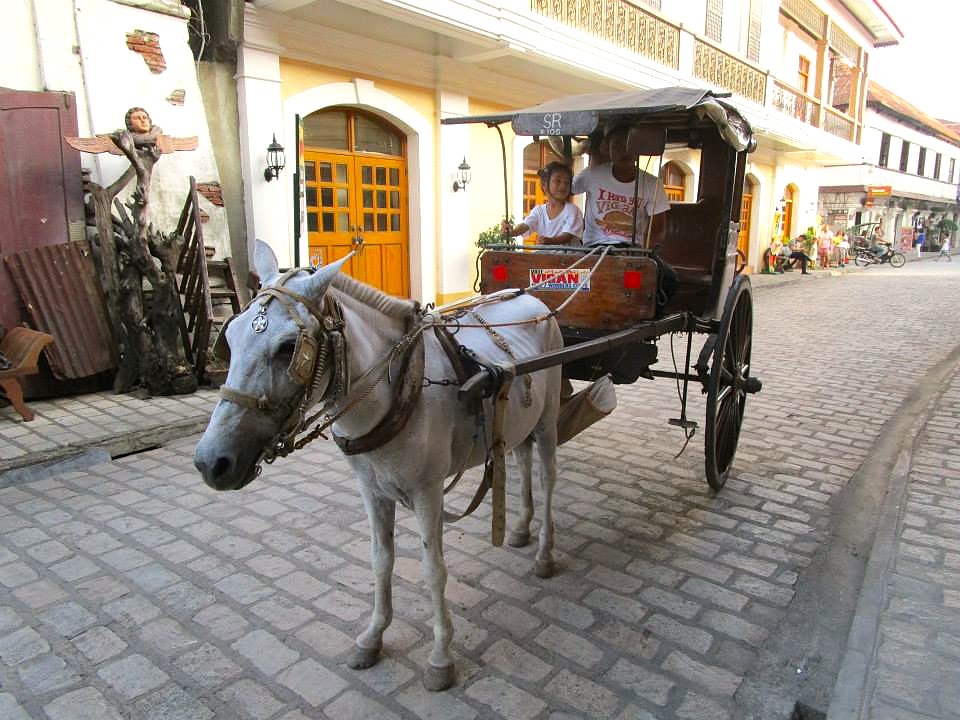
Over an al-fresco dinner along a cobblestoned lane, surrounded by Spanish-era mansions from the 19th century with capiz-shell windows, I wondered how 21st century social media could transform this place. Kalesas, horse-drawn carts, are still a form of public transport, the sound of hooves nearly as common as the buzzsaw sound of low riding three-wheelers. At night, the yellow tinted streetlights gave the town a sepia-toned look, like a faded postcard from a bygone age.
PHILIPPINES ONLY UNESCO HERITAGE TOWN
With a population of 50,000, Vigan is the Philippines only UNESCO heritage town and the best preserved Spanish colonial town in Asia. It has Vietnam’s Hoai An’s antiquity and charm without the tourist hordes and glossy five star hotels. I saw only a dozen or so foreign tourists during our four days there and not that many local tourists either.
With mansions from Filipino, Chinese and Mestizo merchants lining street after street, some well-restored, others falling apart, some just plain run down, it feels like a place that skipped a beat in time. I was reminded of my first visit to Myanmar in 1981 where cars from the 1960s were traversing the roads. Or, my first visit to Luang Prabang in Laos in 2001 where monks in flowing orange robes were the most commonly seen pedestrians. Vigan is that rare town in Asia — a piece of the past that looks joyfully stuck there.
Vigan almost had the war-ravaged and recovered look that many places in Asia have. At the end of World War II, American bombers were about to target Japanese forces stationed there when they found that they had already left. Just before the bombing run the planes pulled up and headed back to base.
The best place to start is the Plaza Salcedo where the St. Paul Metropolitan Cathedral is. A massive pale yellow edifice with white trimming flanked on one side by the archdiocese building, inside ivory-carved saints with natural hair wigs looked down upon the devoted. Kalesas were lined up in front of the church.
Across from the church is the Vigan Dancing Fountain where every night at 7:30pm multi-colored water sprouts swing to the beat of decidedly modern talents such as the Irish chanteuse Enya.
Then further along the church-state power axis is the capitol of the state of Ilocos Sur. A stolid Spanish colonial building, it’s an imposing counterweight to the church.
Next to the town’s other plaza, Plaza Burgos, is the beating heart of Vigan, Crisologo Street. A pedestrian only cobble-stoned lane lined with mansions and stores selling antiques and handwoven items along with some cookie cutter tourist souvenirs, kalesas regularly trot down it. Some of the antiques were good finds. My wife and I bought a beautiful Chinese porcelain plate painted with swimming fish, a reminder that Vigan is just a few kilometers from the shore and has been a trading port since before the Spanish arrived.
PHILIPPINES “MACONDO”?
On Quirino Blvd, we visited Syquia Mansion, home of Elpidino Quirino, the sixth President of the Philippines. Inside was a 19th century European home with unique Filipino touches. Figurines graced oversized antique mirrors and furniture. Paintings of the house’s most famous occupants were set high in the living room, looking down at visitors. Sprinkled throughout the home were black and white photos depicting earlier eras in a time-warped town. Filipino touches were panels of fabric that hung from the ceiling over the dining room table where they were pulled back and forth to create a cooling breeze. Between the outside of the home and its interior was a narrow corridor which was meant to trap the heat.
On Liberation Blvd. is the Crisologo mansion. The Crisologos were one of the leading families of Illocos Sur. Floro Crisologos was governor, senator and a Philippine military adviser during the Vietnam War. At the museum is the rusting Chevy his then pregnant governor wife Carmeling was in when it was attacked, bullet holes along one side of the car. She survived. But he wasn’t so lucky, having been assassinated in the cathedral in 1970. His trousers, neatly ironed, covered in dried blood, sit in a glass case, along with his shoes and a glasses case, a reminder of his sacrifice.
The presence of the Sy and Crisologos families dominating the town reminded my wife and I, both fans of the Gabriel Garcia Marquez book, “100 years of Solitude,” of the mythical town of Macondo. You sensed that there was a novel hiding somewhere in the town, in hidden courtyards, up musty stairwells.

A visit to the museum in the Archbishop’s palace gave you the sense of the pull of faith. Religious icons carved in ivory, embellished by silver, were pushed together in the downstairs room of the museum. But it was the upstairs, where the baroque presence of the palace held heavy sway. You could feel the secular power the clergy once had.
FAMED POTTERY AND LOOMWEAVING
The iron pottery works at the edge of the town have been a traditional source of commerce for centuries. The RG Jar Factory has a fifty-meter dragon kiln which can bake a thousand pots at one time. The pottery is called “iron” because a tap on it with a coin provides a metal clink even though it is clay.
Loomweaving is another traditional form of commerce. Barangay Camaggaan is about a fifteen minute three-wheeler ride from town and has a half dozen looms all being worked to create colorful blankets, towels, placemats, washcloths.
GOOD BASE TO TRAVEL ILLOCOS
Getting to Vigan isn’t easy. It isn’t on the way to anywhere else. It’s an eight-hour bus ride from Manila or you can fly into the city of Laoag, captital of Illocos Norte, and take a two-hour car ride south to the city.
The town provides good base to explore Illocos, an under touristed part of the Philippines.
South of Vigan, about an hour coastal drive, is the UNESCO protected church of Santa Maria, at the top of eighty-eight granite steps, an auspicious number. Built in 1769, it is what is known as “earthquake baroque”. This architectural style is only found in the Philippines and Guatemala, because of their proximity to earthquake zones. The churches were designed lower and wider with broad-shouldered walls that are heavily buttressed to provide stability during seismic shaking. Santa Maria’s bell tower was stout in keeping with the style. Inside the empty church birds flew to and from the nests they created in the eaves.
CATHOLIC ANGKOR TEMPLE?
North of Vigan about an hour is the town of Paoay. In the 19th century the town was famous for two of its sons: Antonio Luna, a general and Juan Luna, one of the Philippines most famous painters. The latter’s house is a museum. Paoay is also famous for another UNESCO protected baroque church, St. Augustine’s, also known as the Paoay Church. Begun in 1704 and finished ninety years later, it sits in the center of manicured lawns with plants growing haphazardly from the building, giving it the mysterious aura of a Catholic Angkor temple, a place of faith still standing in a place of implacable elements.
MARCOS COUNTRY
Paoay is also Marcos country. While he may be reviled as a dictator in the rest of the Philippines in his home province of Ilocos Norte he is the favorite son. You can get Marcos t-shirts, iphone covers, watch a game at the Marcos stadium, take classes at Mariano Marcos State University, named for his father. At the Malacanang of the North, the traditional mansion on idyllic Paoay lake, you can see how the Marcos family lived and played during his more than two decades in power. The family still
holds the political power in the province with his daughter Imee as governor, his son Bong, a senator, and his shoe-loving wife Imelda, a congresswoman.
The Marcos museum pays homage to his life in a way that is more fitting for the hero of a pulp romance novel. He developed toughness from his grandfather during stints in the woods; learned academic excellence from his mother; discipline from his father. Known as the “golden voice of the north” the baritone Marcos was supposedly the highest scoring student on the national bar exam — except jealous examiners marked him down from 98.01 to 92.35. The museum noted that he was the most decorated Philippine soldier during World War II, having miraculously survived the Bataan Death March to take on the Japanese as a guerilla leader. You can also read about his shinkansen fast 11-day courtship of Imelda after he fell in love at first sight when he saw her munching on watermelon seeds.
IS IT REALLY MARCOS?
At the squat gray Marcos mausoleum next door, funereal music plays at too high a volume when you step into its black painted interior. You pass medieval armaments, from battleaxes to maces to clubs, to enter a high-ceilinged room where white flowers created from seashells line the walls. Marcos lays in state, in socks, no shoes, encased in a crystal sarcophagus. While we strolled quietly around we looked closely at Marcos to determine if is it really him? Or, a wax representation? The only security was a middle-aged guard wearing a t-shirt that was stretched over his considerable gut. Once the half dozen visitors were done looking, sometimes gawking, we were ushered out and he shut the door behind us.
CUISINE YOU CAN’T GET ANYWHERE ELSE
The Ilocano cuisine can’t be found outside of the Philippines. Vigan longanizas, pork sausages, are slighty sweet and famed throughout the country. Other specialities are chicken cooked in its own blood; bangus, a local fish, grilled and stuffed with herbs; bagnet, pork with crispy skin; and more exotic dishes such as Ugsa Pochero, sundried wild deer with pork belly made into a stew. If you’re a calorie counter, Illocano food is a challenge.
Hotel options are largely mansions converted into lodgings with various levels of homage to the town’s past. The best and most authentic hotel was the Villa Angela, a 140-year old mansion. Filled with antiques, rattan chairs and artifacts of the family’s history you feel like a privileged guest with a vantage on a more serene lifestyle. It may be museum-like but it’s one you wouldn’t mind living in. In our room at night we could see light from the floor below shine through the worn though highly polished wooden boards.
TOM CRUISE STAYED HERE
On the wall on the living room is a photo of the actor Tom Cruise with the owner of the villa. He stayed there when he was filming the movie “Born on the Fourth of July.” When I asked the manager which of the rooms at the hotel he slept in, she replied, “Yours.”
I smiled and thought, “Yes, I’ll vote for Vigan.” And yes, Vigan got voted as one of the new seven wonder cities of the world. (https://www.new7wonders.com/en/cities)
Published in December 2014/January 2015 Asian Journeys magazine

 Maybe Next Trip
Leave a comment