Tag: vietnam

  • Vietnam: Producing Smiles the Local Way at Suoi Tien Theme Park

    Suoi Tien Theme Park

    We have heard the news about Hong Kong Disneyland’s missteps in trying to connect with its Chinese target audience. To have shark’s fin or not on its menu? Trying to get the park Feng Shui right. Alledgedly, rude staff. First, too few visitors. Then, over Chinese New Year too many. To the point where they had to lock the gates to hundreds of ticket holding visitors. Photos showed tourists scaling Disneyland’s fences to get inside. The managing director of Hong Kong Disneyland, Bill Ernest, apologized to the people of Hong Kong and China. “We are still learning in this market,” he said. “This is our very first Chinese New Year, frankly.” Hong Kong Chief Executive Donald Tsang said, “We feel disconsolate, but we have learnt a lesson.” Legislators in the territory feel the incident has damaged Hong Kong’s international image.
    Yet, in Asia, there are very successful local theme parks who connect culturally with their target audience and produce smiles instead of headlines.

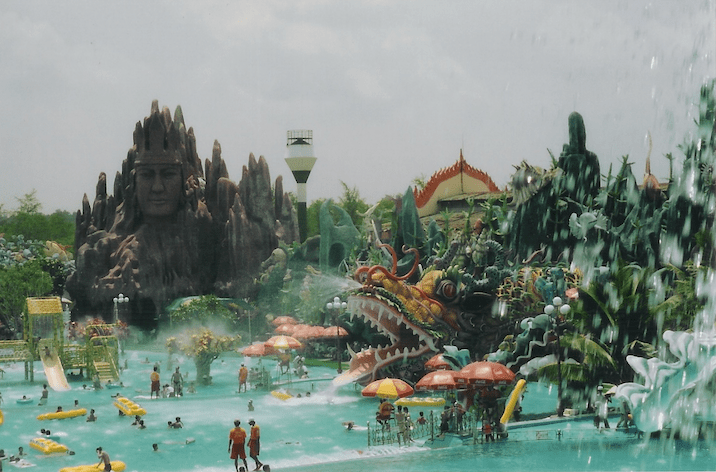
    One such theme park is Suoi Tien, outside of Saigon. Its attractions are decidedly un-Disney in their make-up but their appeal is unmistakable.

    For example, at their “Kingdom of Crocodiles” attraction, I went “crocodile fishing”. For 15 cents I rented a bamboo pole with lump of raw meat tied to a string at one end of it and dangled it over a group of hungry crocs, mouths wide open in anticipation. They snapped. I pulled it away. They snapped again. I pulled it away again – until inevitably they won “the game” and ate. Thankfully, not my fingers and hands as well.
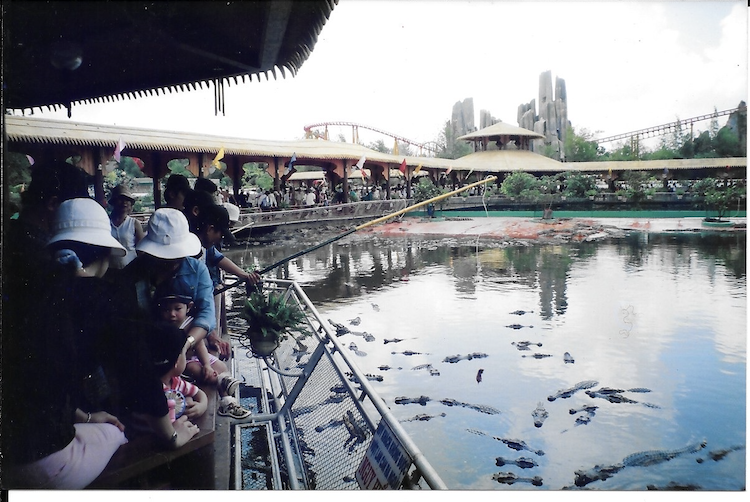
    Crocodile fishing at Suoi Tien

    In Western terms, “Crocodile fishing” may not be politically correct – but based on the excited crowd I saw, it’s certainly spot on in Vietnam. Hong Kong Disneyland might not have an attraction like this one – but they could certainly learn from a park like Suoi Tien on how to bond with its target.  

    Crocodile fishing

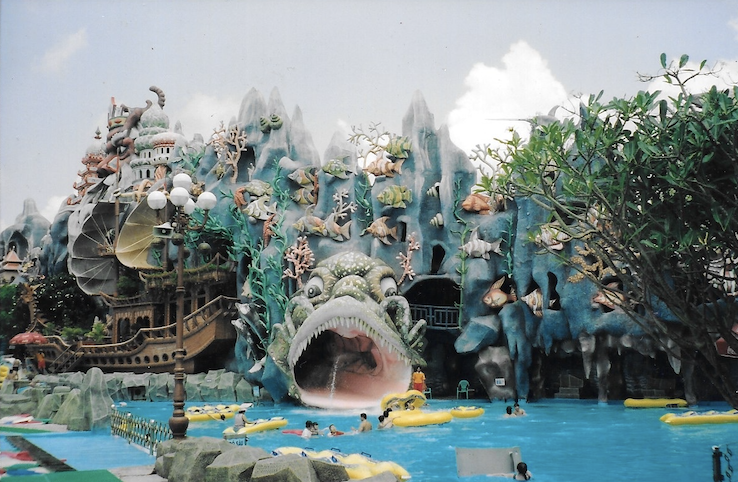
    At nearly the same size as Hong Kong Disneyland, Suoi Tien’s appeal lies in offering attractions that are culturally unique to Vietnam. Like the massive public swimming pool called Tien Dong Beach. Surrounding it are mythical hills and palaces, a massive mist-spewing dragon and dominating the pool, park, and flat surrounding countryside a mountainous likeness of King Lac Long Quan, the mythological founder, with his wife Au Co, of the Vietnamese people. Yet this indigenous version of Mount Rushmore is a kind of Matterhorn ride – I hopped on a yellow raft and slipped and slided through the emperor’s head until I emerged wet and happy from a giant fish’s mouth.

    But my Vietnamese history and cultural lesson didn’t end there. There is a giant statue of the Trung sisters, riding elephants on their way to defeat the Chinese in the 1st century. There is the Phoenix Palace where I visited the 12 levels of hell, a local version of Pirates of the Caribbean – after the pirates had passed to the “other side”. I descended into a dungeon where I saw some neat tortures: somebody getting sawed in half and put back together again; another being eaten alive by a hairy monster; a body squeezed into a large wooden basin and pummeled like a bunch of grapes being turned into wine.

    Then I tried the Palace of Heaven nearby. The re-creation of an emperor’s court had it all: a stern emperor and court officials; beautiful ladies-in-waiting and in one tableaux, mannequins dressed as ghost princesses, swinging angelically from wires.

    The adventures all have a Vietnamese theme that is relevant to its target as, say, the “The Haunted Mansion” or “Space Mountain” rides are to the visitors of Disneyland.

    At Suoi Tien there was a more participatory attraction where I went down a small dingy elevator and “attacked” the “Citadel” in the ancient capital of Hue through a hidden fortress tunnel. “Defenders” of the palace “slapped” my legs as I passed deeper into the fortress.

    There were also prosaic attractions like a rollercoaster, ferris wheel, paddle-boating, aquarium, small zoo and bonsai “forest”.

    And less prosaic ones like the tent with the “freaks” exhibit. Some of the wonders preserved in alcohol were Siamese pigs; a two-headed calf; a calf with six legs; a chicken with a very, very long neck.

    Everywhere there were crowds and long lines – and lots of happy faces. Like Hong Kong Disneyland, Suoi Tien is a big favorite of out-of-towners, coming to Saigon for a visit. Near the end of my visit I came upon the Heavenly Palace. I’ve never been a big fan of “dressing up” in costumes and having my photo taken. But in this Hue meets Las Vegas meets Anaheim attraction I couldn’t resist. So, for a few minutes I wore the headgear and robes of a Vietnamese emperor and had my photo taken on a mock-up of a throne.

    While I certainly didn’t feel like a king, I took away from my day at Suoi Tien rich and culturally unique memories. Not repackaged ones sent from distant shores. Now Hong Kong Disneyland could certainly learn from that.
    Published in South China Morning Post, September 13, 2006
  • A Miracle in Vietnam

    Dong Khoi Street is home to a Prada store and a brand new shopping mall. And for the past few weeks, Saigon’s upscale shopping district has been the site of what many Vietnamese Catholics believe to be a miracle.

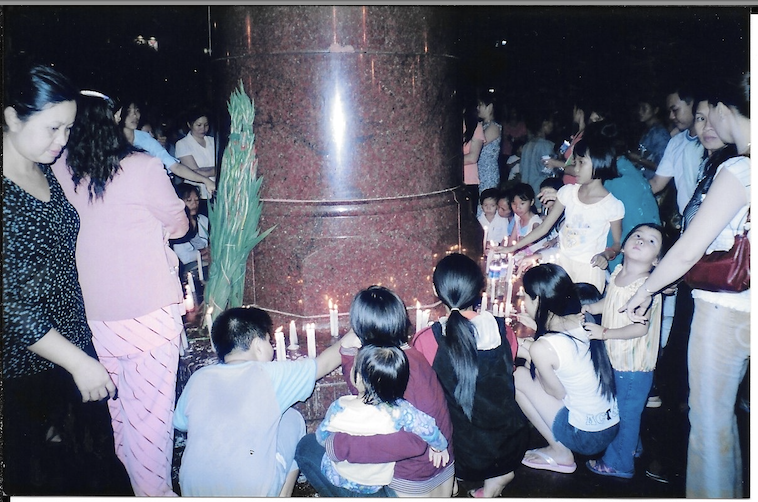
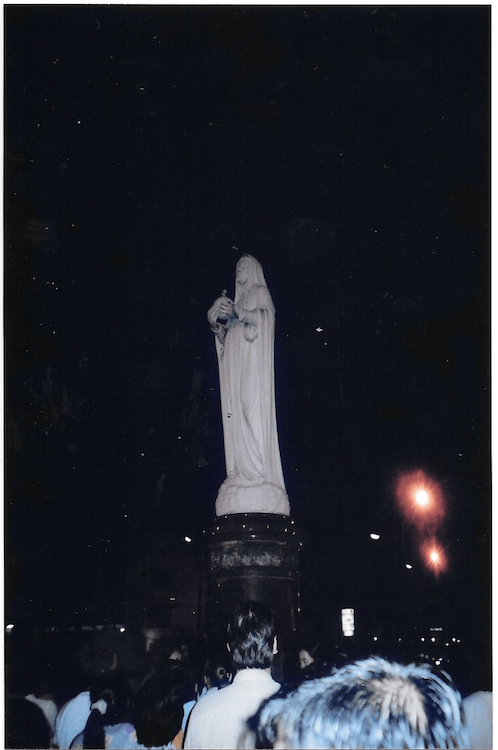
    After word spread that on Oct. 29 a tear streaked down the face of the Virgin Mary statue, staining it, several thousand people flocked to Saigon’s Notre Dame Cathedral to see it. Crowds, many with mobile phone cameras, gathered to record the sight. Initially only city dwellers came, but soon, visitors from the countryside came, too. Traffic around the cathedral slowed to a crawl, and the police arrived to maintain order.

    More than a week later, there was still a mark on Mary’s face, and the phenomenon continued to attract hundreds of daily visitors. People took turns crowding on to the small traffic island that is the site of the four-meter high statue. City gardeners in orange jumpsuits busily repaired the damage caused by feet trampling the grass and shrubbery around the statue.

    Vietnam’s government has been widely criticized for cracking down on religious groups. The U.S. Secretary of State this week again designated Vietnam as a “country of particular concern” in its annual report on international religious freedom.

    Still, several religions, including Roman Catholic and Muslim religious organizations, among others, are officially recognized in Vietnam. There are an estimated five to eight million Roman Catholics in this country of around 80 million. From Phat Diem Cathedral in the north to Notre Dame Cathedral in Saigon, there are so many worshippers on Sundays that people spill out of churches.

    For the most part, the crowd around the Mary statue was orderly. During the day, a sea of umbrellas floated above the crowd as people protected themselves from Saigon’s blazing sun. At night, candles and flowers were placed around the statue, turning it into an outdoor shrine.

    The mood wasn’t completely solemn, however. Children played around the statue. People sold drinks, ice cream, peanuts, prawn crackers — even cotton candy and balloons. Japanese, American and other foreign tourists have visited the site.

    Faithful at Virgin Mary Statue

    The event has been the talk of the town, and the subject of articles in local newspapers. Those keeping a vigil at the statue say it’s a miracle; others say it’s a warning. Some Vietnamese speculate that the tear is an omen about an impending bird-flu pandemic. Some even drew connections between Tuesday’s earthquake — centered in nearby Vung Tau but clearly felt in Saigon — to the weeping statue.

    Other Vietnamese I spoke to were more skeptical, saying the streak was just a mark from the heavy rain that recently fell upon the city. Some speculated about mischief. An executive at a large manufacturing company told me: “I think a game is being played on people. A person put that mark on her face.” Others were simply unmoved by the event. One woman said: “In many countries Mary cries. So it’s not a big deal.”

    The authorities appeared to be tolerant of this public act of faith. I didn’t notice any visible restrictions on who could visit the statue, just some traffic cops making sure people don’t spill out into the streets in front of cars and motorcycles. The police actually discouraged hawkers from selling photos of Mary’s tear-streaked face with a digitally added halo. They don’t want a religious event to be used as a commercial opportunity.

    The crowds of believers surrounding the statue of Mary — against the backdrop of the fancy boutiques and trendy art galleries on Saigon’s Dong Khoi Street — is a telling sight. It suggests that the economic growth and cultural vitality in this communist country are being accompanied by an upsurge of spirituality.

    Screenshot

    Published in The Wall Street Journal, November 11, 2005

  • Good Ol’ Advertising Deserves a Plug

    When Coca-Cola relaunched in Vietnam earlier this year, it did so with fanfare, holding opening ceremonies and a variety show complete with Vietnamese dancers.

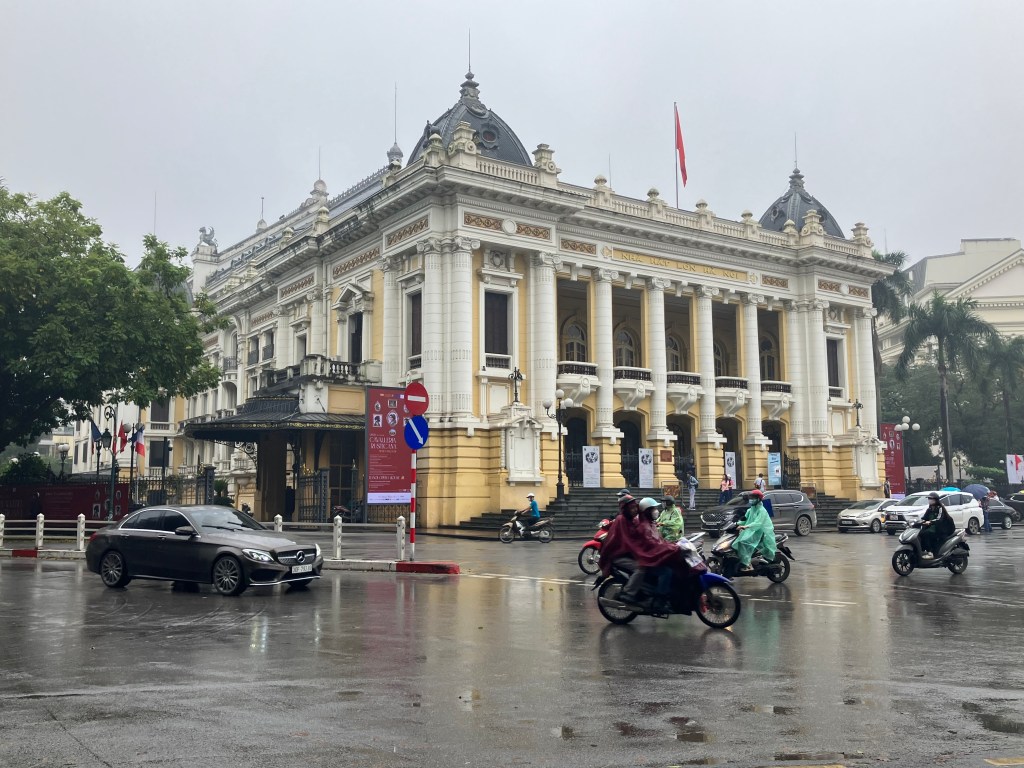
    The show was held, tastefully enough, at the French-built Hanoi Opera House, an imposing ochre-coloured relic from the early years of this century. Less tasteful were the giant inflatable plastic Coke bottles that the company set up outside the building.

    “It shows the U.S. is good at marketing but it was irritating to see a national monument used like this,” a Hanoi resident told reporters, reflecting a widely held sentiment. Not only is the Hanoi Opera House the center of Hanoi cultural life, it is also a national symbol: From its balcony, the left-wing Viet Minh announced its takeover of the city after World War II.

    Postcard of Hanoi Opera House with Coke bottle in front of it

    Coke realized it had made a faux pas. It took down the bottles. The Vietnamese government, meanwhile, has since decided that advertising in general needs to be reined in. It has taken down some billboards in Hanoi and Ho Chi Minh City. It has also restricted the number of outdoor sites where companies can advertise their products.

    In Asia’s developing economies, marketing pitfalls abound. A soft drink television spot in Malaysia a few years ago featured an exuberant woman kicking furniture in her apartment before taking a soothing sip of her drink. A local TV station pulled the ad off the air, saying the woman was “too aggressive.” Malaysia also banned feminine hygiene products a few years ago, in response to pressure from a women’s group. The women argued the products were too personal and an inappropriate sight for the eyes of Malaysian children.

    The Thai government prohibits advertising in which one product is judged better than a competitor. Such a comparison, familiar in Pepsi Challenge ads where consumers compare the taste of Pepsi and Coke, is said to break the taboo of public displays of conflict.

    The Chinese government frowns on revealing clothing. The obligatory lathery shower scene featured in shampoo ads is problematic in Malaysia, where officials don’t want bare shoulders to be seen on television. And in Pakistan, men and women can’t appear together in advertisements.

    Besides the cultural motivations for these restrictions, there is hostility toward what these governments see as promotion of Western values at the expense of their own, and promotion of Western goods at the expense of local companies. As a result, the climate for advertising in Asia’s developing economies can be quite difficult for Western marketers. And because local marketing talent is not as exposed as it could be to the outside industry, the local advertising strategies are in many cases immature. Of course, foreign marketers sometimes stumble into cultural insensitivity. But for all the government officials’ zeal in locking out Western cultural influences and protecting domestic commercial interests, they are hurting their own economies.

    They fail to see advertising’s principal advantage: It creates consumer demand. Workers become consumers who want to satisfy their demand for the convenience-adding or pleasing products they see advertised. In order to make more money to buy these products, consumers work harder at their jobs and upgrade their skills. The collateral advantage to governments is that societies become more affluent, and workers become more productive.

    This cycle has been repeated in all the Asian Tigers. Advertising sells products, and those products are the symbols of a rising standard of living. It’s not that the West’s values are being pushed, but rather that higher quality of life is being sought by consumers.

    Developing-country governments’ protection of local companies isn’t wise either. In the Darwinian logic of the modern market economy, smart companies embrace change. In many cases, local companies recognize advertising as a powerful brand-building tool. In Malaysia, for example, the local haircare brands New & Trendy and Follow Me use advertising aggressively. As a result they control about a third of the market.

    A famous example of a company using advertising to boost its market share is Singapore Airlines. The airline built its reputation by catering to Singaporeans’ exacting standards for service and safety, and communicating those qualities through the memorable image of the Singapore Girl. The result: The airline is one of the largest in the world.

    That’s not to mention the good name the ads create for Singapore itself. The Malaysian government has learned this lesson as well, promoting its airline with futuristic ads that feature a spaceship. The ads move Malaysia beyond its reputation as a producer of tin and rubber, and suggest it is a country ready to enter the 21st century.

    Besides creating demand and a positive image for its products, advertising does another important job as well. It tells information-starved consumers what those products do: How to use a washing machine, a soup mix, or a microwave oven. As developing markets open up, advertising shows the way through a strange new world of consumer choice – a world that the citizens of Asia’s developing markets want very much to join.

    Published in The Wall Street Journal, August 18, 1994