Tag: travel

  • Vietnam: Producing Smiles the Local Way at Suoi Tien Theme Park

    Suoi Tien Theme Park

    We have heard the news about Hong Kong Disneyland’s missteps in trying to connect with its Chinese target audience. To have shark’s fin or not on its menu? Trying to get the park Feng Shui right. Alledgedly, rude staff. First, too few visitors. Then, over Chinese New Year too many. To the point where they had to lock the gates to hundreds of ticket holding visitors. Photos showed tourists scaling Disneyland’s fences to get inside. The managing director of Hong Kong Disneyland, Bill Ernest, apologized to the people of Hong Kong and China. “We are still learning in this market,” he said. “This is our very first Chinese New Year, frankly.” Hong Kong Chief Executive Donald Tsang said, “We feel disconsolate, but we have learnt a lesson.” Legislators in the territory feel the incident has damaged Hong Kong’s international image.
    Yet, in Asia, there are very successful local theme parks who connect culturally with their target audience and produce smiles instead of headlines.

    One such theme park is Suoi Tien, outside of Saigon. Its attractions are decidedly un-Disney in their make-up but their appeal is unmistakable.

    For example, at their “Kingdom of Crocodiles” attraction, I went “crocodile fishing”. For 15 cents I rented a bamboo pole with lump of raw meat tied to a string at one end of it and dangled it over a group of hungry crocs, mouths wide open in anticipation. They snapped. I pulled it away. They snapped again. I pulled it away again – until inevitably they won “the game” and ate. Thankfully, not my fingers and hands as well.
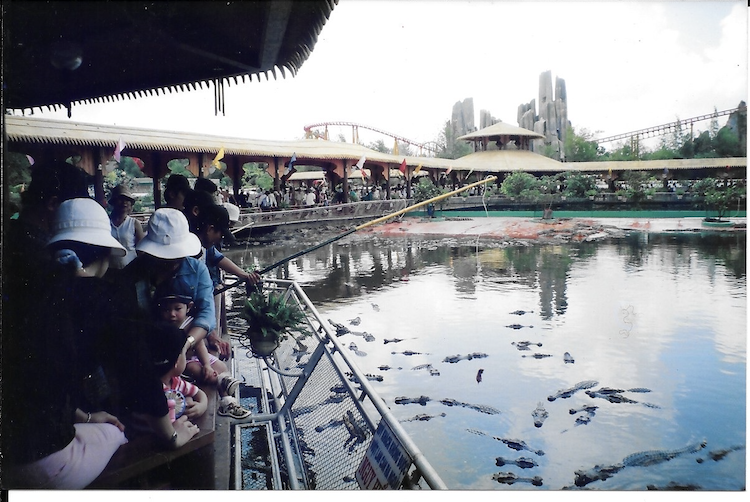
    Crocodile fishing at Suoi Tien

    In Western terms, “Crocodile fishing” may not be politically correct – but based on the excited crowd I saw, it’s certainly spot on in Vietnam. Hong Kong Disneyland might not have an attraction like this one – but they could certainly learn from a park like Suoi Tien on how to bond with its target.  

    Crocodile fishing

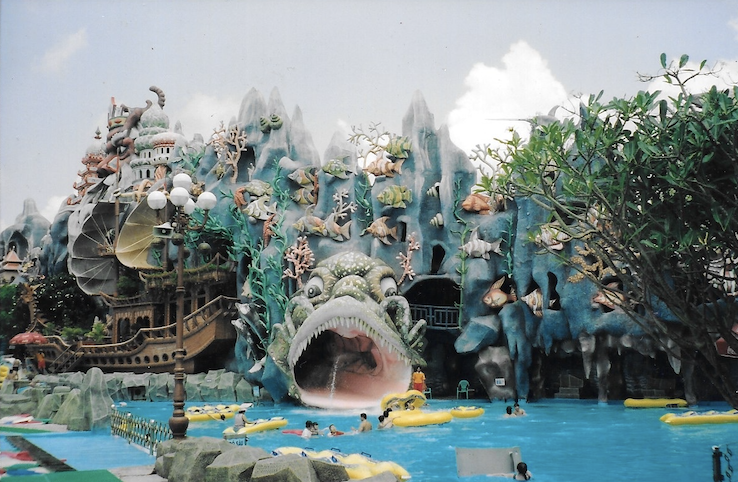
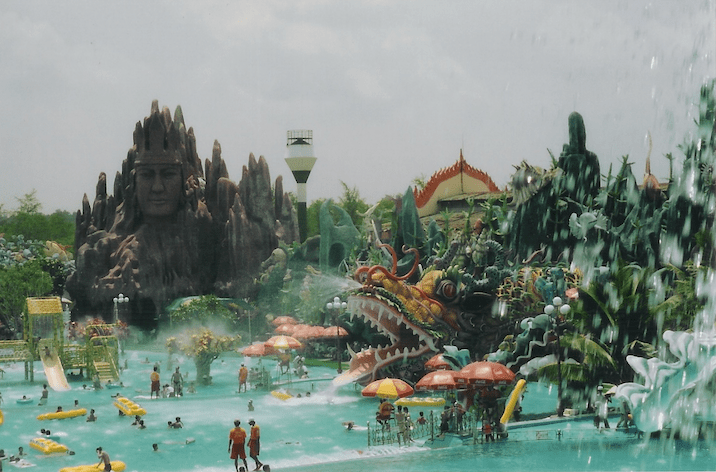
    At nearly the same size as Hong Kong Disneyland, Suoi Tien’s appeal lies in offering attractions that are culturally unique to Vietnam. Like the massive public swimming pool called Tien Dong Beach. Surrounding it are mythical hills and palaces, a massive mist-spewing dragon and dominating the pool, park, and flat surrounding countryside a mountainous likeness of King Lac Long Quan, the mythological founder, with his wife Au Co, of the Vietnamese people. Yet this indigenous version of Mount Rushmore is a kind of Matterhorn ride – I hopped on a yellow raft and slipped and slided through the emperor’s head until I emerged wet and happy from a giant fish’s mouth.

    But my Vietnamese history and cultural lesson didn’t end there. There is a giant statue of the Trung sisters, riding elephants on their way to defeat the Chinese in the 1st century. There is the Phoenix Palace where I visited the 12 levels of hell, a local version of Pirates of the Caribbean – after the pirates had passed to the “other side”. I descended into a dungeon where I saw some neat tortures: somebody getting sawed in half and put back together again; another being eaten alive by a hairy monster; a body squeezed into a large wooden basin and pummeled like a bunch of grapes being turned into wine.

    Then I tried the Palace of Heaven nearby. The re-creation of an emperor’s court had it all: a stern emperor and court officials; beautiful ladies-in-waiting and in one tableaux, mannequins dressed as ghost princesses, swinging angelically from wires.

    The adventures all have a Vietnamese theme that is relevant to its target as, say, the “The Haunted Mansion” or “Space Mountain” rides are to the visitors of Disneyland.

    At Suoi Tien there was a more participatory attraction where I went down a small dingy elevator and “attacked” the “Citadel” in the ancient capital of Hue through a hidden fortress tunnel. “Defenders” of the palace “slapped” my legs as I passed deeper into the fortress.

    There were also prosaic attractions like a rollercoaster, ferris wheel, paddle-boating, aquarium, small zoo and bonsai “forest”.

    And less prosaic ones like the tent with the “freaks” exhibit. Some of the wonders preserved in alcohol were Siamese pigs; a two-headed calf; a calf with six legs; a chicken with a very, very long neck.

    Everywhere there were crowds and long lines – and lots of happy faces. Like Hong Kong Disneyland, Suoi Tien is a big favorite of out-of-towners, coming to Saigon for a visit. Near the end of my visit I came upon the Heavenly Palace. I’ve never been a big fan of “dressing up” in costumes and having my photo taken. But in this Hue meets Las Vegas meets Anaheim attraction I couldn’t resist. So, for a few minutes I wore the headgear and robes of a Vietnamese emperor and had my photo taken on a mock-up of a throne.

    While I certainly didn’t feel like a king, I took away from my day at Suoi Tien rich and culturally unique memories. Not repackaged ones sent from distant shores. Now Hong Kong Disneyland could certainly learn from that.
    Published in South China Morning Post, September 13, 2006
  • Ju Ming Museum: A Sculptural Oasis in Taiwan

    In 1542, sailors on a Portuguese ship heading to Japan spotted Taiwan and named it Ilha Formosa, beautiful island. While driving along the coastal road from Taipei to the Ju Ming Museum it’s easy to understand how the sailors arrived at that name. The coastline, studded with rock formations, is at once dramatic and forbidding. It may have also served as inspiration for Ju Ming, Taiwan’s greatest living sculptor.

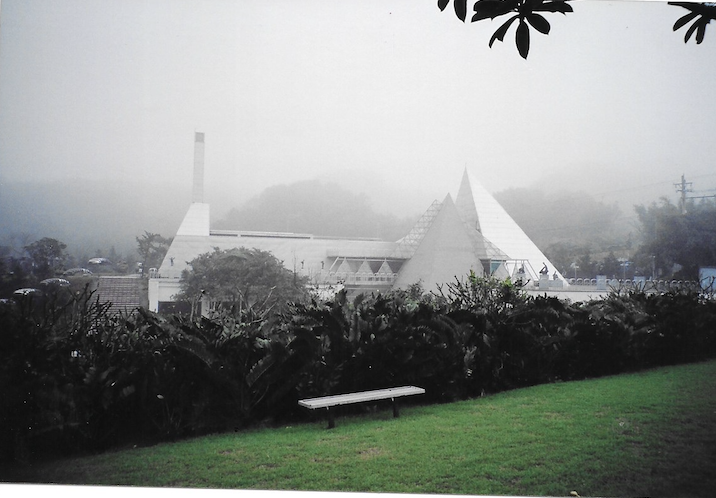
    Ju Ming Museum building

    His museum, opened in 1999, was designed by him to showcase his vision in bronze, stone, clay and wood. While the focus on primarily one artist’s work is unique in Asia, in a nod to inclusiveness great artists from the both East and West are also exhibited. Taiwanese painters such as Chang Wan-chuan, Lee Cher-fan, Liao Chi-chun as well as Western artists such as Henry Moore, Andy Warhol, Joan Miro, Picasso, Bernard Buffet and Robert Rauschenberg can be seen there. The closest to a Western equivalent to it would be the Rodin Museum in Paris or the Picasso Museum in Barcelona – but minus the ego.

    Born in 1938, Ju Ming began sculpting as an apprentice at the age of 15. For the next two decades he modestly viewed himself as just a talented craftsman and sought teachers such as the sculptor Yang Ying-feng to mould and shape his skill into true artistry.

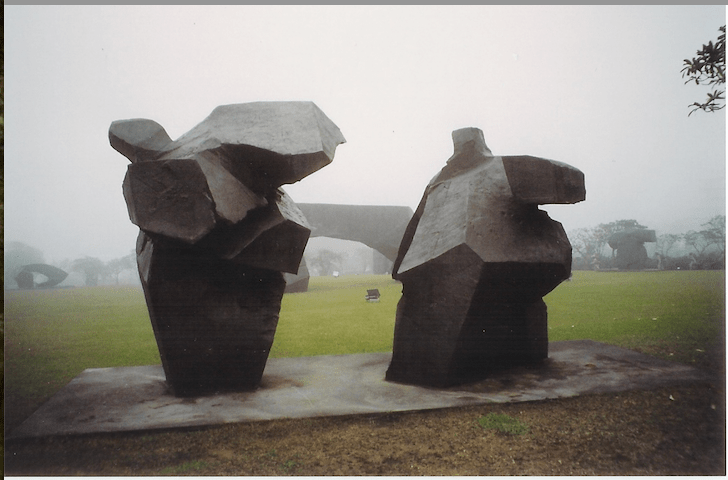
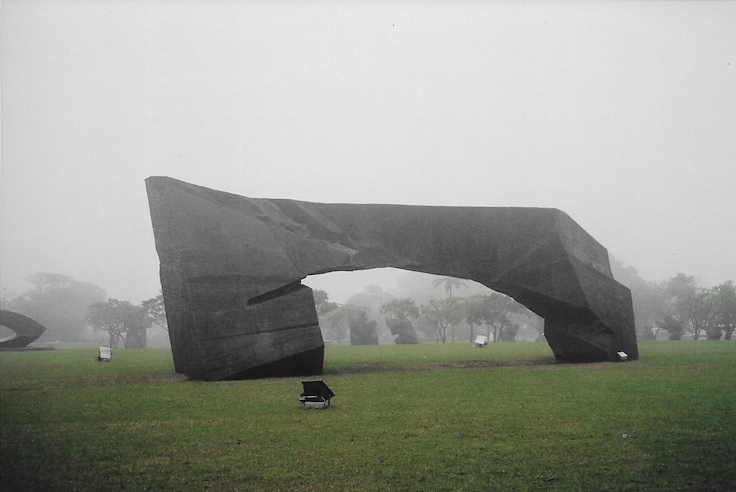
    Monumental Sculpture by Ju Ming

    In 1976, Ju Ming’s work, including his iconic Taichi Series, was featured at Taiwan’s National Museum of History. His Living World Series furthered his reputation internationally. In 1994 his work was featured at the Hakone Open-Air Museum in Japan, the first exhibition by a Chinese artist there.

    Colorful sculptures inside the museum building

    I entered the 11-hectare museum through a white angular building, descending some stairs before walking down a long, white hallway. I had the impression that the architect’s vision was that the hallway was like a birth canal and the outdoor exhibition just beyond the glass doors a new way to see the world.

    Sculpture with an urban theme

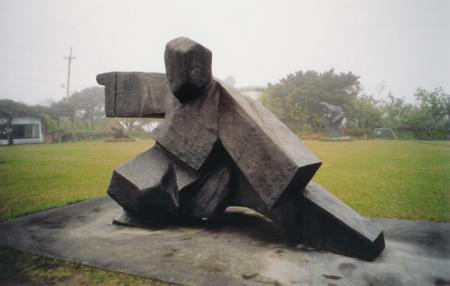
    I visited on a foggy weekday. Mist rolled over the works, at once obscuring and revealing them. Lack of sunlight dulled the color of the grass and the grey milkwood trees, but gave the works more gravitas as the Tai Chi figures were pushing at each other and the intrusive sky. The ever changing motion from the ground cover clouds helped to convey the stillness and movement of the figures, the uncanny sense that they were observers as well as the observed, like actors in a tableaux. While the figures were abstract or semi-abstract, the strength of their inner spirit was apparent. I was dwarfed by the size of the largest of the pieces, which at 15.2 meters wide by 6.2 meters high was the size of a small house.

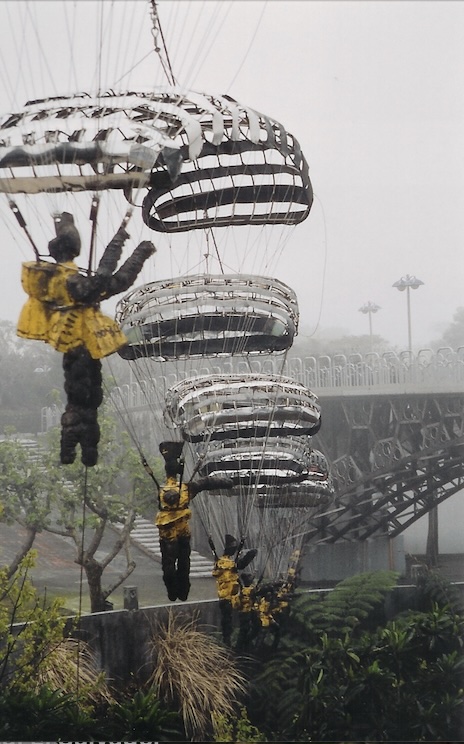
    Celebrating the Navy

    There was a series of pieces on the Taiwan military. A platoon of life-size sculptures of soldiers was marching, exhausted, on a path. In another piece, soldiers stood at attention while an officer addressed them. There was an eight-story high bare metal frame of a naval ship, its mast lost in the fog of that day, while Ju Ming’s sculptured sailors were ready to be reviewed. His parachutists descended towards a landing zone beneath a bridge that connected the two sides of the museum grounds. Pilots stood impassive beside a mock-up of a fighter jet. His military were less enshrined heroes than people worn down by duty and obligation.

    Whether it’s the Tai Chi masters or the Taiwan military, Ju Ming’s inspiration comes from the land of his birth. His angular Tai Chi masters look as if they emerged from the rocky shores the Portuguese sailors saw centuries before.

    His stature, and statues, are helping Taiwan to carve a separate cultural identity, at once a part of and yet distinct from China. On both sides of the Taiwan Strait he is viewed as a great Chinese artist. A visit to his museum will show you why.

    Screenshot

    Published in South China Morning Post, April 18, 2007

  • Iconic Buildings Live Up to Hype as Billboards

    SINGAPORE: There was symmetry to the moment: I was standing on the balcony of Singapore’s colonial-era iconic building, the Supreme Court, while taking a photo of its 21st century one: the Marina Bay Sands. The meanings of the two buildings couldn’t be more different yet more appropriate for their respective eras. The Supreme Court stood for rule of law in an unruly part of the world in the 1930s. And the triple-towered Marina Bay Sands, designed by Moshe Safdie, with its colossal boat-shaped SkyPark, stands for fun in a country that recognizes the economic value of “the pursuit of happiness.” As “billboards” advertising their respective messages, they work. The Marina Bay Sands, for example, just brought in a record-breaking profit of $314 million for its corporate parent, Las Vegas Sands.

    Iconic buildings have been central to humanity since Stonehenge. Architecture has always been about context. This is what Moshe Safdie calls on his website, “Responding to the Essence of Place”. And also content, or “Shaping the Public Realm”, also from his website. Their purpose in ancient times was either to foster religion or generate fear and respect for the governing body. Whether it was the Parthenon on the Acropolis or the pyramids of Egypt, rulers created iconic buildings to secure their hold on the populace.

    But now it is different. Culture and business, today’s soft power drivers, are the reason these buildings are created. Government involvement is more backseat: from encouraging the development through zoning laws, approvals or tax and other incentives.

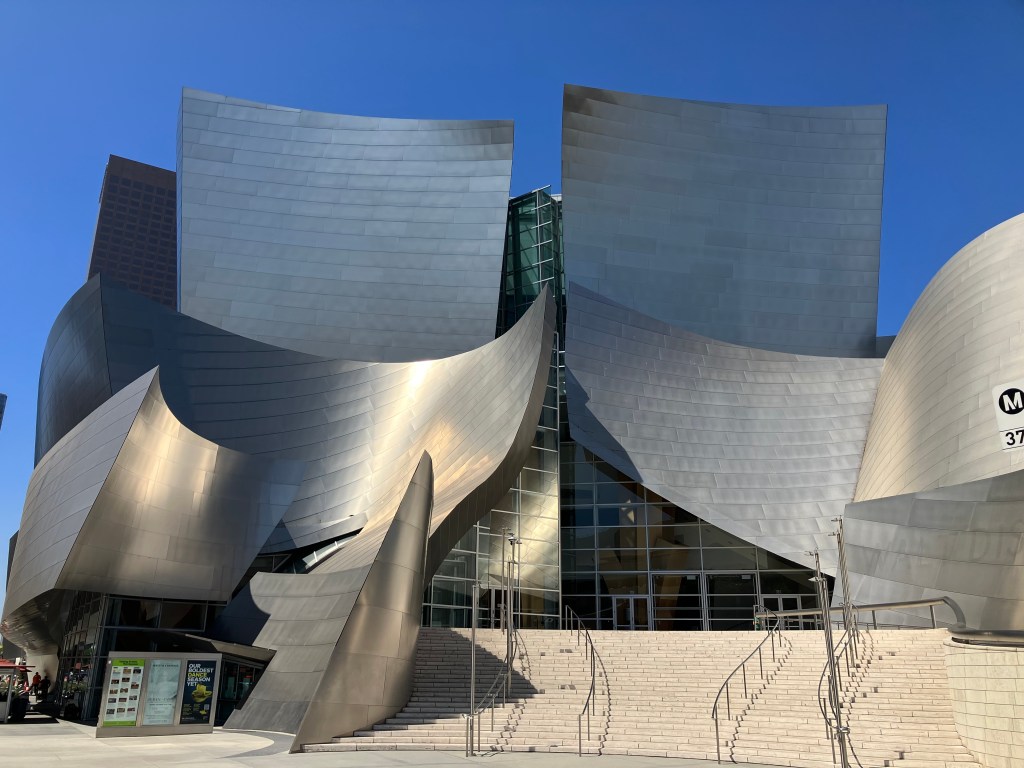
    It is perhaps Frank Gehry’s Guggenheim Museum in Bilbao that started the latest wave of iconic buildings as billboards. Although Asia and the Middle East were already approving plans and laying foundations for their own monumental billboards before the Guggenheim was opened in 1997.

    The Petronas Towers in Kuala Lumpur, opened in 1998, signaled the emergence of Malaysia as more than a country of rubber and palm oil plantations. Architect Cesar Antonio Pelli said, “I tried to express what I thought were the essences of Malaysia, its richness in culture and extraordinary vision for the future.” And Taipei 101, from 2003 until this year the world’s tallest building, reminded people that Taiwan still mattered as a business hub and wasn’t overshadowed – yet— by China.

    Iconic buildings can create a buzz that translates to perceptual and economic benefits over time. When the Burj-al-Arab opened in 1999, it put Dubai on the map as the ultimate luxury destination. Like the Marina Bay Sands, it communicated fun in a part of the world that is usually more associated with oil and the occasional war. The term “seven star” hotel was invented to describe the hotel. Looking like a colossal chrysalis from which a butterfly is about to emerge it has attracted celebrity guests and incalculable positive PR.

    Dubai followed up this year with the can’t top this Burj-al-Khaifa. As Christopher Davidson, a University of Durham professor said, “The tower was conceived as a monument to Dubai’s place on the international stage.” The world’s tallest building by far it is a litany of superlatives: 828 meters high, 160 floors, world’s fastest elevators at 64 kilometers per hour, 12,000 workers and contractors involved in the building of it. When compared to the rest of the Dubai skyline it looks like it is nearly double the height of the next highest building. It is truly a Great Pyramid of Giza for our time. But its opening earlier this year was colored by the collapse of Dubai’s economy. Still, I believe that over time it will deliver on its promise to transform the city’s image. Scenes from Tom Cruise’s next “Mission Impossible” movie will feature the building, creating buzz for Dubai that it needs in its economic recovery stage.    

    Not that Qatar will allow its sister gulf state to grab all the attention easily. Doha, the capital of Qatar, now has its own iconic building: the Museum of Islamic Art, which opened in 2008. The I.M. Pei designed building showcases a stunning collection of Islamic Art to remind the international community of the richness — not just riches – of the Arab world. Like the Guggenheim museum in Bilbao, it’s a transformative culturally-oriented building, making Doha a destination in its own right. Perched pyramid-like on the edge of Doha Bay, it is a visual anchor of the city. As the Qatar Museums Authority website says: “It will bring the world to Doha, but it will also connect Doha to the world.”

    And of course China is building a number of iconic buildings to flesh out its progressive 21st century image. I remember standing on the Oriental Pearl building in Shanghai, that 1990s Flash Gordon inspired image of the future with its spheres and pointy spire and looking down on the iconic buildings of the 1920s on the Bund with their colonial-era stolidness, projecting wealth and power with fluted columns and granite. And I looked up at the iconic building of the 21st   building, the Shanghai World Financial Center building, opened in 2008, which at one angle looks like a giant bottle opener overshadowing the nearby Jin Miao tower. Shanghai, like the New York it seeks to emulate, and Hong Kong, which it is overtaking, is a city of iconic buildings.

    When will this latest wave of building competition end? Not anytime soon. If you want to understand the power of iconic buildings to attract attention to a city trying to compete in this globalized economy, then think of the cities that don’t have them. Bangkok perhaps. Or Mumbai. Or Jakarta. Or Manila. You’ll discover that the negative clichés about these metropolises tend to define them. In a world where a positive image translates to economic advantage, iconic buildings give just that more of a winning edge. You only need to take another look at the Marina Bay Sands and its recent profits to see that the gamble to build it has paid off. As British archaeologist, Jacquetta Hawkes, said, “every generation gets the Stonehenge it deserves – and desires.”

    Published in The Straits Times, November 2, 2010

  • Miri: Seahorse City on the South China Sea

    If you’re in Miri, chances are you’re on the way to somewhere else. The second largest city in the Malaysian state of Sarawak, Miri is a crossroads and stopover destination.  In my case we were heading to Mulu National Park from Singapore and needed to overnight there.  But it’s also a good stopover if you’re driving from Kuching to Brunei. Miri is also popular with expats from Brunei who visit beachside hotels like the 5 star Marriott for the weekend with their families and a chance to drink some alcohol, which is not allowed back in Brunei.

    Niah Caves for Rock Paintings or Bird’s Nest

    But Miri is worth more than just an overnight or weekend stay.  The Niah Caves are about an hour drive from the city. Human remains some 40,000 years old have been found there. It’s the oldest settlement in East Malaysia and Painted Cave has rock paintings over 1,200 years old. Bird’s Nest, that seriously expensive Chinese delicacy, is also harvested here from Swiftlet nests. So is bat guano. According to tradition, the local Penan tribe get to harvest the Bird’s Nest while the Iban the bat guano.

    Lambir Hills National Park

    Just 32 kilometres away is Lambir Hills National Park, a tropical rainforest with an astounding 237 different species of birds as well as wild pigs, gibbons, flying squirrels. There are great trails to get into the park’s terrain with its cooling waterfalls and bathing pools.

    Birthplace of Malaysian Petroleum Industry

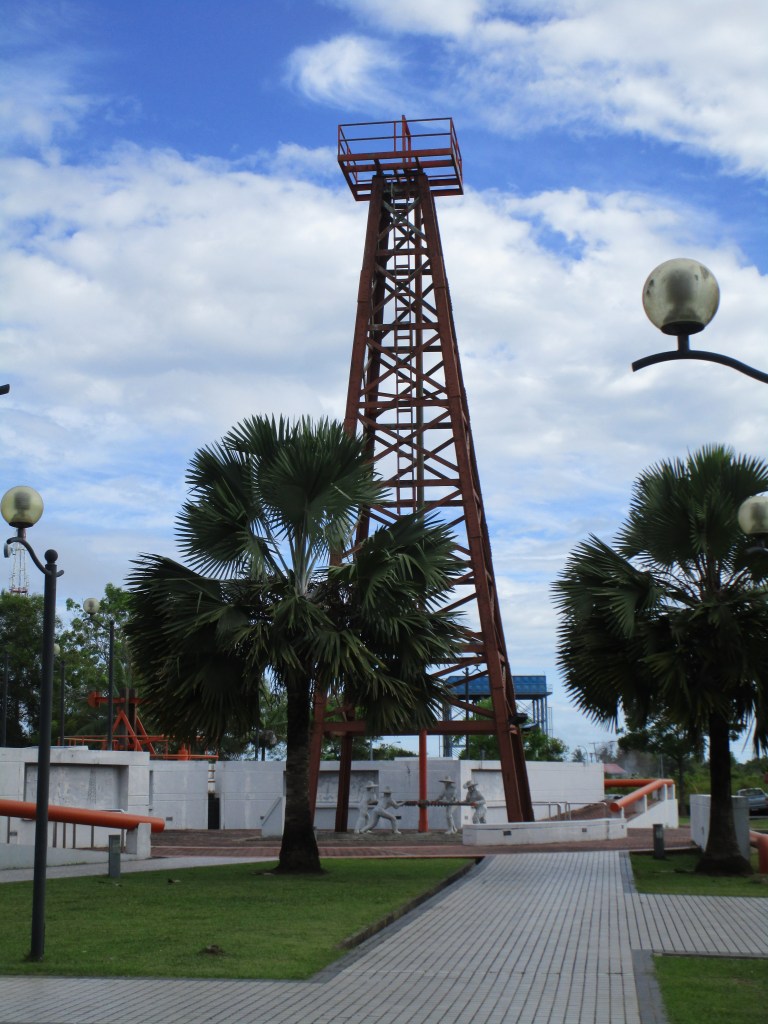
    Miri is also where the Malaysian petroleum industry got its start, with the first well dug in 1910. The old derrick, called the Grand Old Lady, has been preserved. At its base are statues of Chinese labourers depicted as manually doing the drilling. Wrapped around it is a curving monument with panels describing the history of the industry in Miri. The sleek Petroleum museum just steps away is definitely pro-big oil and understandably so. The oil business built Miri and is its main income contributor.  Opened in 2005 it goes in-depth into how the industry works, including a scale model of a drilling platform. When I visited there was an informative exhibit on the indigenous people in Sarawak. Outside the museum is a sweeping view of the city and the sea from its on the top of Canada Hill.

    Ethnically Diverse

    Of 27 ethnic groups in Sarawak, 19 are in Miri. Chinese is the largest followed by Iban, Malay and Melanau. The Miri Handicraft Centre showcases indigenous crafts including flutes, baskets,  and kueh, a Malay dessert. It’s well a browse.

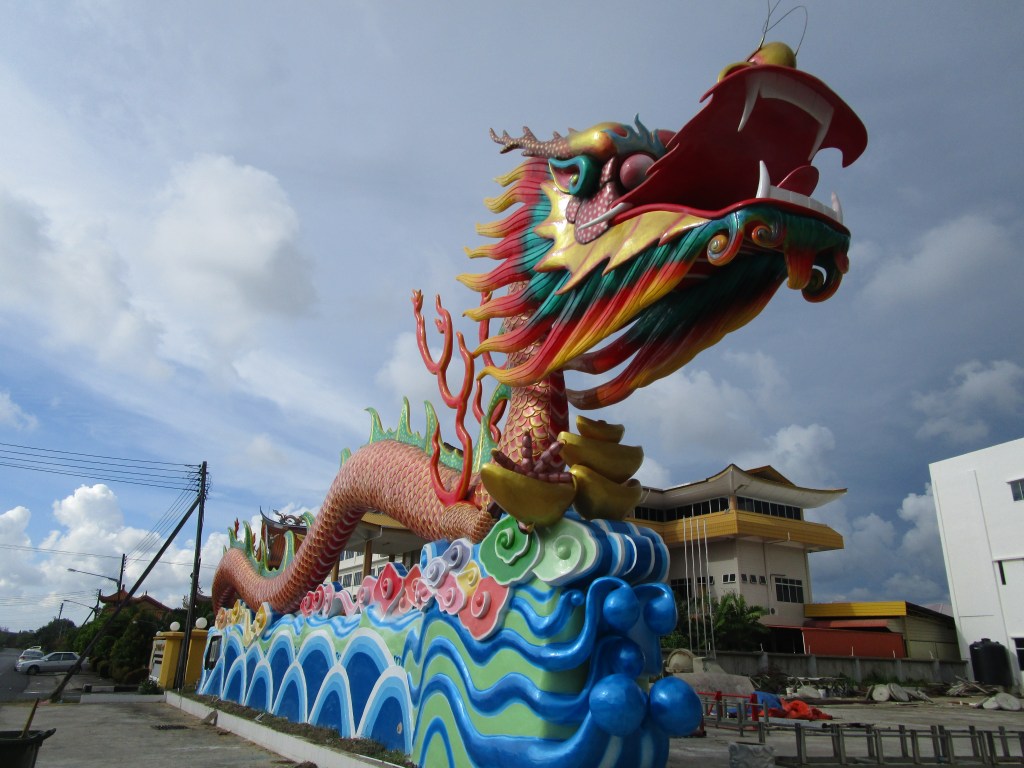
    The San Ching Tian temple is the largest Taoist temple in Southeast Asia and well worth a look for its huge ceramic dragon.

    Popular Dive Spot

    Miri is popular dive spot with the Miri-Sibuti Coral Reefs National Park just off the coast at a depth of 7 to 30 metres. There are some wrecks that you can easily visit. It’s not as well known as other famous sites in  Malaysian Borneo but you can quickly reach the park from Miri.

    Why Seahorse City?

    Why did I title the piece “Seahorse City”? Around the city are statues of seahorses: at a roundabout; a restaurant named Seahorse Bistro and a giant statue overlooking the sea. When I asked town’s people no one knew why the seahorse is such a commonly used symbol. But it is. So I thought, let’s call it Seahorse City. It has a nice ring to it. Especially for a nice stopover.

    Published in Asian Journeys magazine, October-November 2015

  • Jakarta’s Money Central

    A trip to Jakarta is usually a chore. Traffic can be so bad that you’ll spend more time commuting to a sight than you did at the sight itself. With a little digging, though, the city has some one-of-a-kind cultural gems.

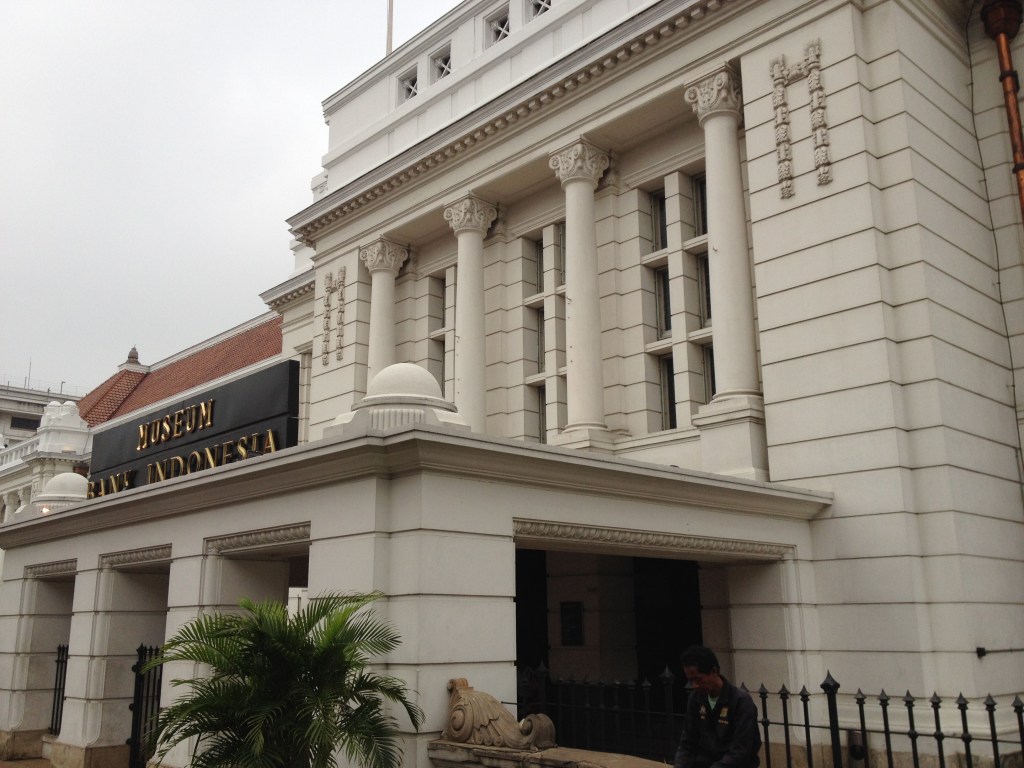
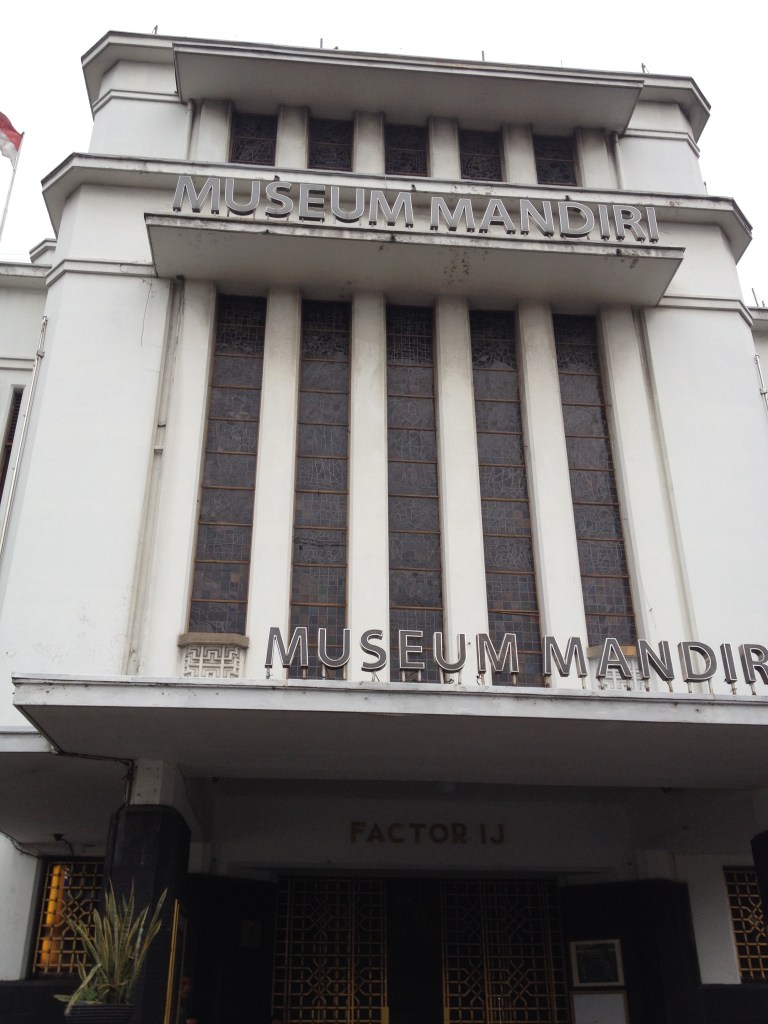
    In Kota, also known as Old Batavia, are a number of museums in stolid Dutch colonial buildings better suited for northern European winters than the tropics. The Fatahillah, Shadow Puppet, and Ceramic museums all sit around a picaresque cobblestoned square where you can almost forget the jammed traffic in the streets around you. Two of the most engaging museums though are nearby and next to each other: The Bank of Indonesia and the Bank Mandiri museums.

    The Bank of Indonesia museum is the flashier of the two, with informative exhibits that underline its role as a pillar of a volatile ever-evolving society. After three years of meticulous restoration, it was opened July 2009.

    MUSEUM WITHIN THE DE JAVASCHE BANK BUILDING

    The museum sits within what was once the The De Javasche Bank. That bank, also known as the Bank of the East Indies, was founded in 1828 and moved into this building by Dutch architect Edward Cuypers, in 1909. As the colonial central bank it played a stabilizing role through the Japanese occupation, the 1945 declaration of independence until finally the Indonesia government nationalized the bank in 1953 and turned it into the Bank of Indonesia.

    While the replacement of De Javascche Bank was a nationalist move, it is curious to note the original Bank of Indonesia logo was closely aligned with the De Javasche logo: the letter J was changed  to the letter I without altering any other design elements. So much for continuity.    

    EARLY 20TH CENTURY DESIGN

    For early 20th century design aficionados, the museum is a treat. The lobby has tiled azure pillars supporting a high vaulted ceiling. Through an archway is the old teller system. A bank customer would go into an enclosed room and do their transactions through a wire mesh.

    The exhibits take you through Indonesia’s mercantile history. Life size mannequins of laborers loading sacks of spices for shipment to Europe for the VOC company; Dutch colonialists having dealings with pigtail wearing Chinese; even soldiers firing on the Japanese in a World War II scene. The message was clear: the bank and nation’s history are intertwined.

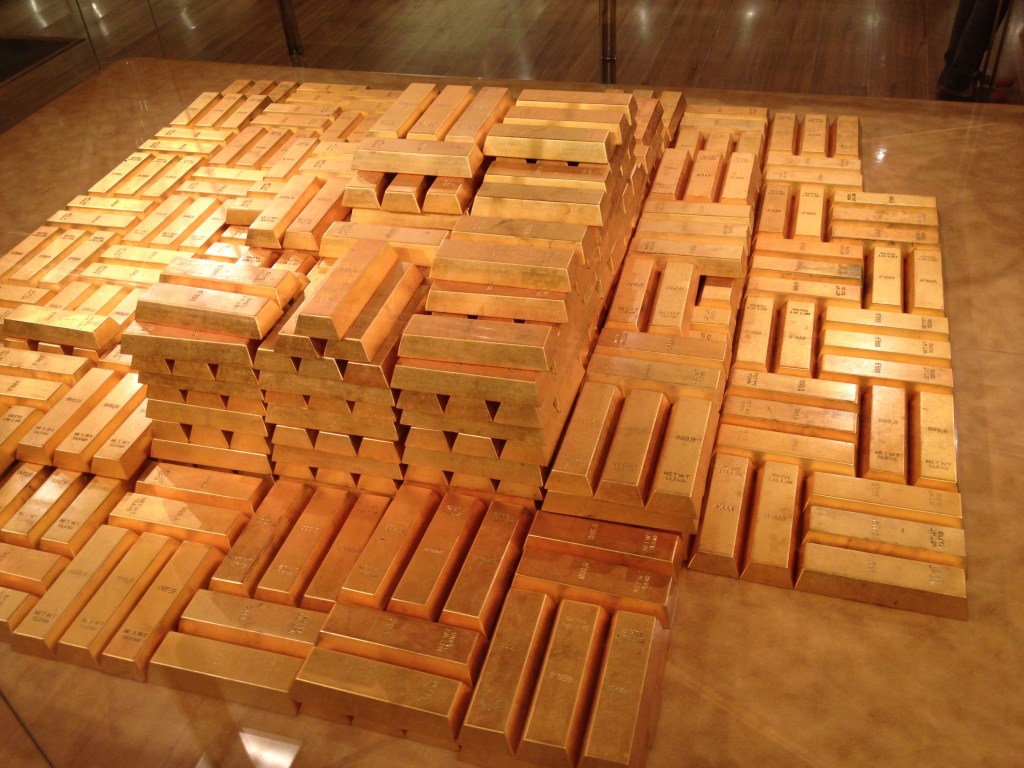
    STACKS OF GOLD BULLION

    And, of course, no visit to a central bank is complete without seeing its gold bullion. Within a clear plexiglass enclosure are stacks of gold bricks. And nearby, inside a spacious walk-in vault, are displays of Indonesian money from the 14th century to the present.

    While I like history, the restored to its original grandeur building was worth lingering in: the bank’s boardroom with its malachite green-tiled walls and intricate stained glass windows, a grandfather clock in the rear; the huge open-air courtyard covered in decorative tiles and potted trees surrounded by the bank’s white-colored pillars and covered interior walkways. The building projects the stability it sought to achieve.

    BANKING IN THE 1930S

    While the Bank of Indonesia museum projects a stolid national institution, the Bank Mandiri museum next door is more lively, a sort of this is how banking really was in the 1930s.  The building originally was the Netherlands Trading Society. Designed by Dutch architects JJ de Bruyn, A.P. Smits and C van de Linde in an art deco style it was opened in 1933. The building was nationalized in 1960 to become part of the Bank Export Import Indonesia until finally through a series of mergers it became Bank Mandiri in 1999.

    The museum has a cluttered hodgepodge collection with teletypes from various eras, paper shredders, logbooks, securities, antiquated computers, old currency, and colonial era antiques.

    ART DECO AT ITS BEST

    Fans of art deco will be delighted. As you walk in the massive building you see a 50-meter long polished counter where a lot of the bank business was conducted with customers. Behind the counter bank officers sat at elegant wooden desks on polished red-tiled floors. You can stroll amidst the exhibits and mannequins to get more of the bank experience. The walk-in vault in the basement was the highlight. There were walls lined with safe deposit boxes, and a mannequin bank officer and his female assistant going through a log book while soldiers in wide-rimmed hats stood nearby.

    PANORAMA VS. NOSTALGIC SNAPSHOT

    While the Bank of Indonesia museum is structured and organized as a panorama walk through history, Bank Mandiri is a snapshot focused on a nostalgic 1930s experience. Two sides of Indonesia banking: one depicting the nation’s history; the other it mercantile spirit. Both set in stunning architectural examples of the early and mid-twentieth century. A visit to both will give you a perspective of Jakarta that will be refreshing after a long bumper to bumper drive.

    Published in the April-May 2015 issue of Asian Journeys magazine

  • Seattle Sizzles

    Last year, a psychological benchmark was breached when the capitalization of Petrochina exceeded US$1 trillion, making it the most valuable company on earth. This was more than twice the value of the world’s second valuable company, Exxon Mobil.

    Add to that the continuing sub-prime mortgage crisis in the United States and the falling greenback, and it’s easy to assume that the Asian markets are not just “emerging” but have “emerged” – proof that the Pacific Century has moved irrevocably from rhetoric to reality.

    But before anyone waves the banner of victory, it is worth studying a notable success story on the opposite side of the Pacific – Seattle.

    A city of approximately 600,000, Seattle is the home of, or has given birth to, many global businesses, including Microsoft, Amazon, Boeing, Starbucks, Costco, Expedia, Weyerhaeuser, and UPS. In addition, many large US domestic businesses can trace their roots to Seattle: Nordstrom’s, Alaska Airlines, and Safeco.

    In contrast, consider the leading global brands from Asia (excluding Japan): Singapore Airlines (Singapore); Lenovo (China); Samsung, LG, Hyundai (South Korea); San Miguel (the Philippines); Arcelor-Mittal, Oberoi (India); Cathay Pacific (Hong Kong, China); Acer, Taiwan Semiconductor (Taiwan); Thai Airways (Thailand).

    Indonesia, Malaysia, and Vietnam do not have any major international brands.

    With a combined population of more than three billion, emerging Asia has produced approximately the same number of leading global brands as Seattle with a population of under a million.

    Why does this matter when the trend is clearly in Asia’s favour? Because strong brands ultimately drive strong growth economies over the long term.

    Despite all the bad news about the US recently, its proportion of the global economy has remained at about 30 per cent over the last decade. In contrast, Japan’s share has dropped to 10 per cent from 15 per cent a decade ago. Since globally contestable output – goods and services that are subject to international competition – account for about one third of global output, countries with strong brands are likely to be winners.

    Though emerging markets have 85 per cent of the global population, their economic output accounts for only 21 per cent of the global GDP. In order for them to increase their share of the world’s economic pie, they might study some success stories. Seattle would be a great place to start.

    Lesson 1: Not size, but innovation

    In addition to being the birthplace of so many global brands, Seattle is home to the grunge music movement. Despite its small size, it has the second largest number of theatres in the US, after New York. Jimi Hendrix and Quincy Jones spent their formative years in the city.

    According to the US Census Bureau, Seattle has the highest proportion of college graduates of any US city. The University of Washington plays a role similar to Stanford University’s in Silicon Valley in being an incubator of new ideas. All this art and innovation breeds an innovation culture.

    The lesson has been absorbed by some markets. The Esplanade in Singapore has helped place the city on the itinerary of the world’s leading artistes. The large Dashanzi arts district in Beijing complements the newly opened National Theatre near Tiananmen Square. South Korea and China have been producing the most edgy, critically acclaimed films in Asia.

    Lesson 2: Diversity equals strength

    The foreign-born population of Seattle rose by 40 per cent in the 1990s. Diversity has been credited for driving the dot.com boom in Silicon Valley, with one-third of its engineers being foreign-born. 

    Again, Singapore has picked up on this lesson. Lenovo’s CEO lives in Singapore and its chairman in North Carolina. Singapore’s largest bank, DBS, just hired an American as its CEO. Singapore recently liberalized its visa policies to allow qualified professionals to enter the country to look for work – instead of waiting to be given a job first before coming in.

    In China, more foreign students are entering its leading universities, Beijing and Tsinghua. Leading white-goods company Haier has hired an American to be its chief marketing officer. Hong Kong is now looking at its “soft” infrastructure such as schools to entice more qualified professionals to live there. There are a million expatriates living in South Korea, which is quite a change for a country once known as the “Hermit Kingdom.”

    Lesson 3: Free trade enhances the economy

    Seattle, of course, has been the beneficiary of America’s commitment to free trade. Similarly, Asean countries are dropping barriers to allow more intra-bloc trade. China is encouraging more trade liberalization – although perhaps not fast enough, given its trade imbalance. India’s markets are starting to open up more with special economic zones. And Indian multinationals are shopping for foreign companies. But the license raj still exists, as do antiquated restrictions in sectors such as retail.

    Lesson 4: Rule of law leads to affluent societies

    Again, Seattle has benefited from America’s commitment to the rule of law. The same cannot be said of all Asian cities, where the rule of law is applied unevenly. Singapore, Hong Kong and Taiwan have strong rule of law, but politics in other countries has played havoc with the law.

    Both Thailand, with its military coup last year and the resulting laws that were discriminatory towards investors, and Indonesia, with its anti-monopoly commission’s ruling against Singapore’s Temasek’s stakes in two leading Indonesian telecoms companies, have set their economies back.

    Lesson 5: Value add

    Seattle’s companies have never been component manufacturers for original equipment manufacturer (OEM) companies, producing goods for someone else to brand.

    Malaysia has factories that produce for OEMs, which are now sourcing from cheaper countries such as Vietnam and Cambodia.

    Singapore, in particular, has tried to stay ahead of the value curve by constantly upgrading its industrial sector. Biotech, for example, is a new area of growth. Solar power is yet another new focus.

    In India, the government of Andhra Pradesh has built a high-tech city for its software, hardware, and biotech industries. Its planned development is in contrast to the chaotic growth of the more famous Bangalore.

    No discussions of Seattle can be complete without mention of its open, welcoming society. Start-ups are flocking to the city. After California and Massachusetts, Washington state is now tied for third place with Texas in attracting the most venture capital in the US.

    Google now has an R&D lab in Seattle’s cool Fremont district, where there is a statue of Vladimir Lenin and a whimsical concrete troll underneath a bridge.

    Looking at “best practice” success stories elsewhere is always a good way to see how and where one can improve one’s own city’s performance. Such “competition” can be a source of inspiration.

    Finance Minister Tharman Shanmugaratnam in his budget speech last week referred to Austin, Texas, among other cities, as a centre of innovation. It holds the third-highest number of patents in the US and is a leader in clean technology. It was also recently named by Moody’s as the best place to do business in the US. It’s possible that Seattle is eyeing Austin as it strives to improve its own performance.

    Lesson 6: Giving back

    Finally, one last lesson from Seattle, perhaps the most important of all: If it is a place you want to live in, then it is a place you would want to contribute to.

    Asian cities aspiring to First World status should try to become places where talented people of all kinds would want to put down their roots.

    Published in The Straits Times, February 19, 2008

  • A Miracle in Vietnam

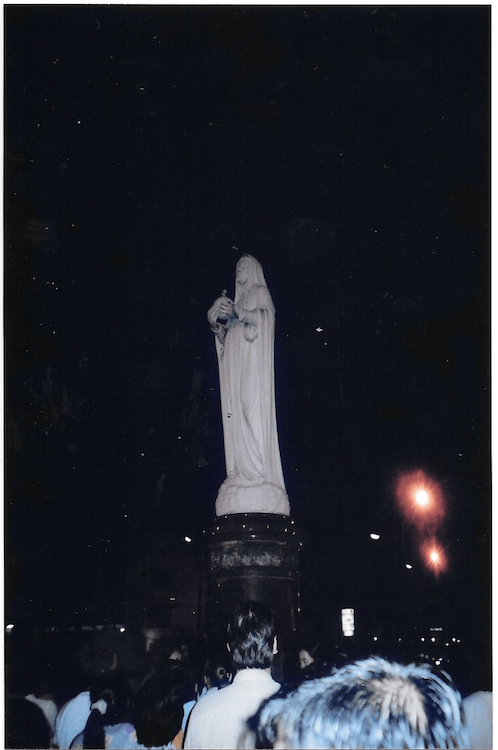
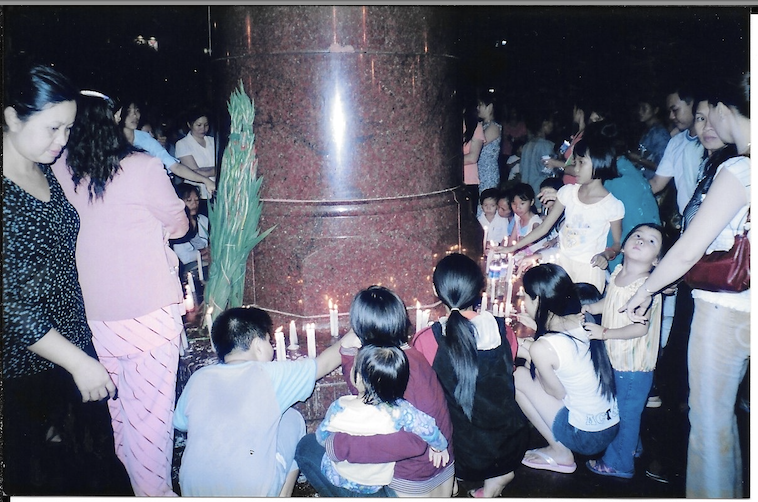
    Dong Khoi Street is home to a Prada store and a brand new shopping mall. And for the past few weeks, Saigon’s upscale shopping district has been the site of what many Vietnamese Catholics believe to be a miracle.

    After word spread that on Oct. 29 a tear streaked down the face of the Virgin Mary statue, staining it, several thousand people flocked to Saigon’s Notre Dame Cathedral to see it. Crowds, many with mobile phone cameras, gathered to record the sight. Initially only city dwellers came, but soon, visitors from the countryside came, too. Traffic around the cathedral slowed to a crawl, and the police arrived to maintain order.

    More than a week later, there was still a mark on Mary’s face, and the phenomenon continued to attract hundreds of daily visitors. People took turns crowding on to the small traffic island that is the site of the four-meter high statue. City gardeners in orange jumpsuits busily repaired the damage caused by feet trampling the grass and shrubbery around the statue.

    Vietnam’s government has been widely criticized for cracking down on religious groups. The U.S. Secretary of State this week again designated Vietnam as a “country of particular concern” in its annual report on international religious freedom.

    Still, several religions, including Roman Catholic and Muslim religious organizations, among others, are officially recognized in Vietnam. There are an estimated five to eight million Roman Catholics in this country of around 80 million. From Phat Diem Cathedral in the north to Notre Dame Cathedral in Saigon, there are so many worshippers on Sundays that people spill out of churches.

    For the most part, the crowd around the Mary statue was orderly. During the day, a sea of umbrellas floated above the crowd as people protected themselves from Saigon’s blazing sun. At night, candles and flowers were placed around the statue, turning it into an outdoor shrine.

    The mood wasn’t completely solemn, however. Children played around the statue. People sold drinks, ice cream, peanuts, prawn crackers — even cotton candy and balloons. Japanese, American and other foreign tourists have visited the site.

    Faithful at Virgin Mary Statue

    The event has been the talk of the town, and the subject of articles in local newspapers. Those keeping a vigil at the statue say it’s a miracle; others say it’s a warning. Some Vietnamese speculate that the tear is an omen about an impending bird-flu pandemic. Some even drew connections between Tuesday’s earthquake — centered in nearby Vung Tau but clearly felt in Saigon — to the weeping statue.

    Other Vietnamese I spoke to were more skeptical, saying the streak was just a mark from the heavy rain that recently fell upon the city. Some speculated about mischief. An executive at a large manufacturing company told me: “I think a game is being played on people. A person put that mark on her face.” Others were simply unmoved by the event. One woman said: “In many countries Mary cries. So it’s not a big deal.”

    The authorities appeared to be tolerant of this public act of faith. I didn’t notice any visible restrictions on who could visit the statue, just some traffic cops making sure people don’t spill out into the streets in front of cars and motorcycles. The police actually discouraged hawkers from selling photos of Mary’s tear-streaked face with a digitally added halo. They don’t want a religious event to be used as a commercial opportunity.

    The crowds of believers surrounding the statue of Mary — against the backdrop of the fancy boutiques and trendy art galleries on Saigon’s Dong Khoi Street — is a telling sight. It suggests that the economic growth and cultural vitality in this communist country are being accompanied by an upsurge of spirituality.

    Screenshot

    Published in The Wall Street Journal, November 11, 2005

  • Good Ol’ Advertising Deserves a Plug

    When Coca-Cola relaunched in Vietnam earlier this year, it did so with fanfare, holding opening ceremonies and a variety show complete with Vietnamese dancers.

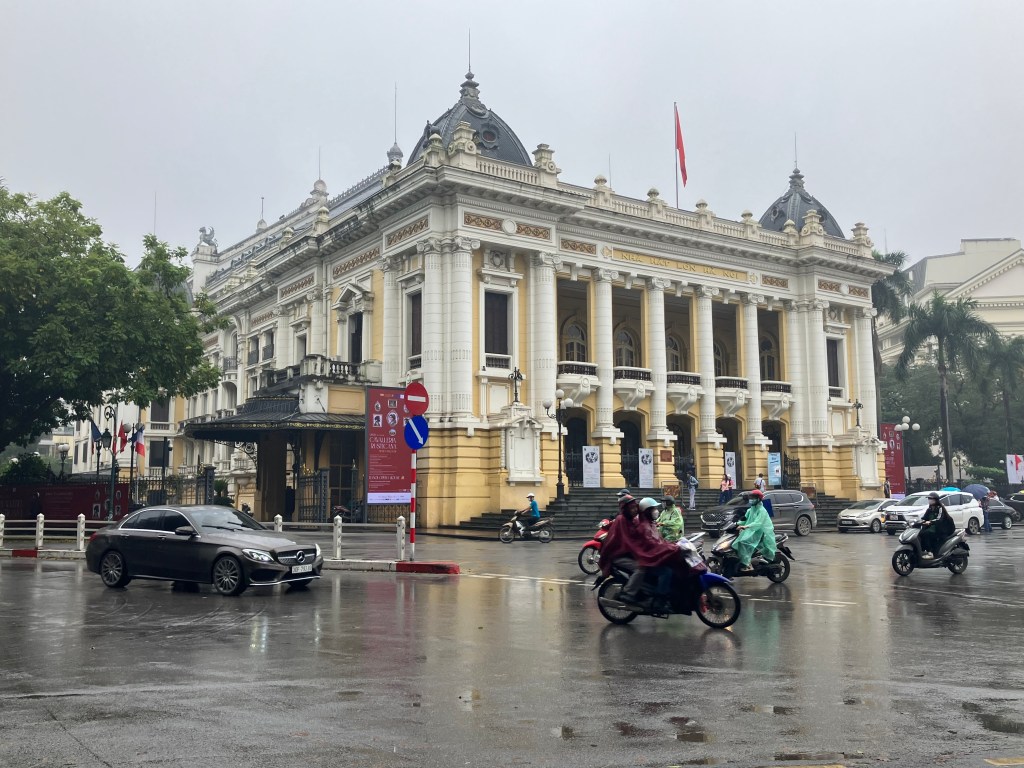
    The show was held, tastefully enough, at the French-built Hanoi Opera House, an imposing ochre-coloured relic from the early years of this century. Less tasteful were the giant inflatable plastic Coke bottles that the company set up outside the building.

    “It shows the U.S. is good at marketing but it was irritating to see a national monument used like this,” a Hanoi resident told reporters, reflecting a widely held sentiment. Not only is the Hanoi Opera House the center of Hanoi cultural life, it is also a national symbol: From its balcony, the left-wing Viet Minh announced its takeover of the city after World War II.

    Postcard of Hanoi Opera House with Coke bottle in front of it

    Coke realized it had made a faux pas. It took down the bottles. The Vietnamese government, meanwhile, has since decided that advertising in general needs to be reined in. It has taken down some billboards in Hanoi and Ho Chi Minh City. It has also restricted the number of outdoor sites where companies can advertise their products.

    In Asia’s developing economies, marketing pitfalls abound. A soft drink television spot in Malaysia a few years ago featured an exuberant woman kicking furniture in her apartment before taking a soothing sip of her drink. A local TV station pulled the ad off the air, saying the woman was “too aggressive.” Malaysia also banned feminine hygiene products a few years ago, in response to pressure from a women’s group. The women argued the products were too personal and an inappropriate sight for the eyes of Malaysian children.

    The Thai government prohibits advertising in which one product is judged better than a competitor. Such a comparison, familiar in Pepsi Challenge ads where consumers compare the taste of Pepsi and Coke, is said to break the taboo of public displays of conflict.

    The Chinese government frowns on revealing clothing. The obligatory lathery shower scene featured in shampoo ads is problematic in Malaysia, where officials don’t want bare shoulders to be seen on television. And in Pakistan, men and women can’t appear together in advertisements.

    Besides the cultural motivations for these restrictions, there is hostility toward what these governments see as promotion of Western values at the expense of their own, and promotion of Western goods at the expense of local companies. As a result, the climate for advertising in Asia’s developing economies can be quite difficult for Western marketers. And because local marketing talent is not as exposed as it could be to the outside industry, the local advertising strategies are in many cases immature. Of course, foreign marketers sometimes stumble into cultural insensitivity. But for all the government officials’ zeal in locking out Western cultural influences and protecting domestic commercial interests, they are hurting their own economies.

    They fail to see advertising’s principal advantage: It creates consumer demand. Workers become consumers who want to satisfy their demand for the convenience-adding or pleasing products they see advertised. In order to make more money to buy these products, consumers work harder at their jobs and upgrade their skills. The collateral advantage to governments is that societies become more affluent, and workers become more productive.

    This cycle has been repeated in all the Asian Tigers. Advertising sells products, and those products are the symbols of a rising standard of living. It’s not that the West’s values are being pushed, but rather that higher quality of life is being sought by consumers.

    Developing-country governments’ protection of local companies isn’t wise either. In the Darwinian logic of the modern market economy, smart companies embrace change. In many cases, local companies recognize advertising as a powerful brand-building tool. In Malaysia, for example, the local haircare brands New & Trendy and Follow Me use advertising aggressively. As a result they control about a third of the market.

    A famous example of a company using advertising to boost its market share is Singapore Airlines. The airline built its reputation by catering to Singaporeans’ exacting standards for service and safety, and communicating those qualities through the memorable image of the Singapore Girl. The result: The airline is one of the largest in the world.

    That’s not to mention the good name the ads create for Singapore itself. The Malaysian government has learned this lesson as well, promoting its airline with futuristic ads that feature a spaceship. The ads move Malaysia beyond its reputation as a producer of tin and rubber, and suggest it is a country ready to enter the 21st century.

    Besides creating demand and a positive image for its products, advertising does another important job as well. It tells information-starved consumers what those products do: How to use a washing machine, a soup mix, or a microwave oven. As developing markets open up, advertising shows the way through a strange new world of consumer choice – a world that the citizens of Asia’s developing markets want very much to join.

    Published in The Wall Street Journal, August 18, 1994

  • At Christmas, Commune with the Crabs

    No, Christmas Island isn’t the suburb where Santa Claus lives. But he might consider vacationing there during the off season. Located 360 kilometers from Java, 1,400 kilometers from Australia, and just this side of nowhere, Christmas Island is as remote as they come. Named by Captain William Mynors on Christmas Day in 1643, this poodle-shaped island has been ruled by Britain, Singapore and now Australia. Once famous for its phosphate mining, now it is known mainly for its casino and its crabs.

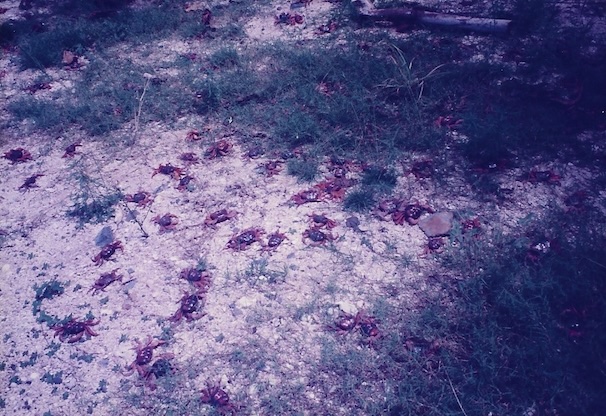
    One of millions of Christmas Island crabs

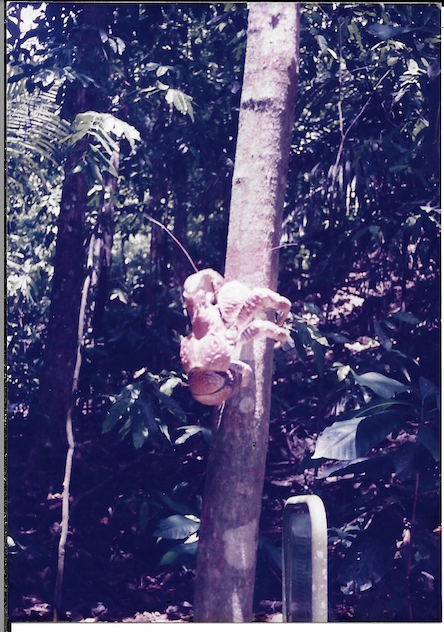
    Crab climbing tree

    Last month, 140 million red crabs marched from the rainforest to the sea to mate. It’s the annual Indian Ocean equivalent of the wildebeest stampede on the great African savannah. The crabs have a certain cuddly quality, although you wouldn’t want to put them under the Christmas tree as a gift or tuck them into bed next to your kids at night.

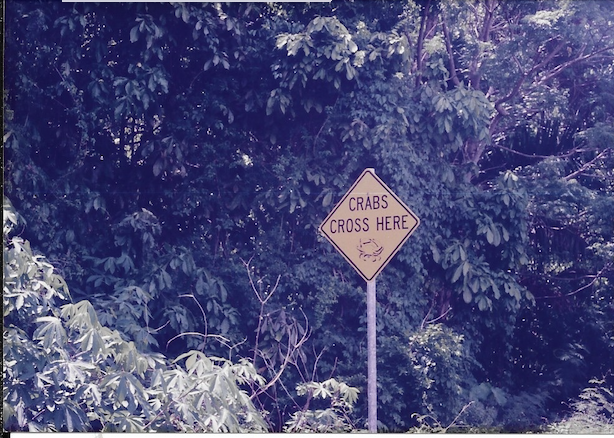
    Crab crossing

    On the bus ride from the airport to the island’s only resort, my four-year-old and I looked intently out the window for any sign of crawling life. We spotted a lonesome crab shortly after the bus left the airport. Then as the bus descended steeply down a road cut through the jungle, we started to see a lot of crabs – hundreds, not yet thousands – and crab carcasses. The smell of rotting crabs reached us in the bus. “Daddy, it stinks,” my daughter said. The jungle smelled more like a fish market at the end of the day. While the Australian government built crab tunnels – like cattle grids – so that crabs can get to the other side of the road in one piece, evidently not all the crabs decided to take the safe route.

    Spare the crabs, use a different road
    Screenshot

    The Christmas Island red crab is not very big – about the size of a man’s fist – and covers about five feet a minute. No way they were going to get out of the way of an oncoming car or bus. A yellow warning sign that says, “Crabs cross here” could not prevent thousands of them from being smashed to smithereens. Although cars and buses really do try to avoid hitting them. For one thing, it’s not pleasant killing a crab. For another, the claws sometimes puncture tires. Try getting a new tire in the middle of the Indian Ocean.

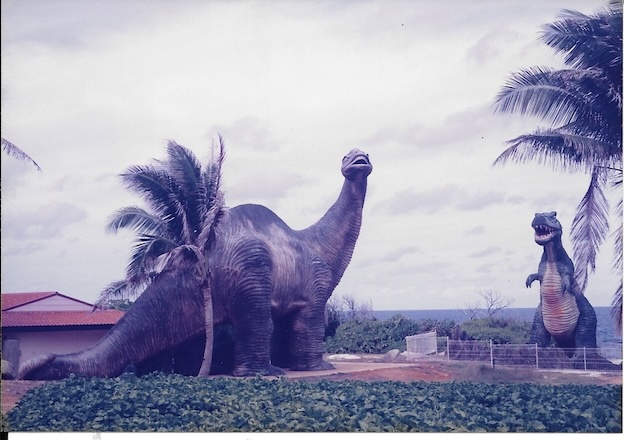
    Christmas Island dinosaurs at resort

    At the resort there was a smattering of crabs across the driveway, across the lawn, along the walkways. Crossing in front of you, crossing behind you. Squatting in front of doorways. Hovering around porches. The resort was a pleasant enough place, perched on limestone cliffs that took a non-stop battering from the sea. It even had a casino meant to attract Southeast Asian high-rollers. At the resort’s swimming pool, which had a white crab guard to keep the crabs from swimming with the guests, frigate birds were constantly dive bombing for a drink of chlorinated water. Away from the pool, near the ocean, were two life-size statues of dinosaurs – a brontosaurus and a tyrannosaurus. When the ocean swells hit the limestone cliffs surrounding the resort, the roar passed through the open mouths of the dinosaurs. Disney World it wasn’t.

    Christmas Island dinosaurs overlooking cliffs

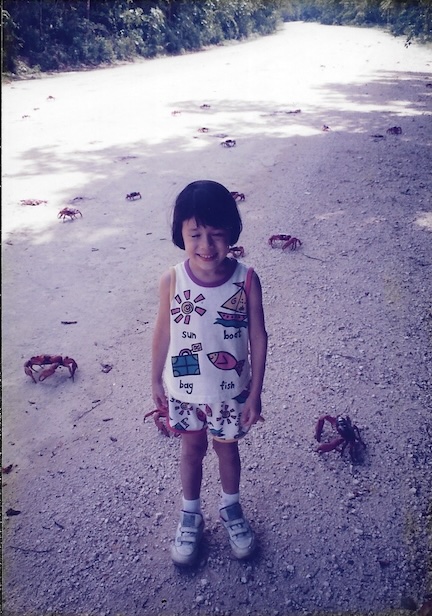
    On a drive through the jungle-covered park that covers two-thirds of the island, we saw a large crab migration. We jumped out of the four-wheel drive to get amongst the crabs. They were everywhere, all over the road, swirling around our feet, carpeting the jungle floor, crawling over each other, fighting each other, even cannibalizing the carcasses of crabs that didn’t make it. My daughter stood in the middle of this moving red carpet and posed, smiling, for one of many photographs. “Daddy, the crabs are my friends,” she said, holding her wide smile effortlessly, as they moved harmlessly around her.

    Screenshot

    Santa may not call Christmas Island home. And he may not even vacation there. But for a little magic to stir a child’s heart, nothing beats the land of the crabs.

    With the Christmas Island crabs

    Published in The Asian Wall Street Journal, December 27, 1996

  • Genghis Lives

    Nearly eight centuries after his death, Genghis Khan still rules the hearts of Mongolians, and his popularity is growing. Since the Russians were pushed out in 1990, a homegrown brand of Mongolian nationalism has started to reveal itself, with Genghis Khan at its center. His face is on the national currency notes, the togrog. A giant image of him has been carved into a mountain just outside Ulan Bator, visible from the city center. There are even calls within Mongolia to relocate the capital from Ulan Bator to Karakoram, the capital of Genghis Khan’s empire, on the 800th anniversary of its founding, which will fall around 2020.

    These reminders of Mongolia’s glory days would not have been visible 20 years ago. When Russia ruled Mongolia from behind the scenes between 1921 and 1990, imagery of Genghis Khan was banned because he was such a strong symbol of Mongolian national pride. Mongolia’s domineering neighbors like to downplay the historical significance of this warrior leader, whose power was won at their expense. His empire became the largest in history, stretching from China to Russia to India to the Balkans.

    It didn’t last. Mongolia was eventually invaded by its neighbors, becoming a fiefdom of China from 1732 to 1911, and then a puppet regime controlled by Russia for most of the 20th century. When protests toppled the pro-Soviet rulers in 1990, democracy took hold — and so did the public memory of Genghis Khan. At Sukhbaatar Square in Ulan Bator, a massive memorial to him is near completion. People line up to have their photos taken in front of it. An energy drink, a vodka and a beer are named after him, not to mention restaurants and tourist agencies. Mongolian legislators even debated a law to license his image last year, which would have allowed the government to charge royalties for use of the warrior’s name and control the ways in which his image could be used.

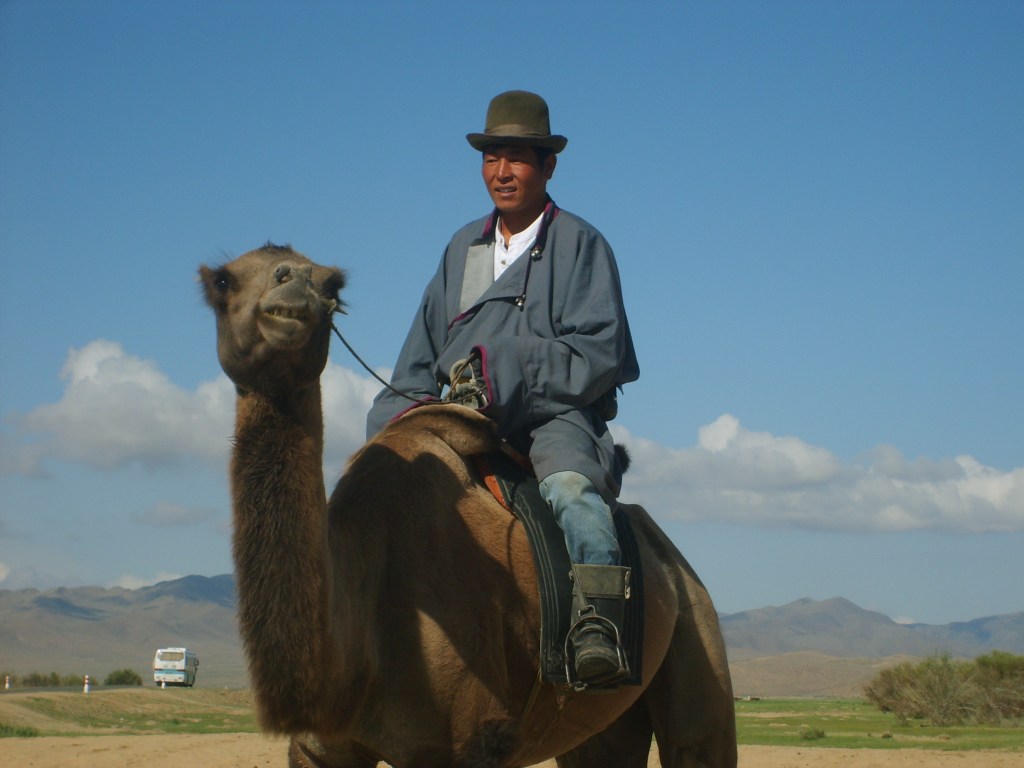
    My guide when I was recently in Mongolia, a college student named Bolor, spoke of him in hushed tones, as if he were still living and very much in charge. Genghis Khan’s cultural legacy is also all around. The annual Nadam festival features the sports famous in Genghis Khan’s time: horseback riding, archery and wrestling. The fermented mare’s milk sold by children at roadsides and served by nomads to visiting guests was the fuel that powered his army on their conquests.

    Genghis Khan may be best known as a warrior, but his legacy of governance is still relevant, too. He introduced a written Mongolian script still in use today and the rule of law, the Yasaq. He practiced a sort of religious tolerance that is progressive even for today: Citizens of the Mongol empire had no religious restrictions and could pray as they pleased – as long as they were loyal to the Mongol rulers. He unified warring Mongolian tribes into one nation and he and his sons conquered more territory in 25 years than the Romans did in 400 years. Mongolia is not the only nation in his debt — modern-day Russia and China were also first united under the reign of Genghis and his descendants.

    In one respect it’s odd that a young democracy should so admire a ruler with such a fierce, autocratic reputation. Yet, the Mongol empire’s success was grounded on the principle of meritocracy. Ethnicity and race mattered less than ability. The Mongolians see Genghis Khan as the embodiment of that principle. That one man could so rapidly create so large an empire from such a remote outpost provides inspiration to his countrymen even today.

    Published in The Wall Street Journal, November 2, 2007