
The World’s Largest Canopy Walk
I was staring at a green viper while perched some thirty meters above the jungle floor on a suspension bridge the width of two narrow planks of wood and with the stability of a trampoline that a five year old had just jumped on. Luckily, the viper didn’t stare back. My son, just behind me, hurriedly me along so he could have a stare too. At 480 metres, the Mulu Canopy Skywalk in the Gunung Mulu National Park is the longest tree-based walkway in the world. With its bouncy suspension bridges fastened to tropical hardwoods you experience sheer drops over the jungle floor and a snaking river while walking – bouncing more like – at the same level as the tree tops and the birdlife while in the occasional shadow of steep limestone cliffs. The day we went there was only me, my son and our guide — and all that jungle.
I first visited the Malaysian state of Sarawak in Borneo in 1981. It was an island enveloped with mystique then, with mist-covered limitless jungle wrapped around isolated longhouse communities. I’ve been back to Borneo a number of times since then and watched cities grow, roads cut through dense rainforest and plantations expand. So imagine my delight when the MAS Wings flight flew low over a landscape of mist-covered rainforest and mountains before landing at Mulu’s tiny airport. I told my son, who at nineteen is just a few years younger than I was in 1981, that this was the way I remembered Borneo.
PARK OF SUPERLATIVES
Gunung Mulu is a 529 square kilometre park which was listed as a UNESCO World Heritage Area in 2000. There’s only 160 in the world and two nature sites in Malaysia, the other one being Mt. Kinabalu. Mulu was selected because of its concentration of caves, river canyons, limestone pinnacles. It is a park of superlatives: the biggest limestone cave system in the world; the largest cave passage in the world; the largest underground river; the largest underground space in the world, Sarawak Chambers, where even St. Paul’s Cathedral can easily fit; a 180 million year old rainforest. The British naturalist and explorer Robin Hanbury-Tenison wrote of the area in his book “Mulu: The Rain Forest”: “all sense of time and direction is lost.”
And yet it is relatively untouristed with approximately 12,000 tourists a year. When my son and I walked to the Deer Cave on the well-maintained jungle boardwalk it was just us, our Iban guide from the Marriott hotel and another hotel employee. We had the forest to ourselves. The Deer Cave loomed above us like a cathedral whose architect was nature itself. It is not only the world’s largest cave passage but has the world’s biggest cave mouth and is 220 meters at its highest point. Limestone cliffs opened up to reveal the majesty of the cave. The path through the cave – it’s 2.2 kilometres from one end to the other – allowed us to see the frequent pulsating dark patches on the ceiling, where an estimated 2 to 3 million Wrinkle-Lipped and Horseshoe bats hang upside during the day before flying out en masse at sunset. We also passed mini-mountains of guano. If you put your hand on the path’s rail it is soon covered in, well, guano. At the far end of the Deer Cave is the site known as The Garden of Eden, a sun dappled malachite green paradise encroaching on stony darkness.
SUNSET BATS
Outside the entrance of the cave we joined the rest of the tourists, maybe only fifty in total, to watch the sunset show. At about 5:30pm the bats started to fly out in spiralling flocks and for the next hour they kept on coming, floating up from the Deer Cave’s entrance like twisting DNA strands until they became black floating clouds. Bats make echolocation sounds to help them navigate. From the ground the sound of tens of thousands of bats creating that noise was like the low rumble of waves washing against a distant seashore, rhythmic yet hushed.

We stayed for an hour until it was dark and we were the last ones there. The walk back to the park entrance was never dull as the nocturnal creatures revealed themselves: a four-inch male walking stick piggybacking on a female walking stick that was easily double its size; frogs, fireflies, giant snails climbing up trees.
AN IN-BETWEEN WONDER
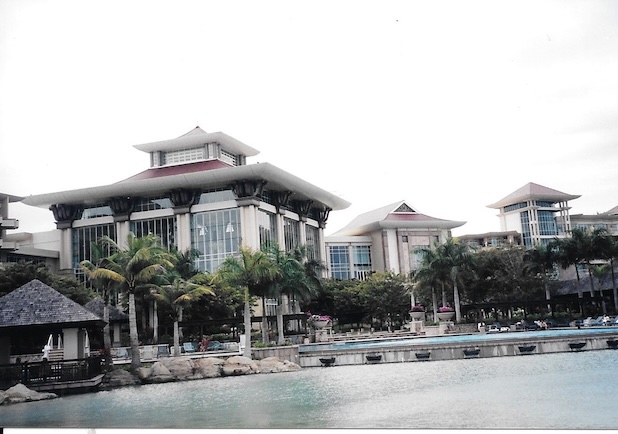
After a day that full we retreated to one of the in-between wonders, the new Marriott Hotel, which was designed to look like a series of native long houses on elevated walkways. It reminded me of the safari lodges in Africa. You may be in a remote place where you don’t expect comfort at all but the lodgings are surprisingly luxurious. And the hotel certainly spent a lot of effort to get it right: over USD16 million on renovating 101 rooms over three and a half years. Everything had to be shipped in.
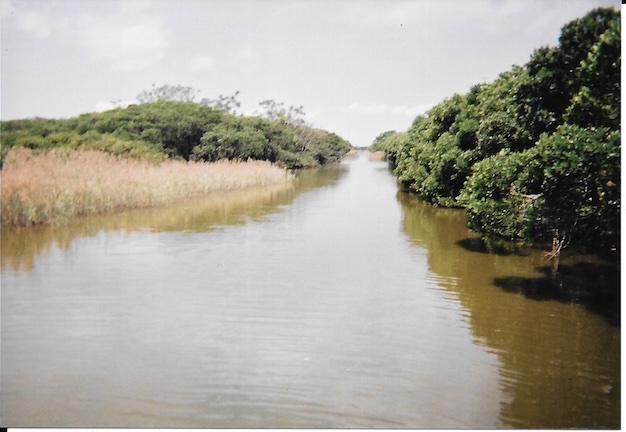
The next morning we took a long boat from the hotel’s pier down the Melinau River. As with the forest walk there was only my son and I and our guide and a boatman. We had the tranquil, cliff-and jungle-lined river to ourselves.
ORIGINAL FOREST DWELLERS
We stopped first at Batu Bangan, a Penan village. While the Penan were originally hunter and gatherers, only about 200 of them live that nomadic life now. The remaining 16,000 have been settled into villages. The Penan are noted for “molong”, the practice of not taking more than necessary. The greatest violation in their society is “see hun”, which is “a failure to share.” They have no word for thief and six words for varying levels of “we.” And even though they have a word for every plant and animal in the forest, they have no word to describe the forest itself. They refer to the forest as “tongtana”, the only world they know. With our over-competitive, overconsuming society I felt we could learn a lot from them.
WORLD’S LARGEST CAVE SYSTEM
Further down the river, we walked along a narrow cliff clinging boardwalk from Cave of the Winds to Clearwater Cave where we were greeted by dozens of Rajah Brooke butterflies with their iridescent green and black wings. The final ascent from a tranquil pond was 200 steps but well worth the effort. In addition to having the world’s longest underground river at 170 kilometres – only 75 kilometres of which have been explored – the Clearwater Cave is known to be the largest interconnected cave system in the world. The crystalline water racing through the mountain was one of the highlights of the park. The bridge over the water was a great place for meditation or reflection.
IMAGINATION RUNS WILD
The stalagmites and stalactites at all of the caves create shapes that bring to mind all sorts of things. The most obvious was the Abraham Lincoln profile near the entrance of Deer Cave but there were wilder interpretations at some of the other caves. The King’s Chamber at the Cave of the Winds looked like a futuristic city from a sci-fi flick. The statue of the lady at the Clearwater Cave. The tropical forest at Lang’s Cave. The caves bring out the best of your imagination.

ON THE WAY TO NOWHERE ELSE
Getting to the park is something of a challenge. It’s right below Brunei and not on the way to anywhere else. The closest city to the park is Miri but you can also get there from Kuching and Kota Kinabalu on MAS Wings, the only airline that flies there. Of course, the difficulty of getting there means not fighting the crowds when you do get there.
GREAT FOR FAMILIES…COUPLES TOO
The park facilities from the museum to the boardwalk paths through the forest and the caves to the motion sensor lights in the caves were all first rate. I saw families with small children enjoying the park. The kids especially loved the bats and caves. Another park attraction is its internet connection — it’s very weak! Which means you may have to talk to the person you’re travelling with — whether it’s your family or significant other. Despite the ruggedness and remoteness of the park, the focus on safety is high. Guides are there to show you the fauna and flora and to make sure you’re safe from them — and of course that they’re safe from you. For the long unguided walks, you’re supposed to register with the park office.
As a UNESCO World Heritage Area Mulu is one of the rare natural wonders of the world. Not as famous perhaps as some of the other sites such as the Grand Canyon, Mount Kilimanjaro, the Great Barrier Reef and Ayers Rock. But much more special because far fewer people visit it. As Robin Hanbury-Tenison said: “There is nowhere in the world like the Mulu National Park.”
Published in Asian Journeys magazine, August-September 2015
























 Maybe Next Trip