
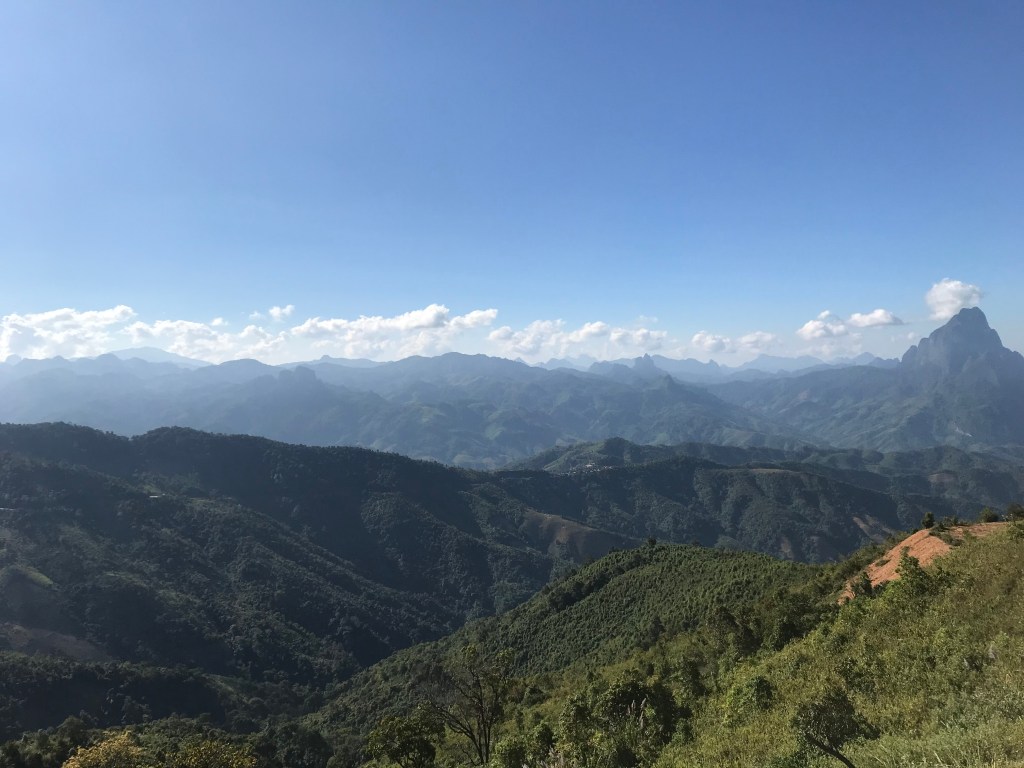
The road to the Plain of Jars revealed ancient mysteries, recent horrors, and an uncertain future.
The Gallic joie de vivre of Laos’ capital, Vientiane, was an out of sync start for our trip to the unknowable Plain of Jars. Anchored around Buddhist temples, colossal communist edifices, and elegant remnants of French colonial rule, the city was a mélange of the sometimes stylish, occasionally dour past, and a promising present built on tourism and foreign investment.

Defined by the Vietnam War period

Every city has its defining era. The Vietnam War period is the historical fulcrum for Vientiane. The 19th century certainly left its mark: evocative Buddhist temples such as Wat Si Saket near the Presidential Palace, and the shimmering golden Pha That Luang, which is featured on Laotian money, sit beside colonial-era French villas, many of which are now hotels and restaurants.

But it’s during the Vietnam War where modern Laos got its stumbling start. The founders of the current government gained power then as the leaders of the Pathet Lao guerilla movement. The colossal Kaysone Phomvihane Memorial is devoted to the first prime minister who headed the Pathet Lao when it took over the country in 1975. The museum has an enormous monolithic statue of him out front and exhibits inside that include a mock-up of his childhood home and the cave where he operated from during the war. Nearby, a mid-century French villa with a lush garden was the home of the late President Souphanouvong, aka The Red Prince, who fled his royal life to co-lead the Pathet Lao. Both are close to the former CIA headquarters compound. The area is heavily guarded and closed to tourists.
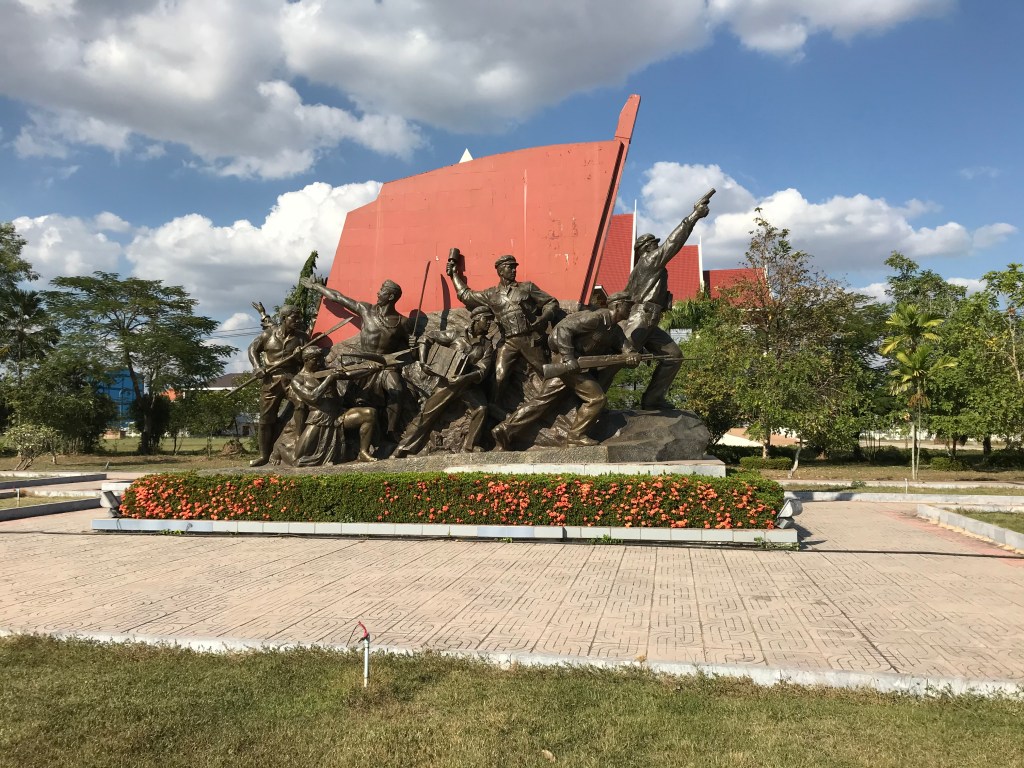
Laotian Har Paw Villa and Arc de Triomphe
Buddha Park, Xieng Khouvan, is 20 kilometers from downtown. Started in 1958 by Luang Pu, a maverick monk, it is a physical representation of his religious philosophy where he had merged Buddhism and Hinduism. With over 200 concrete statues of Buddhist and Hindu figures it reminded me of a Laotian Haw Par Villa, a quirky perspective on religion, that educated as well as entertained.


The Patuxai, Vientiane’s version of the Arc de Triomphe, was built in 1969 to commemorate those who died in pre-independence wars against the French. Concrete from the US that was meant to construct a new airport was used for the memorial. That was how it earned its sobriquet, “the vertical runway.” It straddles the Th Lan Xang boulevard that leads to the Presidential Palace near the Mekong River. You can take stairs to the top for a panoramic view of the city.

A past that bites again and again
Our last stop in Vientiane before heading north was COPE, a meaningful acronym that stands for Cooperative Orthotic and Prosthetic Enterprise. Sobering exhibits explained the prosthetics that they create for the victims of UXO (unexploded ordnance) from the Secret War in Laos. The Secret War was a theatre of the Vietnam War where the US supported the Royal Lao government against the Pathet Lao and attacked the Ho Chi Minh trail.

According to a Russian saying, “it is better to be slapped with the truth than kissed by a lie.” At COPE, I was slapped a lot. Laos was the most heavily bombed country in the world per capita in history. During the Secret War 580,000 bombing missions were flown by the US, working out to one every 8 minutes, 24 hours a day from 1964 to 1973. More than 2 million tons of ordnance were dropped. Cluster bombs containing 270 million bombies (tennis ball sized mini-bombs) were dropped on the country. 30% failed to detonate. Approximately 25% of villages in Laos have UXO. More than 20,000 people, 40% of them children, have been killed and wounded by UXO since the war’s end in 1975. The individual tragedies I read about were so wrenching I wanted to stop but couldn’t, I wanted to leave but stayed. One of the most heavily bombed areas was the Plain of Jars.

Listen to the rice grow
The French had a saying during their colonization of Indochina. “The Vietnamese plant the rice; the Cambodians tend the rice; the Lao listen to it grow.”
In a culture that considers avoiding stress a virtue, our driver of the Avis rental car was so chilled he could make a California surfer envious. He drove us north from Vientiane through landscape that transformed from flat rice paddies three hours later to the stunning karst formations that erupted around Vang Vieng. We stood on a shaky wooden pedestrian bridge over the Nam Song River and watched motorboats ferrying tourists and people in canoes navigating the currents with paddles. Looming behind them was the backdrop of mountains shaped like vertically stretched camel humps.

As we left Vang Vieng at dawn the next day we glimpsed the future. Half-built overpasses of a new China-financed highway were cutting into the landscape. Soon we were in the Annamite Mountains, shades of gold from the rising sun and green from the forest entrancing us as we imagined what creature a particular karst formation resembled. Along a road more coiled than a cobra the driver dodged potholes, oncoming cars and trucks and weaved around villagers going about their chores. He did it with elan and a smile that emulated Mona Lisa’s. At a mountain pass an evanescent cape of clouds was gently draped over peaks and ridges that stretched north to the borders of Vietnam and China.
Southeast Asian Stonehenge

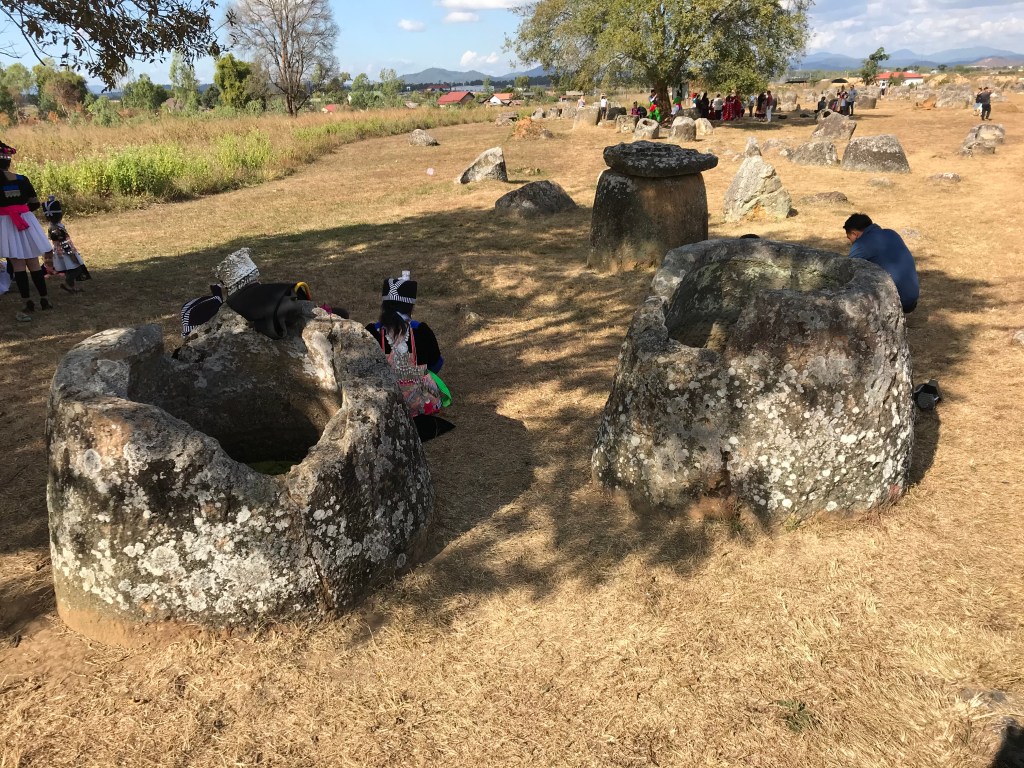
Located 400 kilometers north of Vientiane in the province of Xieng Khouang, near the nondescript town of Phonsavan, the Plain of Jars has perplexed foreigners since the visit of Comte Francois Pierre de Barthelemy in 1896. The French archaeologist Madeleine Colani studied the various Jars’ sites from 1931 to 1933. Nothing is known about the civilization that created the Jars between 500 BC and 500 AD. The Jars’ range in size up to 3 meters in height and up to 14 tons in weight. How this early civilization transported these extremely heavy stone items from quarries kilometers away is still a mystery. Because Madame Colani found bones in the Jars and a cave at Site 1 she believed the Jars were used for funerary purposes. Her hypothesis was that corpses were placed in the Jars and left to decompose until only the bones remained. Then the family collected the bones and buried them. She also believed the cave at Site 1 was used for cremation. But were the Jars originally used for funerary purposes? After all, the Plain of Jars is located on ancient trade routes. Did the Jars play a role in trade? In one legend, when King Kung Jeang defeated the tyrant, Chao Ankha, the people supposedly celebrated the victory by making the Jars and filling them with rice wine.
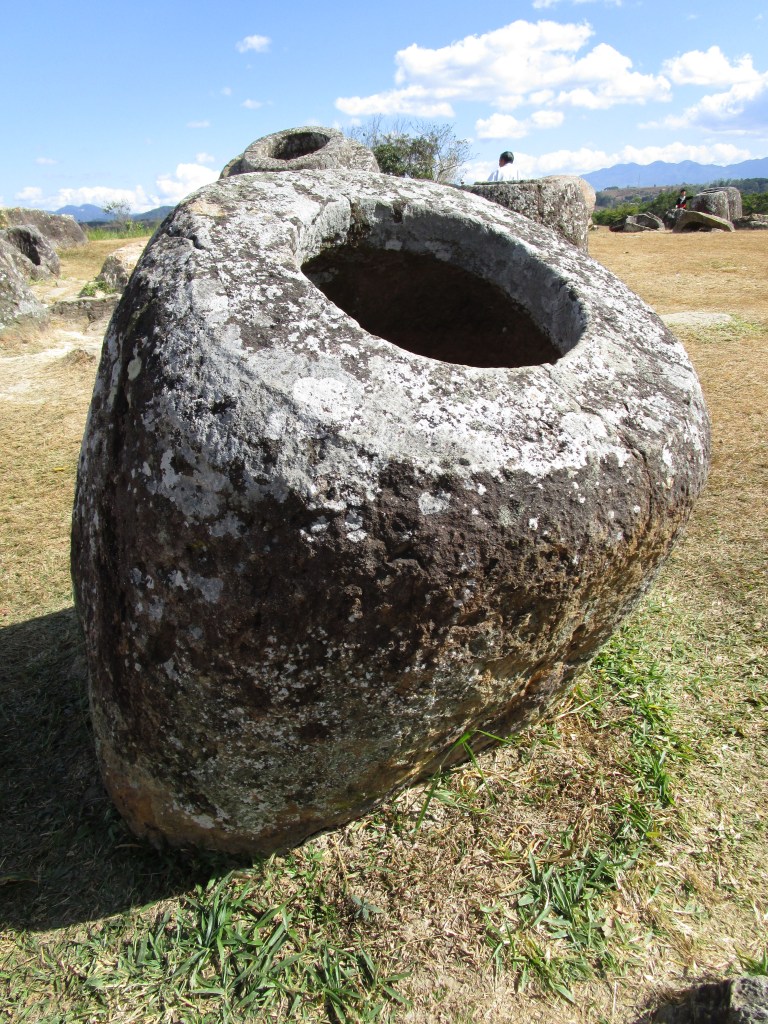
The Plain of Jars has been called a Southeast Asian Stonehenge because of the enduring mysteries surrounding the Jars. The unknowability of the who, what, and why of the Jars makes a journey here more of a pilgrimage than an Instagram moment.

UNESCO World Heritage Site

In July 2019, UNESCO made the Plain of Jars a World Heritage Site. The designation should protect the area and attract tourists who can help fund the Jars’ preservation and the opening of new sites. As one of the most heavily bombed areas during the Secret War, craters dot the landscape like smallpox scars. Bombies still need to be cleared from Jars’ sites that are currently closed. To visit the sites that are open you need to stay on clearly marked trails and scan the ground for barely visible bi-colored pieces of concrete. To stay safe, avoid the side that is painted red while remaining on the side that is painted white.

Mysteries like a fog that won’t ever lift
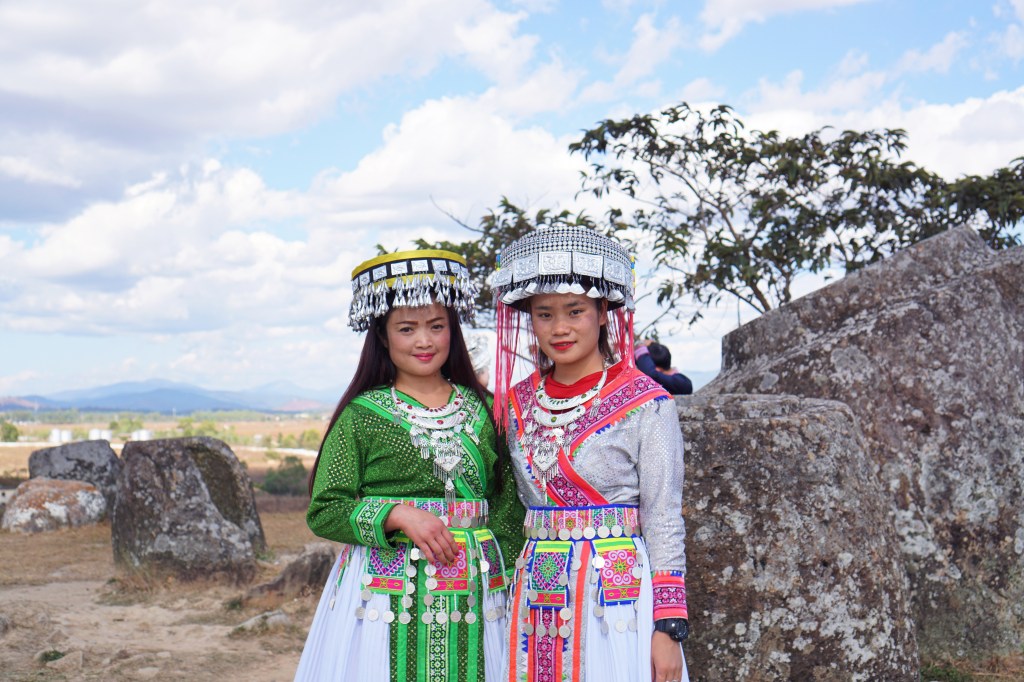
We visited three Jars’ sites. At Site 1, the largest, was a sign from the NGO Mines Advisory Group (MAG), stating that the area had been cleared of mines in a joint effort between UNESCO and the government of Laos. With that sobering thought we climbed a short hill. Huge stone Jars, the patina of time creating blemishes on their eroded surfaces, were scattered haphazardly around a large area. They were for the most part devoid of decoration. Hmong tribesmen, celebrating their new year in their finest clothes, resplendent with colorful sashes, headdresses and newly polished silver jewelry, picnicked underneath lonely gnarly trees. Bomb craters served as reminders of a recent violent past whose ghosts, in the form of unexploded bombies, haunt the soil of the surrounding countryside. Phukeng Mountain was the only elevated point on the flat horizon. Despite the groups of Hmong, an eery silence hung over the area that was punctuated by a light intermittent breeze, as if the funerary past of the Jars was a reminder to visitors that this was a place to pray, not play.
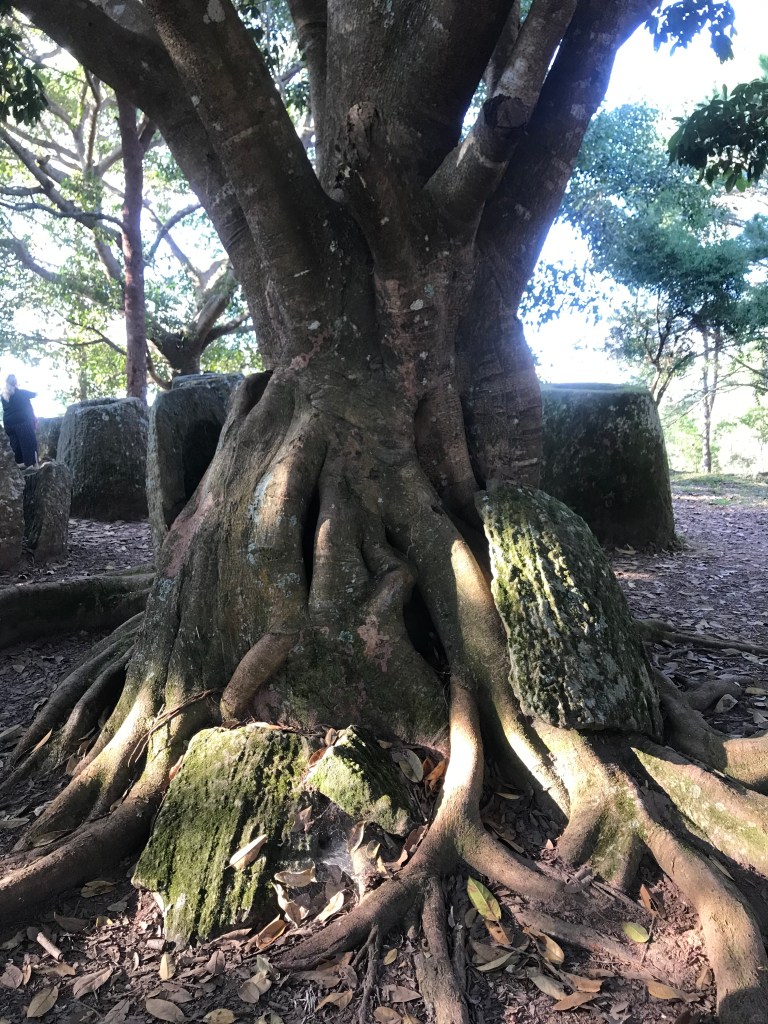
At the top of the nearby cave where Madame Colani hypothesized that cremations took place were two anti-aircraft positions used during the Vietnam War by the Pathet Lao. The Jars were silent witnesses and survivors of the war, late 19th century Chinese raiders, and even the occasional careless, callous tourist.
Hints of Angkor Wat
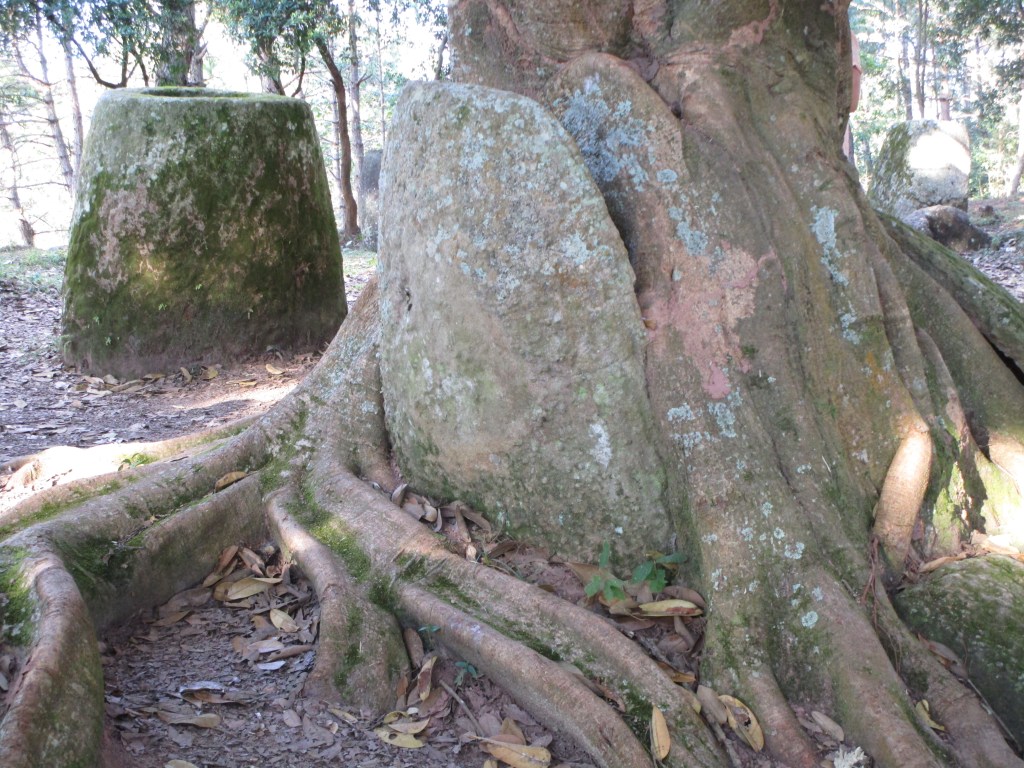
At Site 2 we took a path to a heavily forested area where the Jars sheltered beneath the cover and protection of trees. As with the Angkor Wat temple of Ta Prohm, the trees surrounded and cracked open jars, a reminder that nature always has the last word.
At the end of the day we visited Site 3. The area hadn’t been completely cleared of mines. The sign from MAG informed visitors how to see the Jars and return in one piece by referencing the markers in the ground: “White indicates the areas where sub-surface UXO clearance has occurred. Red indicates where UXO has only been removed from the surface. YOU ARE ADVISED TO STAY BETWEEN THE WHITE MARKERS.”
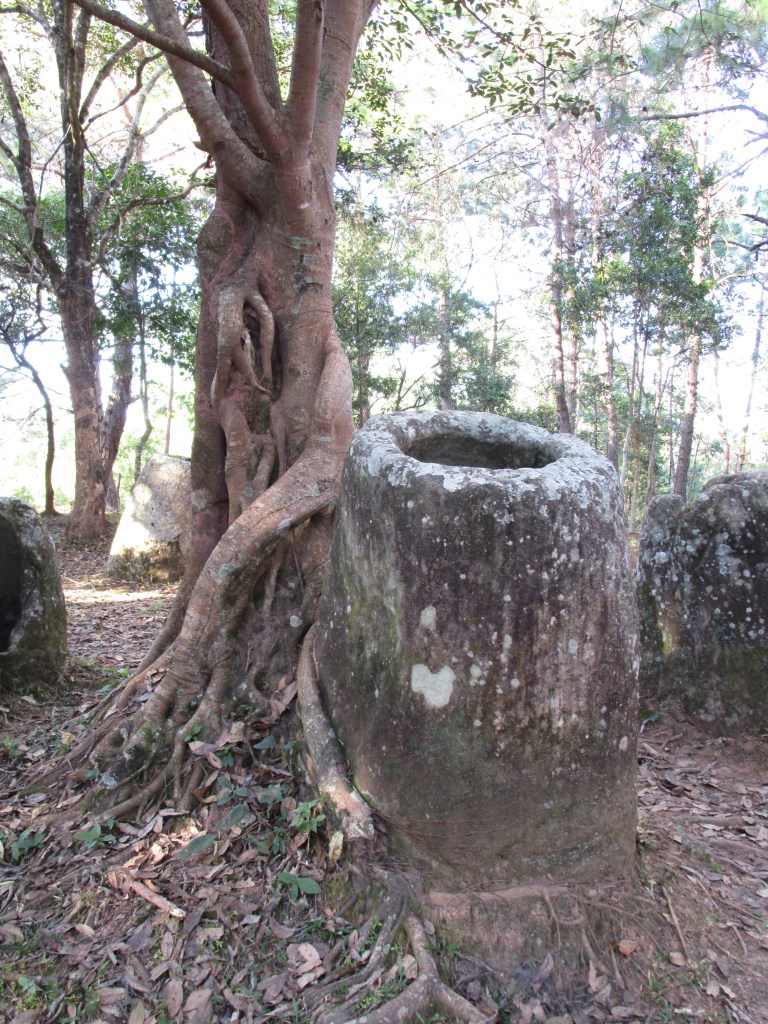
After crossing a rickety bridge, we followed the instructions, walking through muddy paddy fields to a patch of forest that shielded several dozen Jars. Speckled light from the declining day imbued the site with a mysterious aura, more Rousseau than reality. The Jars weight caused them to partially sink into the soil, obscuring their individual stories beneath a blanket of dirt and time.

That night in Phonsavan we visited the Xieng Khoueng UXO Survivor Information Centre where we bought crafts made by UXO survivors. On the way to dinner afterwards we passed a guest house where artillery shells and bombs were displayed in glass cabinets and on the floor. Dozens of shells and bombs of all sizes. When I tried to take a photo, the guest house owner told me to go away. It left me with a feeling that a cult of death still permeated the area. It was my wish that it be replaced by a cult of life.

Travel Tips:
-Dining:
Doi Ka Noi restaurant’s Laotian cuisine was so good it’s practically worth a trip to Vientiane to eat here. Lemongrass stuffed with pork and herbs plus Luang Prabang river weed with tomato chili dip was as good as it sounds. The Blood Plum and Gin ice cream was an inspiring finish to the meal. Try Butterfly Tea, which turns from blue to purple with the squeeze of a lime. Although they participate in the slow food movement you will be tempted to eat fast here.


-Places to stay:
Booking.com was a great source of affordable and excellent places to stay. Our Vientiane hotel was the comfortable VKO Guest House near the Mekong River and the night market.
-Rental car:
We rented a car and booked an excellent driver from Avis.
-What to buy:
The Lao Textile Museum sells intricately designed textiles. Crafts from COPE help fund their efforts. From Bombs to Beans from the Lone Buffalo Student Coffee Company is excellent coffee.

Published in Asian Journeys magazine, February-March 2020
 Maybe Next Trip