Tag: guatemala

  • Guatemala: from BC to B.E. (Before Easter)

    Pre-Easter procession

    Antigua: Three volcanoes surrounding a UNESCO Heritage Site
    Sharing the burden

    Antigua struck me as the legendary town of Macondo come to life. Its streets seemed to embody the mythical town at the heart of Gabriel Garcia Marquez’s novel “100 Years of Solitude.” Yes, I know that Macondo is set in Gabriel Garcia Marquez’s native Colombia and Antigua is in Guatemala. But its mystical feel and magnetic pull made me feel this UNESCO Heritage Site was in a place like no other, one I wanted to linger in for a while.

    Altar along pre-Easter procession
    Solemn pre-Easter wound through the streets

    At the Heart of Guatemala’s History

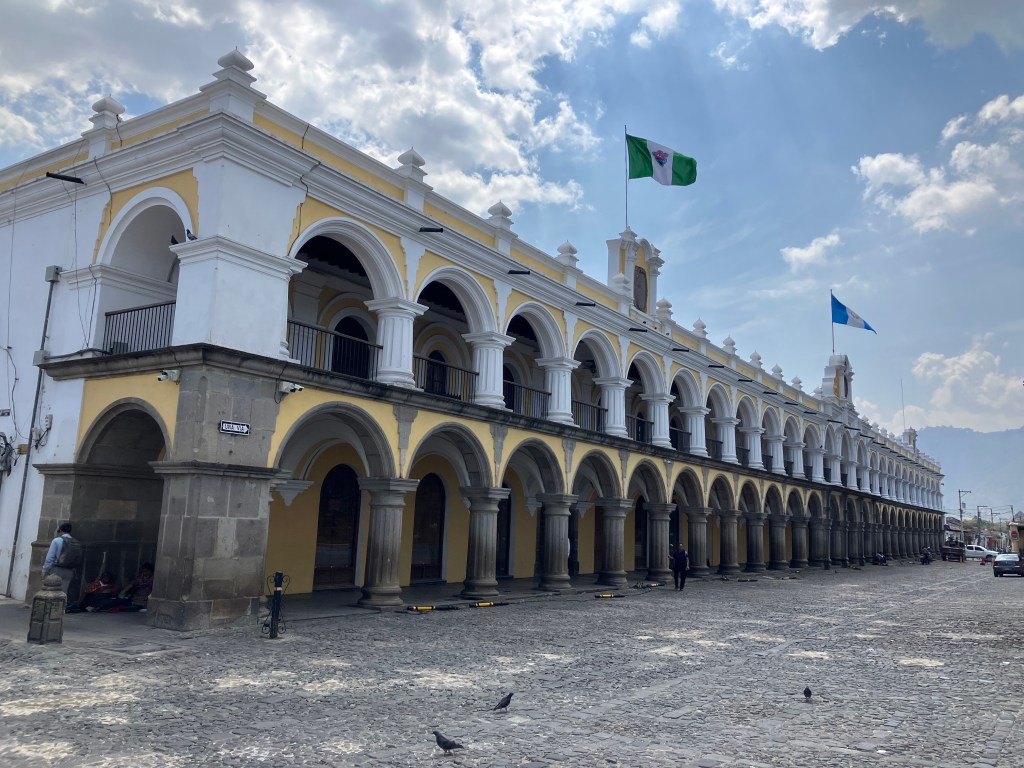
    Palacio de los Capitaines de los Generales
    Palacio de los Capitaines de los Generales at night

    Antigua is at the heart of Guatemala’s history. Ruled by the Maya from 1000 BC to 1524 AD, Guatemala was conquered by the Spanish conquistador Pedro de Alvarado from 1523-24. Antigua was founded in 1543 to become the locus of Spanish colonial rule throughout Central America. A destructive earthquake hit in 1773 and many of its 38 churches as well as mansions, convents, and homes were badly damaged. While many weren’t repaired since then — those that were faced another deadly earthquake in 1976. The visible damage from the two earthquakes is one of the distinctive features of Antigua — a city that at its peak attracted the focus and funds of the unimaginably rich Spanish colonial power. Now, its candor is its charm, a city unafraid to reveal a few gray hairs and age spots that don’t detract from its glamor, even if its glitter is long gone.
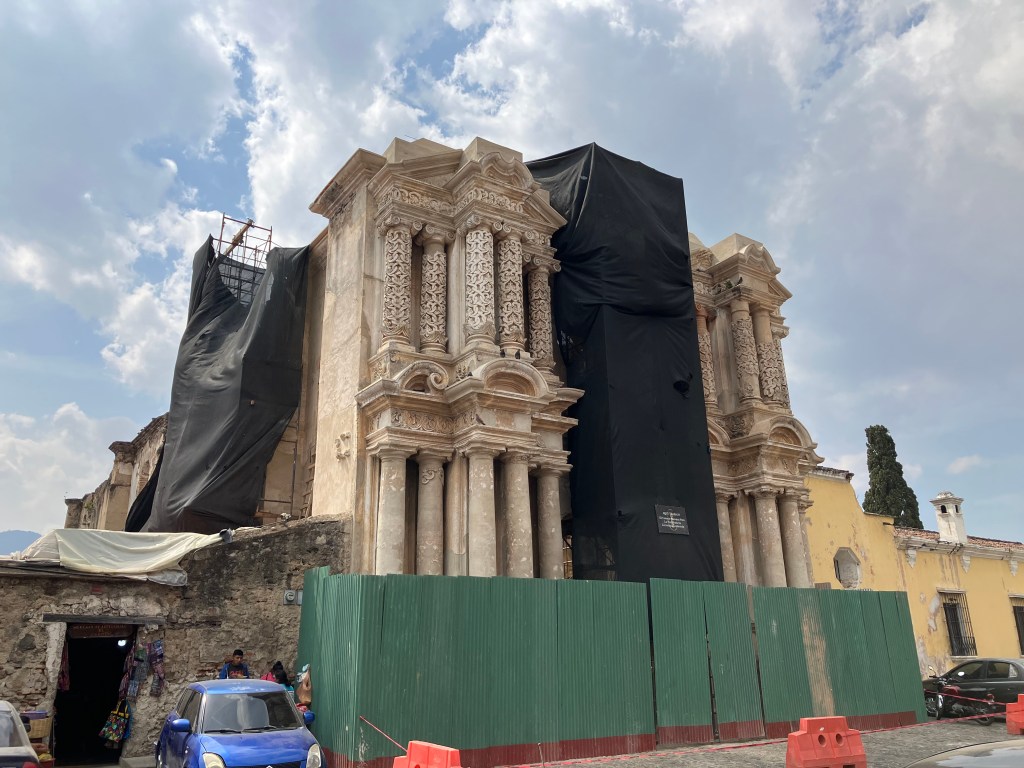
    Repairing earthquake ruins

    Once a Backwater

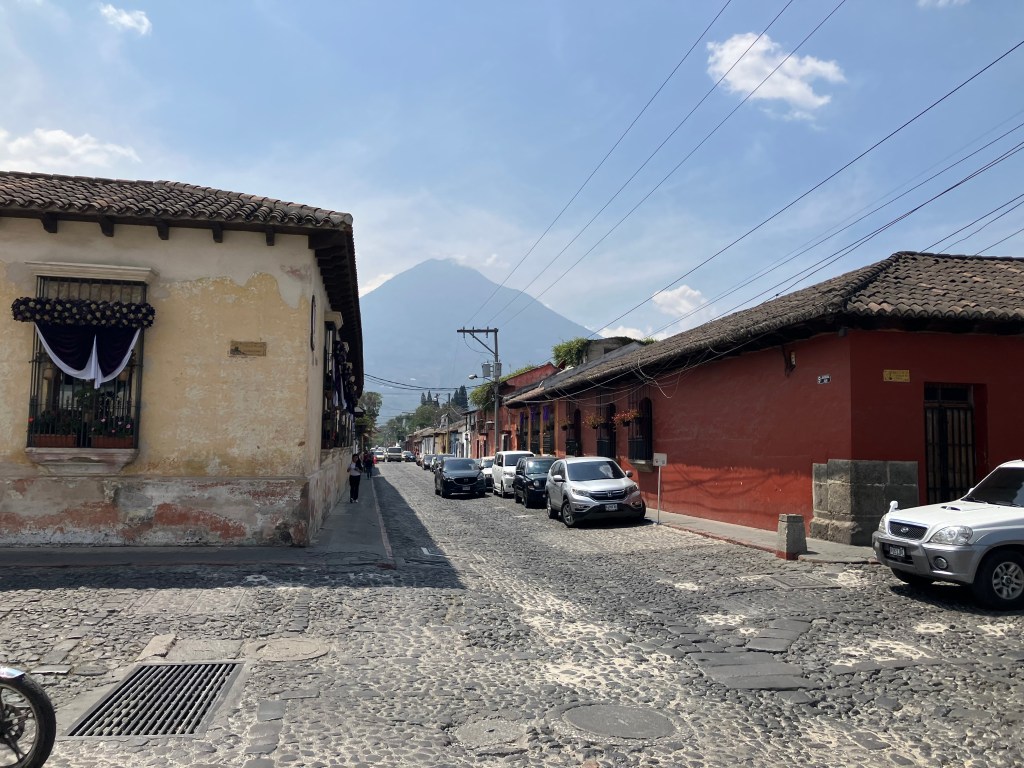
    Surrounded by volcanoes

    Antigua became a backwater in 1775, when two years after the quake Spain moved the colonial capital to Guatemala City. And that’s where Guatemala’s history played out. Independence was achieved from Spain, then Mexico in 1823. A CIA coup against President Jacobo Arbenz happened in 1954. A deadly civil war occurred from 1960 to 1996 with a staggering 200,000 deaths. Now peaceful, Antigua is at the center of Guatemala’s efforts to attract tourists to a country that has been at the political center of Central American history for literally 3,000 years.

    Elegant colonial courtyard

    Fireworks over Antigua

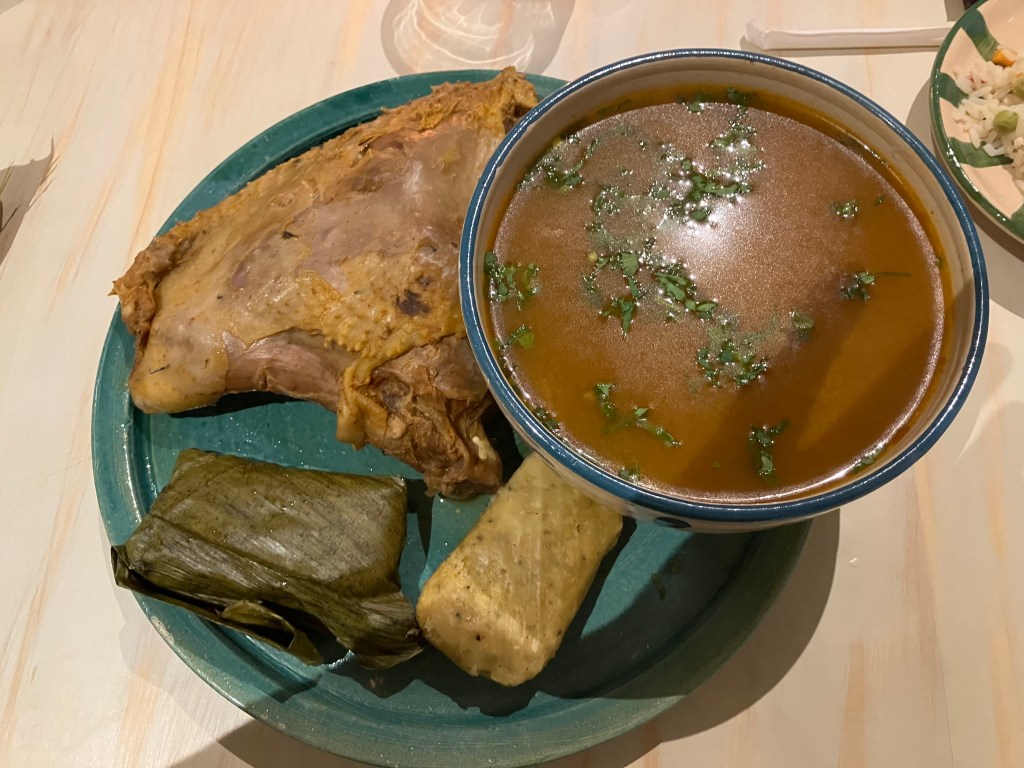
    Kaq’ik

    I was eating Kaq’ik, a multi-layered spicy Maya soup from Coban at the charming El Adobe restaurant, the sound of a woman slapping tortillas onto a grill creating a soundtrack in the background. Explosive fireworks lit up the sky overhead. I went to the second floor to see the fireworks illuminate the night sky and the colonial skyline. Burst, crackle, and then descending colorful lights, fading in illumination as they approached the earth.

    Cucurucho figure. They are part of Easter processions
    Catedral de Santiago

    Pre-Easter Procession

    Easter decoration at San Jose church

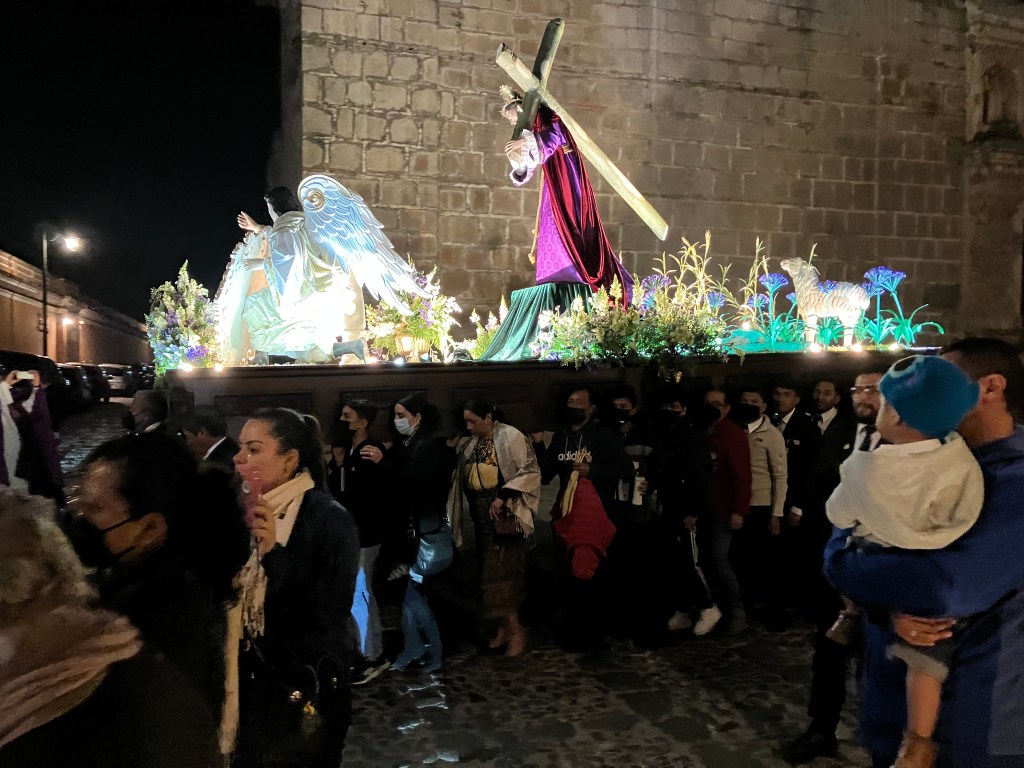
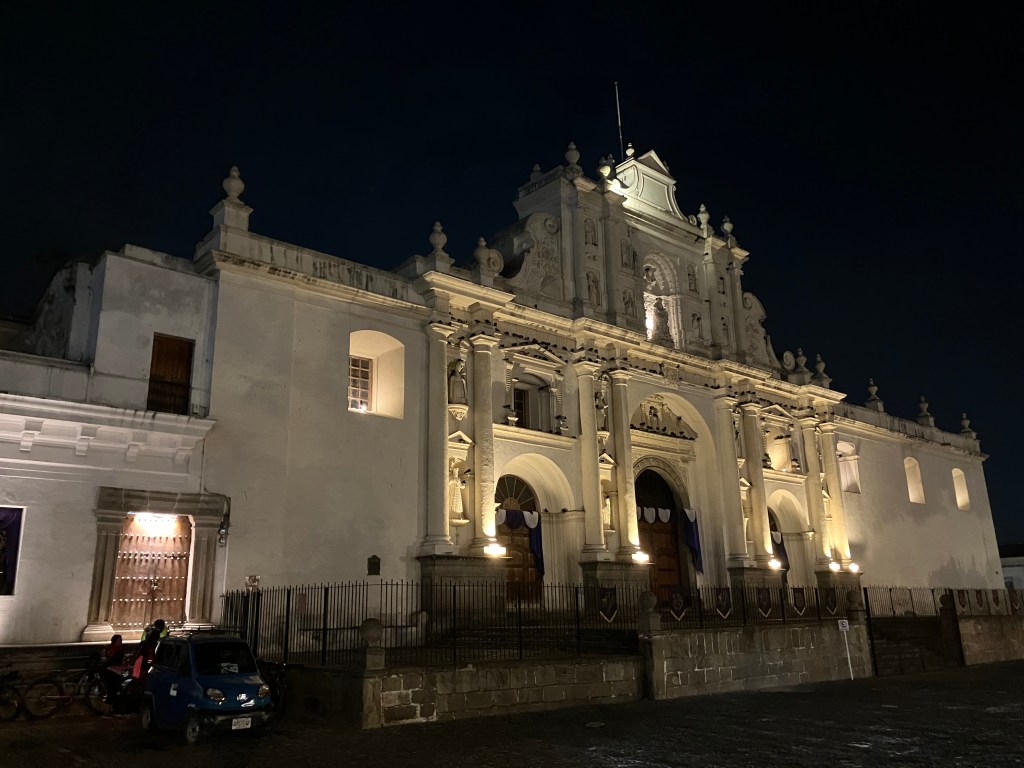
    Outside, I followed a large procession as it moved through the glowing cobblestoned streets, flanked by colonial-era buildings, homes, and churches.   A scarlet red banner with a gold crown was held high and proud. Three mask-wearing women wearing red robes and white aprons and carrying torches led the way. Several dozen people shouldered a large float, called an anda, as they swayed down the street. When a man or woman peeled off from carrying the float, they were immediately replaced, a sense of strong community with the burden shared by all. On top of the float was a statue of Jesus, in a purple cassock with a scarlet sash. Jesus is depicted as struggling beneath the weight of the cross. A sculpture of a winged angel was at the front of the float and a lamb at the back. A half dozen musicians with drums, cymbals, trombones, and horns announced their presence as they slowly walked and played while following the procession.
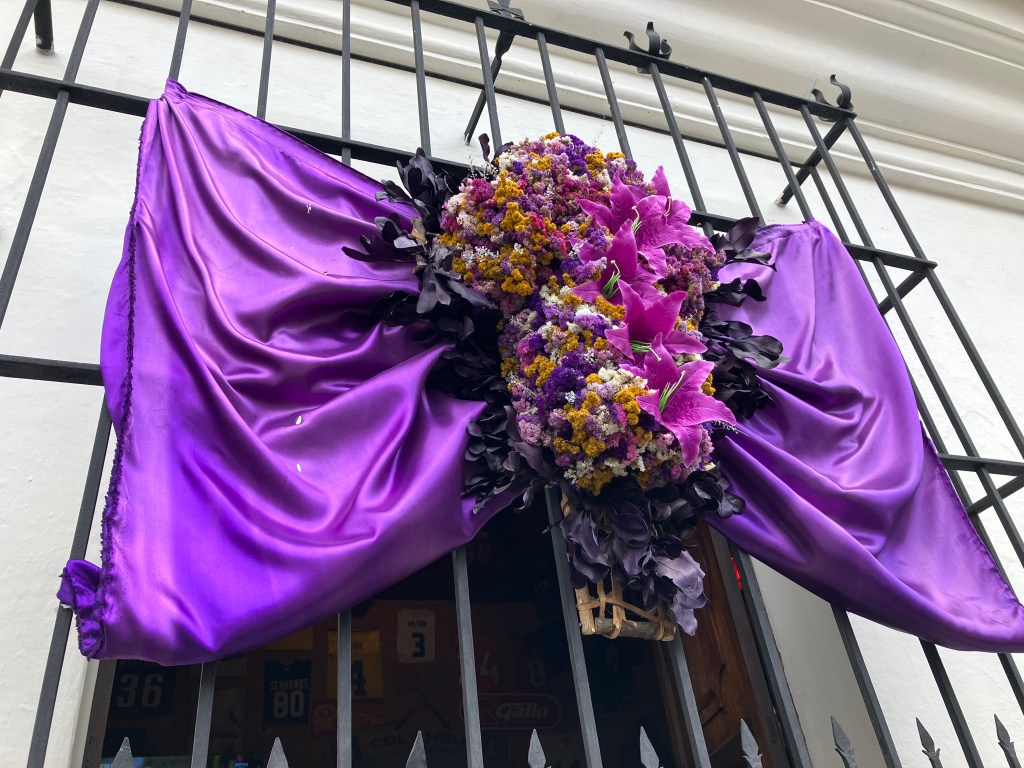
    Easter decoration

    I trailed the procession to its endpoint, the Catedral de Santiago, built in 1545 and ruined in the earthquake of 1773. All that remains is the parish church of San Jose, in what used to be the front of the cathedral. At the entrance to the cathedral was an alfrombra, an elaborate carpet made of sawdust, pine needles, fruit, vegetables, and flowers. After the procession and the band entered the San Jose church, I looked at the ruins of the cathedral, pillars with no roof to hold anymore, carved angels that were meant to gaze down on congregations, looking at no one now, exposed to the elements.
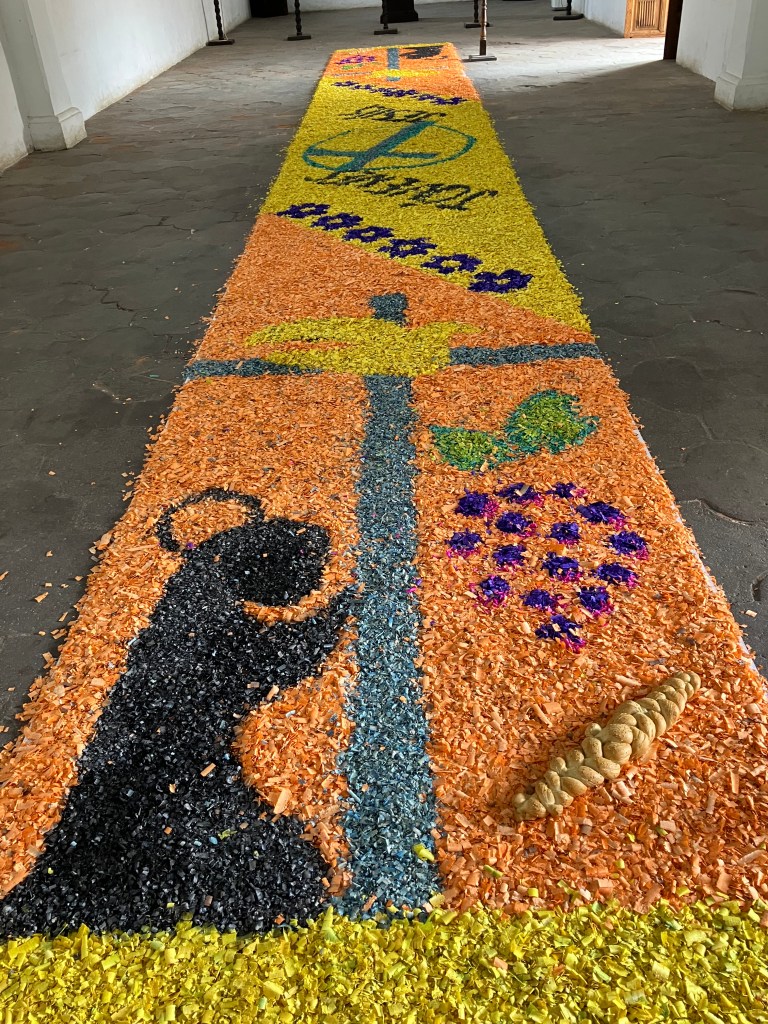
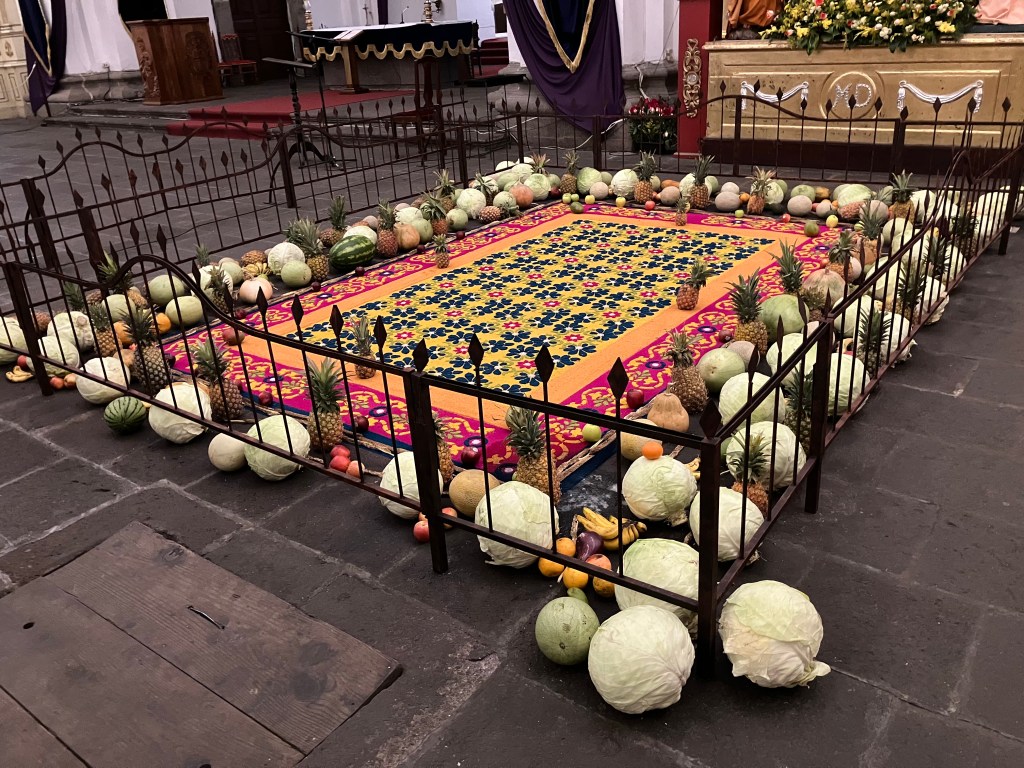
    Decorative alfombra
    Alfombra

    Traditional Pastries from Antigua’s Oldest Pastry Shop

    Dona Maria Gordillo pastries

    Pastries from Dona Maria Gordillo were a sweet way to start many of my days here. Founded in 1872, the traditional pastries it serves are astounding – light, nuanced flavors with varying levels of sweetness across the topography of each piece. I would get them packed in a box and devour them in the Parque Central.
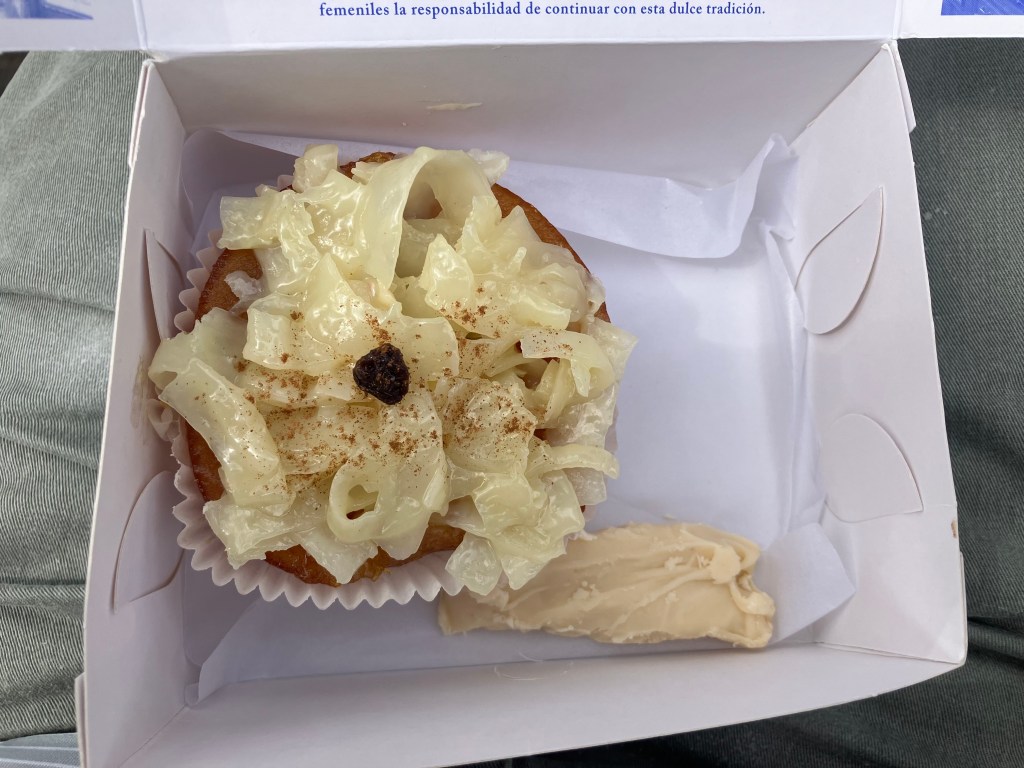
    Delectable Dona Maria Gordillo pastry

    Parque Central – Social Nexus of Antigua

    Jacaranda trees in bloom at Parque Central

    Jacaranda trees in bloom dropped purple petals onto the footpaths of Parque Central. Birds of Paradise with colorful, pointy beaks lined the flowerbeds. I sat near the central fountain where water streamed through the fingers and breasts of sculptural depictions of nymphs. Surrounding the plaza were some of Antigua’s finest colonial edifices. The Catedral de Santiago — the San Jose church part of it — was on one side, the elaborate white façade dotted with sculptures overlooking the plaza. The ruins weren’t visible from here.
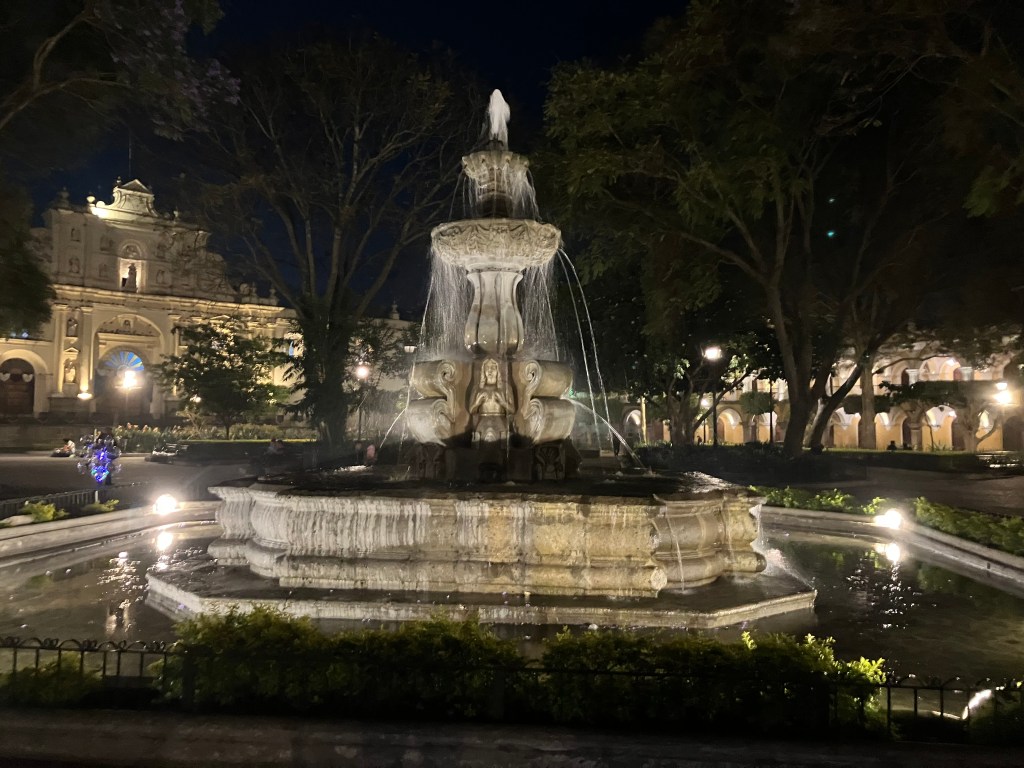
    Parque Central during evening
    Water bearing nymphs

    The imposing Palacio de los Capitaines de los Generales was on another side. Built in 1549, it was once the capital of all of Central America. It is now a mind-blowing art museum known as MUNAG, Museo Nacional de Arte de Guatemala. The building itself is a UNESCO World Heritage Site. I spent several hours here seeing art from pre-colonial to the colonial era and to the Republican period. The stunning art pieces were beautifully displayed. I had a coffee at the Café Condesa at the Antiguo Colegio de la Compañía de Jesus, occupying another side of the plaza. I noticed that people at the café were more interested in each other and the people watching than their phones. The building was built in 1626 as a Jesuit monastery and college until the order was expelled in 1767. Six years later, the building was ruined in the 1773 earthquake. Now there are shops, cafes, and a cultural center.
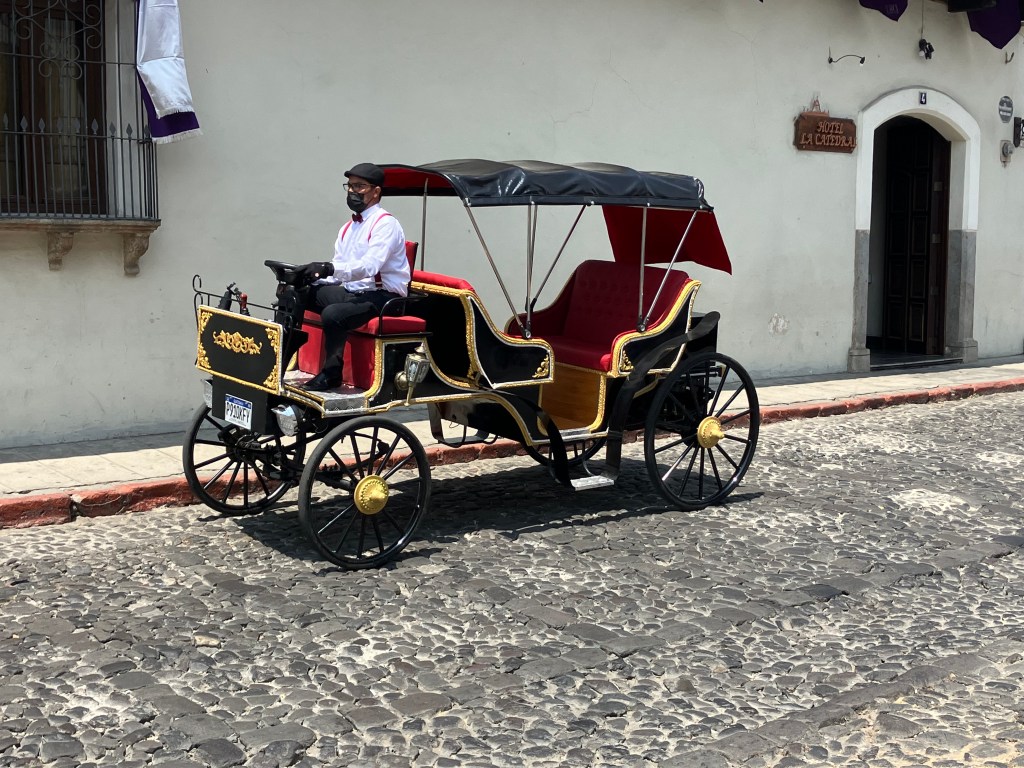
    Nostalgic carriage ride
    Corridor along Parque Central

    I strolled past the 18th-century Palacio del Ayuntamiento to the Arco de Santa Catalina, built in 1694. This arch is perhaps Antigua’s most iconic monument. When you look through it, you can see one of the three volcanoes that surround Antigua, Volcan Agua. At any time of day, groups or individuals, from proud brides to friends proud of each other, are posing in front of it.
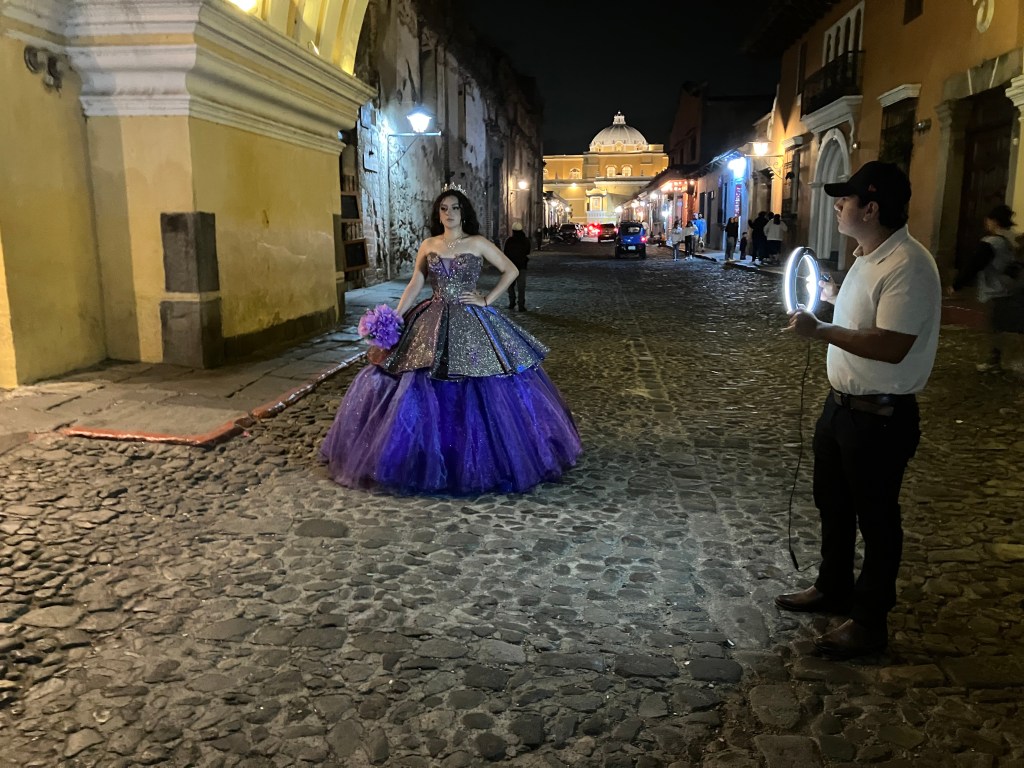
    Arco de Santa Catalina

    Maya Stews from Ancient Recipes

    La Cuevita de los Urquizo restaurant

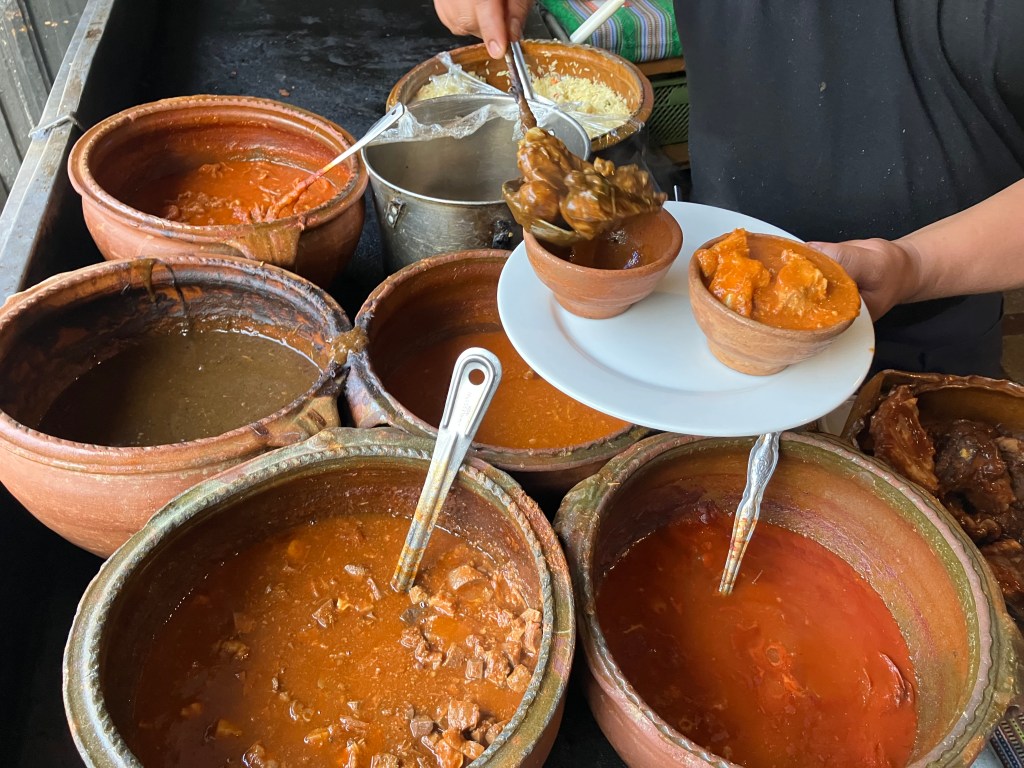
    For lunch, I liked to eat Maya stews at La Cuevita de los Urquizu. Large earthenware pots contained Pepian Chicken (chicken and veggies in a piquant pumpkin seed sauce), jocon (green stew with herbs and chicken with tomatillos), kaq’ik (turkey stew), and other dishes I didn’t know the names of. It was a feast. And I was the only foreigner in the restaurant.

    Guatemala History, Art and Culture on Display in Museums
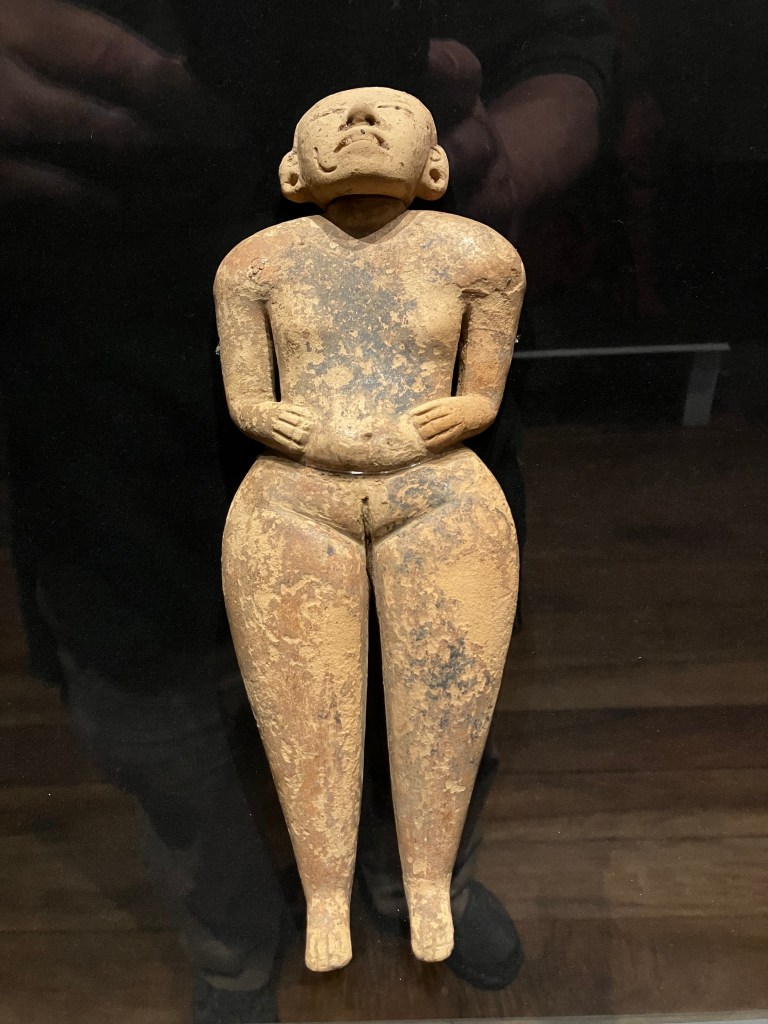
    Maya art at MUNAG

    Antigua has some great museums. The Iglesia y Convento de Santo Domingo was a monastery founded by Dominican friars in 1542. Buildings on the site were rummaged for materials after the earthquake of 1773. The haunting ruins and restored buildings now house six museums: stunning silverwork at the Museo de Plateria; 16th-18th paintings and woodwork at the Museo Colonial; Maya stonework and ceramic at the Museo Arqueológico; Maya art juxtaposed with modern pieces at the Museo de Arte de Precolombino y Vidrio Moderno; traditional Antigua handicrafts at the Museo de Artes y Artesanias Populares de Sacatepequez; and a restored 19th apothecary shop at the Museo de la Farmacia. There’s also the ruins of the monastery’s church, candle and pottery maker workshops, and the Calvary Crypt, which houses a 1683 mural of the crucifixion. All of these museums and ruins are now part of the grounds of the atmospheric Casa Domingo Hotel, where I took well-needed breaks over coffee while working my way through the museums.
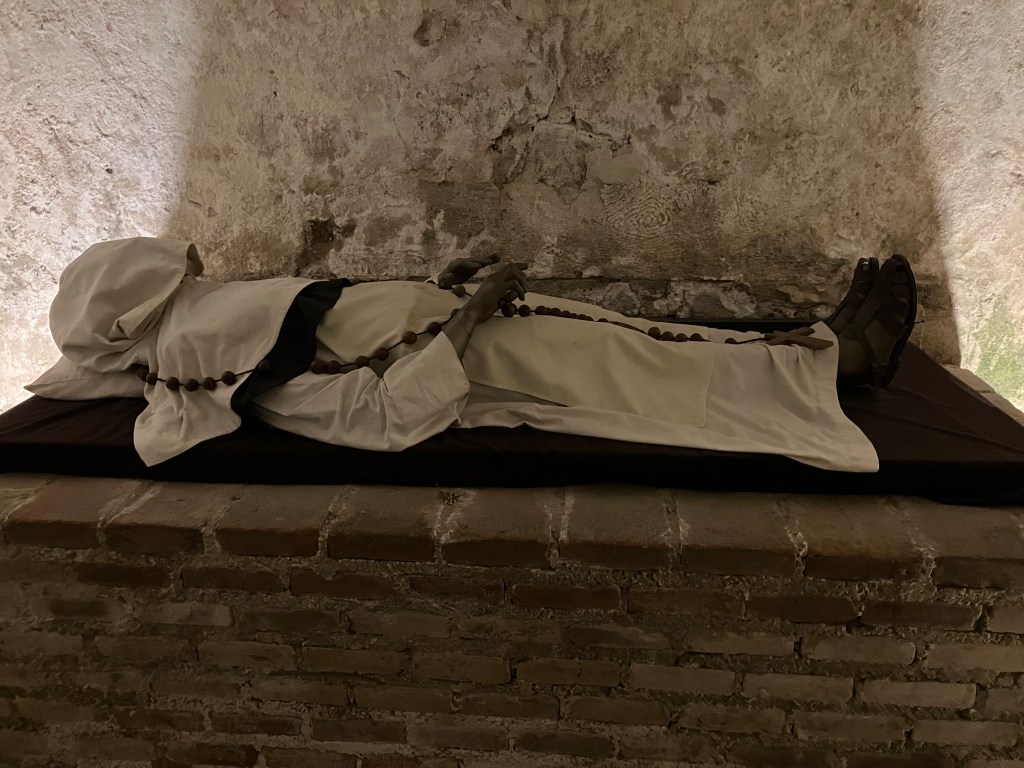
    Crypt sculpture of monk being readied for burial

    Colonial-era Churches Provide Spiritual Depth
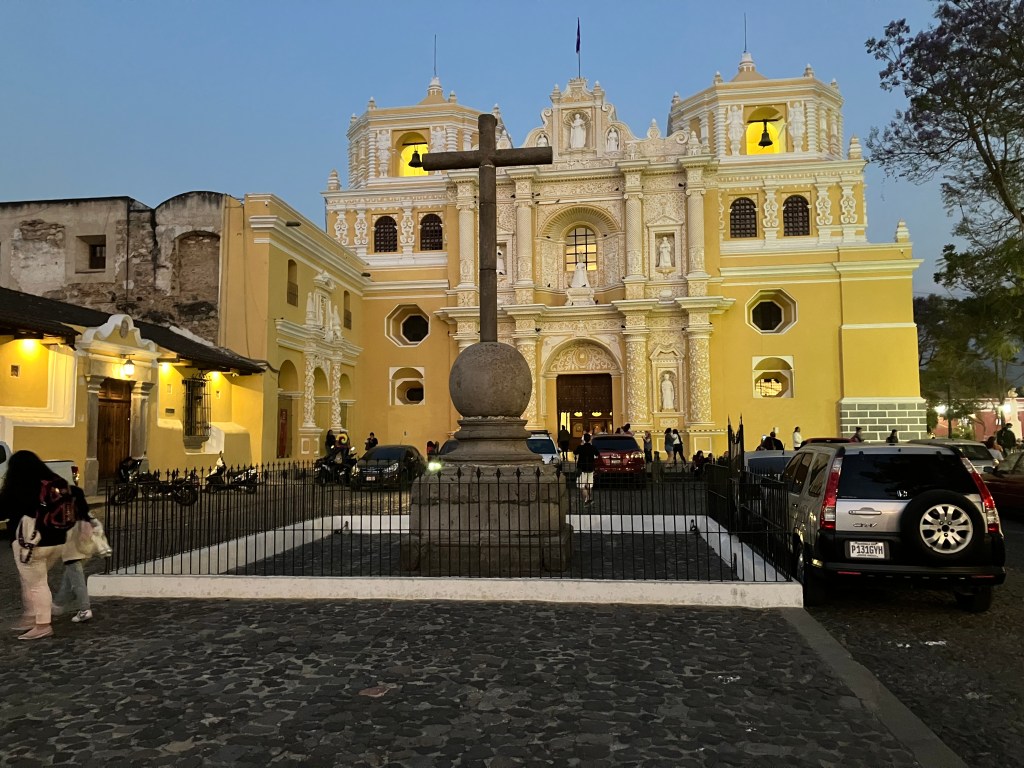
    Iglesia Merced

    Antigua is of course, famous for its colonial-era churches — intact as well as ruined — that provide spiritual depth to the city. Iglesia Merced, built from 1749 to 1769, was built with the thick earthquake-proof walls similar to the baroque churches in the Philippines. It’s a vibrant religious destination in the city.

    Convento de Capuchinas

    At the Convento de Capuchinas, renovated after the 1773 earthquake, I got a sense of how the nuns lived. I strolled past an indigenous woman wrapped in colorful fabrics, through the markets where fruits and vegetables shimmered in the bright, though opaque light. At nearly every turn, one of Antigua’s looming volcanoes – Agua, Fuego, and Acatenango – stood sentinel-like, serene, almost omniscient in their quiet force.
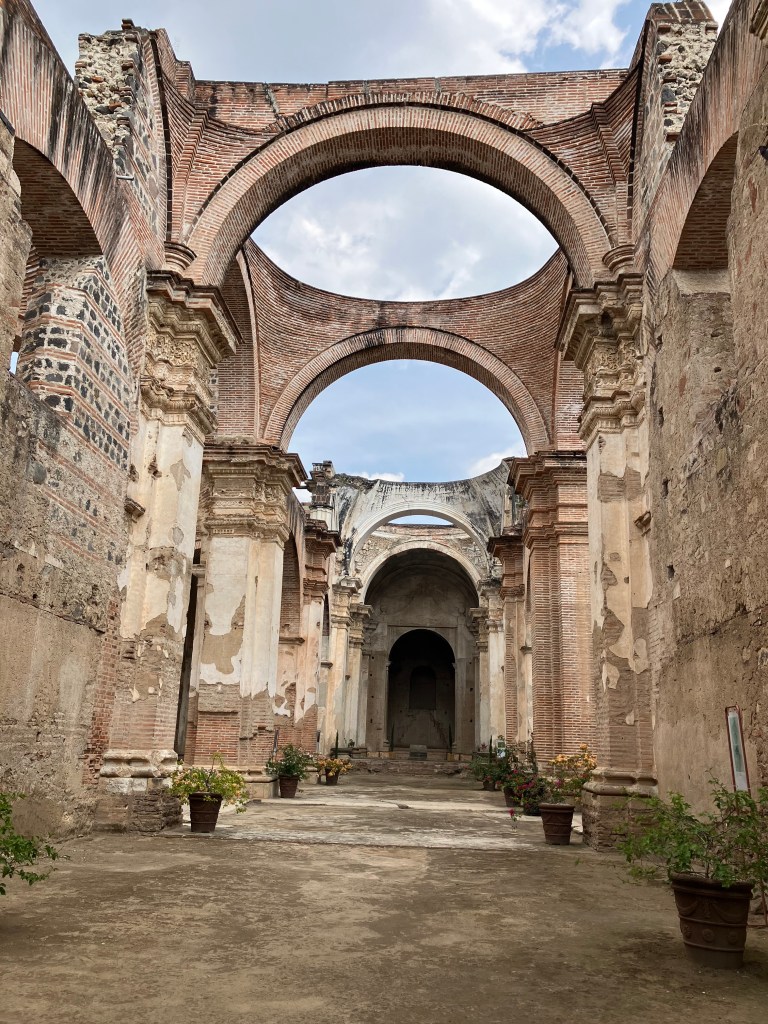
    Ruins of Catedral de Santiago

    Ruins from the 1773 earthquake, combined with partial repairs and renovations such as those at the Colegio de San Jeronimo and Iglesia y Convento de la Recoleccion, gave Antigua a haunting beauty that is both timeless and stuck in time. It wasn’t the spic n’ span over-polished look that some colonial-era cities have.

    Sculpture of angel at Catedral de Santiago

    A Vibrant Nightlife

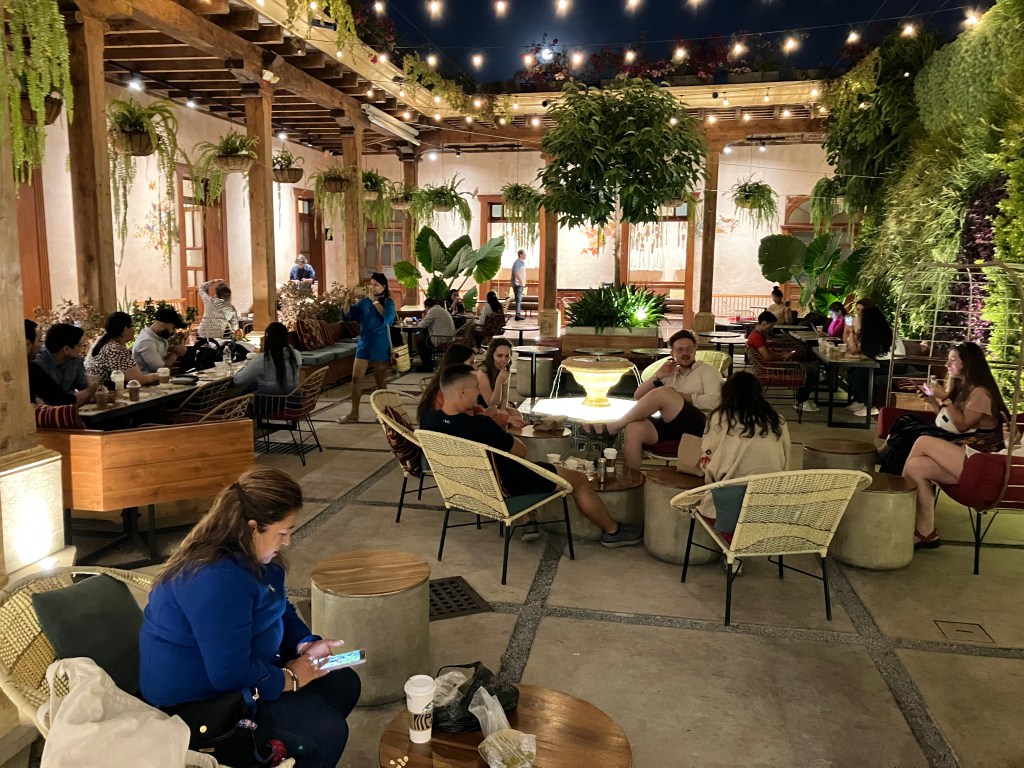
    Best Starbucks ever

    Antigua surprised me by having a really lively nightlife. Even Starbucks was a truly stylish hangout here. On the weekend, partygoers from Guatemala City, just an hour or so away, crowded into the city — and then into the bars and nightclubs. The restaurants and bars were north of Parque Central. After a few bottles of Moza beer, I slipped off a stool and headed back for the night.
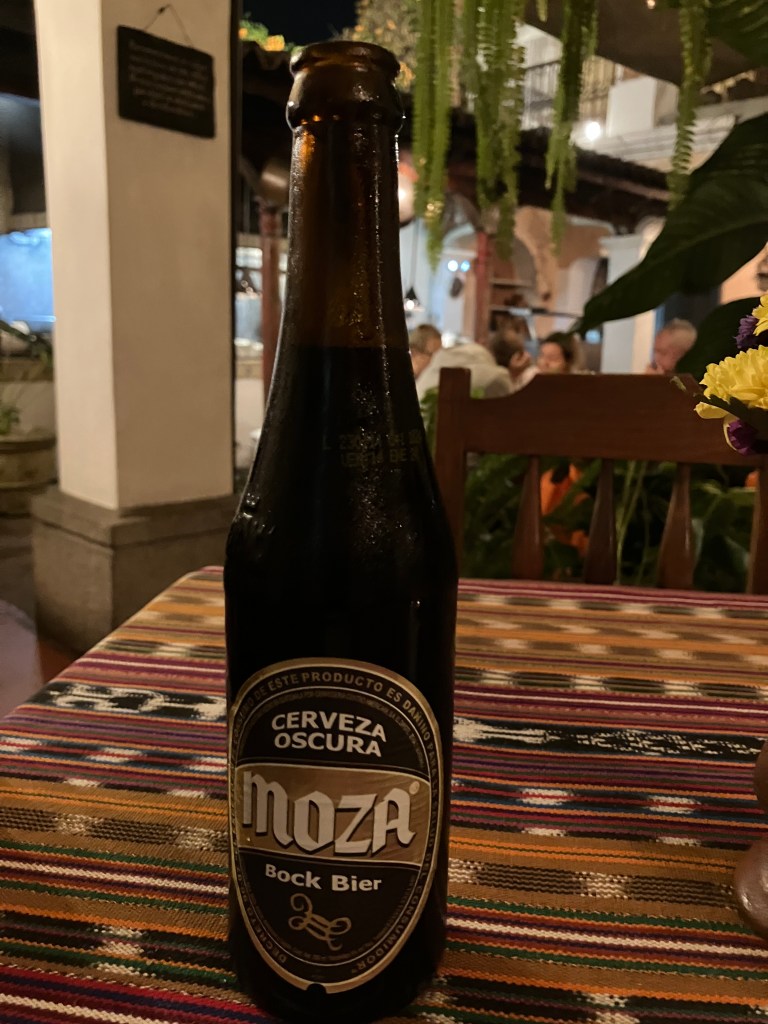
    Cerveza Moza

    Post-Sunset Fairytale Ambiance

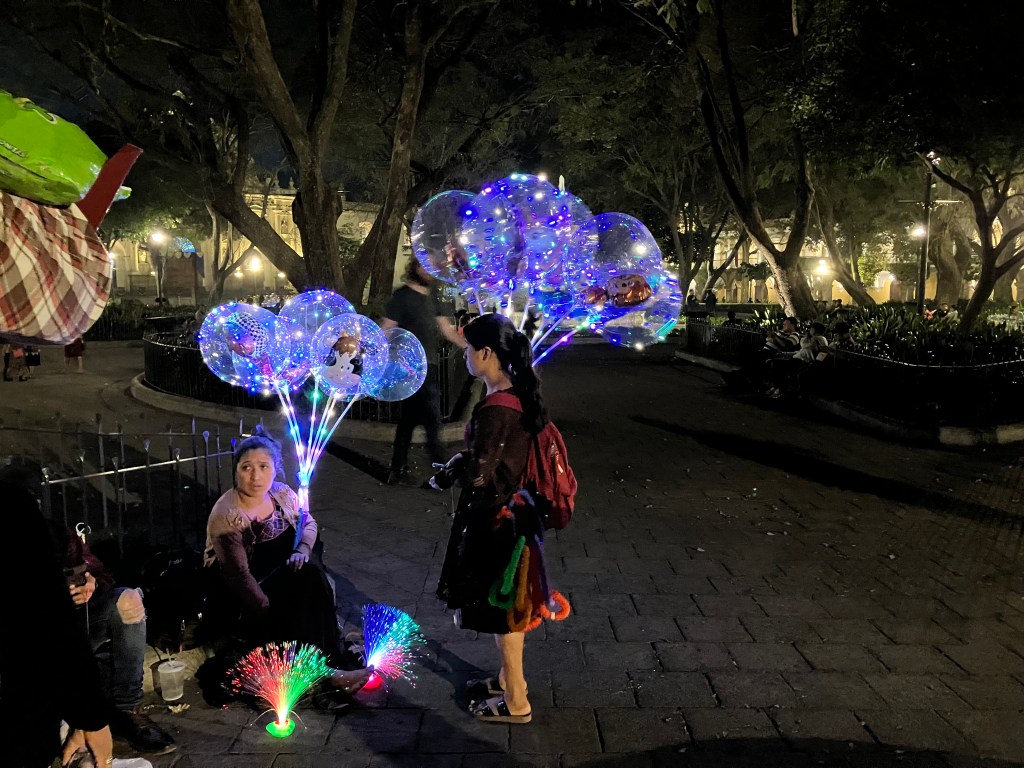
    Selling fairytale balloons

    I passed a woman in Parque Central, selling sparkling purple balloons that provided a fairytale-like ambiance to the post-sunset city. On my walk down the empty cobblestoned streets, soft echoes trailed me at every step. At the simple, elegant Hotel San Jorge by Porta I knocked on the heavy wooden door and was let in by the receptionist. I sank into a chair by the courtyard and let the crisp mountain air envelop me. Antigua, I decided, wasn’t just a city to see but a city to help you see yourself — ruminations via ruins.

  • Guatemala: from BC to B.E. (Before Easter)(con’t)

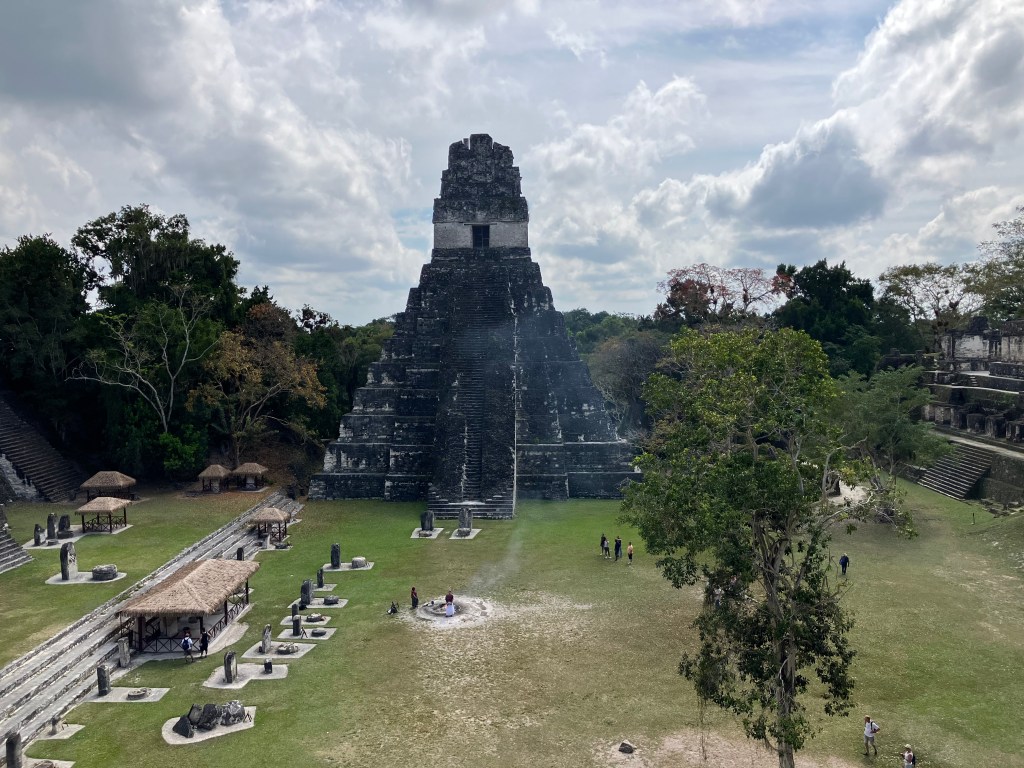
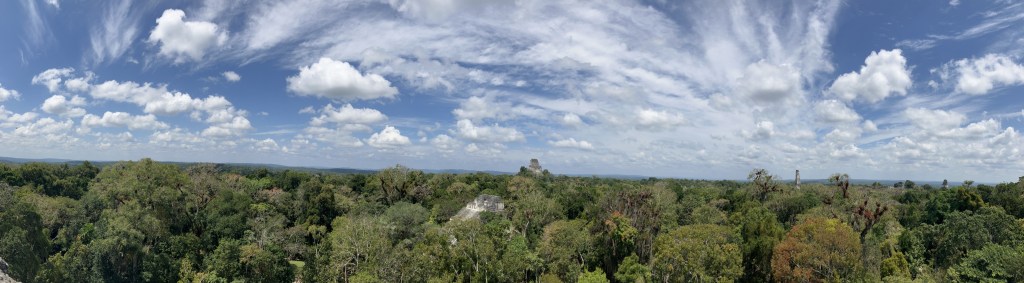
    Gran Plaza from Templo II

    Tikal: Ruins of an ancient Maya kingdom

    Templo II at Gran Plaza

    I’ve wanted to visit Tikal for decades. When I lived in Asia for 27 years, it was always too far away — until I moved back to this hemisphere. The city started its journey in 700 BC and built its monumental temple complex, Acropolis del Norte, by 200 BC. By 250 AD, Tikal was the center of power in the Maya world, which was spread throughout Central America into Mexico. Its population peaked at 100,000 in the mid-6th century before its mysterious collapse around 900 AD. The 10,000 buildings over 30 square kilometers on the site started to succumb to the jungle and decay until a Guatemalan government expedition discovered the site in 1848. Even today, much of it remains untouched, buried, and covered in jungle. If the mystery and magic of ancient ruins are your thing, this site will send chills down your spine.

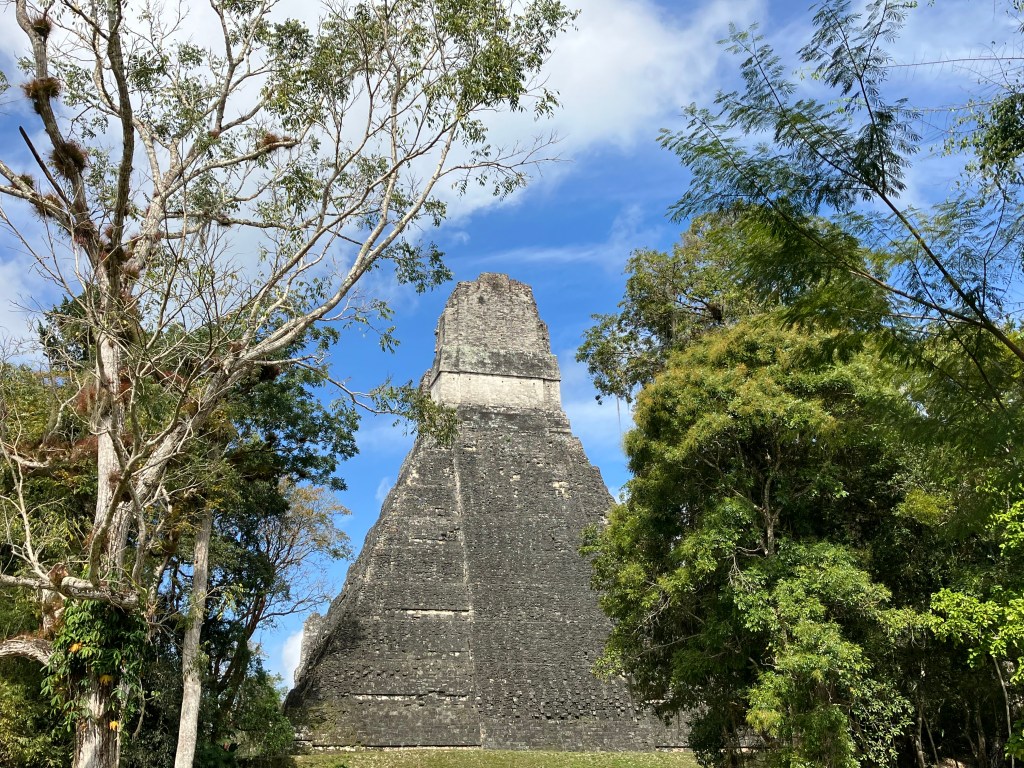
    The back of Templo I

    Screams of Howler Monkeys

    Elusive howler monkey

    When our van drove through the gates of the park, we were greeted by the piercing screams and grunts of howler monkeys. Howler monkeys can make sounds that travel miles, at up to 140 decibels. It’s a piercing and unnerving sound. It’s also a little like entering a Jurassic Park movie.

    Jungle still rules at Tikal

    Because of the relative lack of tourists, it’s easy to soak in the atmosphere of this UNESCO Heritage Site, explore the ruins without crowds at all, and in some places without people at all.

    Pyramids emerging from jungle

    Gran Plaza at heart of UNESCO Heritage Site

    Long way up Templo I

    I felt a sense of anticipation when I approached the towering pyramids of the Gran Plaza. The Temple of the Grand Jaguar (Templo I), where King Ah Cacao is supposedly buried beneath layers of the pyramid, faces the Temple of the Masks (Templo 2). I climbed the Temple of the Masks for a view of the Gran Plaza, the Temple of the Grand Jaguar, and the Acropolis Central, a warren of ruined palaces, courtyards. This complex was completed between 740 AD and 800 AD. Between the chirping of the birds, the distant screams of howler monkeys, a languid breeze drying my sweat, I settled in to absorb and observe. In the plaza, a local woman was performing a Maya ceremony at a fire pit with a Caucasian woman. Their solitary intensity permeated the scene.

    Maya ceremony in Gran Plaza

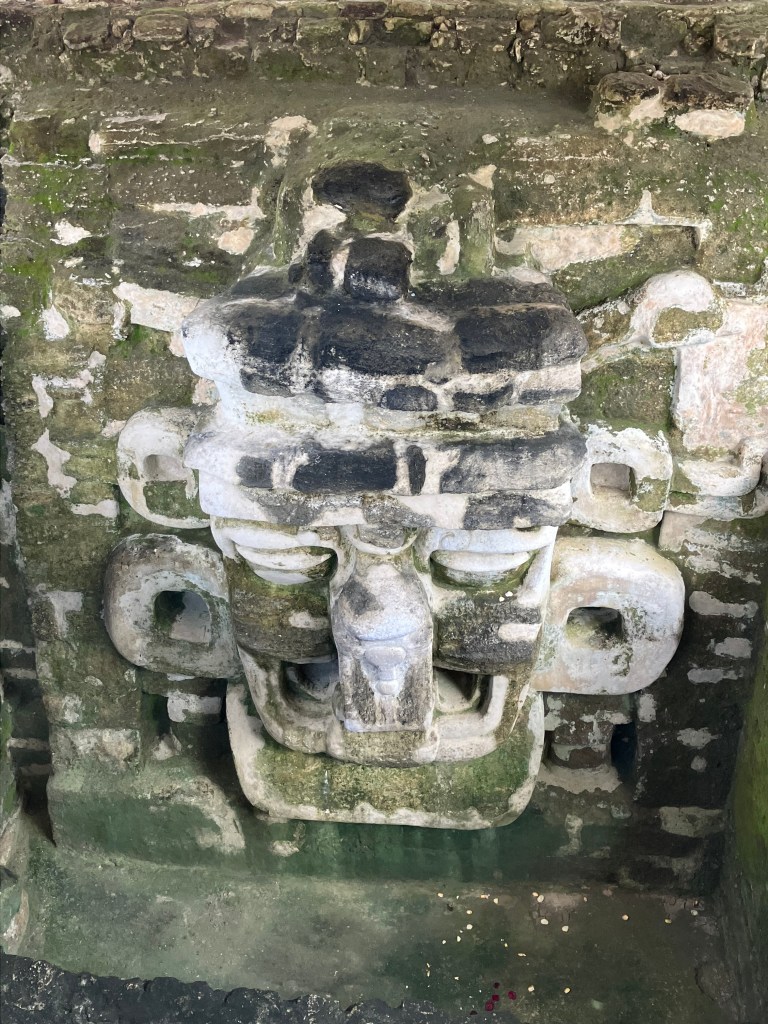
    At the Acropolis Del Norte was a monumental carved stone mask that glowered from a wall. It was over three meters high. It provided a sense of the drive and ambition that fueled the growth of this civilization. I could easily see the citizens of this Maya city intimidated when they stood in front of it.

    Monumental mask

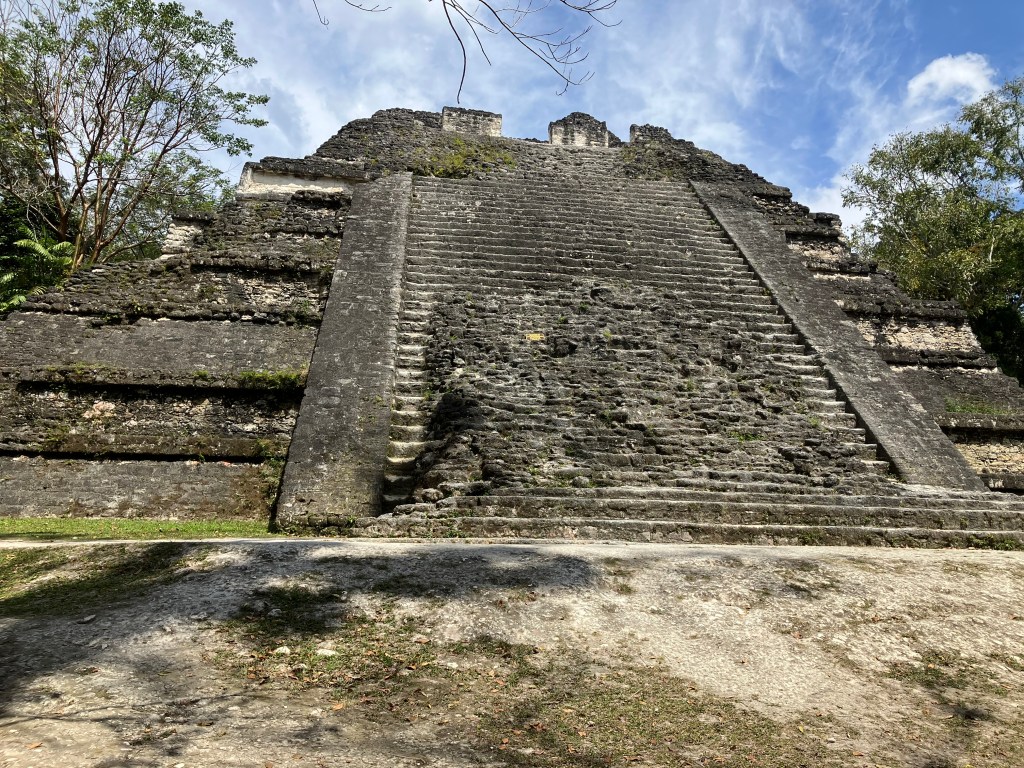
    South of the Gran Plaza, I turned a corner on a forest path and saw Templo V emerge as a solitary temple, sentinel-like, dominating the foliage around it. It was built between the 7th and 8th centuries AD and is 57 meters high. The chance to see a structure without crowds gave me a chance to feel its majesty — and to wonder what it was like with crowds of the apex of the city’s power.

    Templo V

    Entering the Mundo Perdido, the Lost World

    View from Mundo Perdido pyramid

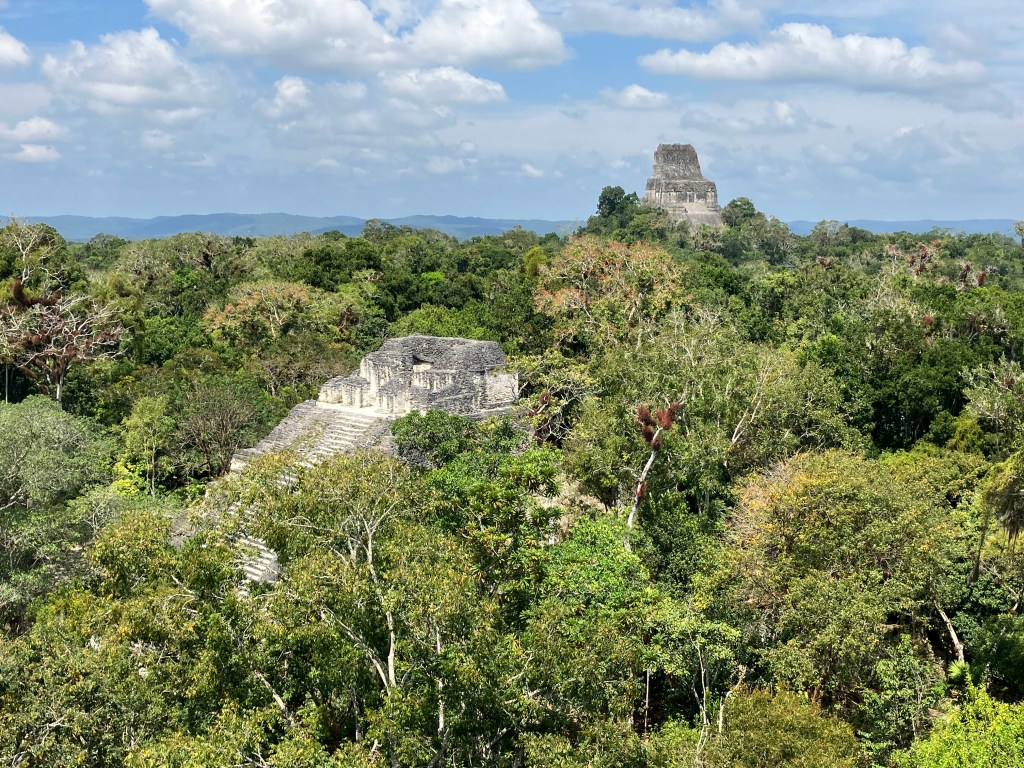
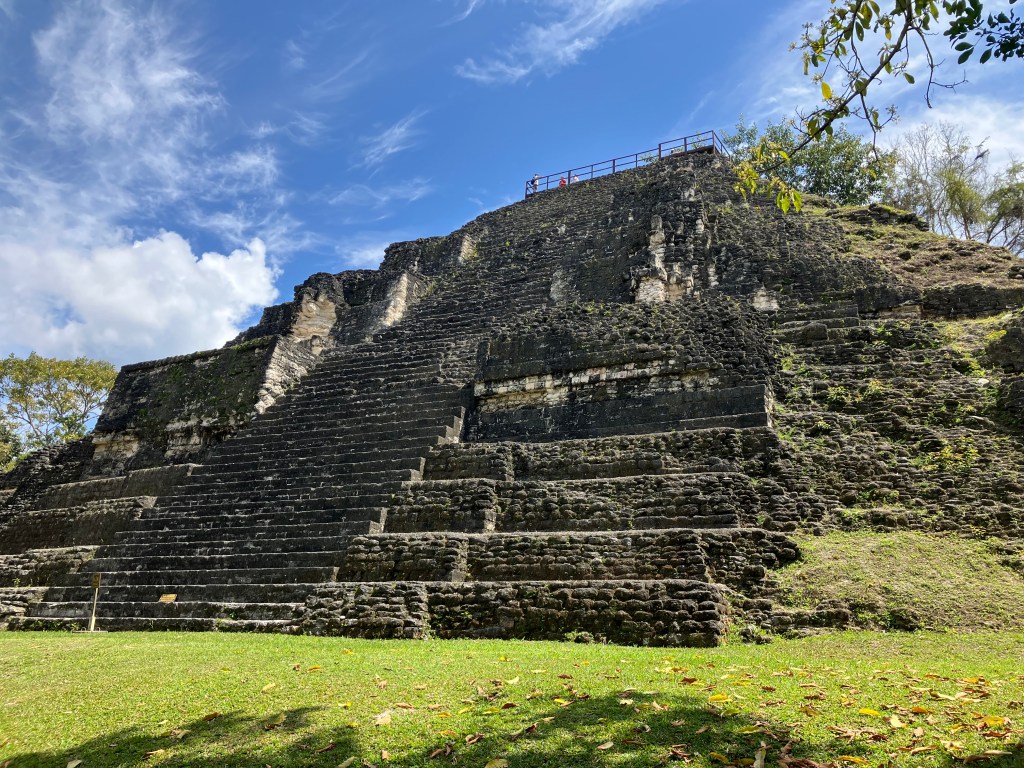
    From there, I walked to the Mundo Perdido, the Lost World.  A few dozen structures surrounded a huge pyramid, 32 meters high and 80 meters around the base. I climbed to the top for a stunning view of the ruins. Nearby was Templo IV, at 65 meters the highest temple in Tikal and the second highest pre-Columbian building the Western Hemisphere after La Danta in the ruins at El Mirador.

    Tikal is well-explored, with widely visited ruins. But there are other Maya ruins in Guatemala, more remote, very difficult to reach. El Mirador, also located in the El Peten province of Guatemala, can be reached via a 5-day, 83-kilometer hike through jungle. Or, if money is no object via helicopter from Flores. El Mirador is more expansive than Tikal, across a larger area, with larger pyramids. Historically, it is considered the most important Preclassic period ruins. Tikal’s ruins, in contrast, span from the Preclassic to Classic to Postclassic periods.

    Temple IV from Mundo Perdido
    Templo IV, Tikal’s highest pyramid emerges from foliage
    Tikal pyramid Mundo Perdido

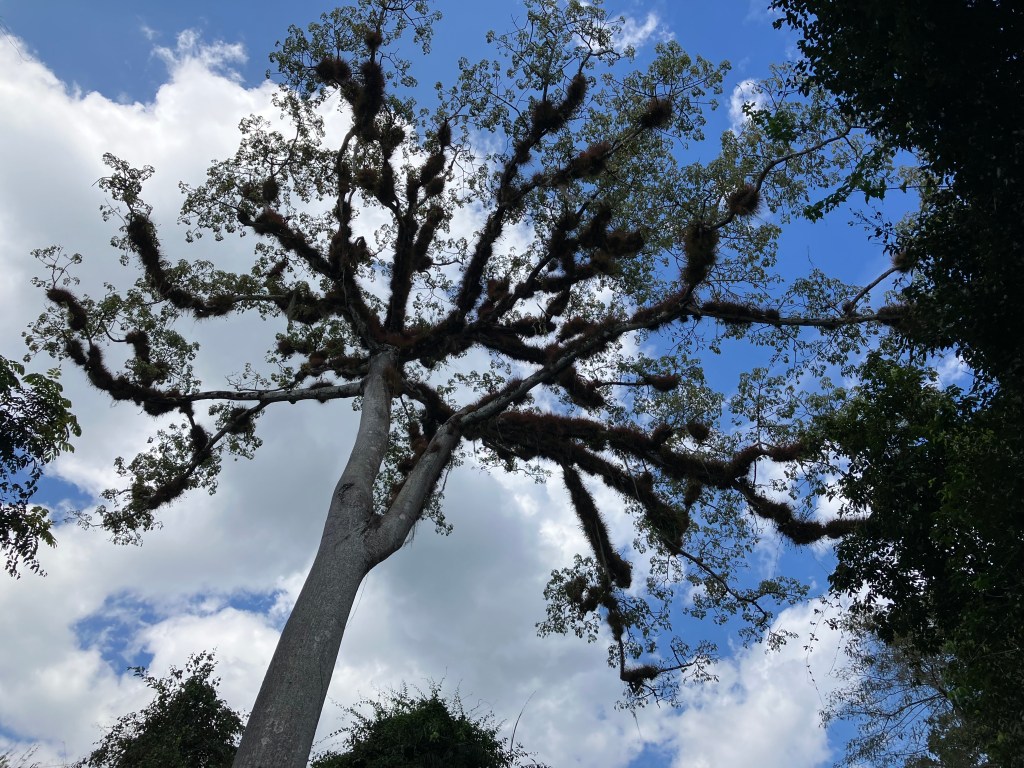
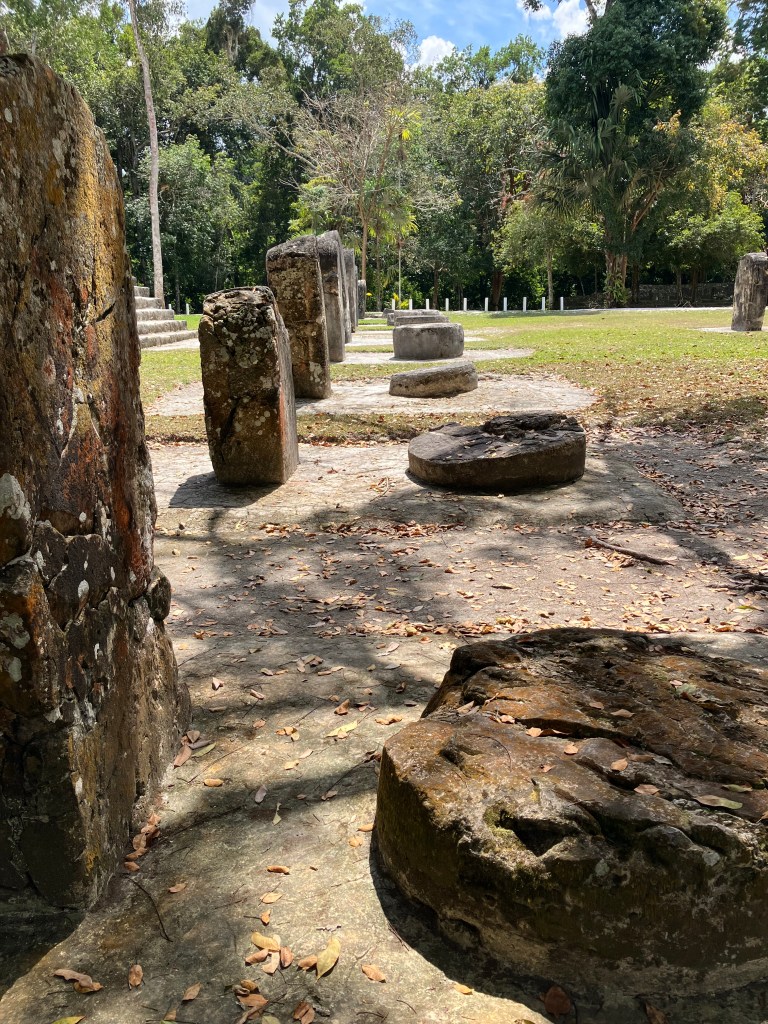
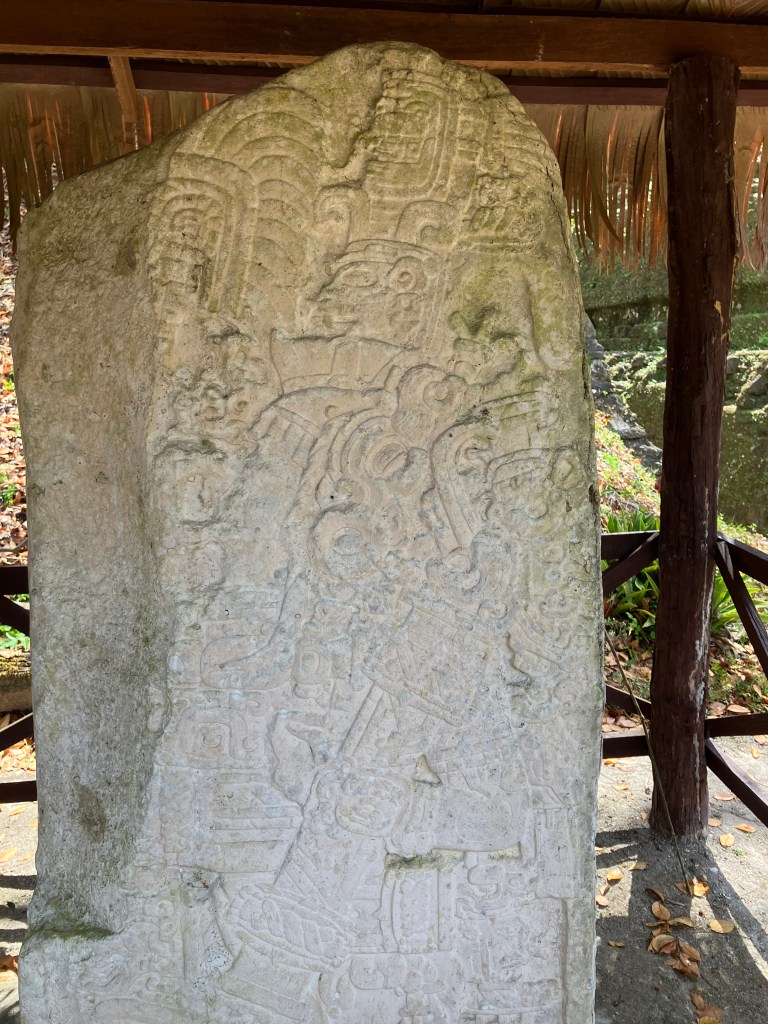
    I came across a line of stone stela with indecipherable writing and reliefs that had been worn down with time. Above them loomed a ceiba tree, the Maya tree of life. But the life that was lived here has long since disappeared. The rulers that reigned here had fearsome names: Dark Sun, Moon Double Comb, Yax Kin to name a few. Their power was absolute until time and the tides of history swept their civilization away, where you needed machetes, shovels, and pickaxes to uncover it.

    Ceiba tree
    Stone stela

    Birdlife overtakes human civilization

    Toucans in a tree
    Toucan
    Tree ravaged by woodpeckers

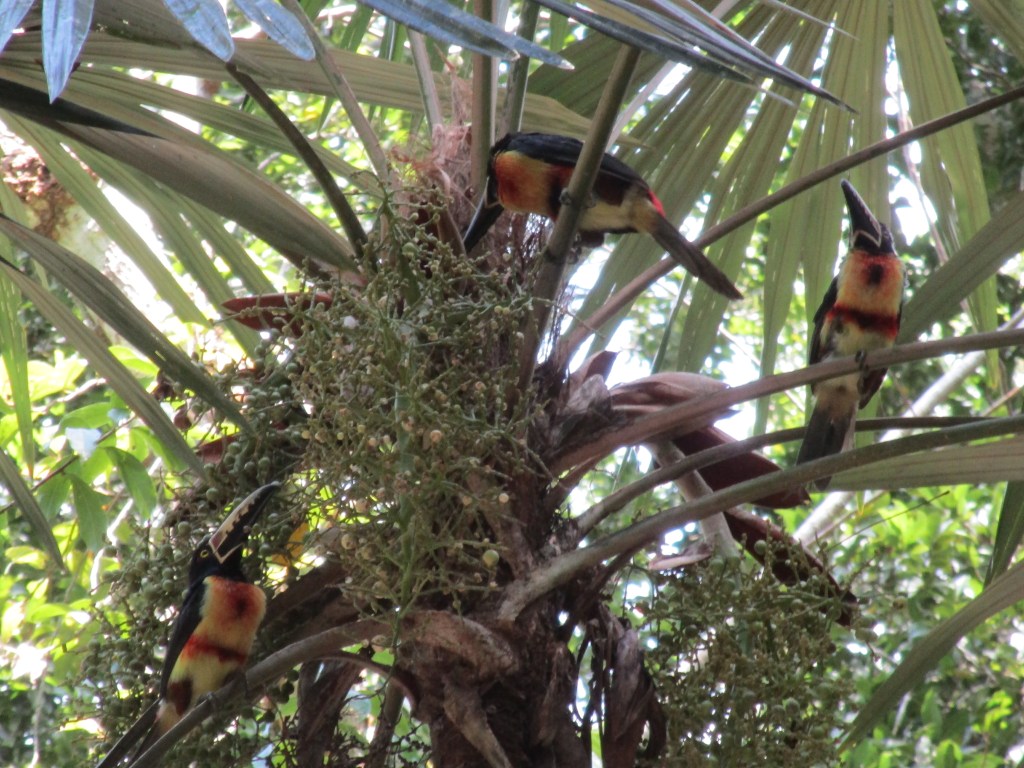
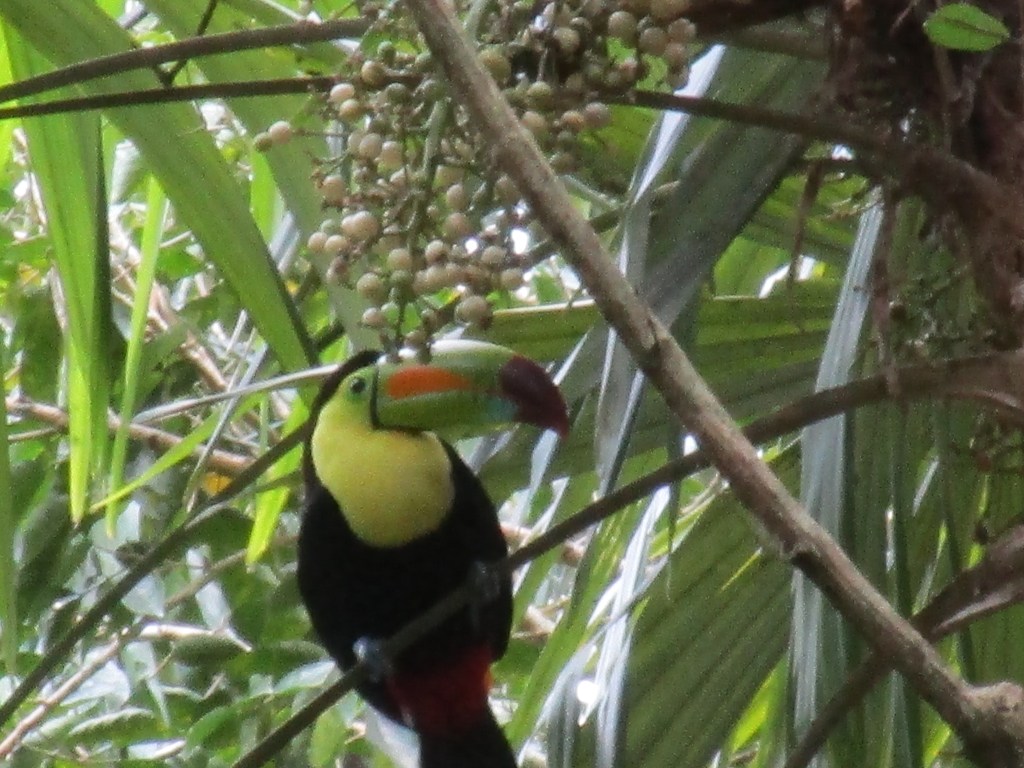
    My visit ended by focusing on the rich birdlife and their incessant chirping amidst the distant screams of the howler monkeys. Toucans, Ocellated turkeys, parrots, shrikes, herons, and the woodpeckers who left ravaged trees and trunks in their wake. Underfoot, I watched to avoid streams of relentlessly marching army ants. Humanity might have been the dominant force here once, but nature was now. As I passed through the pyramid-shaped archway on my way out of the park, I brought with me thoughts of how Tikal stretched over 1,000 years with wars that were devilish and a civilization that reached a divine peak — for a time. Just a time.

    Maya king depicted on stele
    Depiction of Maya king on stone stele

    Maya goddess of fertility, Ix Chel
  • Guatemala: From BC to B.E. (Before Easter) (continued)

    Flores

    Flooded Flores: Gateway to Ancient Maya Sites

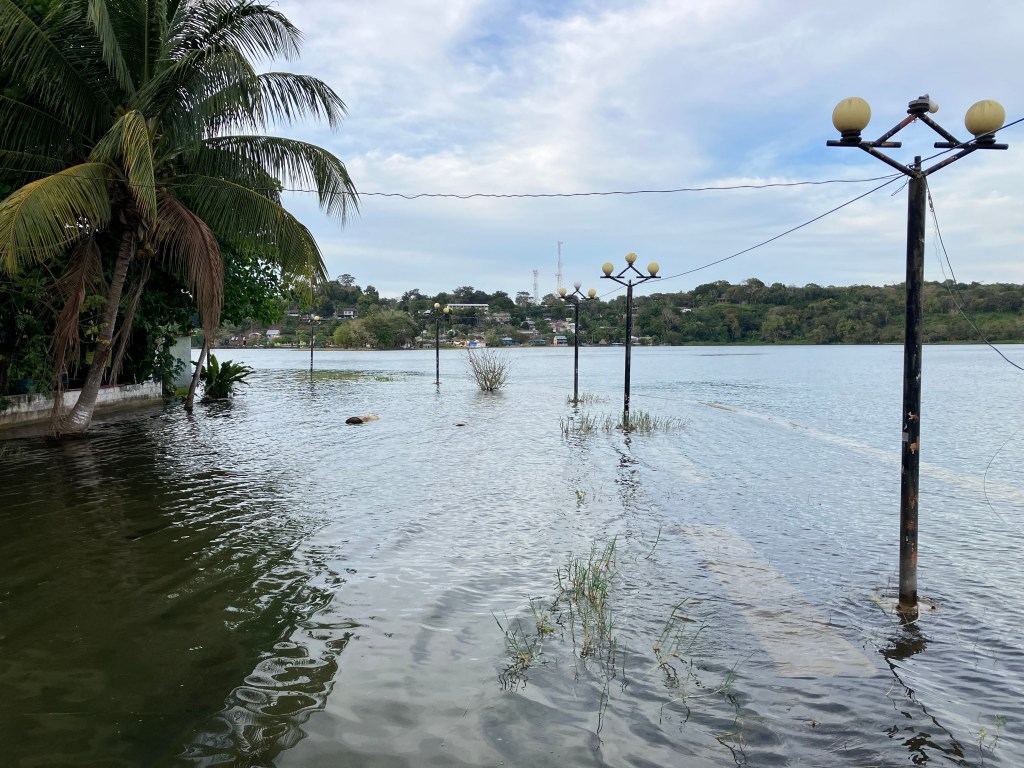
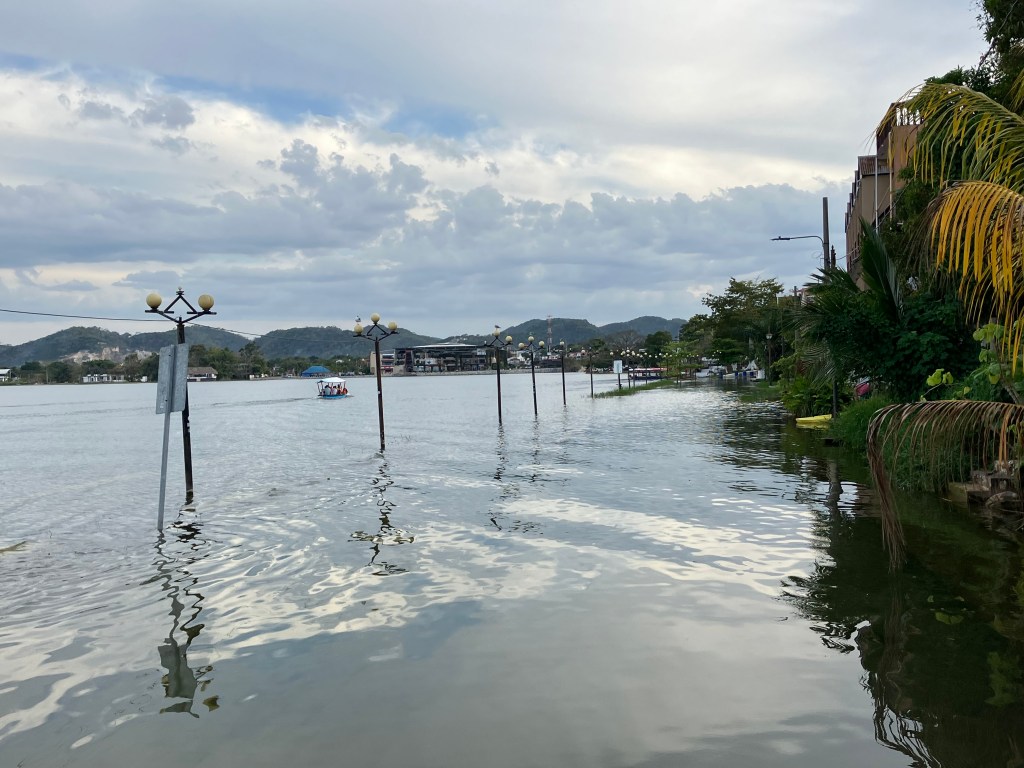
    Flooded promenade Flores

    I’ve wanted to visit Tikal for as long as I can remember. I’ve visited ancient ruins at Machu Picchu, the Pyramids, Petra, Borobudur, Angkor Wat, and many others.

    Stone lion in front National Museum of Archaeology and Ethnology

    But unlike those sites at various times in their history, Tikal has never been heavily visited. Certainly, the 1960-1996 Civil War affected traveler visits as well as a poor safety reputation. While exact figures aren’t available, on average Tikal gets around 200,000 visitors a year. For a 16 square kilometer park, that’s not a lot of visitors. Contrast that to the over a million visitors that Angkor Wat and Machu Picchu get every year, and visiting one of the great ancient sites in the world is an opportunity to experience its mystery and magic without the tourist hordes. And yes, it’s now safe to visit.

    Tag Airlines

    But first, you have to get there. At the time I travelled there, only Tag Airlines flew to Flores from Guatemala City multiple times daily. Now Avianca does too. The competition has led to more time options and lower prices.

    My hour-long Tag flight to Flores was comfortable — but also three hours delayed, even though the weather was perfect. I spoke with two American women in the boarding area and they said this was their second attempt at visiting Flores. Their first attempt, more than a year and a half earlier, had to be aborted after a more than 24-hour delay due to weather. The rainy season in Peten, where Tikal and Flores is located, is from May to October. And I’m told the rains are fierce.

    To spend my time waiting for the flight from Guatemala City, I visited the nearby National Museum of Archaeology and Ethnology.

    National Museum of Archaeology and Ethnology

    A day in Flores is a day well spent

    Walking the Flores promenade

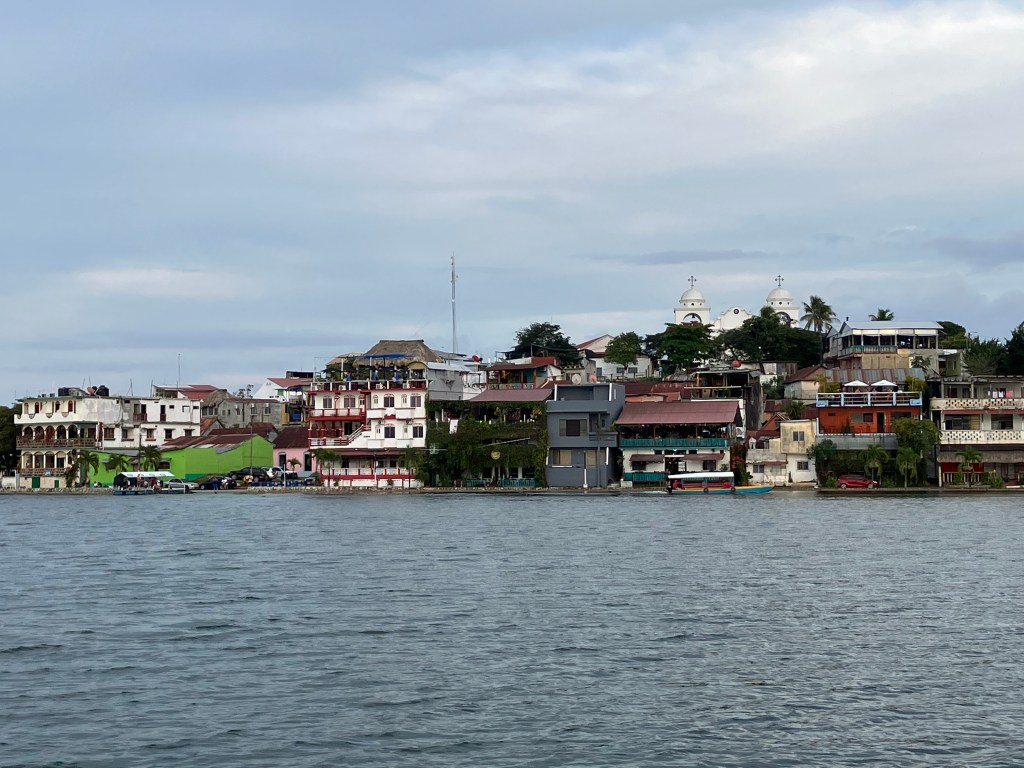
    Flores oozes with charm and flood waters, too. On an island connected to the mainland via a causeway, Flores is surrounded by the serene and ever-rising Lago de Peten Itza. As I tried to walk around the island on the waterfront promenade, I found myself making detours to avoid getting my feet wet. I didn’t mind — but if I lived there, I would.

    The lake and promenaade are one

    The town is filled with pastel-hued houses. Imagine a rainbow crashing out of the sky and spreading colors where it fell and you get an idea of the delight the town imbues on its visitors.

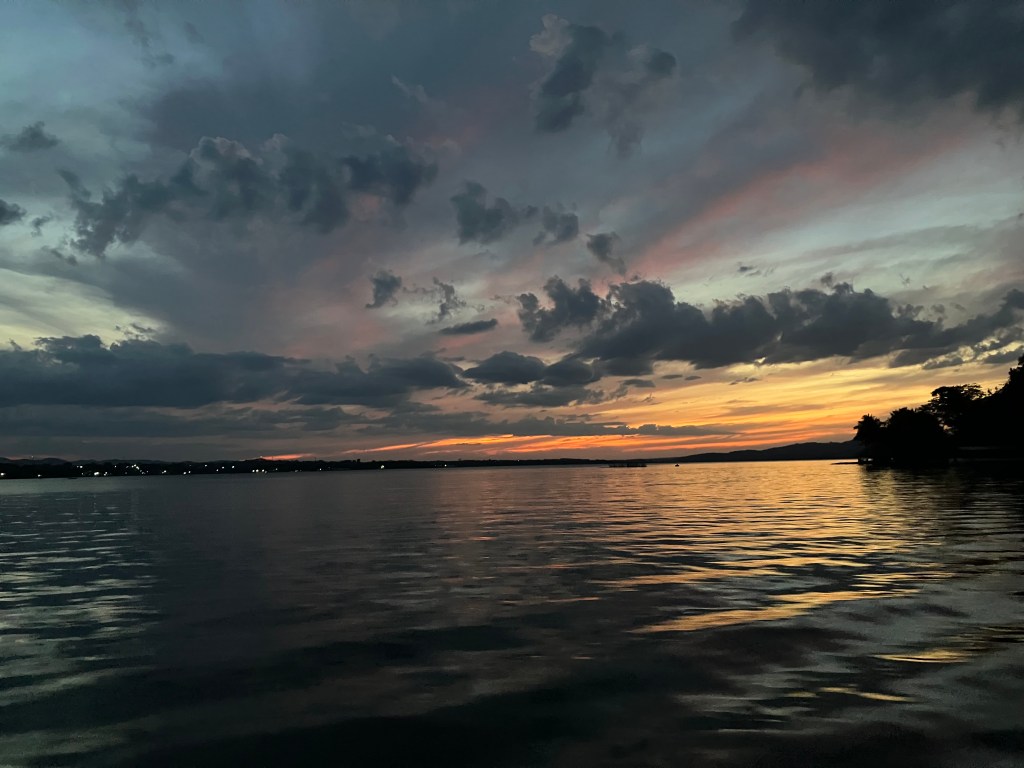
    I didn’t go anywhere in particular and everywhere I could as the town is small. At sunset, I took a boat from Raices Restaurant’s pier to visit their sister restaurant across the lake. I was after ambiance and the restaurant delivered that in spades. The view of Flores and the lake as the fading sun, wreathed in clouds, covered the landscape in a diminishing yellow light, was just this side of angelic. The food was solid, the enchanting ambiance is what a visit here is about though.

    Sunset Lago Peten de Peten Itza

    After I returned to Flores, I wandered around the city in the evening, the weather warm and pleasant, a light breeze drifting in from the lake.

    Lago de Peten Itza

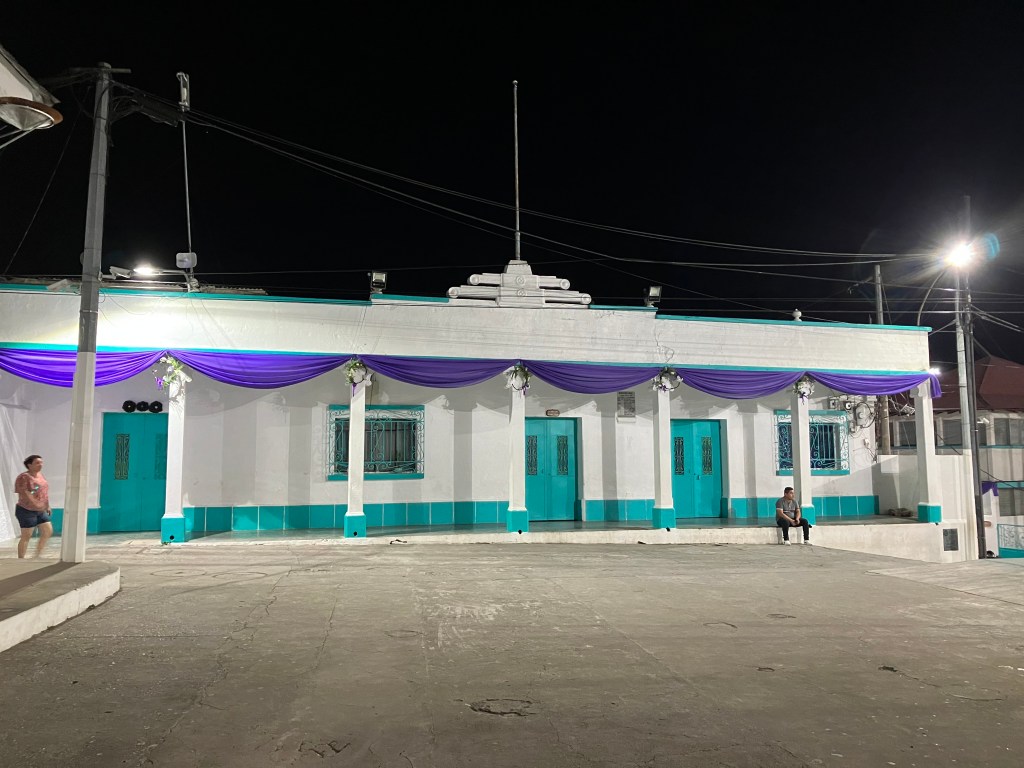
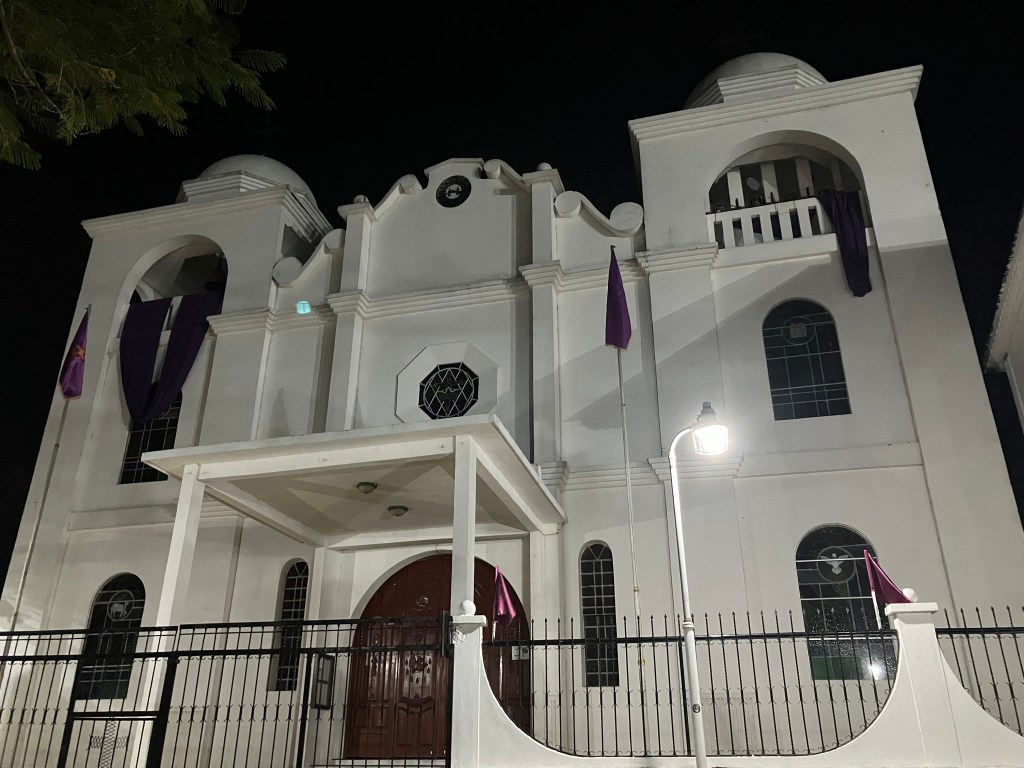
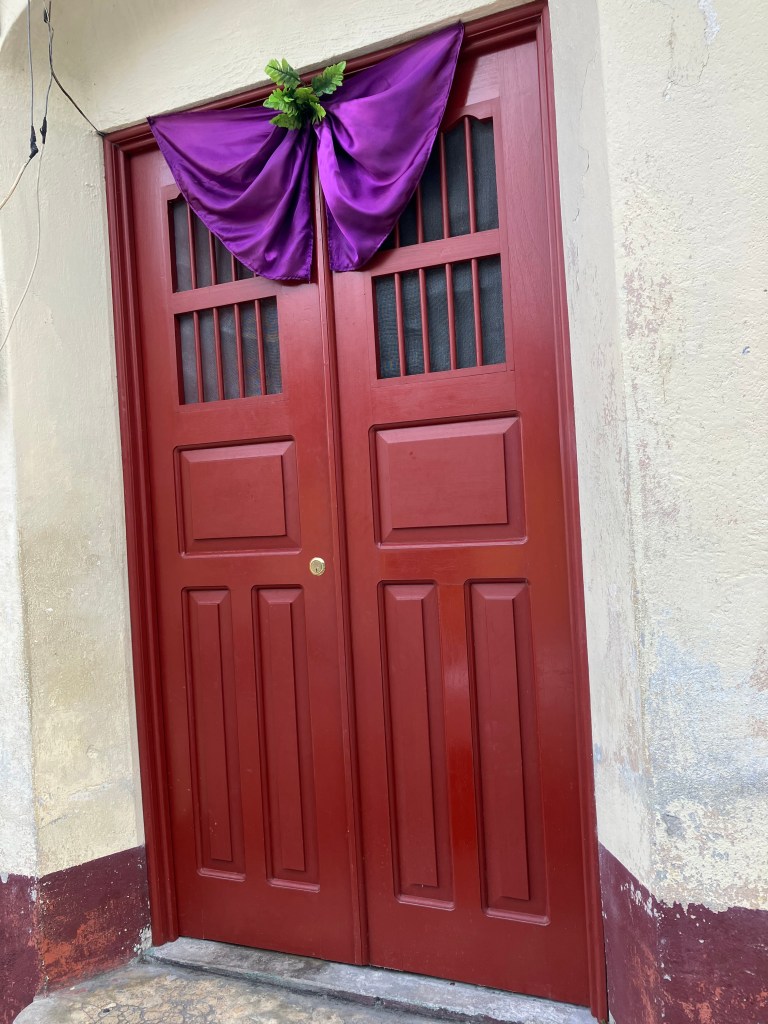
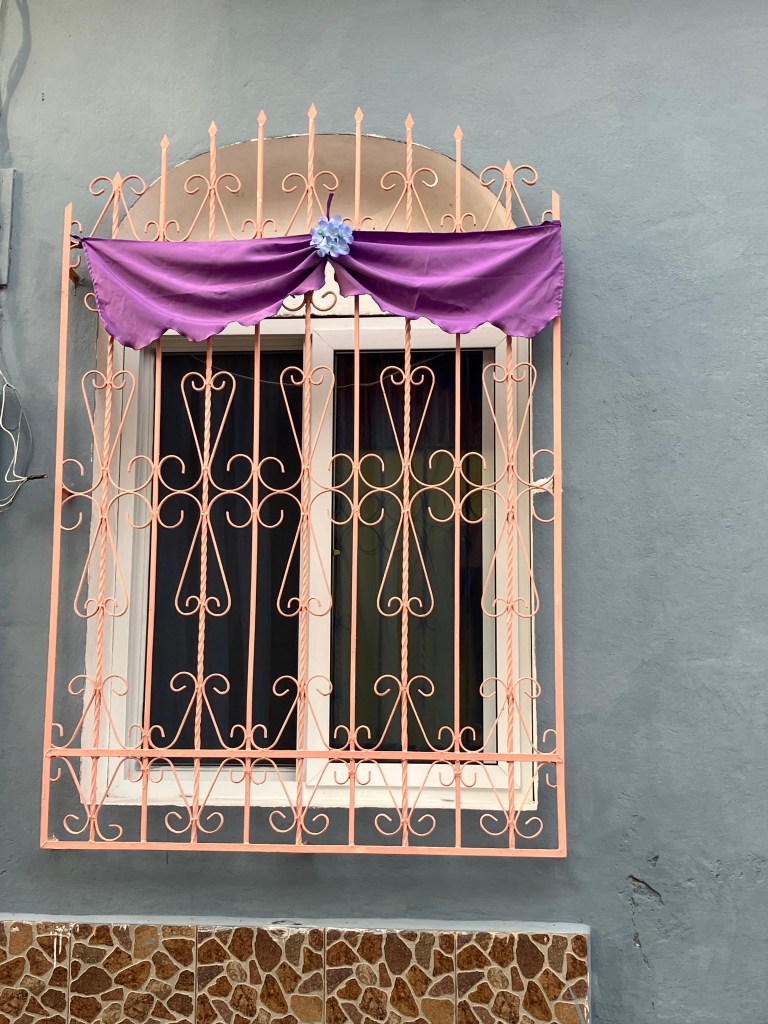
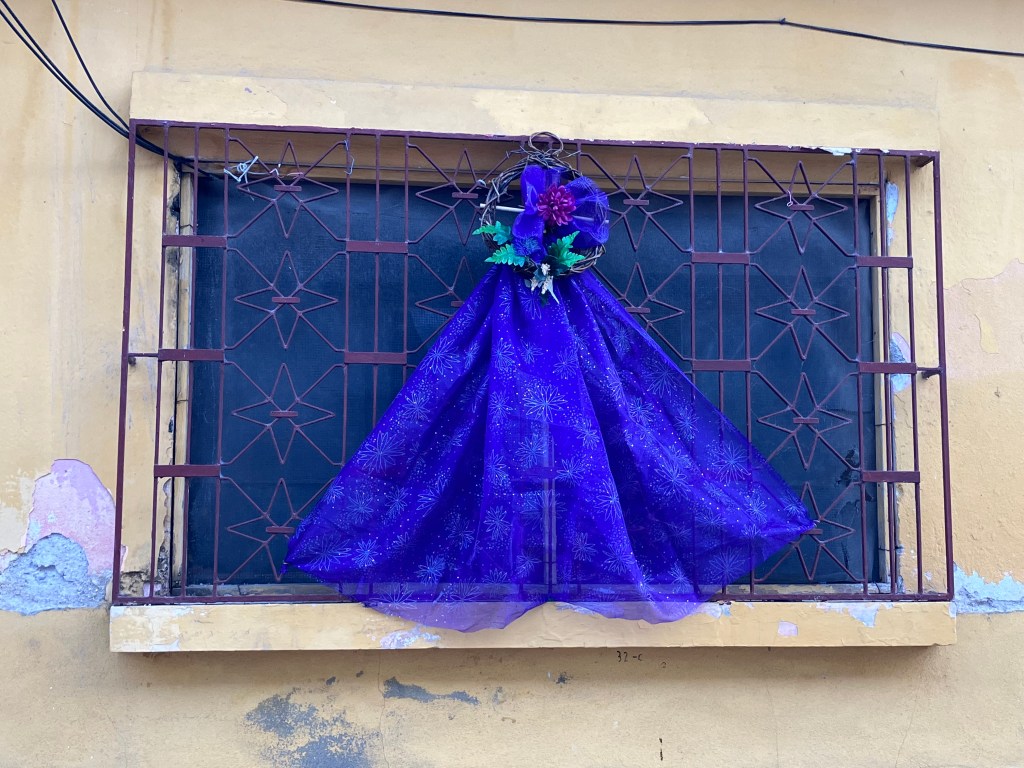
    As the town got ready for Easter, purple fabric was draped, folded, embellished from archways and window sills. At the highest point of the town, the twin cupolas of the Cathedral Nuestra Señora de los Remedios, dominated the skyline.

    Easter decorations at Parque Central
    Cathedral Nuestra Senora de los Remedios

    At the Parque Central, two teenage women’s sports teams played chamusca, a casual street version of soccer that’s played in Guatemala, floodlights animating their play.

    Chamusca being played in Parque Central

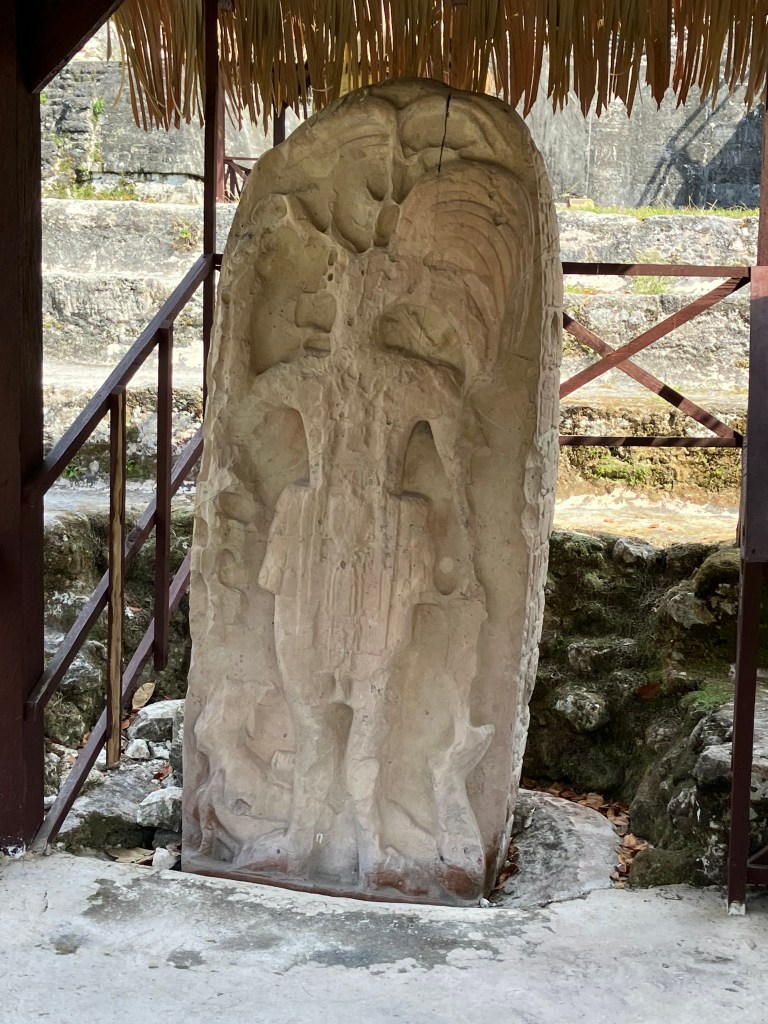
    Nearby, beneath a simple shelter, was an ancient Maya carving. I knew that early the next morning, I would visit one of the most magnificent Maya ruins in the world.

    Maya stone relief, Parque Central

    It was a short stroll to my simple and charming hotel, Hotel Isla de Flores, and sleep.

  • Guatemala: from BC to B.E. (Before Easter)

    Mural at San Juan da Laguna
    Mural at San Juan da Laguna

    Lake Atitlan: Three volcanoes and a deep, deep blue lake

    Lake Atitlan volcanoes

    Maya tradition alive today

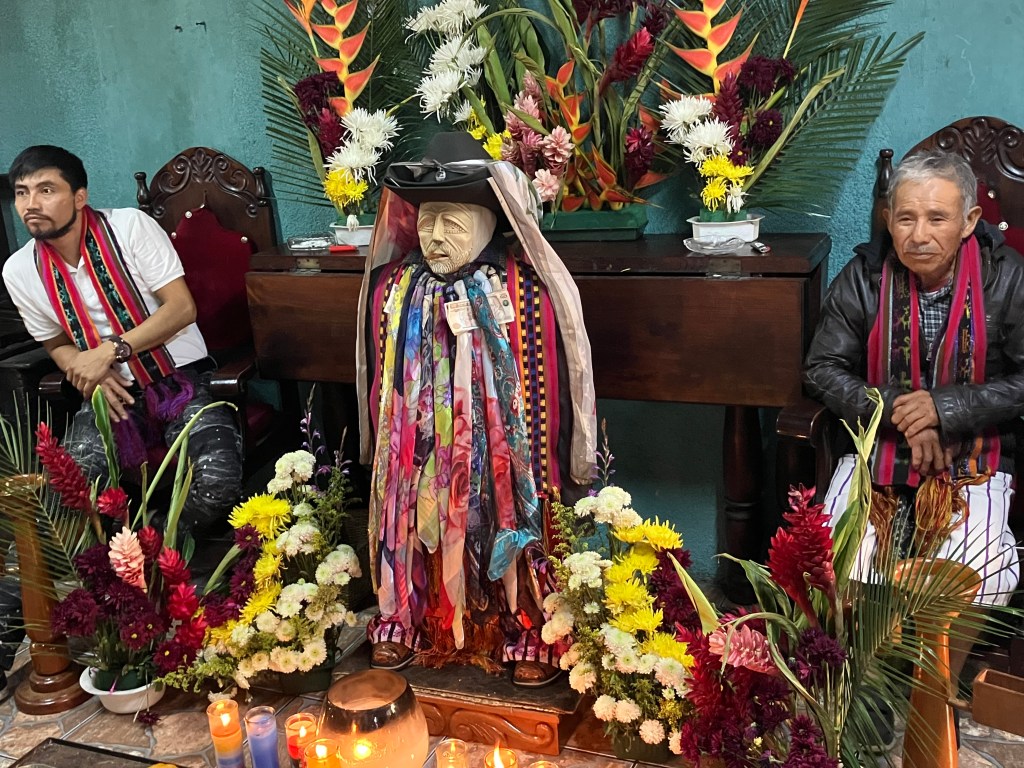
    Maya deity Maximon

    In the town of Santiago Atitlan, the guide led me down steep, narrow streets, looking furtively to see if we were being followed. No, it wasn’t a secret assignation we were going to, but it was the location of a discrete brotherhood: the confradia of Maximon. The confradia, brotherhood, looks after the Maya deity, Maximon. We slipped unnoticed into a nondescript building and entered a long, narrow room on the right side.

    Confradia taking care of Maximon

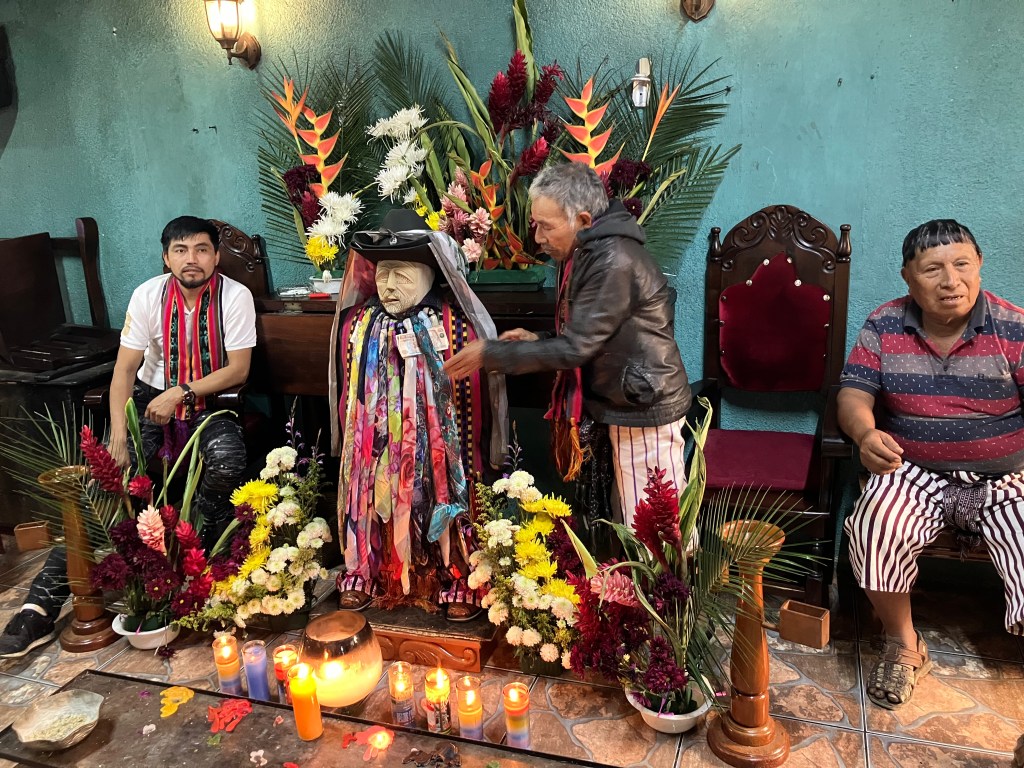
    Inside, three men were tending to a nearly life-sized wooden effigy of Maximon, draped in layers of scarves, a hat with a scarf laying over it, and a cigarette butt gripped between his lips. The attendants from the confradia tended to him like a beloved uncle. Flowers flanked and were behind Maximon. A dozen lit candles were in front of him, melted and hardened wax staining the floor. I gave a donation, which was silently slipped beneath a scarf.

    Syncretism is the amalgamation of different religions and Maximon is an example of this. He is a Maya deity who is the granter of all wishes — no matter what they are. As he is non-judgmental, disciples feel they can ask him anything. The Maya believe he is a descendant of a pre-Spanish God called Maam. The Catholics’ interpretation of him is a combination of the Catholic Saint Simon and maybe even Judas Iscariot.

    Maximon in glass casket

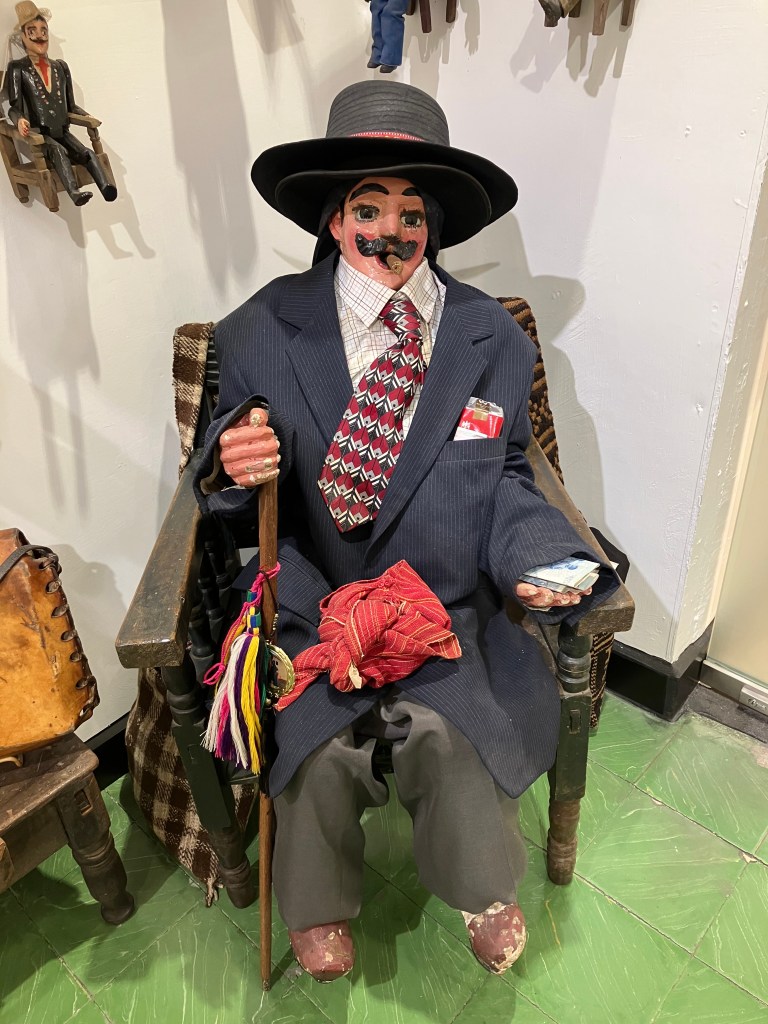
    In antique shops, I saw depictions of Maximon for sale, wearing a suit, hat, sometimes sunglasses, and often a cigarette, sometimes a cigar, in his mouth.

    In an adjoining room, I saw another effigy of Maximon laying in a brightly lit glass- enclosed casket with flowers in front of it. Well-wishers paid their solemn respects.

    Every year the confradia secretly moves the effigy of Maximon to another location in the city. Visiting Maximon gave me an insight into the layers of spiritual belief in Guatemala.

    Iglesia Parroquial Santiago Apostol

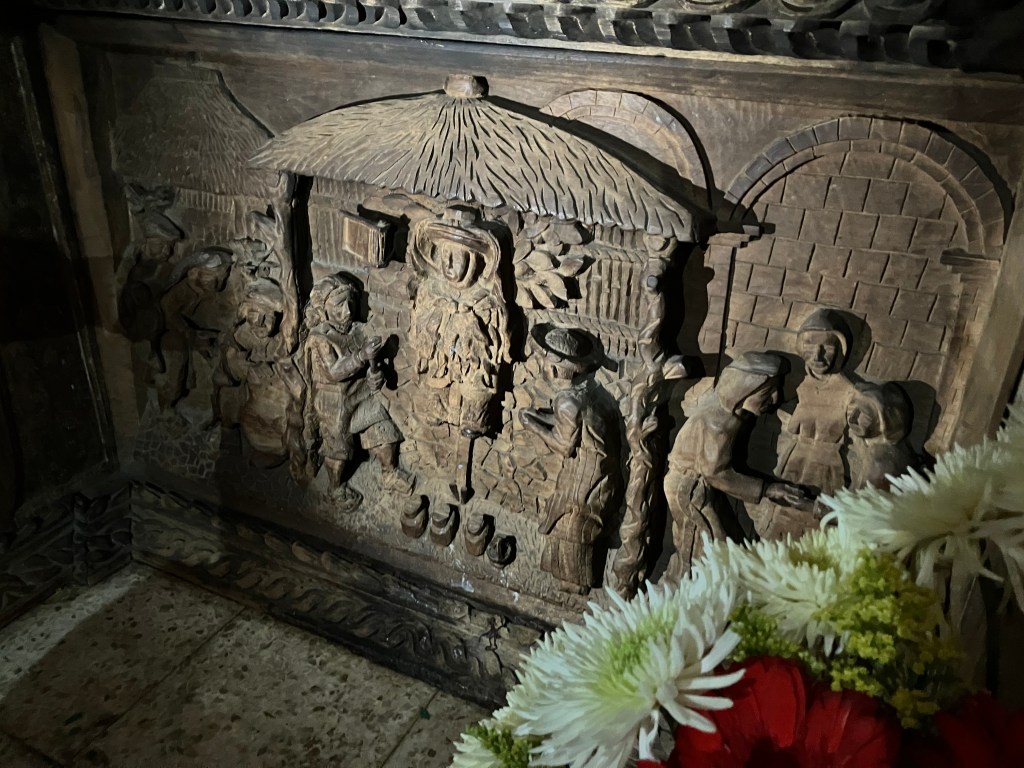
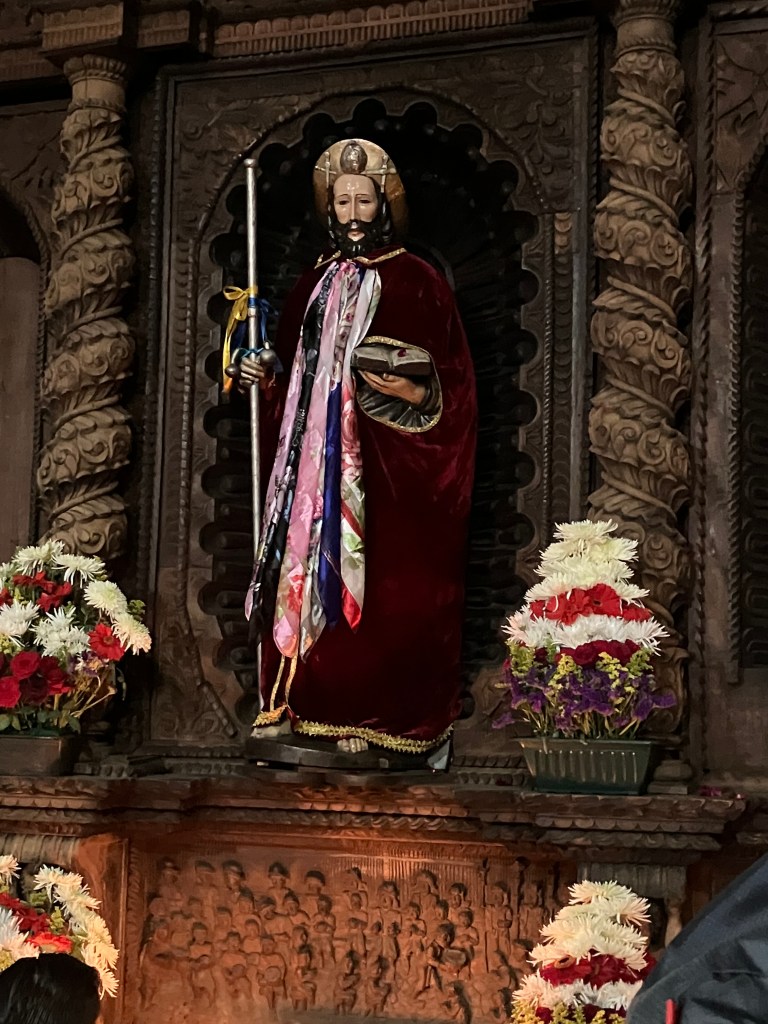
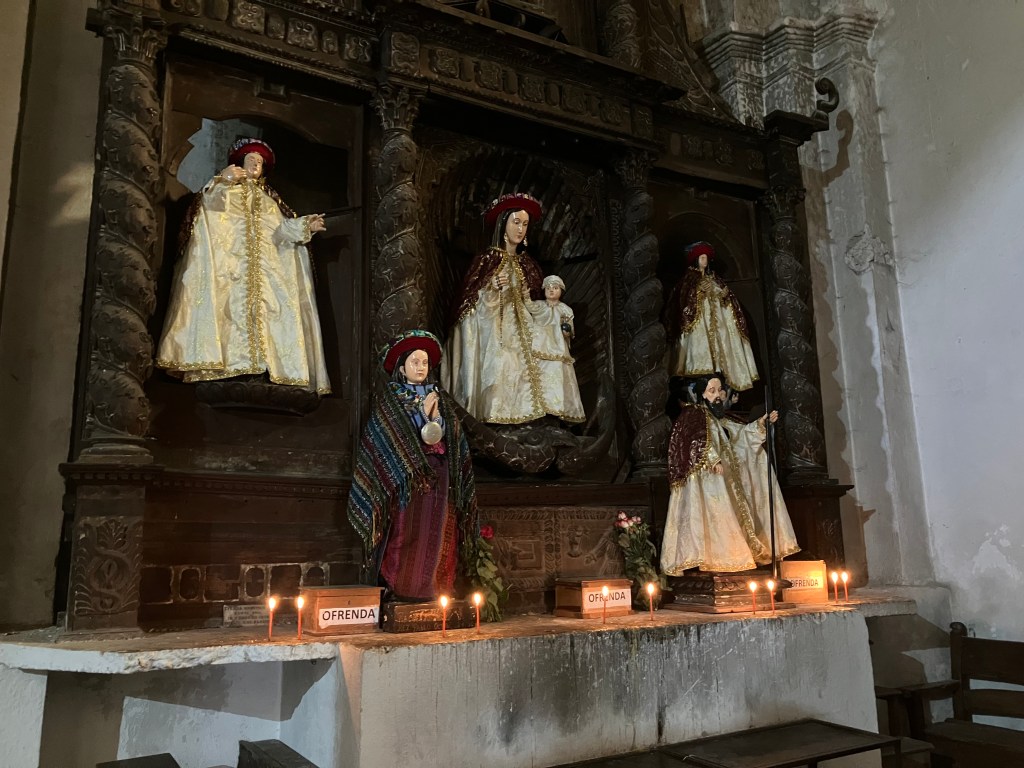
    At the nearby mid-16th-century Iglesia Parroquial Santiago Apostol, I saw more examples of syncretism. Jesus laboring beneath a huge cross on a flower-covered platform is dark-skinned, like the indigenous people of Lake Atitlan. A statue of a saint inside the church is draped with layers of scarves just like the Maximon effigy I saw earlier. Along the walls is a wooden carving of Maximon, the Maya deity clearly displayed inside this Catholic church. Despite its age, the church is the dynamic center of the community, the saints in the church having new clothes made for them every year by local women.

    Maximon carving at Iglesia Parroquial Santiago Apostol
    Statue of Jesus
    Saint in Maya dress

    When I visited, the church was draped in luxuriant purple fabric as part of the decorations for Easter.  Before I left, I paid my respects at the shrine in the church to Father Stanley Francis Rother from Oklahoma, who was murdered by ultra-rightists in 1981, the Civil War in full swing then.

    Father Rother shrine

    Digital nomad and party town

    San Pedro La Laguna
    San Pedro La Laguna’s steep streets

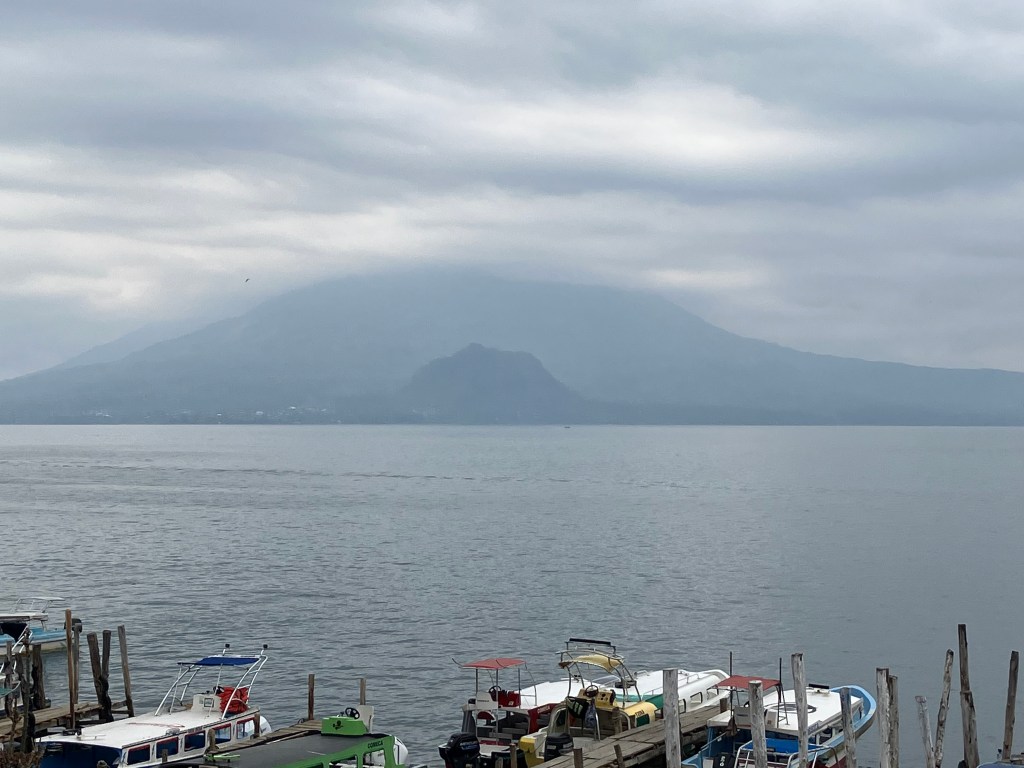
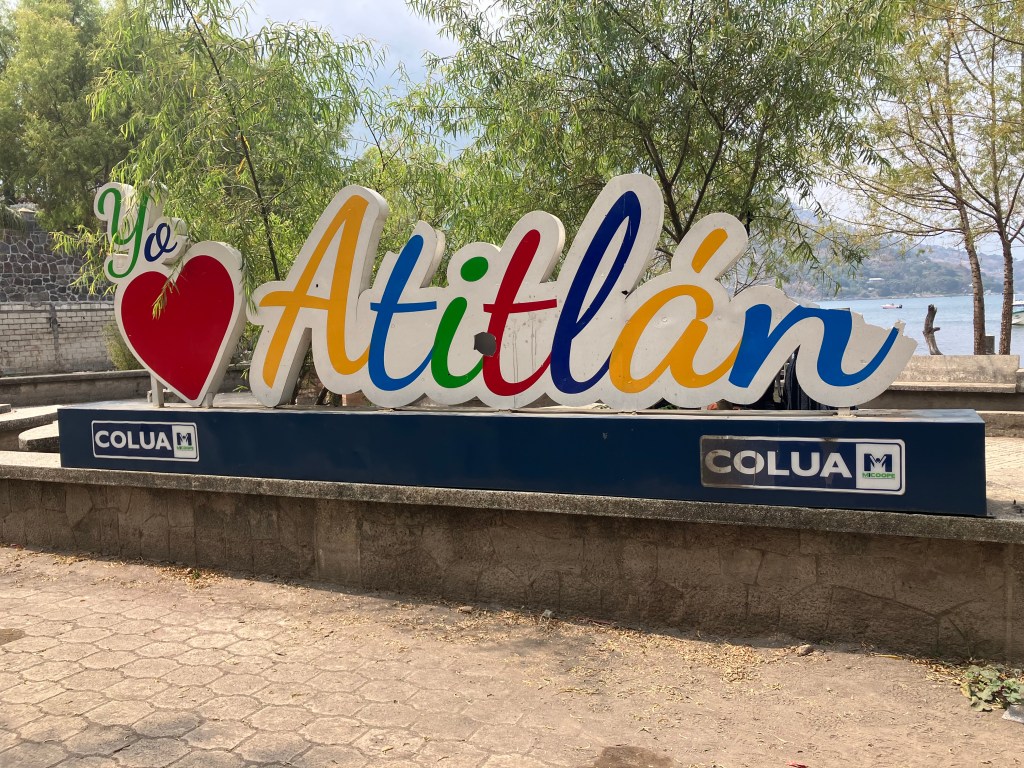
    From Santiago Atitlan, I took a boat to San Pedro La Laguna. Lake Atitlan stretches 18 kilometers by 8 kilometers, drops as deep as 300 meters and is surrounded by three volcanoes: Volcan San Pedro, Volcan Atitlan, and Volcan Toliman. If Central America is the Earth’s ring finger, then Lake Atitlan is the polished sapphire that decorates it. The Spanish, under Pedro de Alvarado, colonized the area in 1524, allying with the Maya group Kaqchiquels against the Tz’utujils, then turning against Kaqchiquels in 1531 after they defeated the Tz’utujils. During the 1960-1996 Civil War, Lake Atitlan was a focus of the military as indigenous people comprised the majority of the rebels. It’s tragic, violent history is a startling contrast to the serene tranquility of today — and especially painful to comprehend after spending time with the warm, welcoming people of the lake.

    San Pedro La Laguna from the lake
    On top of San Pedro La Laguna

    San Pedro La Laguna has a reputation as a digital nomad and backpacker haven and something of a party town. When I visited a Western traveler was sprawled face down along the side of the road. Given that I was there in the early afternoon he didn’t just have a rough night, he must have had a rough morning too. No one bothered him and he seemed to be sleeping off whatever he was on peacefully. Nearby, I got a jolt from an espresso at a simple café that wasn’t notably appealing to Western tourists. I took a three-wheeler, a Guatemalan tuk-tuk, up the steep streets to an IMAX-like view of Lake Atitlan. The clouds were moving in, enveloping the landscape in a veil that gave the environment a mysterious aura.

    Lake Atitlan tuk tuk
    View from top of San Pedro la Laguna

    Maya craft traditions alive today

    San Juan La Laguna

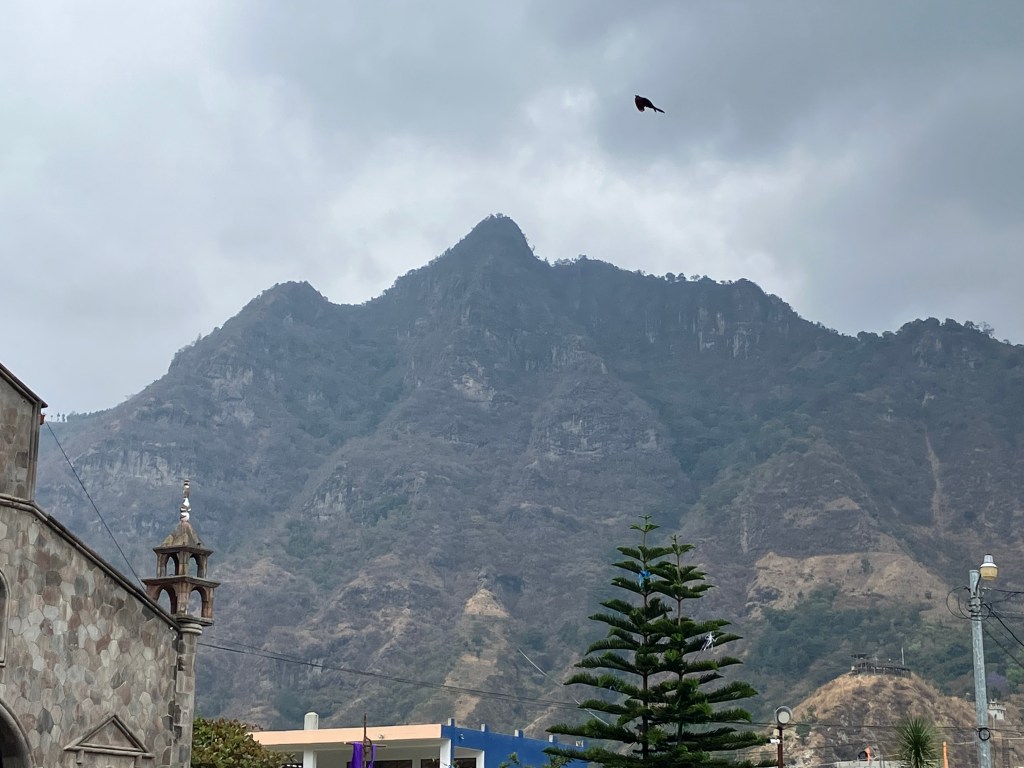
    A boat zipped me over to San Juan La Laguna next. This village takes pride and its Tz’utujil Maya crafts. Visitors here seem keen to learn and give back by supporting the trades that fuel its economy: painters, weavers, coffee growers, fishermen, farmers. This village is also popular for its Spanish schools. Looming over the village in the Cristalina Hill, with a profile of a man.

    Cristalina Hill with man’s profile San Juan La Laguna

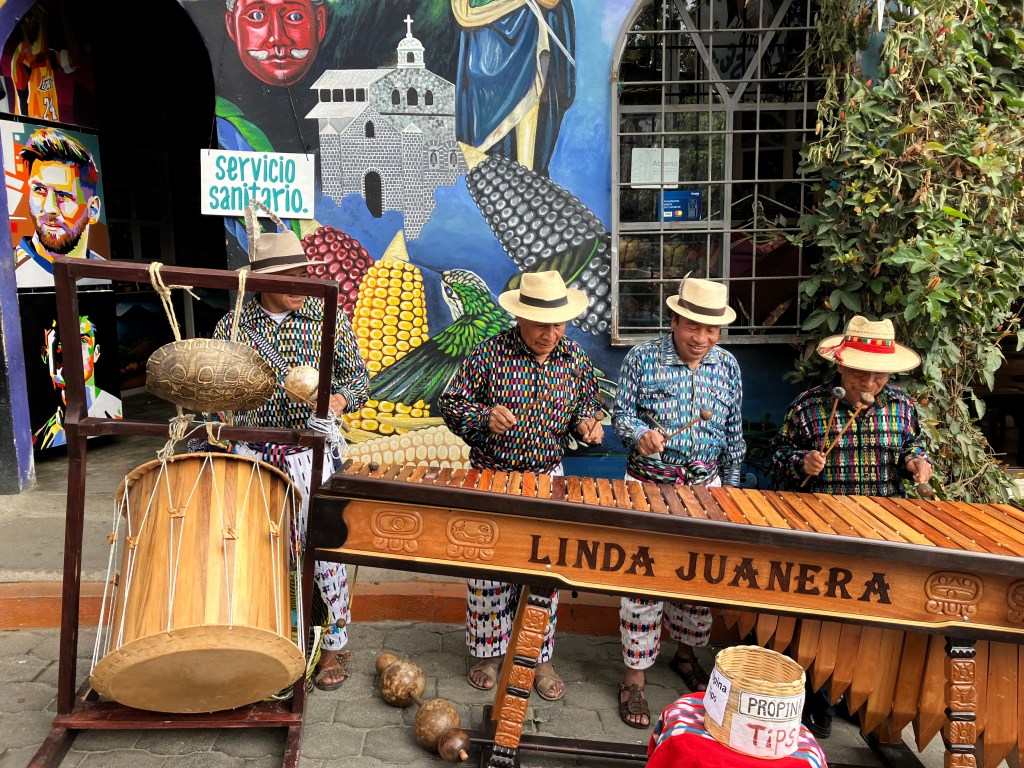
    Upon walking away from the dock, I was greeted by a marimba band, three men tapping out a tune on a large marimba, a type of xylophone made of palo de hormigo, a type of wood, and pumpkins. A fourth man shook maracas filled with seeds. It was a joyful entrance to a lively village.
    Mairmba band

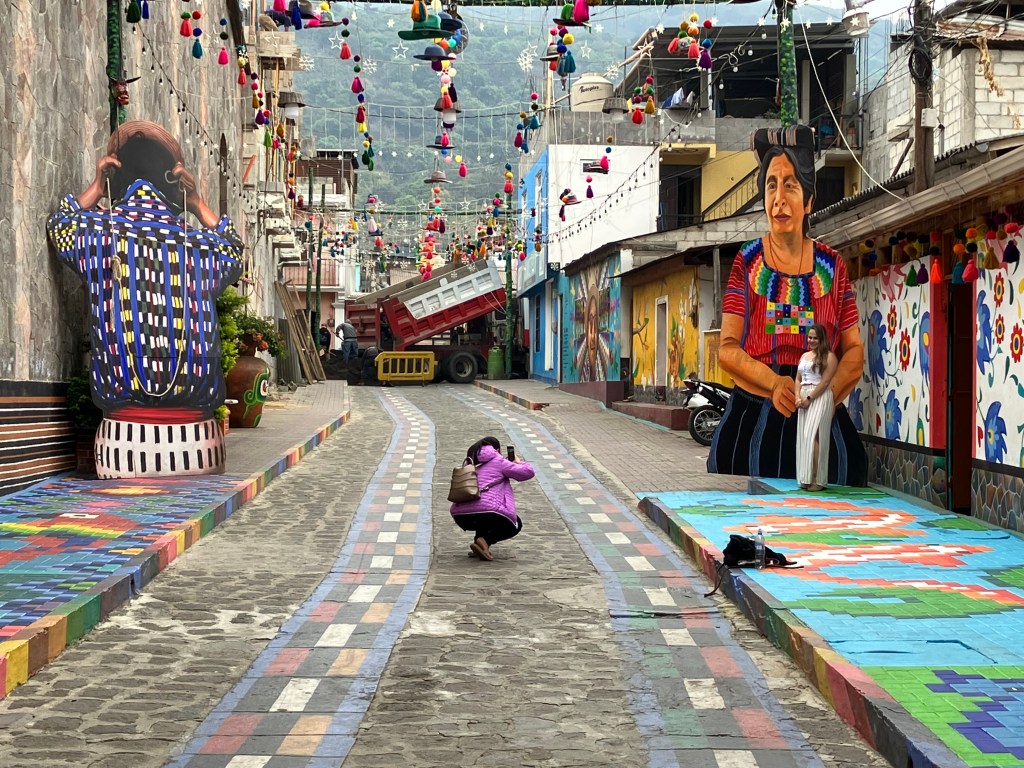
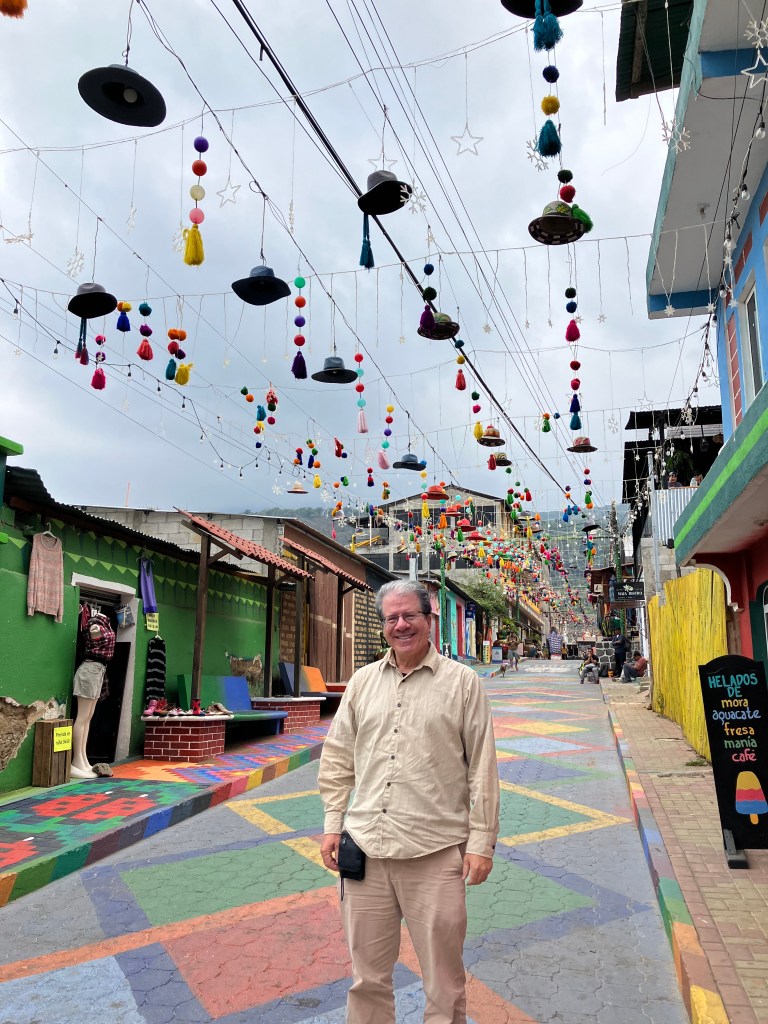
    A decorative canopy of multi-colored umbrellas covered the street as it led upwards into the high reaches of the town. Walls were covered with bold murals depicting Tz’utujil Maya life: from Maya ancestors playing ball games to shamans to contemporary Tz’utujil playing music. There were even huge 3-D cut-outs of Maya at key junctures of the streets. The umbrellas give way to bowler hats and tassels overhead.

    Umbrella canopy at San Juan da Laguna
    3-D cutouts at San Juan da Laguna

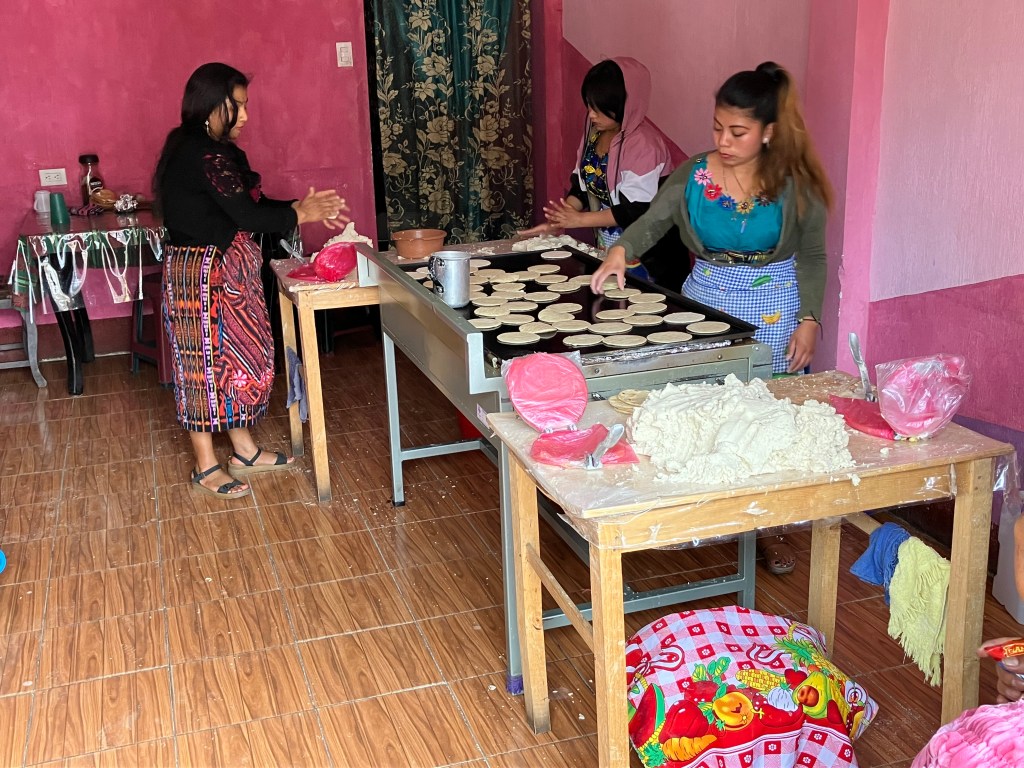
    I visited a weaving cooperative and saw a demonstration on how they dye fabric before buying a multi-hued scarf there. I spent time watching a shop harvest honey from their beehives before buying a bottle of robust-tasting honey. I also visited galleries featuring Tz’utujil oil paintings, a primitivist style depicting Maya life. And around nearly every curve and corner, I could see women slapping and grilling corn tortillas, the scent wafting out onto the street, the sound a rhythmic, ambient beat.

    My next stop was back where I started my journey on Lago de Atitlan, Panajachel, the largest and busiest of the towns on the lake. It’s the jumping off point for visits to the lake. For most travelers, including me, it’s really a transit point.

    At San Juan da Laguna

    Lago de Atitlan is only around a 3-hour bus ride to Antigua, but it’s a journey to an indigenous Guatemala that is finally finding the peace it needs to provide a better future for its citizens and their centuries-old culture.