Tag: food

  • Mesmerizing Mexico City is the New Capital of Cool

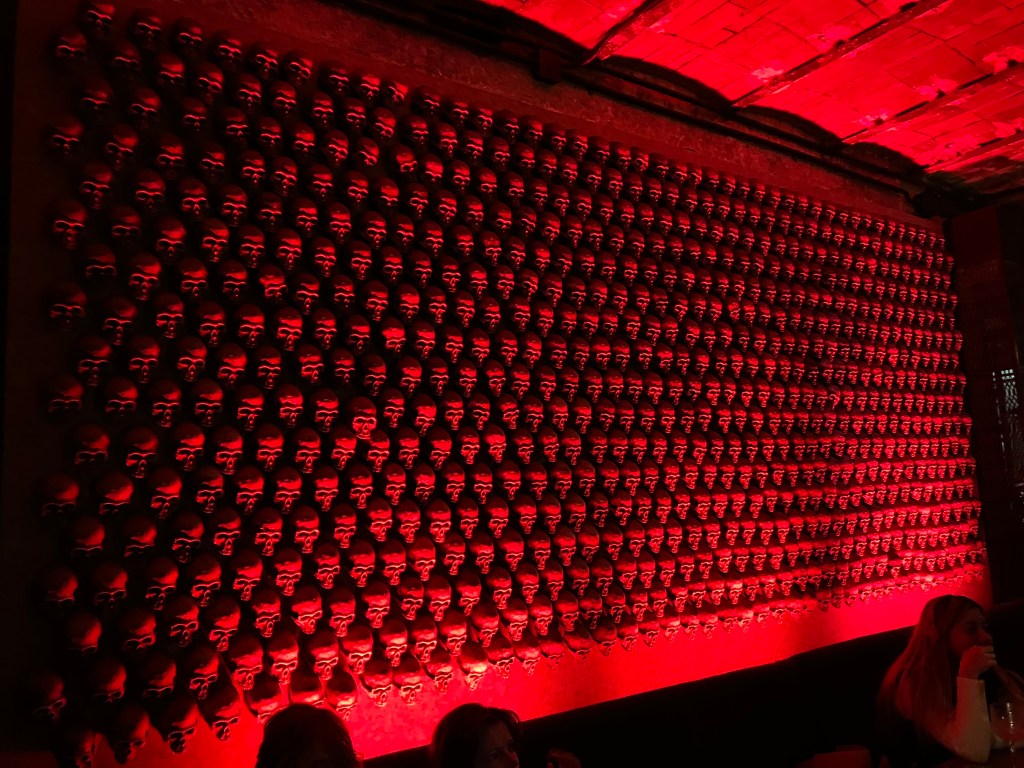
    Wall of Skulls Gin Gin Bar Mexico City

    During a Taco Crawl in Mexico City’s Roma neighborhood, we came upon Carinita. Packed with the young, hip set that now defines the hood, Thai tacos were served in corn husks. Never heard of Thai tacos? Neither did I. But I’ll never forget them either, wolfing down a spicy one called Isaan. We had al pastor tacos at next stop Tacos los Alexis where the bill is provided in a miniature shopping card. 

    Roma, featured in the Oscar winning movie of the same name, is filled with restless humanity ebbing and flowing while scouting for restaurants, cafés, bars, and music clubs. A baroque mansion is converted into a bazaar. At Gin Gin, walls decorated with rows of skulls illuminated by red lighting, we downed mezcal spiked cocktails.

    Pinnacle moment for the city

    Mexico City is having its pinnacle moment. In November 2023 Time Out named it the number one city in the world for culture. Time Out also rated it the sixth best city in the world to visit in 2024. But it’s not just the foreign media that praise the city. Locals love it too, according to Time Out. 96% say they are happy living there. 94% say it’s easy to make friends. After my fourth visit there I’m a convert. Some cities are sonnets, other are short stories or a novel. Monumental, magical Mexico City is an all-engrossing trilogy.
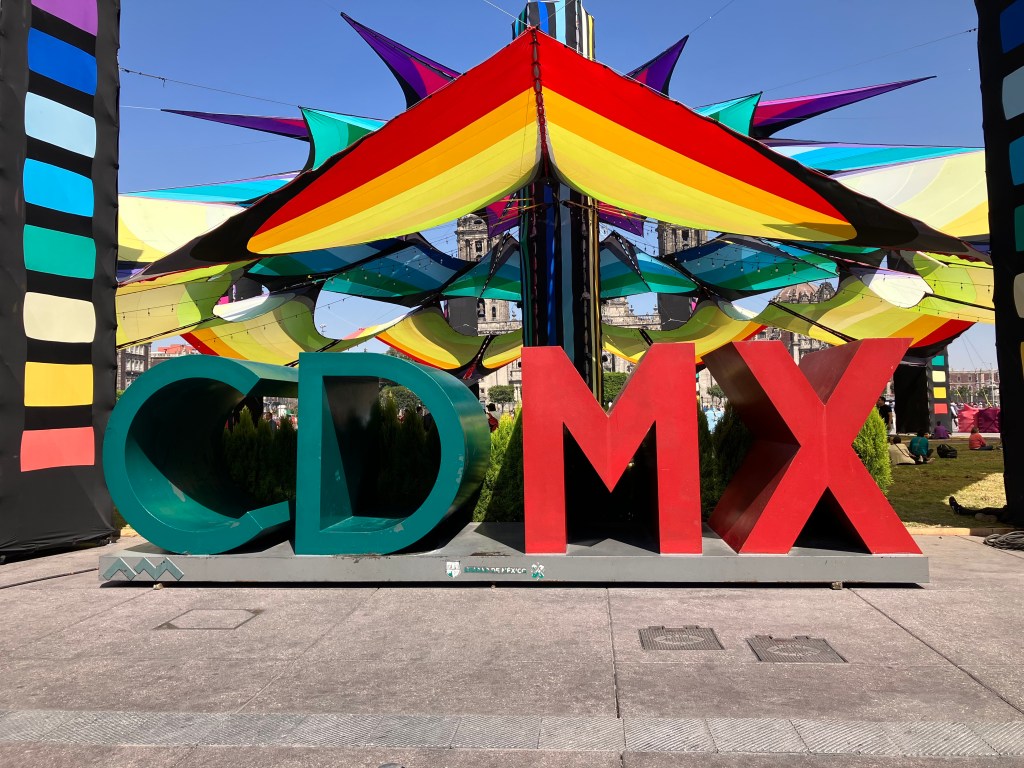
    CDMX sign at Zocalo

    During the 1990s and early 2000s Mexico City was known for treacherous streets and unbreathable air. In 2001 the Washington Post ran an article titled, “A kidnapper around every corner.” Express kidnappings were common: tourists were grabbed and driven to ATMs around the city to withdraw cash or else. In 1992 the UN named it the world’s most polluted city. Now, according to Swiss company, IQAir, it’s ranked 917th. You may still be breathless here but because of the elevation. At 7,350 feet Mexico City, ringed by mountains and two volcanoes, is certainly high. Why did it improve so dramatically? Strong leadership by former mayor Claudia Sheinbaum and other civic leaders who transformed this maximum metropolis.

    Colossus of the Americas

    At 22.28 million people, second only to Sao Paulo in the Americas, the city is a colossus. The National Autonomous University of Mexico (UNAM) is the largest in the Americas with 373,000 students and 42,000 staff. Its public art work is also massive in scale, earning it a place on UNESCO’s World Heritage Sites in 2007. The ten-story high Biblioteca Central is a tapestry of mosaics depicting Aztec times and colonial history by artist Juan O’Gorman. Other colossal mosaic artworks on campus are from David Siqueiros and Francisco Eppens.
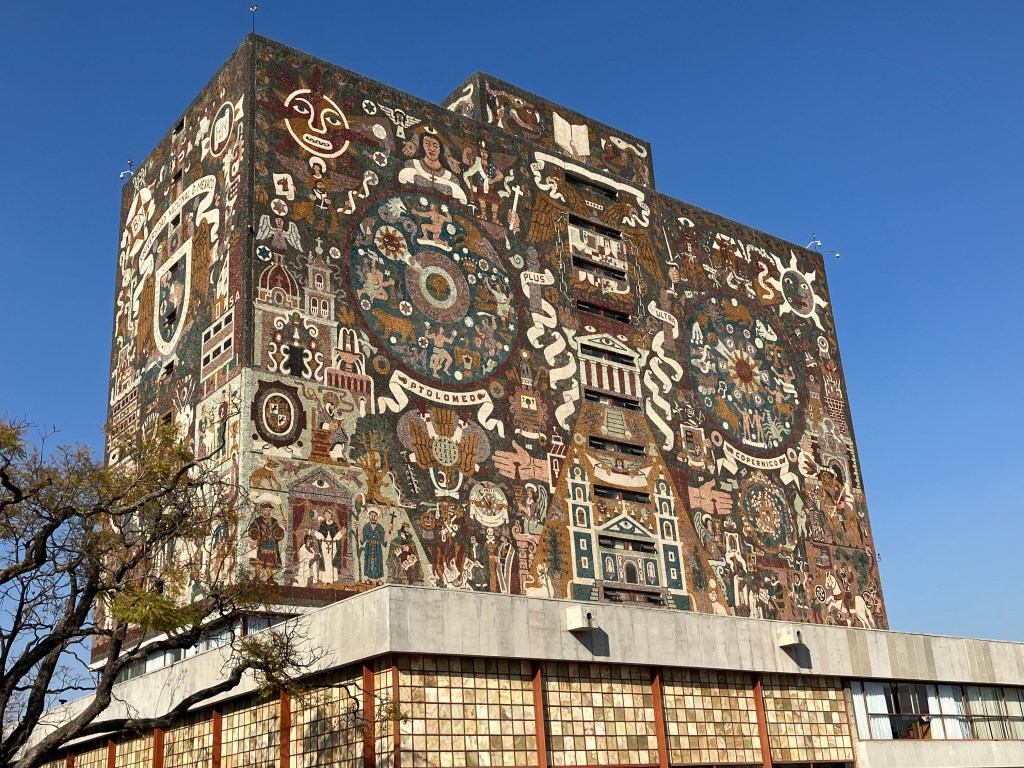
    Bibloteca Central UNAM

    Altiplano Venice

    Other great cities are built on a river, lake, or seashore. While Mexico City was built on the drained Lake Texcoco, water is not the city’s defining element. But there is an exception, the canals at Xochimilco, originally built by the Aztecs. Located at the southern edge of the city, this UNESCO World Heritage Site is where families and friends rent trajineras, gondolas, and glide along canals amongst floating islands call chinampas while passing boats of mariachi bands playing music, and others selling cervezas and tamales or a traditional alcoholic drink called pulque. Poinsettias and marigolds thrive here. A creepy feature of these Venice-like canals are the dolls that are strung up on shacks and trees These pay homage to the Isle of the Dolls where Don Julian Santana Berrera hung a multitude of children’s dolls from trees, time and the elements disfiguring them.
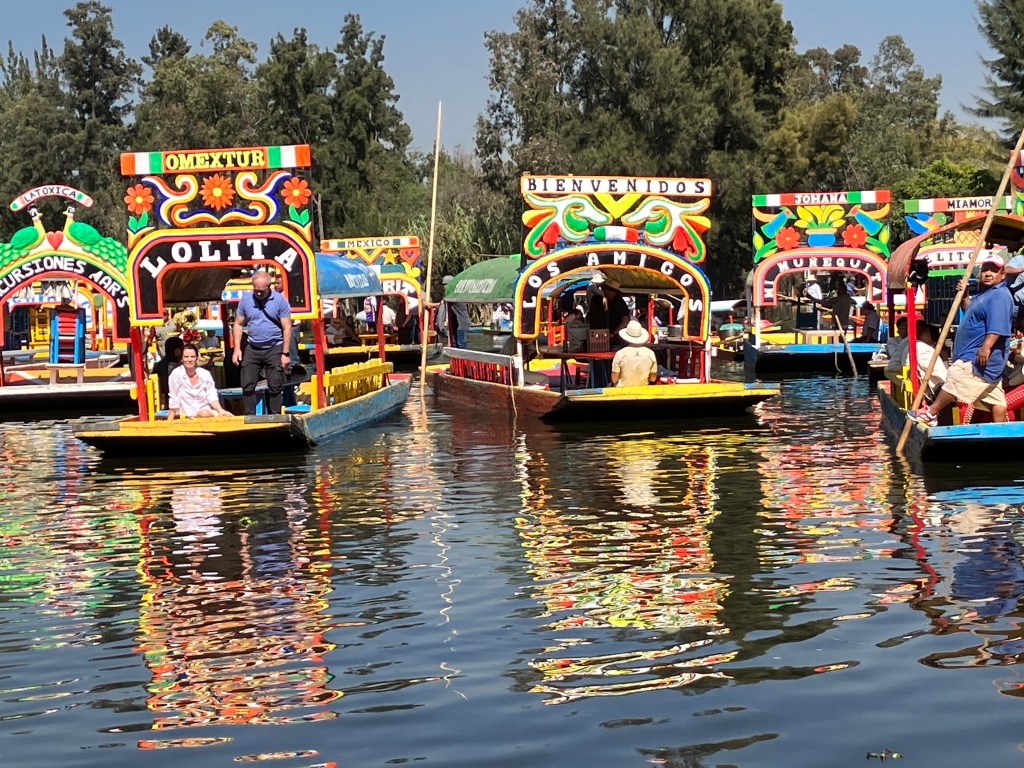
    Gondolas at Xochimilco

    History going back thousands of years
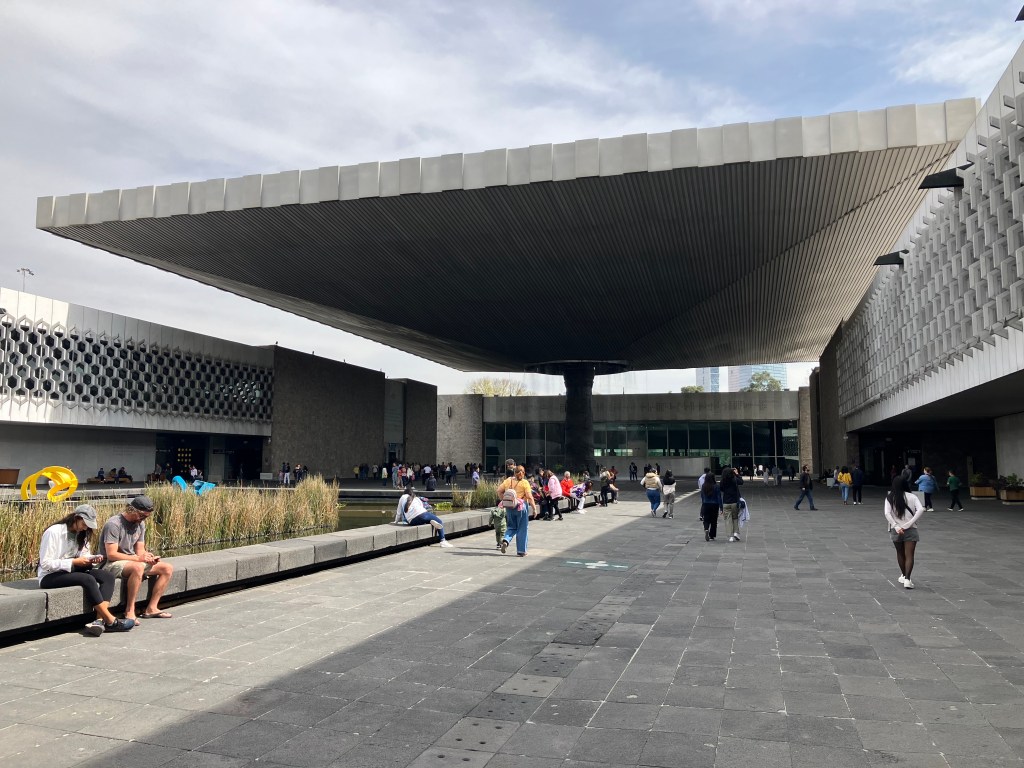
    Museo de Antropologio

    At the summit of Mexico City’s cultural offerings is the world famous Museo Nacional de Antropologia. Designed by architect Pedro Ramirez Vazquez and opened in 1964 it depicts Mexico’s history from pre-Hispanic times. From colossal Olmec heads weighing 20 tons to the replica of King Pakal’s tomb to the Aztec Sun Stone that is the symbol of Mexico, the museum takes hours to absorb. The central plaza is dominated by a monumental sculptured column with a gushing fountain of water and a huge concrete canopy that acts as an umbrella. In front of the museum indigenous Totonac twirl in a flying pattern from the top of a 30-meter pole to the sound of rhythmic music. This ritual dance is known as the Voladores de Papantla ceremony.

    Olmec head

    While the Museo Nacional de Antropologia depicts Mexico’s storied past, the Zocalo, also known as the Plaza de Constitucion has been the city’s and the country’s center of power since Aztec times. It is one of the world’s largest squares: 220 meters north to south, 240 meters east to west. The ceremonial center of the Aztec civilization was here: the Teocali of Tenochitlan. After defeating the Aztecs Cortes dismantled the Aztec pyramids and used the stones to pave the plaza and build the Metropolitan Cathedral. The baroque cathedral was built between 1573 and 1658, athough elements of the building were not completed until the end of the 18th century. Breathtaking in scale, it’s 109 meters long, 59 meters wide and 65 meters high. To get a sense of its majesty I went into the choir area and listened to its two massive organs being played during mass. The largest in the Americas, they were completed in 1736.
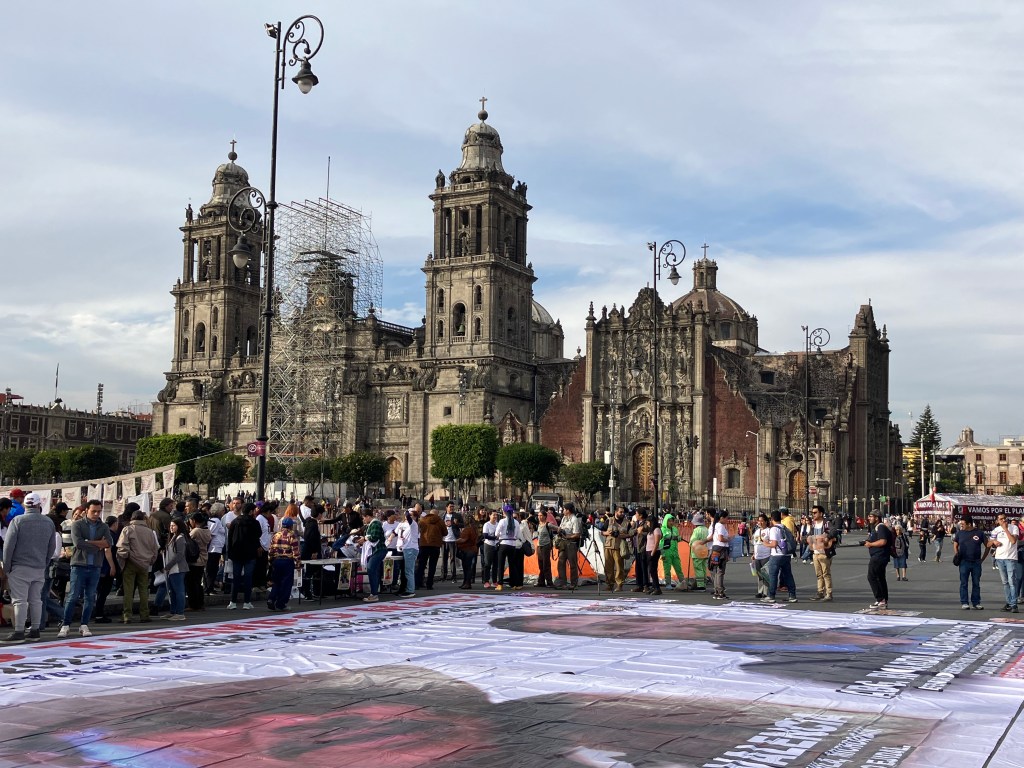
    Protest in front of Metropolitan Cathedral

    Near the cathedral is a line of people wating to be spiritually cleansed by Aztec shamans. The ceremony, known as limpia, included being rubbed with herbs and having a silver cup of smoke blown into your face. It ended with the haunting sound of a conch shell being blown.

    Aztec shaman performing cleansing ceremony

    Rivera’s murals depict Mexican history

    Palacio Nacional

    The Palacio Nacional is opposite from the cathedral on the Zocalo. The Aztec emperor Moctezuma II occupied the first palace here, which Cortes replaced with a fortress. The Spanish crown took it over and transformed it into a palace the New Spain viceroys. After independence, the presidents of Mexico have lived here, including current the president. In the palace is a series of nine murals by Diego Rivera, painted between 1929 and 1951. The largest mural is The History of Mexico. Rivera commuted here from the Blue House, the home that he shared with Frida Kahlo in the Coyoacan neighborhood. Now a museum, it illustrates their life and trials together.
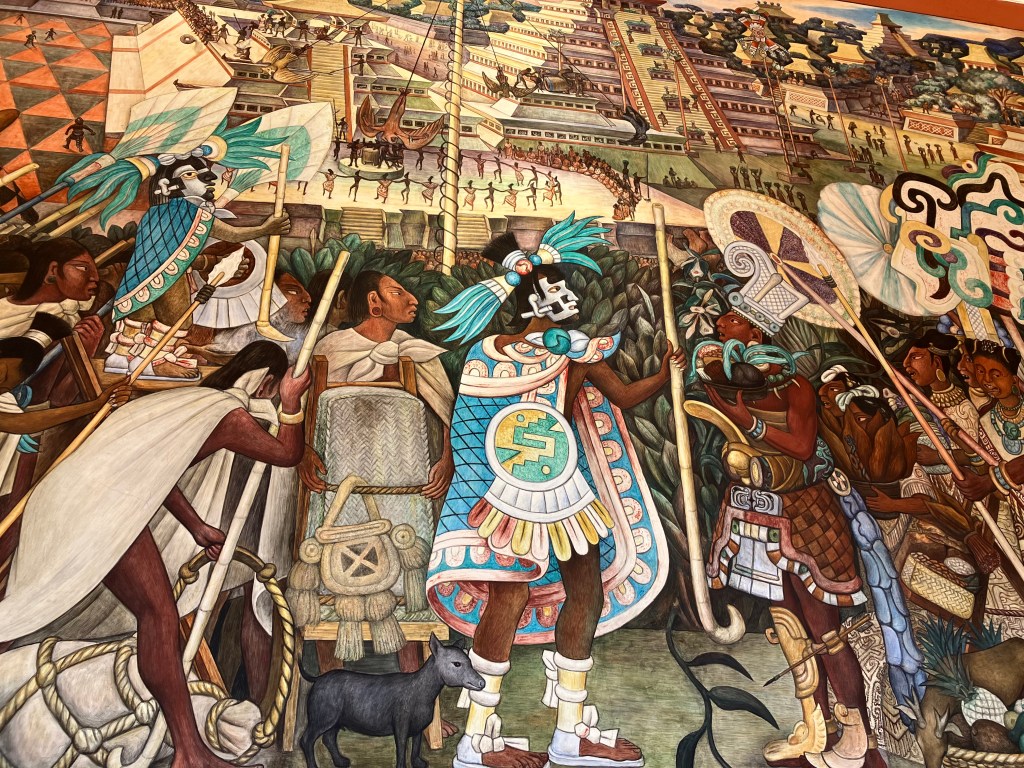
    Detail from The History of Mexico mural

    In the palace I passed through a cactus garden representing northern Mexico and tropical garden representing its south. In the symmetrical palace’s courtyard I climbed stairs to reach the murals. On my left is the entrance to the president’s residence. The palace allows only 240 visitors a day on free guided tours. On most days, the military closes the palace completely to visitors.

    Palacio Nacional courtyard

    Mexico’s mural masters

    At the nearby Palacio de Bellas Artes, started in 1905 but only completed in 1934, a delay caused by the Mexican Revolution, the floors are dominated by murals by Mexico’s most famous muralists: Diego Rivero, Rufino Tamayo, David Alfaro Siqueiros and Jose Clemente Orozco. Rivera’s “Man at the Crossorads” was originally painted at the Rockefeller Center in New York until Nelson Rockefeller ordered it painted over because it included flattering images of Lenin and a Soviet May Day parade.

    Palacio de Bellas Artes

    Culinary art and lively nightlife

    Mexico City isn’t all about museums. Cafes and bars, restaurants and music serenade the senses. Opened in 1952 the Café La Habana with its sepia toned colour scheme, was a favorite haunt of Fidel Castro and Che Guevara as they planned the Cuban Revolution. Nobel prize winning writers Gabriel Garcia Marquez and Octavio Paz socialized here. My son and I soaked in the atmosphere over hot chocolates.
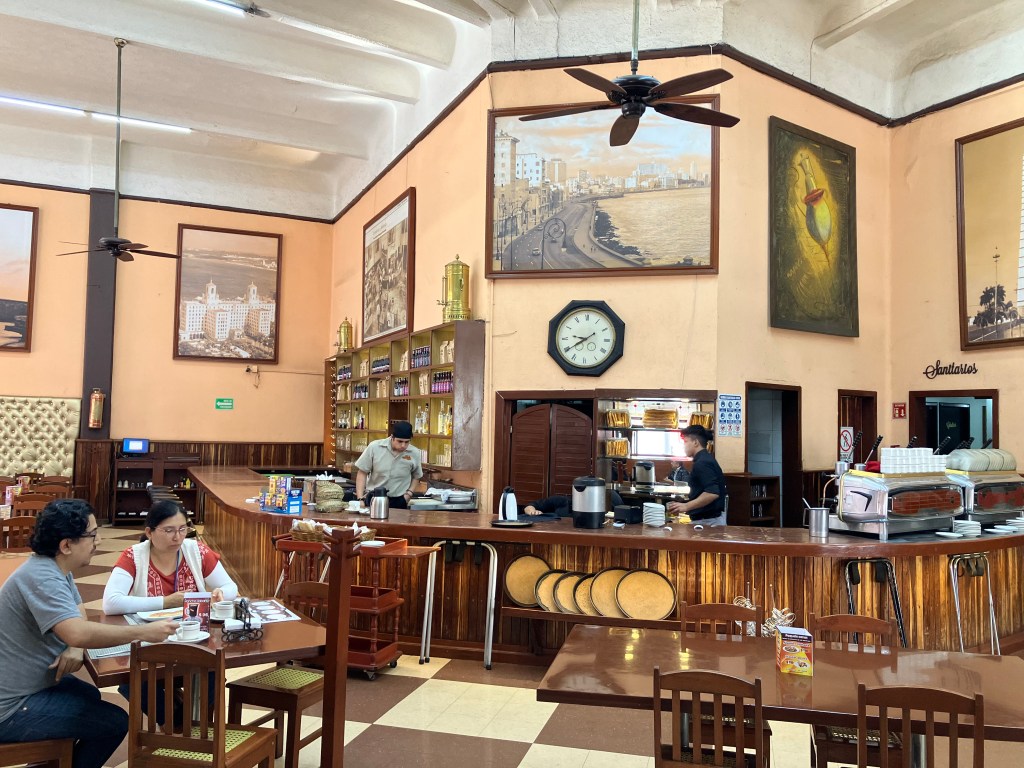
    Cafe La Habana

    The storied La Opera has been serving drinks and food to Mexico’s richest and most powerful since 1876. Revolutionary Pancho Villa fired a bullet into the ceiling in protest against the plutocrats who congregated here. The dictator Porfirio Diaz was a regular here as was Gabriel Garcia Marquez who once refused to autograph napkins for fans but later returned with autographed books for all of them.

    Haute cuisine

    Quintonil restaurant, Polanco

    Lately, Mexico City has become a mecca for haute cuisine with three of the world’s top 50 restaurants. Our most memorable meal was at Quintonil, ranked 9th in the World’s 50 Best Restaurants list. They take Mexican cuisine to new levels by relying on traditional ingredients like insects. Yes, insects. During our ten course tasting menu, my wife and I had ant larvae, agave worms, stink bugs, and grasshoppers. In some Mexican customs, the stink bug, jumil,  represents the souls of dead relatives so eating them while alive is a traditional custom. The stink bugs we ate were definitely dead and thank god for that! The restaurant was intimate — only eleven tables and eight counter seats — with muted colours that didn’t detract from the vibrantly coloured dishes.

    Cactus and vegetables at Quintonil

    Our experience at the 49th ranked Rosetta was less sublime and more factory line. Given its fame, people crowded the entrance. Located in a magnificent mansion in the Roma neighborhood, they were eager to get a table, any table. At our meal I had white mole and fermented carrots as a starter and cacahuazintle corn cappellaci and brown butter as a main. The food was outstanding but the portions so miniscule, I felt like emulating Oliver Twist, “Please sir, can I have some more?” My family and I decided to finish our meal at Churreria El Moro, with abundant crispy churros dipped in chocolate sauce.

    Rosetta restaurant mansion, Roma

    World’s Best Bars

    When it comes to the top 50 bars in the world, Mexico City has four of them. Our experience with two of the bars was like the restaurants, hit and miss. Handshake Speakeasy made it to Number 3 on the World’s 50 Best Bars list. Its staff stand in front of the office building where it’s located in the Colonia Juarez neighborhood, dealing with a crowd of those who have reservations and those who want to get them. My family and I and were led down stairs to a hidden entrance in the basement. Inside was a slick bar, with black sofas and shiny black surfaces on tables and counters. There was no bar counter. My son-in-law and I ordered the same drink, Salt and Pepper. Lost Explorer Espadin mezcal was combined with strawberry and Yellow Pepper Habanero. Both of us had the same puzzled expression on our face when tried it: we couldn’t taste nor feel the mezcal. My wife had better luck with the Matcha Dame Blanche which had Bombay Sapphire Gin with Matcha Tea, Greek Yogurt, and White Chocolate.
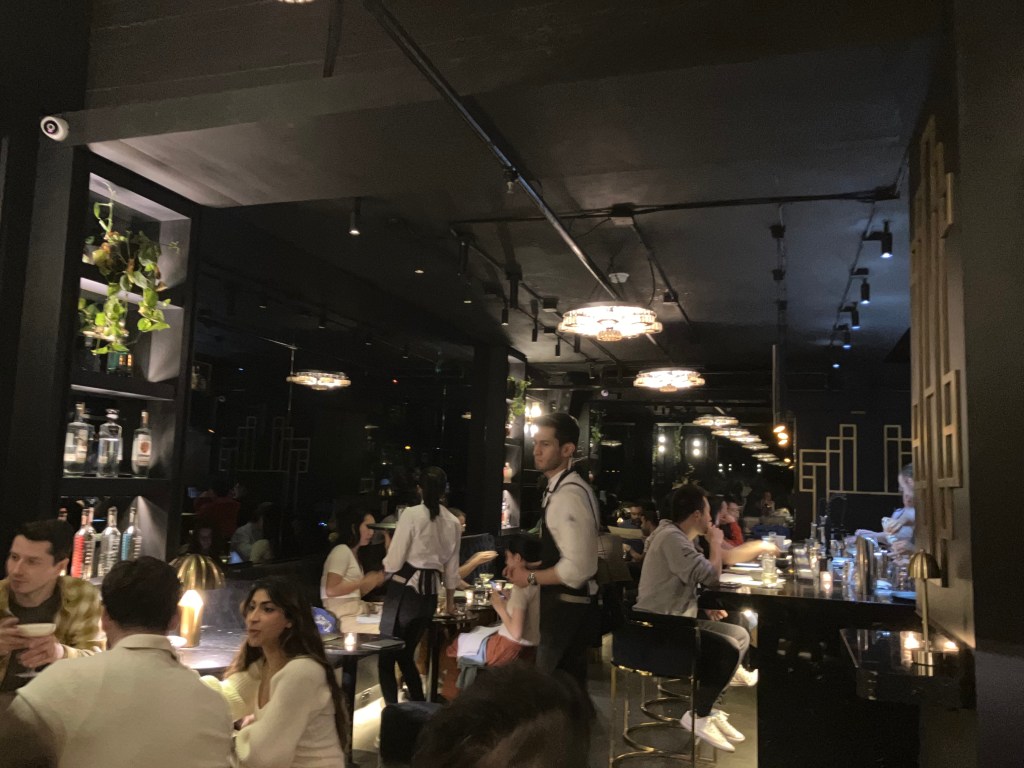
    Handshake Speakeasy

    My wife and I also visited the 7th top ranked bar in the world, Licoreria Limantour — a boisterous bar in the Roma neighborhood with an outrageously tasty mezcal cocktail flavored with pineapple and bitters.
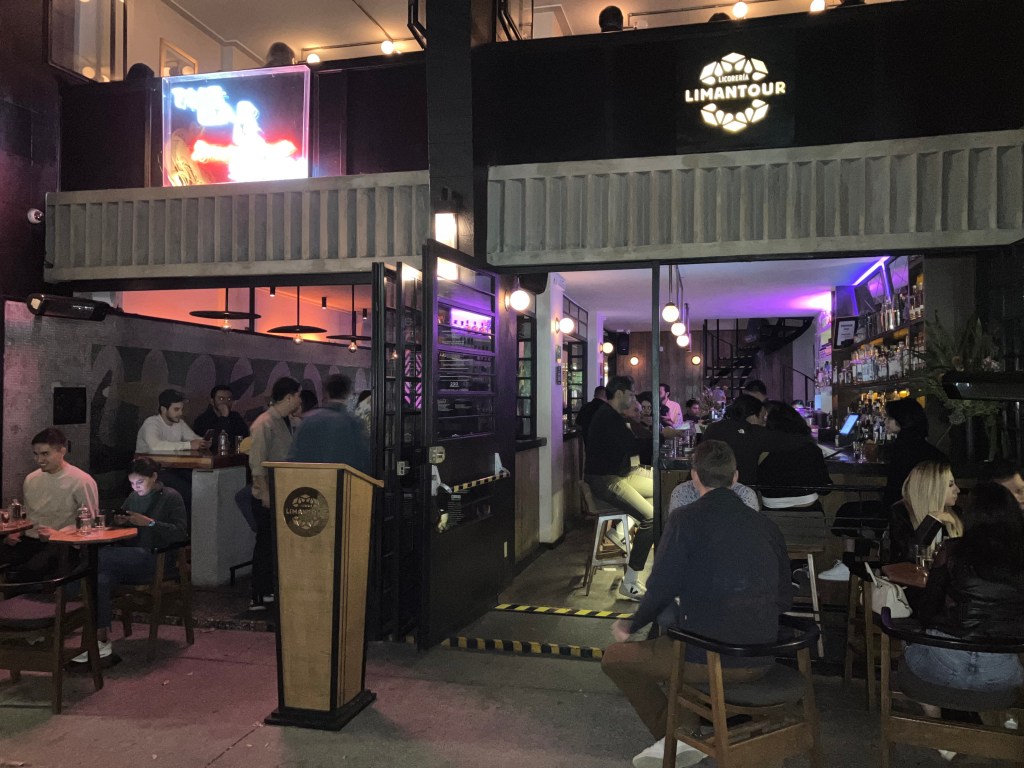
    Licoreria Limantour

    Zesty street life

    But Mexico City isn’t all about fine art, fine dining and cocktails with recipes that would intimidate a PhD in chemistry. When my wife and I returned to our hotel after a couple of strong drinks at Licoreria Limantour we saw a large crowd of people dancing to a street band at the Alameda Park across from our hotel, Hilton Reforma. Some were great dancers, some weren’t. All of them were having an marvelous time. So with my hand out and my two left feet my wife and I took a twirl — terrible dancers having a terrific dance. That’s the real magic of Mexico City.

    Dancing at Alameda Park

    Where to stay:

    Hilton Reforma for downtown’s buzz. AirBnbs in trendy Roma, La Condesa and Polanco neightborhoods.

    Dining and bars:

    Mux for Mexican cuisine in Roma; La Catrina churros in Centro Historico; El Morro Churerria in Roma; Baltra Bar in La Condesa.
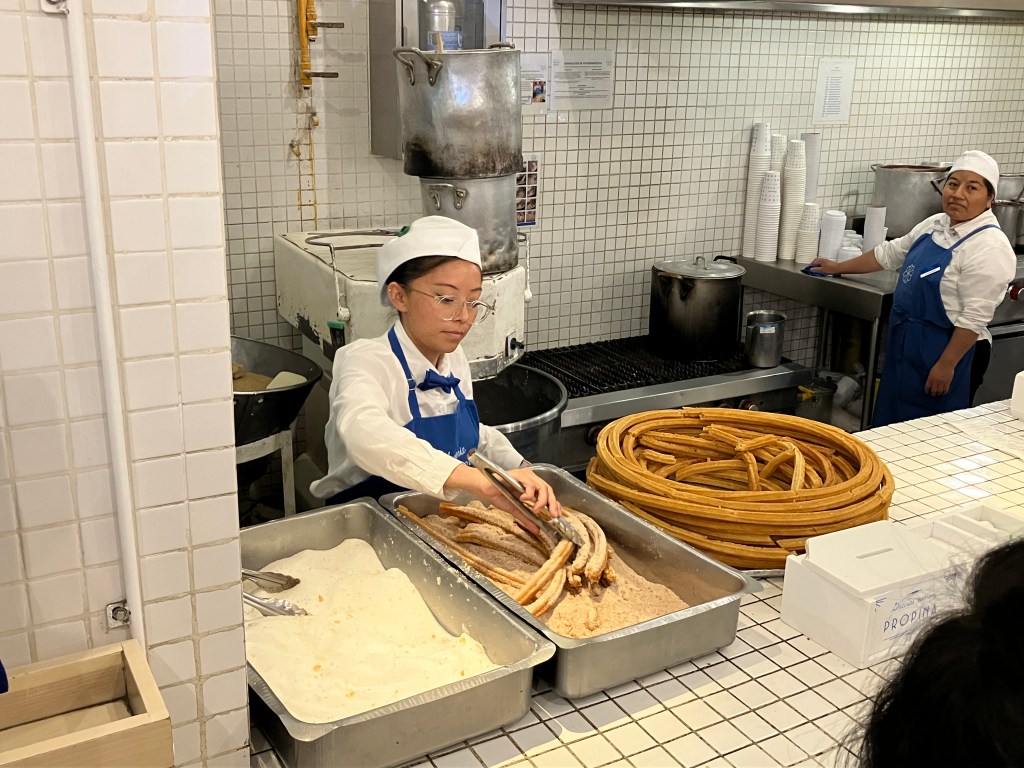
    El Morro Churreria

    Museums and art buying:

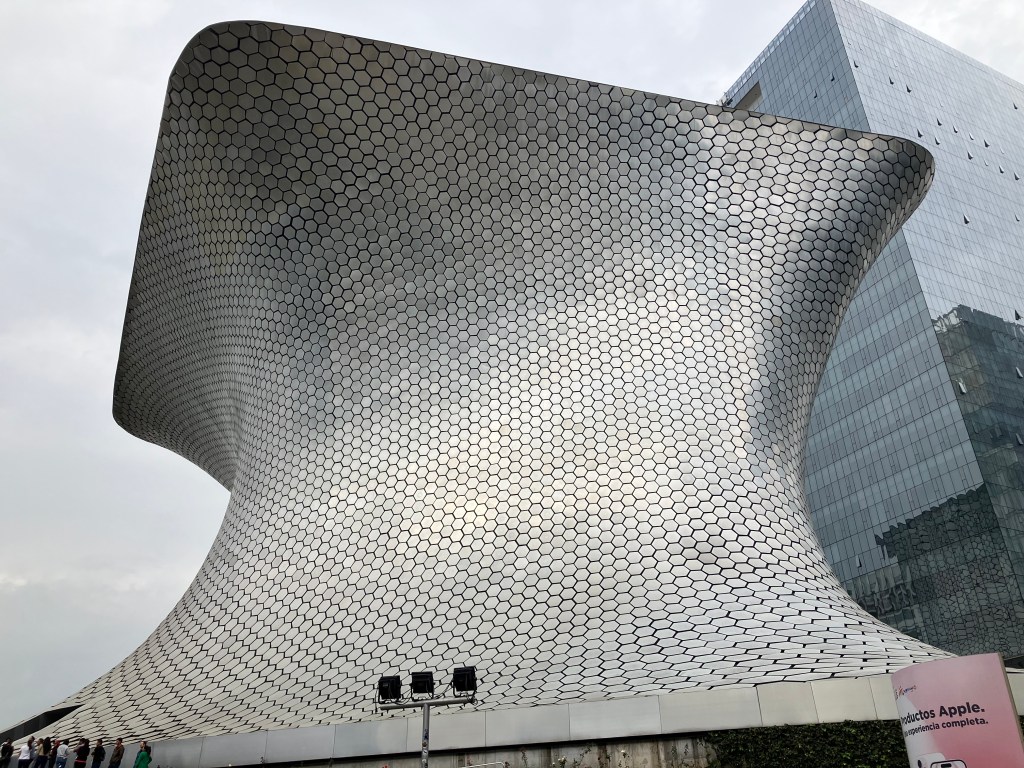
    Soumaya Museum, Polanco

    Soumaya Museum in Polanco. Buy art directly from artists at Jardin del Arte Sullivan on Sundays and San Angel Saturday Bazaar and Art Fair.

    Buying a painting at Jardin del Arte Sullivan

    Where to donate:

    Salvation Army has staff playing organ grinders throughout the city.
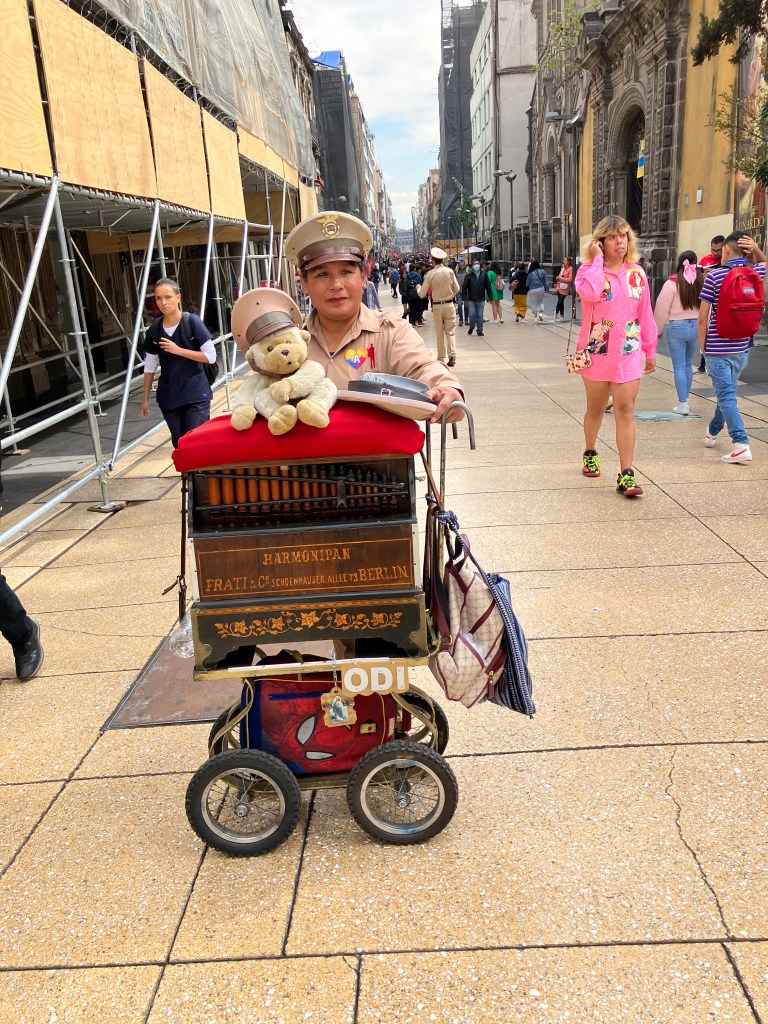
    Salvation Army organ grinder

    Published in Asian Journeys magazine, April-May 2024
  • Balancing Breathless Bangkok’s Ying with Yang: At the Anantara Siam Even the Fighting Fish are Relaxed

    Bangkok leaves you breathless. A pulsating, mega hive of frenetic activity, shopping is in malls wall to wall with branded goods and one of a kind items from one of the world’s most creative societies. Nightlife ranges from the pinnacle of high life in Sathorn and Thonglor — sky bars on rooftops to restaurants and clubs with sky high prices — to tawdry dens of iniquity that operate in dingy, neon lit alleys in Patpong and Soi Cowboy.

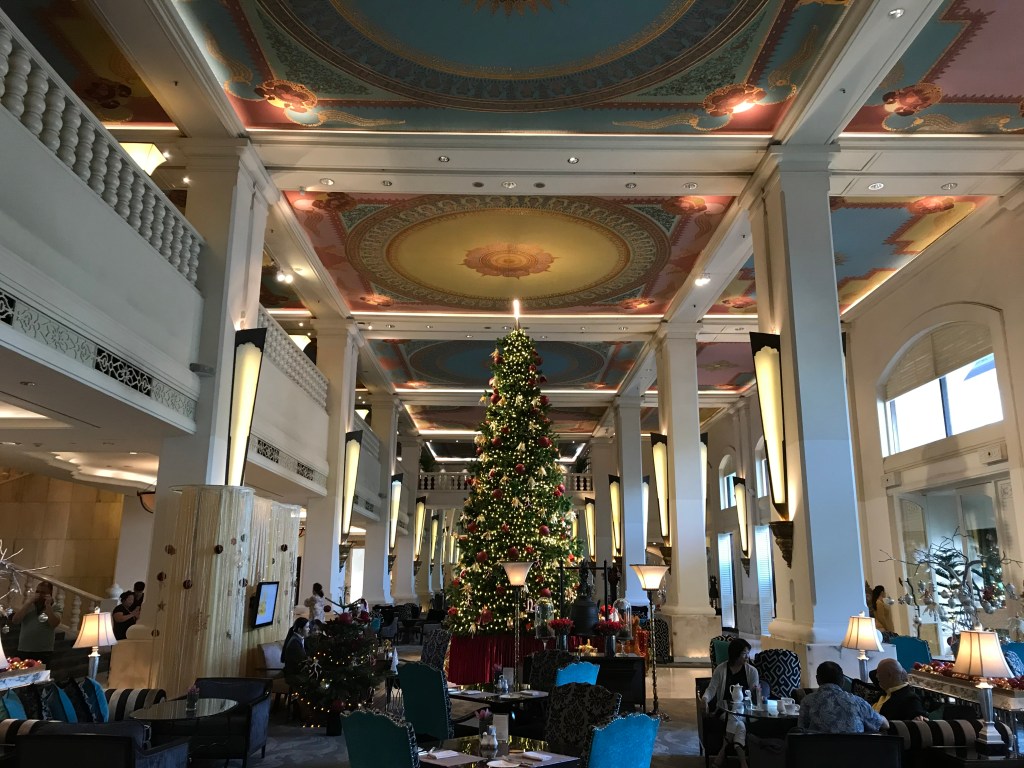
    All that activity can sometimes grate like a chainsaw tasting the bark of a tree before it’s cut down. Which is where Anantara Siam comes in. Just a few minutes’ walk from the Ratchprasong shopping district, it’s as tranquil as a posh private club in London. Its Thai design style from leading architect Dan Wongprasat gives you a sense of place and differentiates it from other hotels which have by the numbers luxury. More treat than retreat, you can take a breather here from this breathless city. From its palatial lobby, you view the soaring celling filled with mandala paintings from plush chairs you sink deeper and deeper into. The wall sized painting at the grand staircase’s landing by one of Thailand’s most famous painters, the late Arjarn Palboon Suwannakudt, is worth taking the stairs for to have a closer look. While he didn’t live to finish the work, his children, also artists, helped complete it as well the ceiling paintings in the lobby and mezzanine. It’s an enormous artistic achievement, 700 square meters of work.

    From “Well well” to wellness

    My wife and I had dinner at Anantara Siam’s Biscotti Restaurant, rated one of Bangkok’s best, according to Thailand Tatler and the Bangkok Restaurant Awards. It also received recognition from Michelin. I had a starter of creamy burrata cheese with tomatoes, ciabatta bread, basil dressing and shavings of truffles, while my wife had sea scallops, cream of buffalo mozzarella, cherry tomatoes confit and olives pate. Following our main courses of risotto black truffle with porcini, and grana Padano cheese and black ink angel hair pasta with king crab, prawns, and sundried tomato basil, we were stuffed. But we figured we would diet another day. Dessert was carmello spuma with layered dolce di latte foam, coffee granite, arabica crumbs and cocoa crackers and the Mascarpone Berry Salad with mixed berries, raspberry coulis, mascarpone cheese and pistachio sponge. The theatre of the dessert almost overwhelmed the taste. It was delivered to our table complete with trailing wisps of dry ice like something a sorcerer would prepare.

    “Well, well,” we thought. Not a meal we’d soon forget. Nor our scale. Just describing the meal was a mouthful.

    In the morning, we went from an indulgence ying to a wellness yang. We joined Anantara Siam’s new signature wellness program, “Morning Wellness at Siam.” It’s a program designed for travelers like my wife and I, who have come a long way, are a bit weary yet are eager to immerse ourselves in the culture of Bangkok. The program mirrors what for many Bangkokians, is an everyday routine.

     At 6am my wife and I were in the lobby providing alms to a monk on his early morning rounds. Anantara Siam is the only hotel in Bangkok which offers this unique local experience on a daily basis with staff who explain to guests how to appreciate and participate in this morning ritual. Our offerings were in pink and blue tiffin boxes. One box had curry, another an apple and Danish, a third fruits. Along with another hotel guest we did a Wai Pra, which is the appropriate way to bow to a monk to show respect. The chief concierge taught us: first, you place your palms together, then raise your hands in front of your face – your index finger tips must touch the hairline as your thumbs are placed between your eyebrows.  You need to bend the upper half of your body at an approximately 45-degree angle and bow for a couple of seconds before returning to your standing position. 

    Our alms, along with rice and bottles of water, were delivered direct to the temple the monk was from, Wat Pathum Wanaram Temple, between Siam Paragon and CentralWorld.

    From all twisted up to laid out flat

    The walk on Rajadamri Road to Lumpini park was a sensory feast, the crackling, chopping, cutting, dicing, slicing and munching of breakfast dishes being prepared and enjoyed at a food centre at the park’s edge. Like New York’s Central Park, Lumpini is the green, wellness lungs of the city with people trying to do right by their bodies. We passed a group doing tai chi to find our own spot at the lake’s edge. Two mats were laid down for us and a member of the hotel’s staff tried to teach us basic yoga. Our complete inability to execute the moves we were being taught certainly amused our instructor as well as a couple of monitor lizards who felt it was worth the climb from the water to have a stare at us.

    Once the yoga session was over it was our turn to feast. A huge, healthy spread was laid out for us on a picnic table overlooking the park’s lake. Cold pressed juices, prawns and salad with quinoa, cereal and milk — and handcrafted chocolates. Too much of a good thing, we simply couldn’t finish. It was a relief to have a tuk tuk carry us back to the hotel where we truly zoned out to a Chakra Crystal Balancing massage. In a room as chilled as they come our feet were bathed in a bowl of warm water. Like rare porcelain vases (which we’re far from being) we were gently lowered onto the massage tables, with our faces staring through to a bowl of petals floating in a water-filled brass urn. The masseuses surrounded us with rose quartz for our hearts, amethyst for our minds, tiger’s eye for harmonizing energy, and lapis lazuli for our throats. The throat is, apparently, a centre for spiritual energy. I’m not sure about the science of being surrounded by all of those stones but we were definitely beyond relaxed when it was over. And supposedly detoxed too. No small feat for a person like myself.

    In a single morning, we went from being spiritually centred to being all twisted up like pasta to being laid out flat on our stomachs then backs. We were knocked out — and Muay Thai star Tony Jaa wasn’t anywhere near us.

    Creativity flows by the river

    Energized, we continued our pursuit of Bangkok’s ying by visiting the Creative District.  It runs from Saphan Taksin BTS station along the Chao Phraya river to Chinatown. If you can handle the heat and humidity, it’s a great way to explore on foot what was once Bangkok’s commercial heart.

    The concierge at the Oriental Hotel gave us a map to the district. At the first stop, Assumption Cathedral, a Filipino priest was giving a Sunday sermon. Next to it, abutting the river, was the dilapidated East Asiatic headquarters building from the late 19th century. After strolling by the antique stores and boutiques of the plush OP Place past the modernist French embassy, we explored down a narrow alley to see the old Haroon Mosque with a silent green garden behind it. The pulsing intensity of Bangkok was an alternative universe, light years away.

    Bangkok meets Miami

    A little further on, down another narrow alley, we saw the 19th century Customs House, a once grand building now in disrepair overlooking the river. We walked past the imposing Grand Central Postal building. Built in art deco style in 1940 it had huge pinkish Garudas garlanded with yellow flowers at the top of the central facade. Legend has it that when the Allies bombed Bangkok in World War II, they took flight to protect the building. Soon we were at the Thai Artists Wall. The huge murals reminded me of Miami’s trendy Wynwood district, both in terms of the art and the galleries and cafes nearby. Warehouse 30 was a collection of local fashion boutiques, a café and a restaurant occupying World War II-era military storage buildings. It was founded a little over a year ago by Duangrit Bunnag, one of Thailand’s most famous architects. Given the heat and humidity it was an ideal place to press the pause button on our stroll and have a couple of glasses of ice coffee. My wife bought slippers there from the brand called Other Leathers.

    Bangkok meets George Town meets Mad Max

    After Warehouse 30, we entered Talad Noi, a neighborhood whose architecture reminded me of George Town in Malaysia, where Pernankan meets European – but this time in a Thai setting. We stopped to see the towering spire of the cream-coloured Kalawar Church, completed during King Rama V’s reign. Down a zigzag of alleys we found Sol Heng Tai, a 200-year old Hokkien-Teochew mansion near the Chao Phraya, which serves drinks in a decidedly quirky environment. complete with a swimming pool that no one was using. Apparently, it is used for a scuba diving school. The 7th and 8th generations of the Posayajinda family still live here.

    We passed banyan spirit trees which sometimes had images of former Thai kings hanging from them, other times were festooned with multi-coloured ribbons. Shop after shop had immense piles of auto parts in front of them, making the area look like both a hoarders’ paradise and a back lot for a Mad Max movie.

    Soon we were in Chinatown, where the throbbing mania of the megalopolis returned, like a feverish dream. We chilled – literally – over a coffee and dessert at Chata Speciality Coffee, a café with creatively named brews and dainty cakes to complement them.

    The Siamese Fighting Fish aren’t in a Fighting Mood

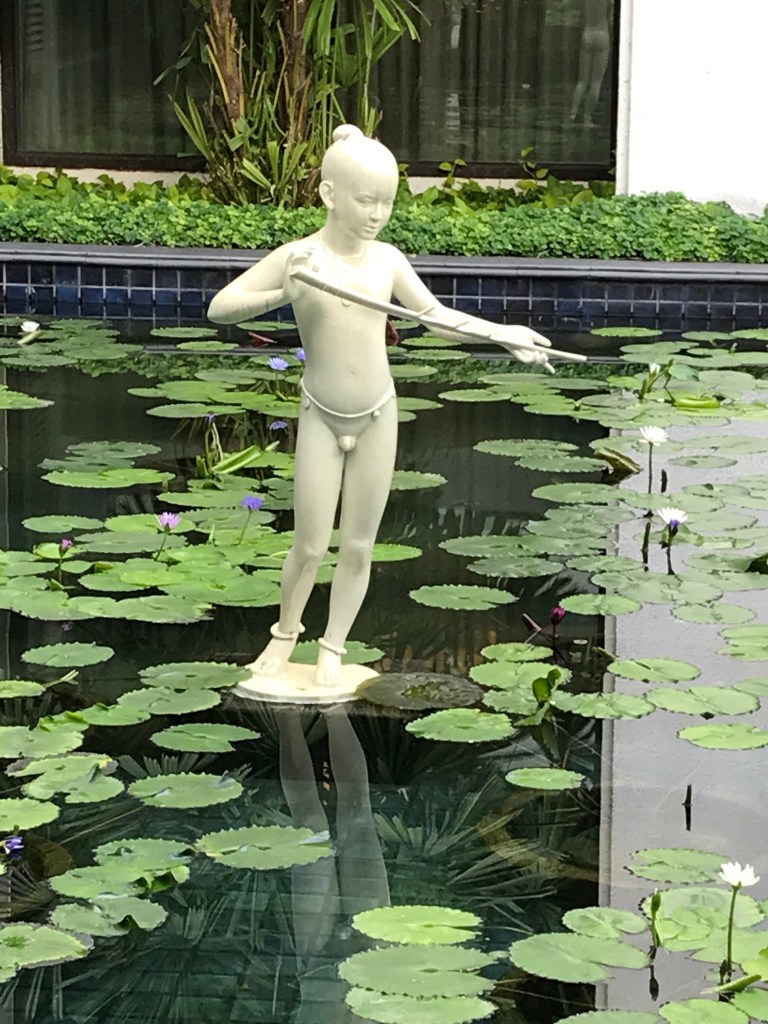
    In front of the Anantara Siam is a statue of a water sprite blowing a conch shell atop water lilies – a harmonious greeting for our return. Our room overlooked the Royal Bangkok Sports Club. two panes of glass giving us the view without the street noise. On the desk, a Siamese Fighting Fish was swimming alone in a fishbowl without a care in the world. One of the world’s most aggressive species — agitation so much a part of its DNA that it immediately fights when it sees another fish — it was utterly at peace. The Anantara Siam was so tranquil even the Siamese Fighting fish doesn’t feel like fighting anymore. Now that’s the right kind of ying to balance Bangkok’s breathless yang.

    Anantara Siam Hotel address:

    155 Rajadamri Road

    Bangkok 10330 Thailand

    http://www.anantara.com

    Published in Asian Journeys magazine, August-September 2018

  • If You Have One Night in Bangkok

    Since my first visit to Bangkok in 1981, I’ve been back dozens of times. For a few years I even commuted to a job that was based here. I’ve seen the city transform again and again from a seedy backwater with a “reputation” to a glittering, glamorous metropolis with some gritty corners.  But there’s one label that no one has ever put on Bangkok and that is boring.

    So imagine the challenge I set for myself on my last trip: if I only had one night in the city what would I do?

    For inspiration I used the lyrics from the Murray Head song, One Night in Bangkok:

    One night in Bangkok makes a hard man humble

    Not much between despair and ecstasy

    One night in Bangkok and the tough guys tumble

    Can’t be too careful with your company

    I can feel the Devil walking next to me

    With those alarmist lyrics I decided I needed a really good meal to fuel the long evening ahead.

    SPOILED BY BANGKOK’S BEST STEAKHOUSE

    For fortification I started with a perfectly executed Citrus Martini, shaken not stirred, at the lushly appointed “Manhattan Lounge” at the JW Marriott Hotel. I followed this with dinner at the “New York Steakhouse” next door, consistently rated as Bangkok’s best. That’s a tough accolade to get year after year in a food-centered city like this. I couldn’t help but compare the experience here with a famous steakhouse in Palm Springs, California earlier this year where a grumpy, BMI-challenged waiter gave my family and I a Tomahawk-steak on a large platter where we all tucked in forks and sharp knives at the ready. The “New York Steakhouse’s” version of the Tomahawk-steak was altogether a different, much more elevated experience.  When the waitresses with model-like looks and killer smiles draped the elegantly cut slices of meat on the Tomahawk bone I knew it was going to be tough to dine at an American steakhouse again. I’ve now been spoiled.

    ASIA’S MOST HAPPENING STREET

    Properly nourished, I headed out with a friend to explore nearby Soi 11, in my opinion Asia’s most happening street.  When you think of nightlife areas in Asia, Hong Kong’s raucous Lan Kwai Fong springs to mind, or its more trendy, edgier sister Soho, or the upscale Xintiandi district in Shanghai or Singapore’s tony Club Street or Seoul’s fashionista Gangham district. But whereas those other nightlife areas

    give you a non-representative slice of those cities’ lives, on Soi 11 you feel the entire human spectrum and kinetic energy of the city, Bangkok on full display and in your face.

    Soi 11 is where I was going to spend my one night in Bangkok.

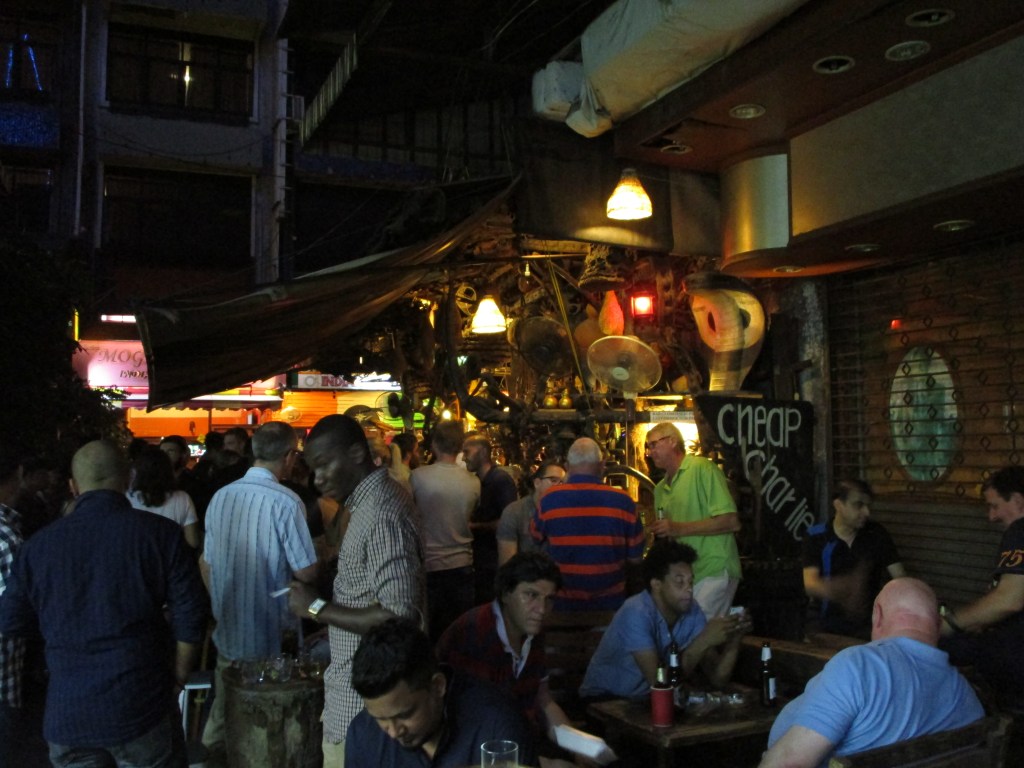
    Our journey up and down and from ground-level to high above the Soi was a both a trek across broken sidewalk pavements and a peek into the aspirations of the people there that make the Soi a place of unyielding buzz. From “Cheap Charlie’s” with its outside pavement seating and a reputation for the cheapest beers in Bangkok to “Above 11” for a contemplative view of the city that looks a lot tamer 33 floors up, away from the stumbling crowds and the cruising pink and yellow and green taxis that always seem to barely miss hitting someone. The skyline’s supercharged sparkle was borderline surreal. Emerald City on steroids.

    PEOPLE-WATCHING PERCH

    We found a central perch at “Oskar’s”, which gave us a panorama view of the Soi in action. With a counter seat, you can see the denizens of the street marching purposely towards a destination or lurching from one bar to the next. Usually packed after 9pm, it becomes the Soi’s defacto people watching fulcrum: inside the bar everyone is rubbing elbows with everyone else, in a hurry to meet or make friends. It is not a place for a solitary drink. Or soulful chats for that matter. Meaningful encounters just isn’t on the menu in this place.

    Having a tough time hearing each other, my friend and I made our way to the quieter “Wolff’s”, owned by former private investigator Malcolm Schaverien who writes thriller novels under the pseudonym of Harlan Wolff. Mr. Schaverien provided a bit of oral history of the Soi and its rise up Bangkok’s neon rankings: “Soi 11 became the local…nightspot when Q Bar first offered the option of trendy nightlife for those living on Sukhumvit. Before that we had pubs, gogo bars, cocktail lounges, restaurants and hotel bars – that was about it. So we would mostly make the trek to Silom or Siam Square for nightlife. After Q Bar came Bed Supper Club and others making Soi 11 a ‘trendy’ destination.”

    Sadly, both Bed Supper Club and Q Bar are now closed. A hotel is now being built where Bed Supper Club was. Q Bar is being transformed in a new venue called The District. The Soi’s reinvention continues.

    When I asked Mr. Schaverien why he created “Wolff’s” he said: “I was nostalgic for the classic bar I remember from my early days. The sort of place where people meet and talk over cocktails or a glass of wine. I couldn’t find one in my area so I built one with bricks and a copper top bar.”

    A few steps away we visited Brew, for a stylish beer-focused experience. Owner Chris Foo said the bar was “based on a space under a Trappist…Monastery in the mountains where monks produced beer. The water coming down the mountain would

    be collected and used to make the Trappist Beers and then they would store the beer

    in oak casks for fermentation.” With “the largest selection of beers and ciders in Asia,” Mr. Foo’s aims to make his bar a destination for beer-lovers. The menu was amazingly long. I could imagine drinking a different beer there almost every day of the year. Not a bad goal to set yourself.

    MUSIC YOU DON’T USUALLY GET ELSEWHERE

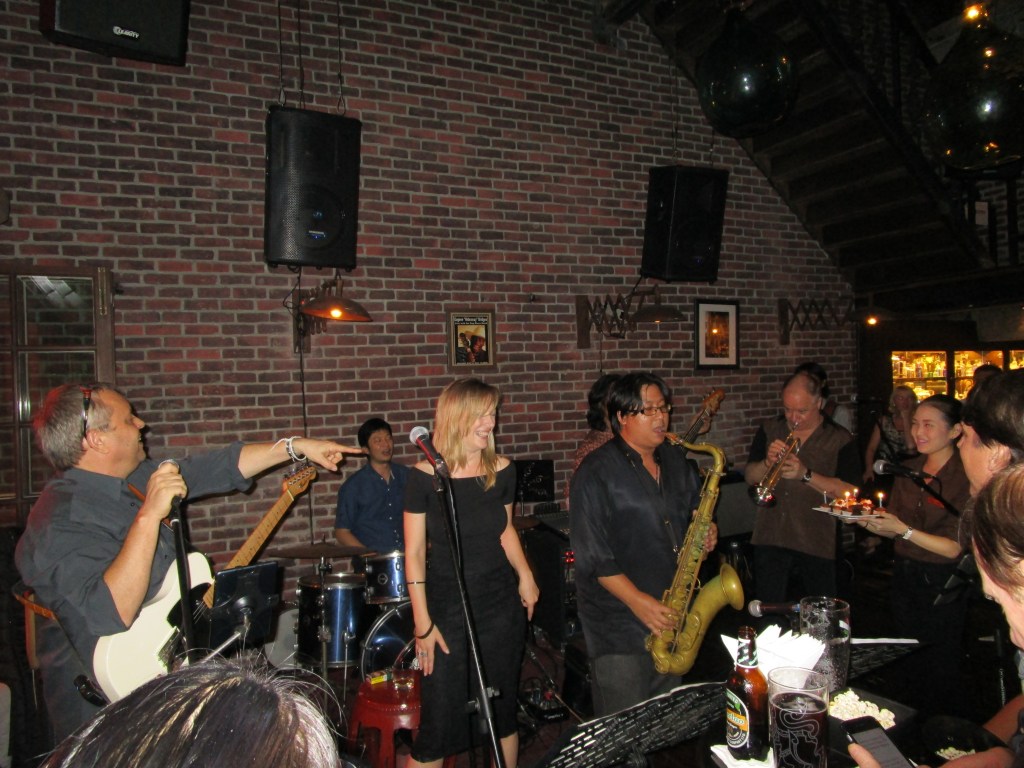
    At some point in any long evening music is as good a reason as any other to visit a bar. And Soi 11 is one of the best destinations in Bangkok for the more unusual types of music. At “Apotheka”, blues is played every evening except Sunday, when it’s jazz. With its dark wood interior the bar could be in Chicago or New York, only it isn’t. It’s completely open in the tropical heat and we briefly lingered on the sidewalk before being sucked into the bar for a better view of the band leader playing the trombone with aplomb while coaxing his fellow musicians. Munching on popcorn while sipping a craft beer was a great way to pass the time.

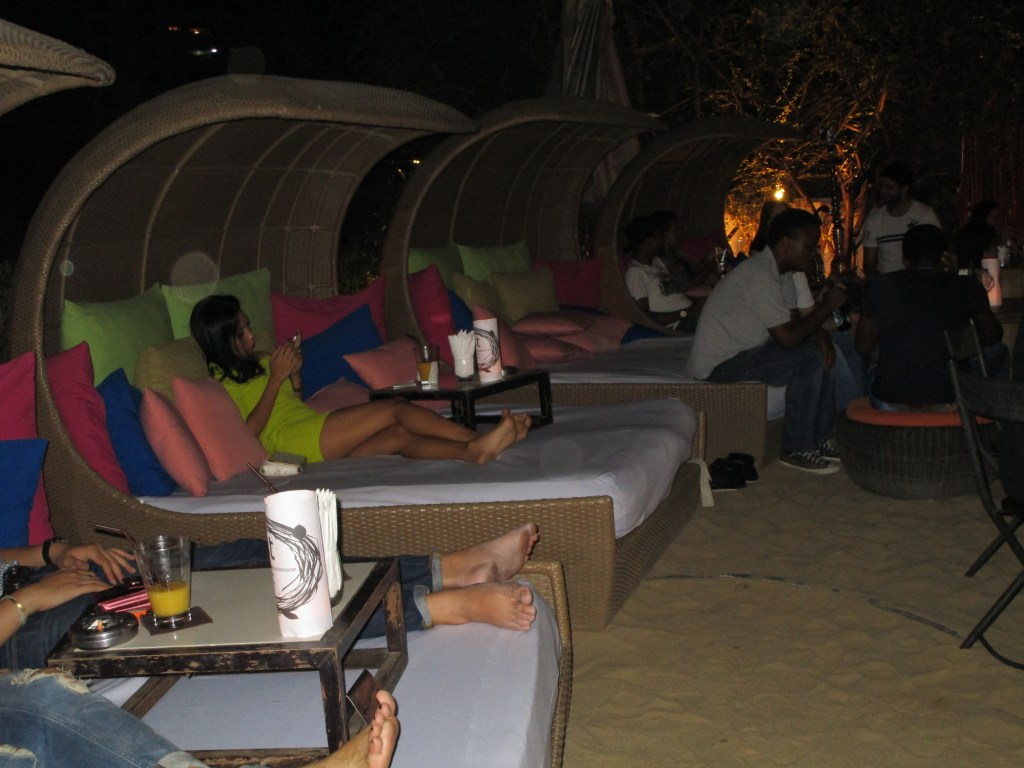
    Above “Apotheka” is yet another refuge from the Soi, “Nest”, where we sought temporary solace. With plants and alcoves and a floor covered in sand in places to reinforce the you’re-in-the-tropics feel, a guitarist provided the music to make it a chill place to hang.

    SINGLE-DIGIT TIME

    There comes a point in any evening where the drinks start to hit the double-digit point and the hour hand single digits. That’s when noisier, more primal venues hold greater appeal. “Levels”, on the 9th floor of the Aloft Hotel, fit that bill. It too had a view, of Soi 11 as it marched through the chaotic tide of humanity to not-so-distant Sukhumvit. With a more aggressive but more snappily dressed crowd, it was an ideal place to see the Soi from a different vantage point. It has a gigantic curving bar with a colossal sparkling chandelier above it, like a fountain of descending glass that never quite splashes down.

    After a drink there I too started my transformation into one of the lurching zombies of the late night Soi. Not quite an extra from the movie World War Z but in a few more hours I might have passed for one. I walked past brightly-lit drink and food carts that lined the streets selling pad thai, seafood of all kinds packed in ice, stacks of coconuts. There was even a shiny yellow van with seats out front called Taco Taxi. I thought of some more lyrics from Murray Head’s song:

    “One night in Bangkok and the world’s your oyster.

    The bars are temples but the pearls ain’t free.”

    ONE NIGHT ISN’T ENOUGH

    The Soi has startling variety of venues: from an Indian nightclub called “Daawat” in the Ambassador Hotel, to a German bar called “Old German Beerhouse”, from an Italian pizzeria called “Limoncello” to a bar called “The Alchemist” tucked away on an alcove just off the main Soi, to a wine bar called “Zaks” to a Thai restaurant, “Suk 11”, set in a traditional wooden building. That doesn’t begin to describe the diversity of choices on the Soi. One night in Bangkok isn’t enough to explore this street.

    I landed with a delightful thud in a basement after hours club named “Climax.” Given the way I was feeling, the long night clearly tugging on me, it certainly wasn’t the climax of my evening but with a glazed view of the revelers it seemed to have lived up to its name for some people.

    No night in Bangkok is complete unless you have a place to R & R (rest and recover) afterwards. The nearby JW Marriott certainly provided that for me. In the morning, I sweated out the previous evening’s indulgences with a lengthy session in the steambath and sauna at the hotel’s state-of-the-art spa. With a swim afterwards I was practically as good as new.

    Relaxing on a lounge chair by the soothing aquamarine pool, I considered with a clear head the challenge I had set for myself. What was I thinking? Who wants to spend just one night in Bangkok?

    Published in Asian Journeys magazine, December 2015-January 2016

  • Dine at SEEN and Be Seen at SIN

    Dine at SEEN and Be Seen at SIN

    Avani+ Riverside Bangkok Hotel’s elevated dining, drinking, and views defined my stay there  

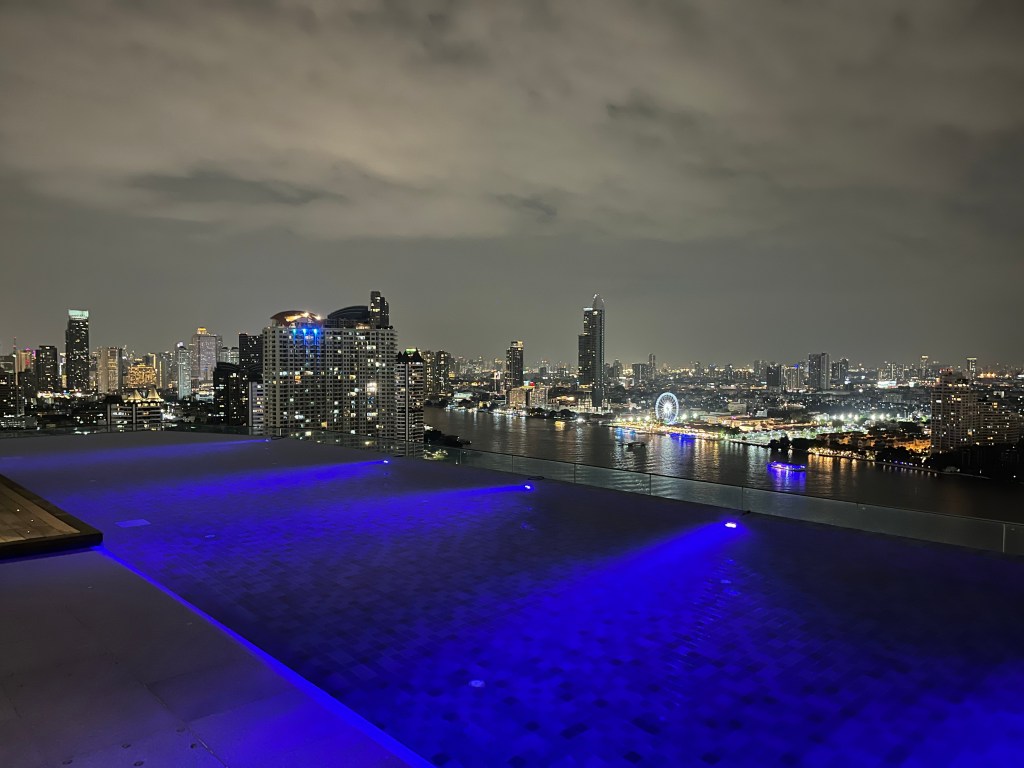
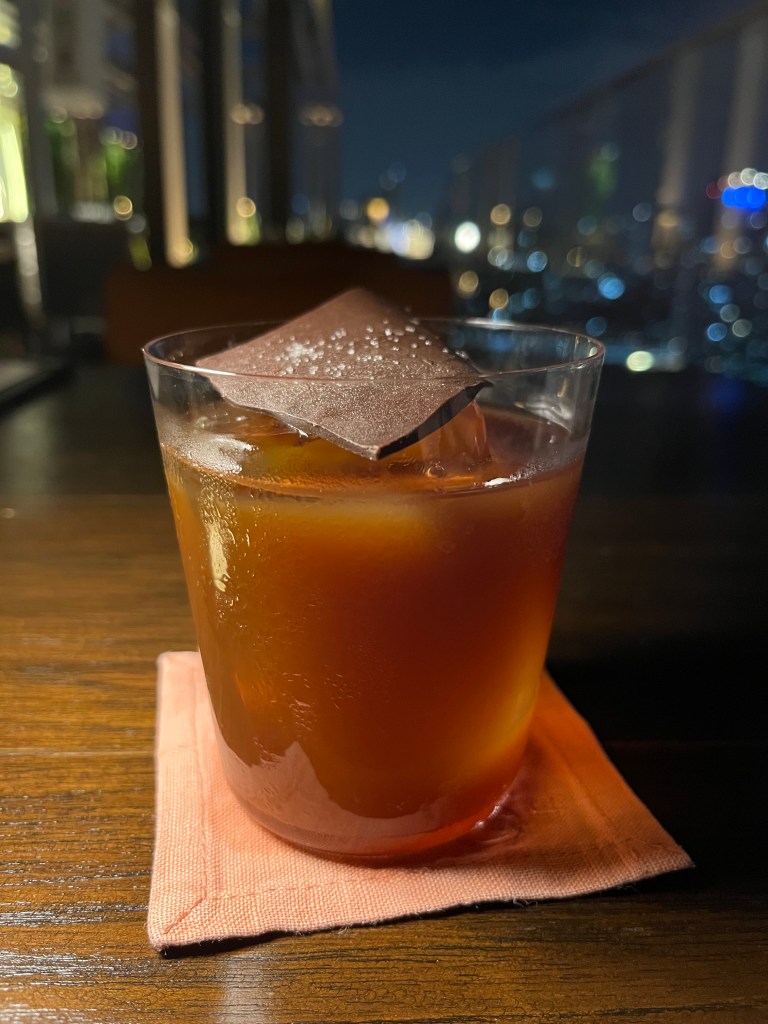
    My dinner at SEEN started with the appropriately named cocktail, Shaman. More magical portion than a cocktail, it mixed Remy Martin 1738, Michter’s US 1 Kentucky Straight Rye, Cinzano Rosso, Cacao, Cynar, Sandalwood, and tobacco. I sipped it while drinking in the view of the Chao Praya River and Bangkok’s jewel-like nighttime skyline.

    Necklace of lights visible from SEEN

    Bangkok is known for its street-level delights: from Chinatown food stalls to shops and shopping malls that invite you to step in from the sweltering heat of the sidewalks to the cooling comfort of air-conditioned retail therapy.

    The Avani+ Riverside Bangkok Hotel, though, defines itself with its views of Bangkok’s nighttime necklace of lights. My 26th-floor meal was an aerial tour of uplifting South American and Asian cuisine by star chef Oliver da Costa. The SEEN group of restaurants started in Sao Paulo, followed by outposts in Lisbon, Rome, and Nice, and now Bangkok and Koh Samui.

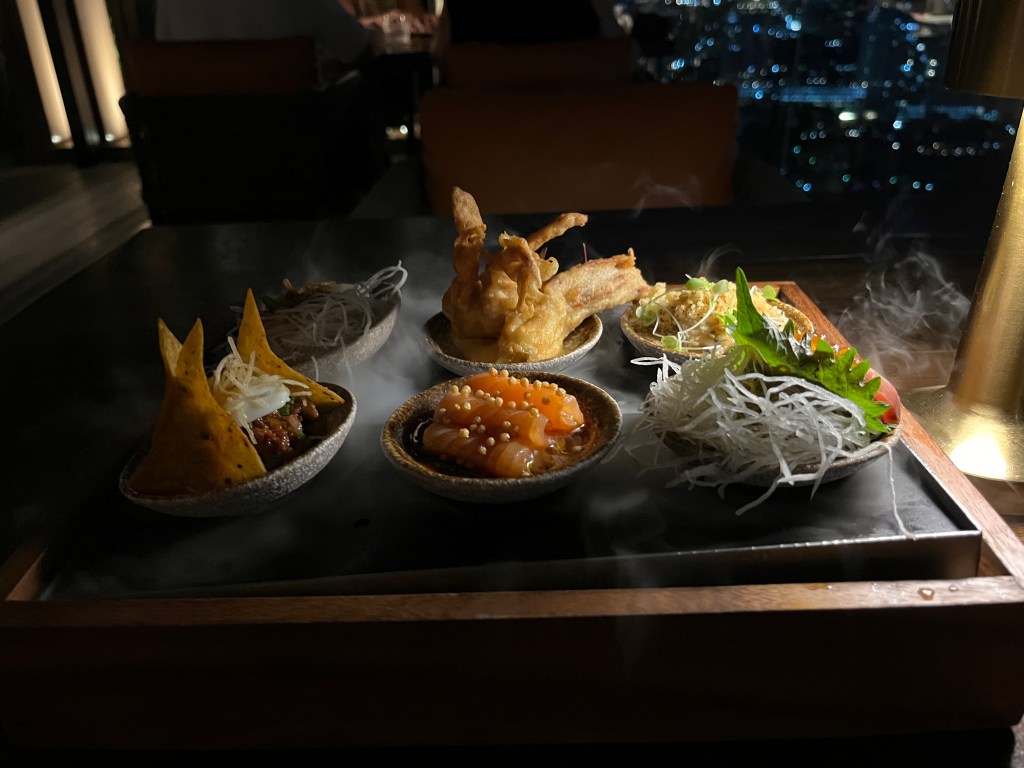
    My meal landed on my palate with a delectable wagyu beef carpaccio with arugula, pesto sauce, and pecorino. Bewitching mussels in a spicy bisque sauce, with scallions and a lemon wedge, followed. I took a well-needed breather before being served the Japanese Mystery Box with dry ice providing a veil of mist that gradually revealed its treasures, from salmon sashimi to tempura to Hamachi with fish eggs. The dishes were so layered and nuanced that I found myself pulled from the view of the river to the equally compelling view of the food I was eating. I finished with chocolate caviar: Belgian chocolate mousse, cherry compote, and chocolate crunchy with hazelnut ice cream.

    To recover, I sauntered over to the infinity pool with the infinite view of the city. The pool’s startling sapphire blue colour jumped from the water to my consciousness. Yes, that Shaman cocktail was well into my bloodstream by now.

    Found Lost & Found

    Too young a night to retreat to my room, I sauntered over to the Lost & Found Club. Located on the third floor of the next-door Riverside Plaza, it’s also part of the Avani +.

    Designed by Australian Ashley Sutton, who created Bangkok’s atmospheric Iron Fairies in Sukhumvit and Maggie Choo’s in Silom, Lost & Found looks like a decrepit spaceship from a high-concept sci-fi movie. Think of the spacecraft in Aliens. High-energy drag performers ignited the club’s vibe.

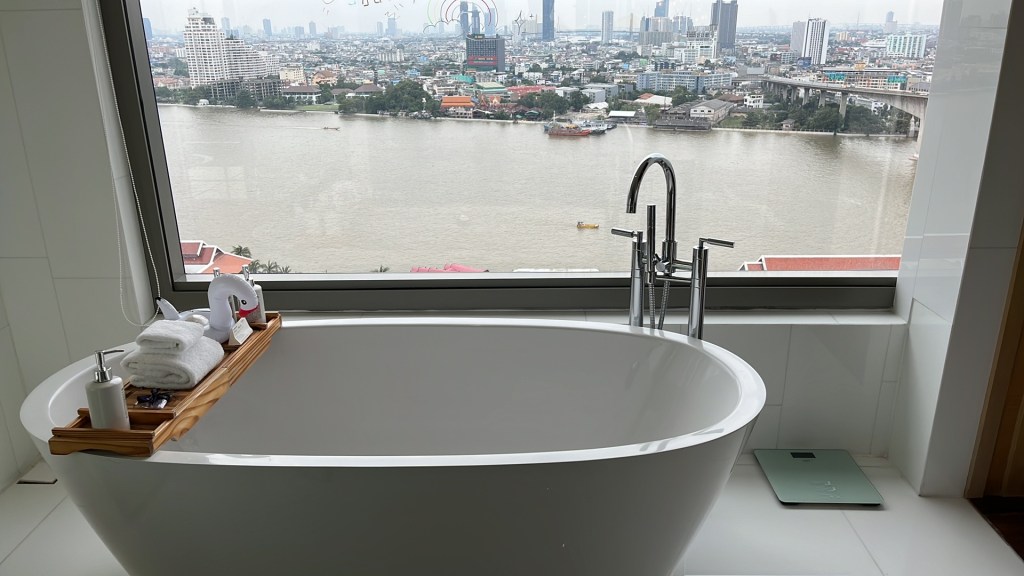
    I retreated at last to my riverside suite with a panoramic, almost IMAX-like view of the Chao Praya River. Even the bathtub has a view and the hotel-provided bath bomb was a bomb along with the MALIN+GOETZ toiletries. A good soaking sent me off on a long, deep sleep.

    Memorable AM to PM meals

    Breakfast at Avani+’s Skyline restaurant is a mixture of dishes that are good for you and those that aren’t. To recover from the night before, I started with a healthy avocado toast with a revitalizing shot of orange, carrot, and ginger juice. But that soon gave way to Thai noodles. And who can resist coconut ice cream in the morning? I couldn’t. And didn’t.

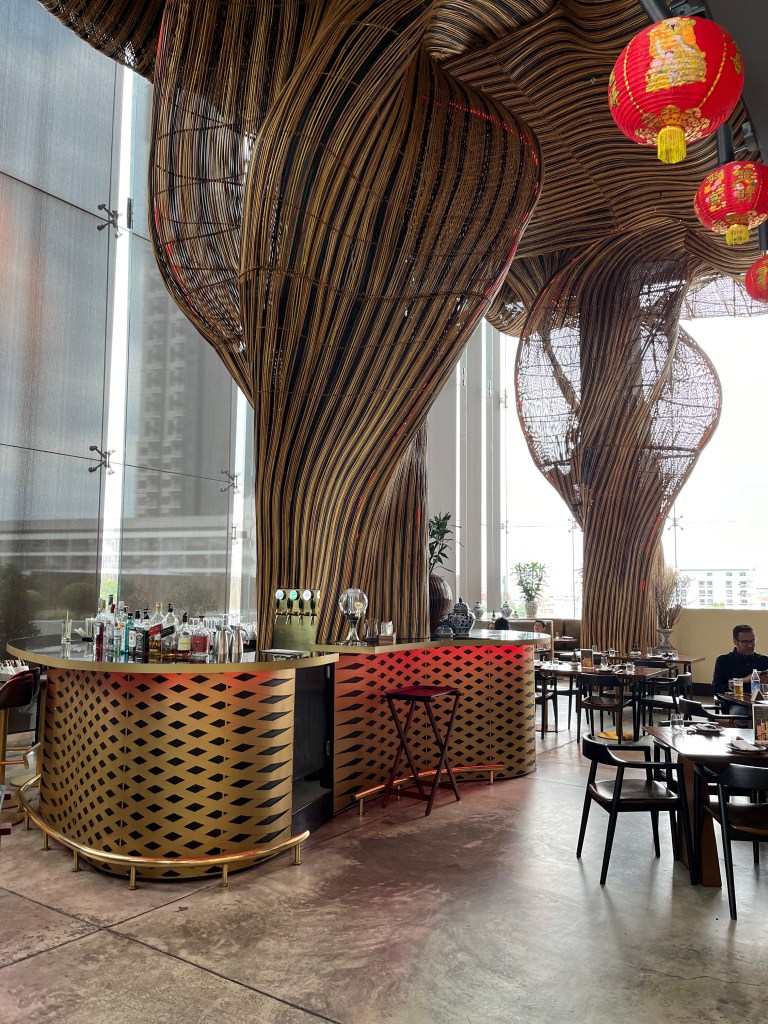
    For lunch, I dined at the Spice & Barley restaurant. Avani+’s Chinese restaurant was awarded best-designed restaurant in the brasserie category at the LIV Design Hospitality Awards. The Patrick Keane and Enter Projects Asia space uses swirling floor-to-ceiling rattan sculptures, a giant mural of an imperial concubine, and a gold-tinted color scheme to communicate a luxurious visual embrace. My chicken clay pot lived up to the high expectations of the setting.

    After lunch, I had a pastry pick-up at The Pantry. The tarty lemon tart with coffee in the light, airy space was a chilled way to spend part of an afternoon and gather steam for what promised to be a long evening ahead.

    On Bangkok’s Thon Buri side

    The Avani+ Riverside Bangkok Hotel is located on the Thon Buri side of the Chao Praya River. Getting to the main part of Bangkok is easy: an hourly ferry runs from the next-door Anantara Riverside Hotel to the Saphan Taksin Skytrain station, where all of the city is accessible. On the Thon Buri side is the ICONSIAM mall — massive with literally all you could ever want. There’s also Wat Arun, the Royal Barges National Museum, and the Thonburi Canals that give a glimpse into an all-but-vanished traditional Bangkok life.

    Experiencing SIN was sublime

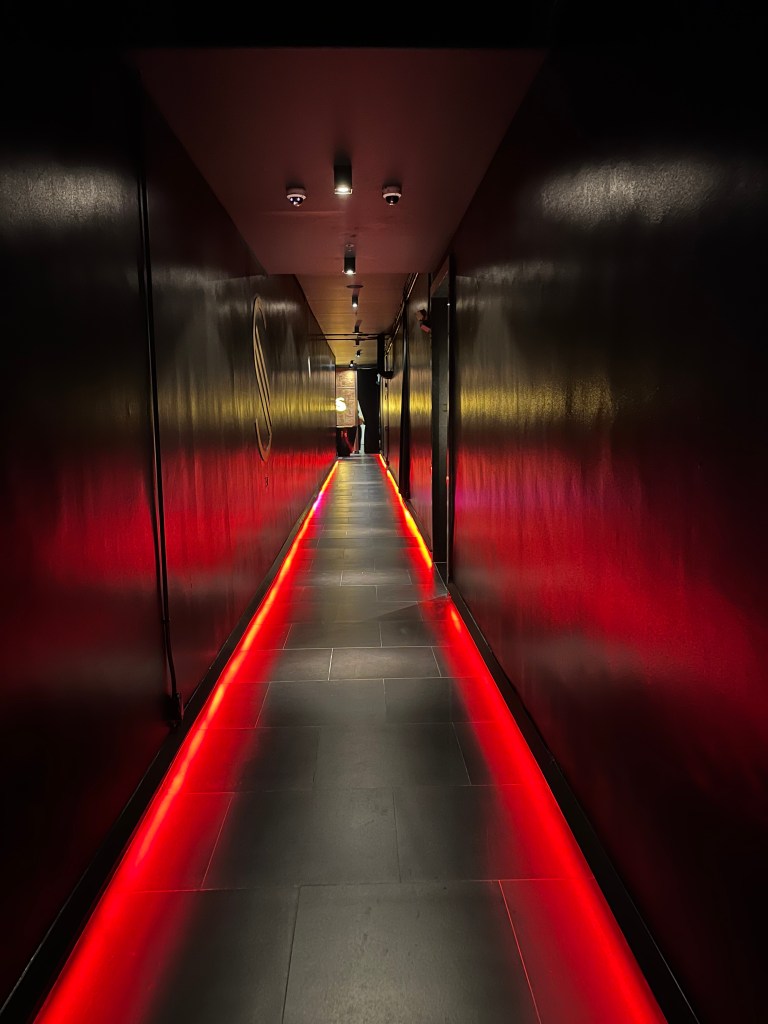
    In the evening, I strolled down a long, narrow corridor flanked by ribbons of red light to be greeted by a hostess who escorted me into the theatrically expansive 27th-floor rooftop bar and club, SIN. The effect of emerging from the narrow corridor into the outdoor area gave me a sense of “Wow.” I found out later that was the design intention. As someone who loves Frank Lloyd Wright’s architecture, it’s a technique he frequently used in the homes he designed. I may have dined at SEEN the evening before, but now it was time to experience SIN.

    With a table overlooking the river but not far from the bar, I was able to savor the view and experience the bar. For a kick-off, I had the Forbidden Nectar cocktail: Michter’s Kentucky Straight Bourbon, miso, caramel yogurt, carrot, and creamy bourbon. The drink was so complicated I imagined that the mixologist needed a chemistry degree to make it. With a cocktail that sublime I didn’t need rose-colored glasses to see the world in a more optimistic light.

    Sinfully good dishes at SIN

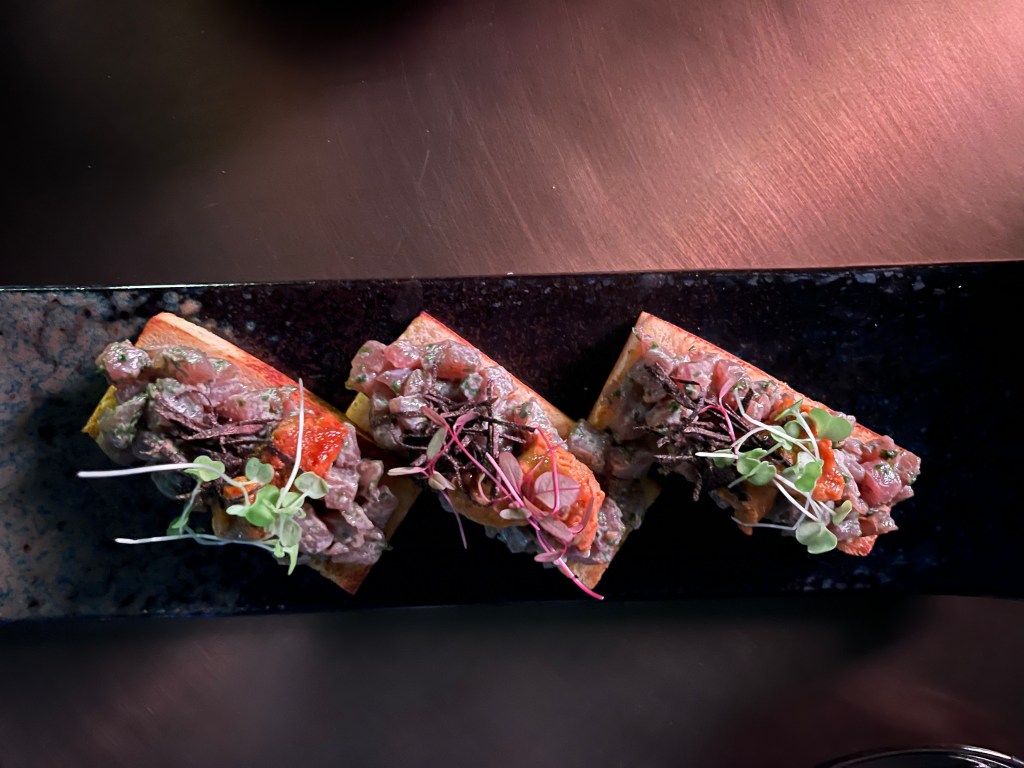
    My dishes soon followed. The starter piqued my tastebuds: scallop crudo with yuzu vinaigrette, yuzu gel, coriander oil, and Kaluga caviar. Following that was a more substantial open-faced sandwich — bluefin tuna, smoked tuna, fresh summer truffle mayonnaise, shaved truffle, and Uni from Hokkaido on a crispy brioche. Just one more dish to round out the meal: wagyu Miyazaki beef A5 grade, bulldog sauce, and a sprinkling of Kaluga caviar on a brioche. No exaggeration: the best food I’ve had in a bar ever. It’s not only the view that is stellar at SIN.

    SIN’s atmosphere is somewhat otherworldly. Overlooking the elliptical-shaped bar and expansive terrace in an immense oval-shaped alcove with a giant golden “S,” a headphone-wearing DJ in a sleeveless purple gown presided over the eclectic, pulsating music and stylish crowd like a Mount Olympus goddess.

    Sip to savor cocktails at SIN

    Which brought me to my evening’s second cocktail. Given the bar’s name, the Midnight Sin was that moment’s go-to cocktail: Remy Martin 1738, Jameson Black Barrel, cacao nibs, cacao husk, coconut cold brew, PX. I like to sip to savor my cocktails, and this was a drink that I hoped would never end.

    Bangkok is a hot and humid city. But at that hour and that elevation, I was cooling down fast. A few sips from a cocktail at SIN and Bangkok is transformed into a serendipitous and serene place. A cocktail bar doesn’t get better than that. And neither does a hotel stay like the one I had at Avani+ Riverside Bangkok Hotel.

    Published in February/March issue of Asian Journeys magazine