“In Xanadu, did Kublai Khan
A stately pleasure-dome decree:
Where Alph, the sacred river, ran
Through caverns measureless to man
Down to a sunless sea
So twice five miles of fertile ground
With walls and towers girdled round:
And there were gardens bright with sinuous rills,
Where blossomed many an incensed-bearing tree;
And here were forests ancient as the hills,
Enfolding sunny spots of greenery.”
When Samuel Taylor Coleridge envisioned Kublai Khan’s palace in Xanadu he imagined a place of over-the-top luxury, of unimaginable wealth. We’ll probably never know if Prince Jefri, the Sultan of Brunei’s wayward younger brother, had this poem in mind when he dreamt up, then built the Empire Hotel and Country Club through the Amadeo Development Corporation. But he could have.
Or maybe he was thinking of that Kevin Costner hit film, “Field of Dreams,” where Mr. Costner’s Iowa farmer character heard voices that said, “Build it and they will come.” In the film, ghosts from baseball’s past such as Shoeless Joe Jackson do come – to play baseball on the field the obsessed hero built against all odds.
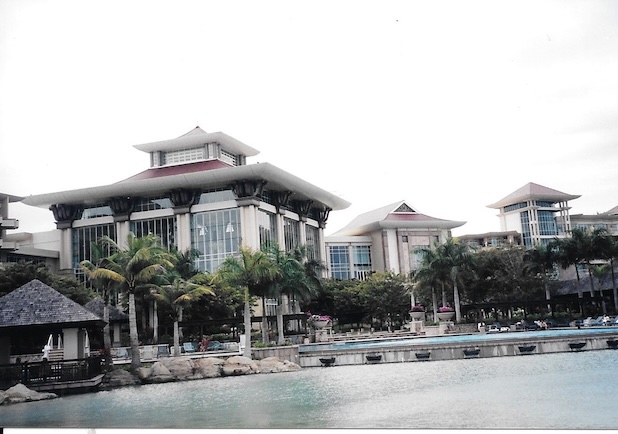
In Prince Jefri’s case, he has built his Xanadu but almost no one has come, giving the hotel a ghostly silence. Though maybe they should, as the Empire Hotel is a place of almost unparalleled splendor on the sunny north coast of Borneo. Imagine a hotel that combines the immensity of the huge Hawaiian resorts with the Arabic touches of the Omani and Dubai beach hotels with the luxury of posh London establishments with the wacky fantasy touches – and emptiness – of Hearst Castle.
The domed lobby of Brunei’s Empire Hotel is supported by six-story-high Italian marble pillars crowned by Corinthian flourishes and trimmed with gold leaf. And that’s not gold-colored paint: that’s real gold. The gold leaf is used generously around the edges of the lobby’s walls as well as the ceilings, giving the whole massive open space a glittering look when the sun hits. In the lobby are generous displays of Baccarat crystal, including a crystal camel with a solid gold saddle. Not to mention the enormous crystal chandelier that hangs over the front entrance.
The marble floors are inlaid with bright decorations of tropical flora. And there’s a huge mural of one of the sultan’s ancestors welcoming British ships of war at an earlier palace that was far less imposing than the hotel. Just so the vastness of the lobby – and not the empty retail area nearby – doesn’t overcome you, there are a couple of Fazioli player pianos endlessly tinkling out lonely tunes.
The walk to the rooms is no less imposing, through bouncy thick-carpeted hallways surrounded by a forest of Italian marble pillars. The décor inside the rooms is lavish, with furniture and linen by Meritalia and prints of ancient maps of Borneo in gilded frames. The china and silverware in the guestrooms is all Asprey – as they are throughout the hotel. The bathroom is the size of a typical Hong Kong apartment, with toiletries from Molton Brown. (If you take a suite or villa you get Bulgari.) The plushness of the room might remind you of somewhere in Europe except when you open the drapes to see a huge balcony and further off the crashing waves of the South China Sea.
To relax you have choices fit for, well, a prince – or a sultan. To get to the clubhouse you ride a golf cart that the staff called a “buggy” past an on-site waterfall and a lake. There’s an eight-lane bowling alley with stylish, aqua-colored furniture – no hard plastic chairs like nearly every bowling alley on earth. My family and I were the only ones playing with a staff of four to cater to our every need. At the club there are two badminton courts. And two squash courts. And a two-story pool and snooker hall. But one thing is missing: players.
In case racket and stick sports aren’t your game, there’s a golf course and clubhouse with day and night golfing. And tennis. And a Jacuzzi and sauna. And row after row of unused polished wooden lockers in the men’s room, each one containing a fresh, folded terrycloth bathrobe, towel, razor, comb and toothbrush. And even though it is in the tropics, there is a heated indoor swimming pool with lanes on the bottom of the pool covered in gold tiles. Again, that’s real gold. When I used the pool and sauna I was the only one doing so. I never saw anyone using the rest of the facilities either. Friendly staff just hung around, waiting for someone, anyone, to show up and give them something to do.
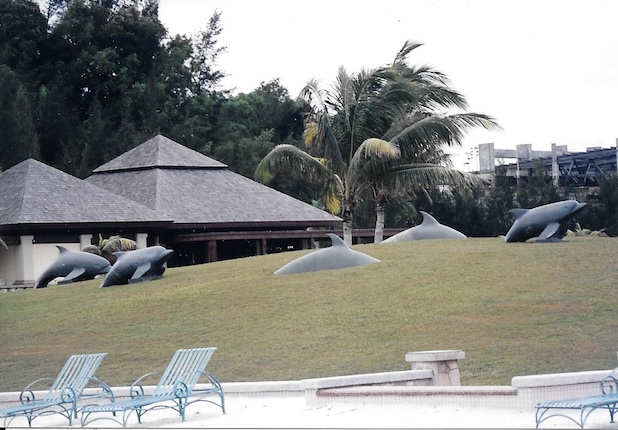
There are also the outdoor pools, four of them. The freeform one is the size of a lake with flooring covered in sand to give it that beach feel. There is also a school of stone sculpture dolphins swimming up a grassy hill towards the sea on the other side. My children loved those. They also loved the freeform pool – especially since we were usually the only ones using it.
At the Arabic-Mediterranean restaurant called “Falafel,” you can admire the world’s only titanium cutlery and dinnerware collection. The prince had it especially designed in the U.S. and produced in France at a cost of several million dollars. It’s the same metal that is used in fighter planes.
After dinner, you can visit one of three cinemas on the hotel grounds. Again, the ghost town nature of the place has its advantages. Unlike other hotels, guests here are not limited to small-screen entertainment in private guestrooms because the empty theaters guarantee a big screen practically all to oneself.
Nearby the hotel is Jerodong Park, another favorite project of the price. This is Disneyland and Coney Island wrapped into one, with everything from kiddy rides to roller coasters for the teenagers or the adults who don’t mind losing their dinner. (Strangely, the park doesn’t open until 5 pm, so your lunch will have been digested by then.) For a mere $3 my children could ride on all the rides they wanted – all night long until 2 am. But as with the hotel, the prince may have built but “they” didn’t come. As for lines, forget about those. My children were almost always the only ones on any of the rides, randomly selected. Whether it was the bumper cars, the merry-go-round or the flying swings, they were all empty. Same for the adult rides. It wasn’t exactly like being in a Twilight Zone episode, but at times the complete desertion of having one’s own private palace got close.
Finally, not to be outdone, Prince Jefri’s Xanadu has a musical fountain. Near an imposing gate flanked by ancient cannons, there is an immense fountain with water sprouts that dance and sway to the music. Again, on the beautiful, starry night of our visit, my family and I were the only ones watching the spectacular light show. While it might have started off with the cheesy “Eye of the Tiger” it soon moved into hotter tunes. My favorites were those by Tina Turner. With the balmy breeze off the South China Sea and the sense of being in a kingdom – a real kingdom, not a fantastical Xanadu – where everything seemed to be done just for you, sometimes literally, the big, colorfully lit droplets hanging magically in mid-air suddenly made Brunei seem like a really cool place to be.
Published in The Asian Wall Street Journal, June 21, 2002




 Maybe Next Trip