Tag: asia

  • Seattle Sizzles

    Last year, a psychological benchmark was breached when the capitalization of Petrochina exceeded US$1 trillion, making it the most valuable company on earth. This was more than twice the value of the world’s second valuable company, Exxon Mobil.

    Add to that the continuing sub-prime mortgage crisis in the United States and the falling greenback, and it’s easy to assume that the Asian markets are not just “emerging” but have “emerged” – proof that the Pacific Century has moved irrevocably from rhetoric to reality.

    But before anyone waves the banner of victory, it is worth studying a notable success story on the opposite side of the Pacific – Seattle.

    A city of approximately 600,000, Seattle is the home of, or has given birth to, many global businesses, including Microsoft, Amazon, Boeing, Starbucks, Costco, Expedia, Weyerhaeuser, and UPS. In addition, many large US domestic businesses can trace their roots to Seattle: Nordstrom’s, Alaska Airlines, and Safeco.

    In contrast, consider the leading global brands from Asia (excluding Japan): Singapore Airlines (Singapore); Lenovo (China); Samsung, LG, Hyundai (South Korea); San Miguel (the Philippines); Arcelor-Mittal, Oberoi (India); Cathay Pacific (Hong Kong, China); Acer, Taiwan Semiconductor (Taiwan); Thai Airways (Thailand).

    Indonesia, Malaysia, and Vietnam do not have any major international brands.

    With a combined population of more than three billion, emerging Asia has produced approximately the same number of leading global brands as Seattle with a population of under a million.

    Why does this matter when the trend is clearly in Asia’s favour? Because strong brands ultimately drive strong growth economies over the long term.

    Despite all the bad news about the US recently, its proportion of the global economy has remained at about 30 per cent over the last decade. In contrast, Japan’s share has dropped to 10 per cent from 15 per cent a decade ago. Since globally contestable output – goods and services that are subject to international competition – account for about one third of global output, countries with strong brands are likely to be winners.

    Though emerging markets have 85 per cent of the global population, their economic output accounts for only 21 per cent of the global GDP. In order for them to increase their share of the world’s economic pie, they might study some success stories. Seattle would be a great place to start.

    Lesson 1: Not size, but innovation

    In addition to being the birthplace of so many global brands, Seattle is home to the grunge music movement. Despite its small size, it has the second largest number of theatres in the US, after New York. Jimi Hendrix and Quincy Jones spent their formative years in the city.

    According to the US Census Bureau, Seattle has the highest proportion of college graduates of any US city. The University of Washington plays a role similar to Stanford University’s in Silicon Valley in being an incubator of new ideas. All this art and innovation breeds an innovation culture.

    The lesson has been absorbed by some markets. The Esplanade in Singapore has helped place the city on the itinerary of the world’s leading artistes. The large Dashanzi arts district in Beijing complements the newly opened National Theatre near Tiananmen Square. South Korea and China have been producing the most edgy, critically acclaimed films in Asia.

    Lesson 2: Diversity equals strength

    The foreign-born population of Seattle rose by 40 per cent in the 1990s. Diversity has been credited for driving the dot.com boom in Silicon Valley, with one-third of its engineers being foreign-born. 

    Again, Singapore has picked up on this lesson. Lenovo’s CEO lives in Singapore and its chairman in North Carolina. Singapore’s largest bank, DBS, just hired an American as its CEO. Singapore recently liberalized its visa policies to allow qualified professionals to enter the country to look for work – instead of waiting to be given a job first before coming in.

    In China, more foreign students are entering its leading universities, Beijing and Tsinghua. Leading white-goods company Haier has hired an American to be its chief marketing officer. Hong Kong is now looking at its “soft” infrastructure such as schools to entice more qualified professionals to live there. There are a million expatriates living in South Korea, which is quite a change for a country once known as the “Hermit Kingdom.”

    Lesson 3: Free trade enhances the economy

    Seattle, of course, has been the beneficiary of America’s commitment to free trade. Similarly, Asean countries are dropping barriers to allow more intra-bloc trade. China is encouraging more trade liberalization – although perhaps not fast enough, given its trade imbalance. India’s markets are starting to open up more with special economic zones. And Indian multinationals are shopping for foreign companies. But the license raj still exists, as do antiquated restrictions in sectors such as retail.

    Lesson 4: Rule of law leads to affluent societies

    Again, Seattle has benefited from America’s commitment to the rule of law. The same cannot be said of all Asian cities, where the rule of law is applied unevenly. Singapore, Hong Kong and Taiwan have strong rule of law, but politics in other countries has played havoc with the law.

    Both Thailand, with its military coup last year and the resulting laws that were discriminatory towards investors, and Indonesia, with its anti-monopoly commission’s ruling against Singapore’s Temasek’s stakes in two leading Indonesian telecoms companies, have set their economies back.

    Lesson 5: Value add

    Seattle’s companies have never been component manufacturers for original equipment manufacturer (OEM) companies, producing goods for someone else to brand.

    Malaysia has factories that produce for OEMs, which are now sourcing from cheaper countries such as Vietnam and Cambodia.

    Singapore, in particular, has tried to stay ahead of the value curve by constantly upgrading its industrial sector. Biotech, for example, is a new area of growth. Solar power is yet another new focus.

    In India, the government of Andhra Pradesh has built a high-tech city for its software, hardware, and biotech industries. Its planned development is in contrast to the chaotic growth of the more famous Bangalore.

    No discussions of Seattle can be complete without mention of its open, welcoming society. Start-ups are flocking to the city. After California and Massachusetts, Washington state is now tied for third place with Texas in attracting the most venture capital in the US.

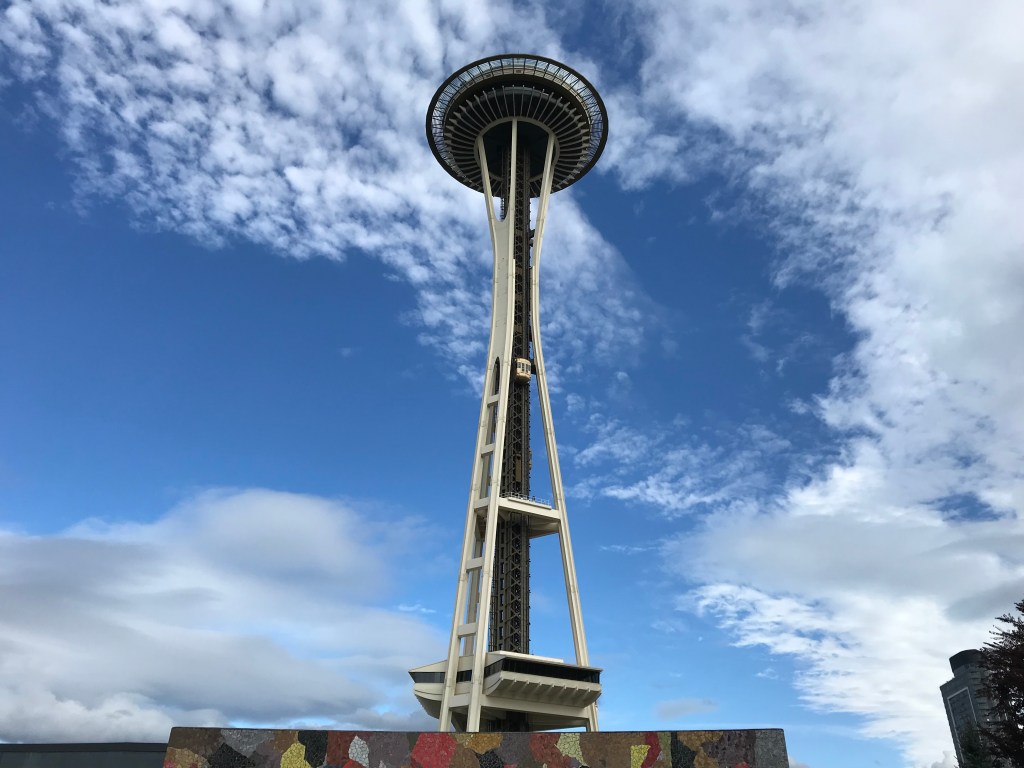
    Google now has an R&D lab in Seattle’s cool Fremont district, where there is a statue of Vladimir Lenin and a whimsical concrete troll underneath a bridge.

    Looking at “best practice” success stories elsewhere is always a good way to see how and where one can improve one’s own city’s performance. Such “competition” can be a source of inspiration.

    Finance Minister Tharman Shanmugaratnam in his budget speech last week referred to Austin, Texas, among other cities, as a centre of innovation. It holds the third-highest number of patents in the US and is a leader in clean technology. It was also recently named by Moody’s as the best place to do business in the US. It’s possible that Seattle is eyeing Austin as it strives to improve its own performance.

    Lesson 6: Giving back

    Finally, one last lesson from Seattle, perhaps the most important of all: If it is a place you want to live in, then it is a place you would want to contribute to.

    Asian cities aspiring to First World status should try to become places where talented people of all kinds would want to put down their roots.

    Published in The Straits Times, February 19, 2008
  • A Miracle in Vietnam

    Dong Khoi Street is home to a Prada store and a brand new shopping mall. And for the past few weeks, Saigon’s upscale shopping district has been the site of what many Vietnamese Catholics believe to be a miracle.

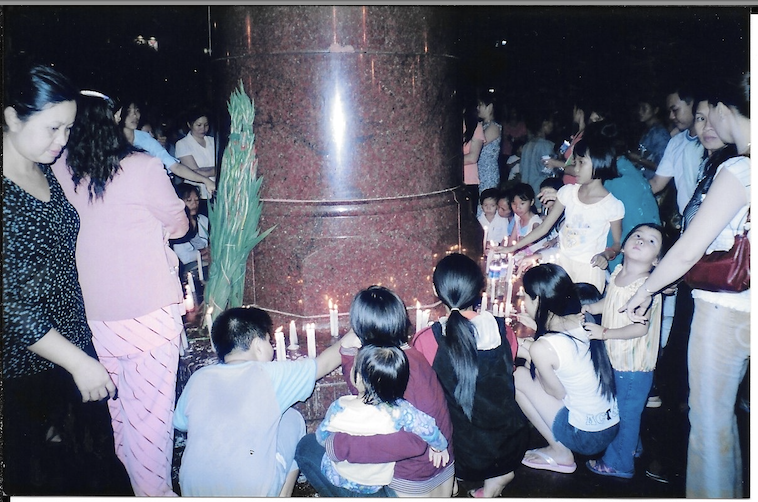
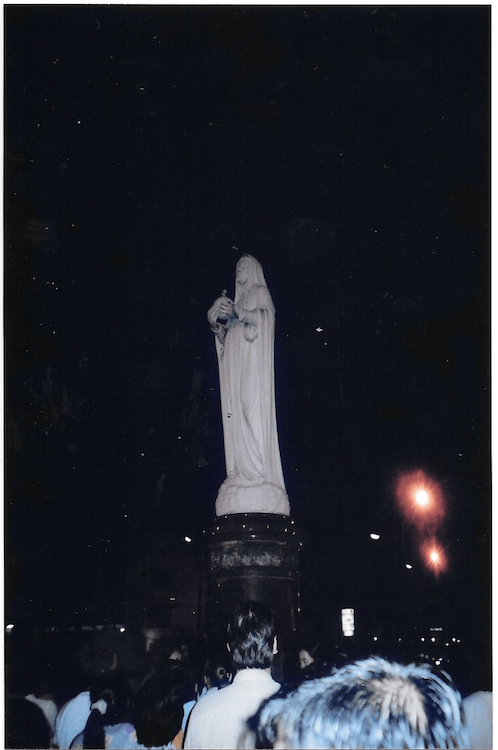
    After word spread that on Oct. 29 a tear streaked down the face of the Virgin Mary statue, staining it, several thousand people flocked to Saigon’s Notre Dame Cathedral to see it. Crowds, many with mobile phone cameras, gathered to record the sight. Initially only city dwellers came, but soon, visitors from the countryside came, too. Traffic around the cathedral slowed to a crawl, and the police arrived to maintain order.

    More than a week later, there was still a mark on Mary’s face, and the phenomenon continued to attract hundreds of daily visitors. People took turns crowding on to the small traffic island that is the site of the four-meter high statue. City gardeners in orange jumpsuits busily repaired the damage caused by feet trampling the grass and shrubbery around the statue.

    Vietnam’s government has been widely criticized for cracking down on religious groups. The U.S. Secretary of State this week again designated Vietnam as a “country of particular concern” in its annual report on international religious freedom.

    Still, several religions, including Roman Catholic and Muslim religious organizations, among others, are officially recognized in Vietnam. There are an estimated five to eight million Roman Catholics in this country of around 80 million. From Phat Diem Cathedral in the north to Notre Dame Cathedral in Saigon, there are so many worshippers on Sundays that people spill out of churches.

    For the most part, the crowd around the Mary statue was orderly. During the day, a sea of umbrellas floated above the crowd as people protected themselves from Saigon’s blazing sun. At night, candles and flowers were placed around the statue, turning it into an outdoor shrine.

    The mood wasn’t completely solemn, however. Children played around the statue. People sold drinks, ice cream, peanuts, prawn crackers — even cotton candy and balloons. Japanese, American and other foreign tourists have visited the site.

    Faithful at Virgin Mary Statue

    The event has been the talk of the town, and the subject of articles in local newspapers. Those keeping a vigil at the statue say it’s a miracle; others say it’s a warning. Some Vietnamese speculate that the tear is an omen about an impending bird-flu pandemic. Some even drew connections between Tuesday’s earthquake — centered in nearby Vung Tau but clearly felt in Saigon — to the weeping statue.

    Other Vietnamese I spoke to were more skeptical, saying the streak was just a mark from the heavy rain that recently fell upon the city. Some speculated about mischief. An executive at a large manufacturing company told me: “I think a game is being played on people. A person put that mark on her face.” Others were simply unmoved by the event. One woman said: “In many countries Mary cries. So it’s not a big deal.”

    The authorities appeared to be tolerant of this public act of faith. I didn’t notice any visible restrictions on who could visit the statue, just some traffic cops making sure people don’t spill out into the streets in front of cars and motorcycles. The police actually discouraged hawkers from selling photos of Mary’s tear-streaked face with a digitally added halo. They don’t want a religious event to be used as a commercial opportunity.

    The crowds of believers surrounding the statue of Mary — against the backdrop of the fancy boutiques and trendy art galleries on Saigon’s Dong Khoi Street — is a telling sight. It suggests that the economic growth and cultural vitality in this communist country are being accompanied by an upsurge of spirituality.

    Screenshot

    Published in The Wall Street Journal, November 11, 2005

  • Good Ol’ Advertising Deserves a Plug

    When Coca-Cola relaunched in Vietnam earlier this year, it did so with fanfare, holding opening ceremonies and a variety show complete with Vietnamese dancers.

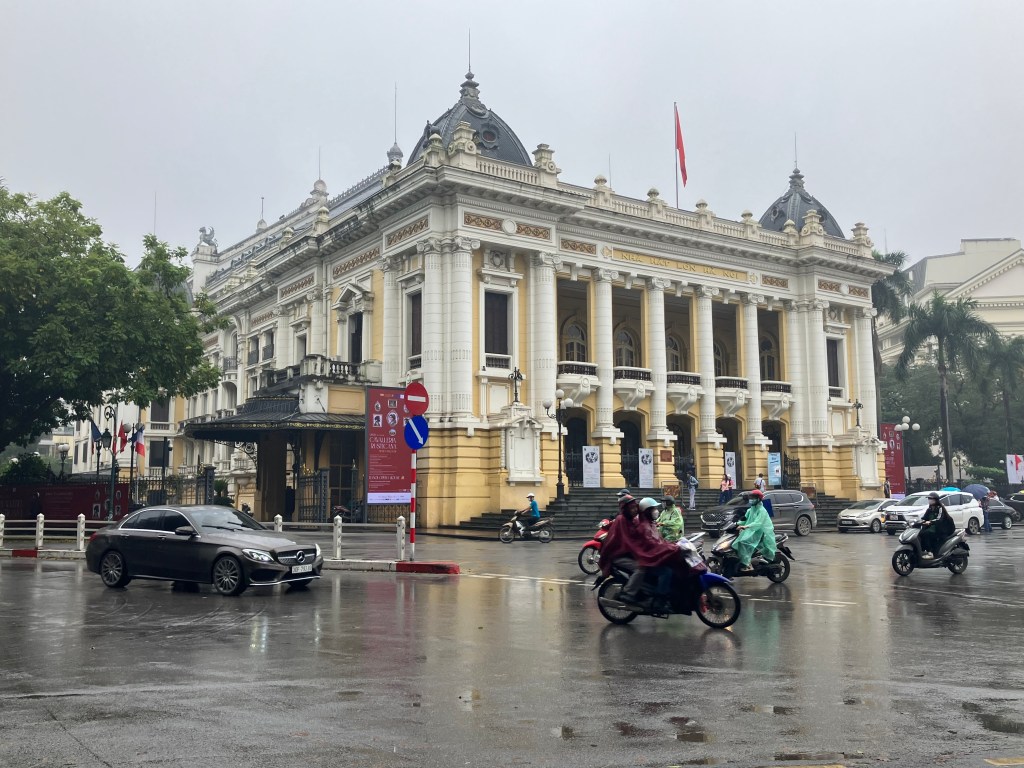
    The show was held, tastefully enough, at the French-built Hanoi Opera House, an imposing ochre-coloured relic from the early years of this century. Less tasteful were the giant inflatable plastic Coke bottles that the company set up outside the building.

    “It shows the U.S. is good at marketing but it was irritating to see a national monument used like this,” a Hanoi resident told reporters, reflecting a widely held sentiment. Not only is the Hanoi Opera House the center of Hanoi cultural life, it is also a national symbol: From its balcony, the left-wing Viet Minh announced its takeover of the city after World War II.

    Postcard of Hanoi Opera House with Coke bottle in front of it

    Coke realized it had made a faux pas. It took down the bottles. The Vietnamese government, meanwhile, has since decided that advertising in general needs to be reined in. It has taken down some billboards in Hanoi and Ho Chi Minh City. It has also restricted the number of outdoor sites where companies can advertise their products.

    In Asia’s developing economies, marketing pitfalls abound. A soft drink television spot in Malaysia a few years ago featured an exuberant woman kicking furniture in her apartment before taking a soothing sip of her drink. A local TV station pulled the ad off the air, saying the woman was “too aggressive.” Malaysia also banned feminine hygiene products a few years ago, in response to pressure from a women’s group. The women argued the products were too personal and an inappropriate sight for the eyes of Malaysian children.

    The Thai government prohibits advertising in which one product is judged better than a competitor. Such a comparison, familiar in Pepsi Challenge ads where consumers compare the taste of Pepsi and Coke, is said to break the taboo of public displays of conflict.

    The Chinese government frowns on revealing clothing. The obligatory lathery shower scene featured in shampoo ads is problematic in Malaysia, where officials don’t want bare shoulders to be seen on television. And in Pakistan, men and women can’t appear together in advertisements.

    Besides the cultural motivations for these restrictions, there is hostility toward what these governments see as promotion of Western values at the expense of their own, and promotion of Western goods at the expense of local companies. As a result, the climate for advertising in Asia’s developing economies can be quite difficult for Western marketers. And because local marketing talent is not as exposed as it could be to the outside industry, the local advertising strategies are in many cases immature. Of course, foreign marketers sometimes stumble into cultural insensitivity. But for all the government officials’ zeal in locking out Western cultural influences and protecting domestic commercial interests, they are hurting their own economies.

    They fail to see advertising’s principal advantage: It creates consumer demand. Workers become consumers who want to satisfy their demand for the convenience-adding or pleasing products they see advertised. In order to make more money to buy these products, consumers work harder at their jobs and upgrade their skills. The collateral advantage to governments is that societies become more affluent, and workers become more productive.

    This cycle has been repeated in all the Asian Tigers. Advertising sells products, and those products are the symbols of a rising standard of living. It’s not that the West’s values are being pushed, but rather that higher quality of life is being sought by consumers.

    Developing-country governments’ protection of local companies isn’t wise either. In the Darwinian logic of the modern market economy, smart companies embrace change. In many cases, local companies recognize advertising as a powerful brand-building tool. In Malaysia, for example, the local haircare brands New & Trendy and Follow Me use advertising aggressively. As a result they control about a third of the market.

    A famous example of a company using advertising to boost its market share is Singapore Airlines. The airline built its reputation by catering to Singaporeans’ exacting standards for service and safety, and communicating those qualities through the memorable image of the Singapore Girl. The result: The airline is one of the largest in the world.

    That’s not to mention the good name the ads create for Singapore itself. The Malaysian government has learned this lesson as well, promoting its airline with futuristic ads that feature a spaceship. The ads move Malaysia beyond its reputation as a producer of tin and rubber, and suggest it is a country ready to enter the 21st century.

    Besides creating demand and a positive image for its products, advertising does another important job as well. It tells information-starved consumers what those products do: How to use a washing machine, a soup mix, or a microwave oven. As developing markets open up, advertising shows the way through a strange new world of consumer choice – a world that the citizens of Asia’s developing markets want very much to join.

    Published in The Wall Street Journal, August 18, 1994

  • At Christmas, Commune with the Crabs

    No, Christmas Island isn’t the suburb where Santa Claus lives. But he might consider vacationing there during the off season. Located 360 kilometers from Java, 1,400 kilometers from Australia, and just this side of nowhere, Christmas Island is as remote as they come. Named by Captain William Mynors on Christmas Day in 1643, this poodle-shaped island has been ruled by Britain, Singapore and now Australia. Once famous for its phosphate mining, now it is known mainly for its casino and its crabs.

    One of millions of Christmas Island crabs

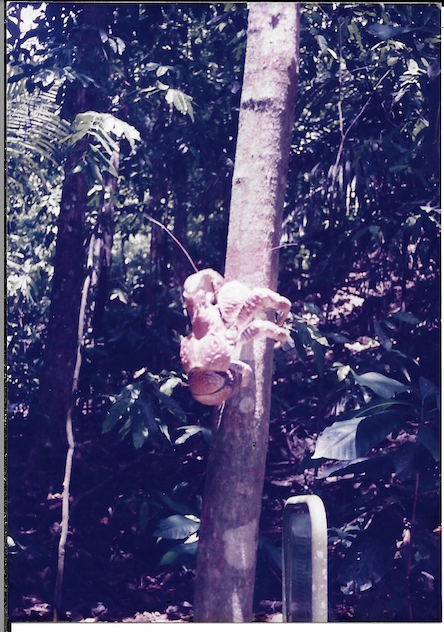
    Crab climbing tree

    Last month, 140 million red crabs marched from the rainforest to the sea to mate. It’s the annual Indian Ocean equivalent of the wildebeest stampede on the great African savannah. The crabs have a certain cuddly quality, although you wouldn’t want to put them under the Christmas tree as a gift or tuck them into bed next to your kids at night.

    Crab crossing

    On the bus ride from the airport to the island’s only resort, my four-year-old and I looked intently out the window for any sign of crawling life. We spotted a lonesome crab shortly after the bus left the airport. Then as the bus descended steeply down a road cut through the jungle, we started to see a lot of crabs – hundreds, not yet thousands – and crab carcasses. The smell of rotting crabs reached us in the bus. “Daddy, it stinks,” my daughter said. The jungle smelled more like a fish market at the end of the day. While the Australian government built crab tunnels – like cattle grids – so that crabs can get to the other side of the road in one piece, evidently not all the crabs decided to take the safe route.

    Spare the crabs, use a different road
    Screenshot

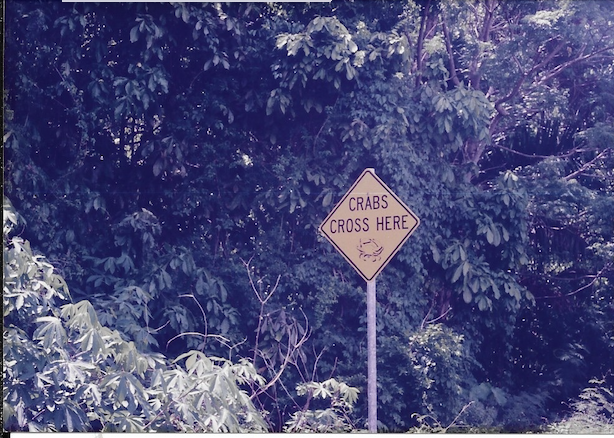
    The Christmas Island red crab is not very big – about the size of a man’s fist – and covers about five feet a minute. No way they were going to get out of the way of an oncoming car or bus. A yellow warning sign that says, “Crabs cross here” could not prevent thousands of them from being smashed to smithereens. Although cars and buses really do try to avoid hitting them. For one thing, it’s not pleasant killing a crab. For another, the claws sometimes puncture tires. Try getting a new tire in the middle of the Indian Ocean.

    Christmas Island dinosaurs at resort

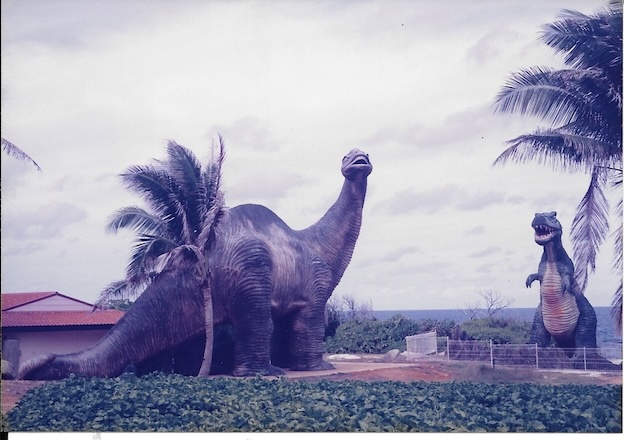
    At the resort there was a smattering of crabs across the driveway, across the lawn, along the walkways. Crossing in front of you, crossing behind you. Squatting in front of doorways. Hovering around porches. The resort was a pleasant enough place, perched on limestone cliffs that took a non-stop battering from the sea. It even had a casino meant to attract Southeast Asian high-rollers. At the resort’s swimming pool, which had a white crab guard to keep the crabs from swimming with the guests, frigate birds were constantly dive bombing for a drink of chlorinated water. Away from the pool, near the ocean, were two life-size statues of dinosaurs – a brontosaurus and a tyrannosaurus. When the ocean swells hit the limestone cliffs surrounding the resort, the roar passed through the open mouths of the dinosaurs. Disney World it wasn’t.

    Christmas Island dinosaurs overlooking cliffs

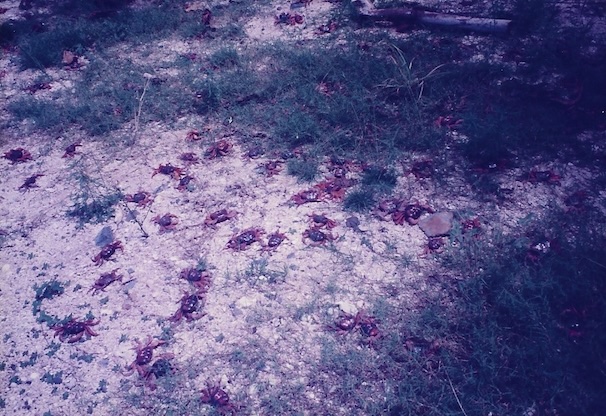
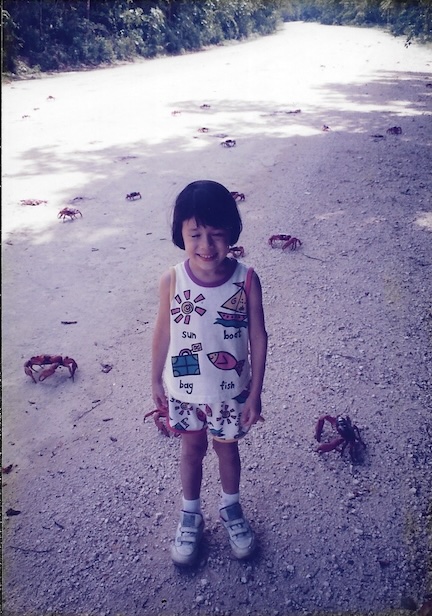
    On a drive through the jungle-covered park that covers two-thirds of the island, we saw a large crab migration. We jumped out of the four-wheel drive to get amongst the crabs. They were everywhere, all over the road, swirling around our feet, carpeting the jungle floor, crawling over each other, fighting each other, even cannibalizing the carcasses of crabs that didn’t make it. My daughter stood in the middle of this moving red carpet and posed, smiling, for one of many photographs. “Daddy, the crabs are my friends,” she said, holding her wide smile effortlessly, as they moved harmlessly around her.

    Screenshot

    Santa may not call Christmas Island home. And he may not even vacation there. But for a little magic to stir a child’s heart, nothing beats the land of the crabs.

    With the Christmas Island crabs

    Published in The Asian Wall Street Journal, December 27, 1996

  • Dine at SEEN and Be Seen at SIN

    Dine at SEEN and Be Seen at SIN

    Avani+ Riverside Bangkok Hotel’s elevated dining, drinking, and views defined my stay there  

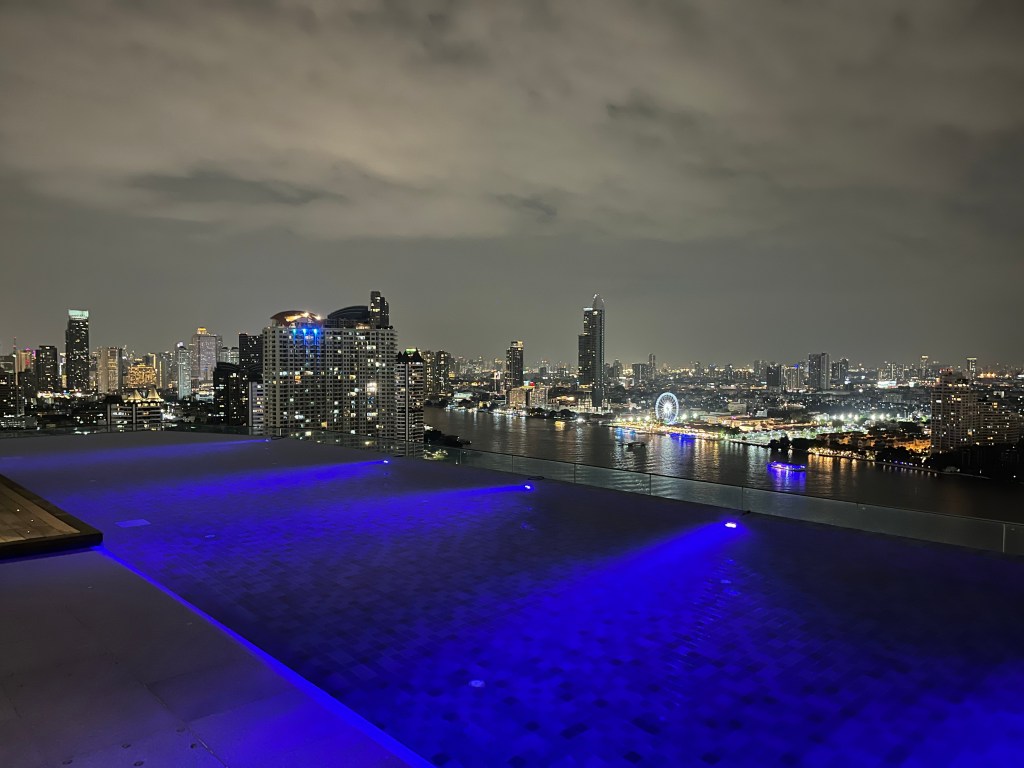
    My dinner at SEEN started with the appropriately named cocktail, Shaman. More magical portion than a cocktail, it mixed Remy Martin 1738, Michter’s US 1 Kentucky Straight Rye, Cinzano Rosso, Cacao, Cynar, Sandalwood, and tobacco. I sipped it while drinking in the view of the Chao Praya River and Bangkok’s jewel-like nighttime skyline.

    Necklace of lights visible from SEEN

    Bangkok is known for its street-level delights: from Chinatown food stalls to shops and shopping malls that invite you to step in from the sweltering heat of the sidewalks to the cooling comfort of air-conditioned retail therapy.

    The Avani+ Riverside Bangkok Hotel, though, defines itself with its views of Bangkok’s nighttime necklace of lights. My 26th-floor meal was an aerial tour of uplifting South American and Asian cuisine by star chef Oliver da Costa. The SEEN group of restaurants started in Sao Paulo, followed by outposts in Lisbon, Rome, and Nice, and now Bangkok and Koh Samui.

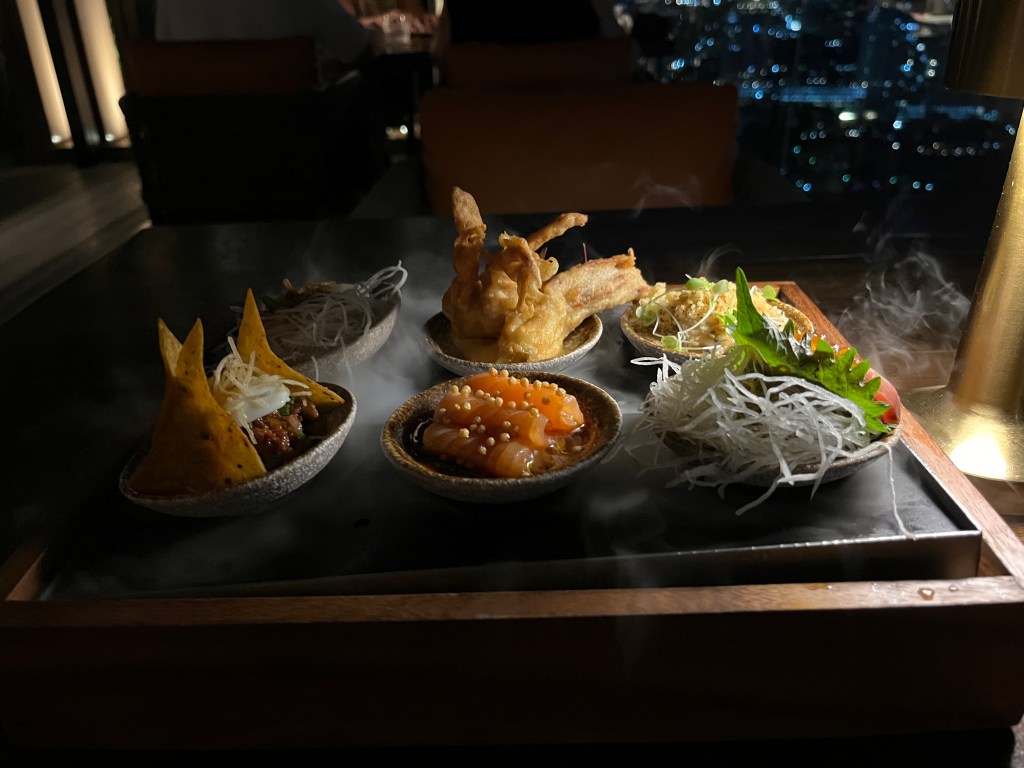
    My meal landed on my palate with a delectable wagyu beef carpaccio with arugula, pesto sauce, and pecorino. Bewitching mussels in a spicy bisque sauce, with scallions and a lemon wedge, followed. I took a well-needed breather before being served the Japanese Mystery Box with dry ice providing a veil of mist that gradually revealed its treasures, from salmon sashimi to tempura to Hamachi with fish eggs. The dishes were so layered and nuanced that I found myself pulled from the view of the river to the equally compelling view of the food I was eating. I finished with chocolate caviar: Belgian chocolate mousse, cherry compote, and chocolate crunchy with hazelnut ice cream.

    To recover, I sauntered over to the infinity pool with the infinite view of the city. The pool’s startling sapphire blue colour jumped from the water to my consciousness. Yes, that Shaman cocktail was well into my bloodstream by now.

    Found Lost & Found

    Too young a night to retreat to my room, I sauntered over to the Lost & Found Club. Located on the third floor of the next-door Riverside Plaza, it’s also part of the Avani +.

    Designed by Australian Ashley Sutton, who created Bangkok’s atmospheric Iron Fairies in Sukhumvit and Maggie Choo’s in Silom, Lost & Found looks like a decrepit spaceship from a high-concept sci-fi movie. Think of the spacecraft in Aliens. High-energy drag performers ignited the club’s vibe.

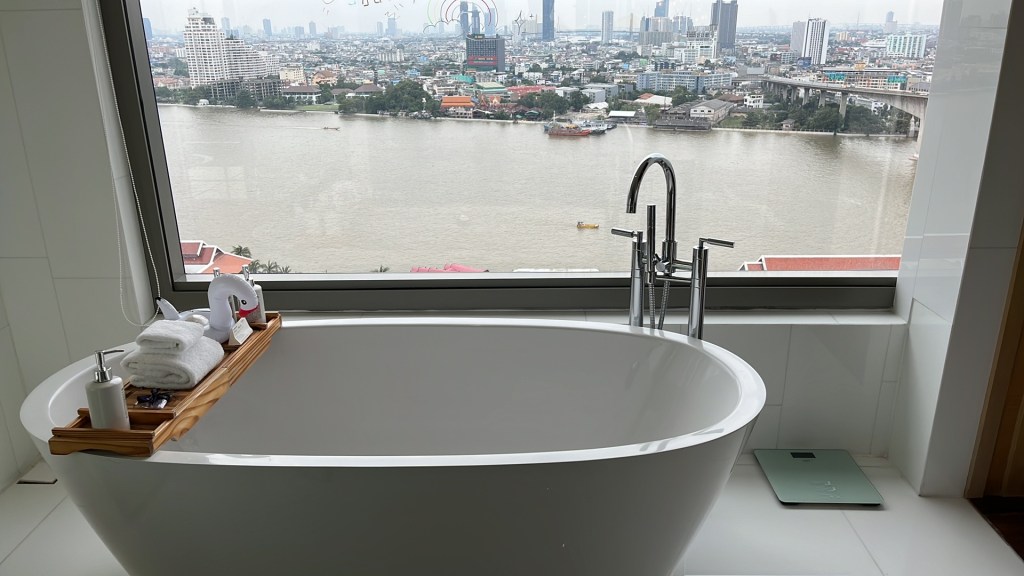
    I retreated at last to my riverside suite with a panoramic, almost IMAX-like view of the Chao Praya River. Even the bathtub has a view and the hotel-provided bath bomb was a bomb along with the MALIN+GOETZ toiletries. A good soaking sent me off on a long, deep sleep.

    Memorable AM to PM meals

    Breakfast at Avani+’s Skyline restaurant is a mixture of dishes that are good for you and those that aren’t. To recover from the night before, I started with a healthy avocado toast with a revitalizing shot of orange, carrot, and ginger juice. But that soon gave way to Thai noodles. And who can resist coconut ice cream in the morning? I couldn’t. And didn’t.

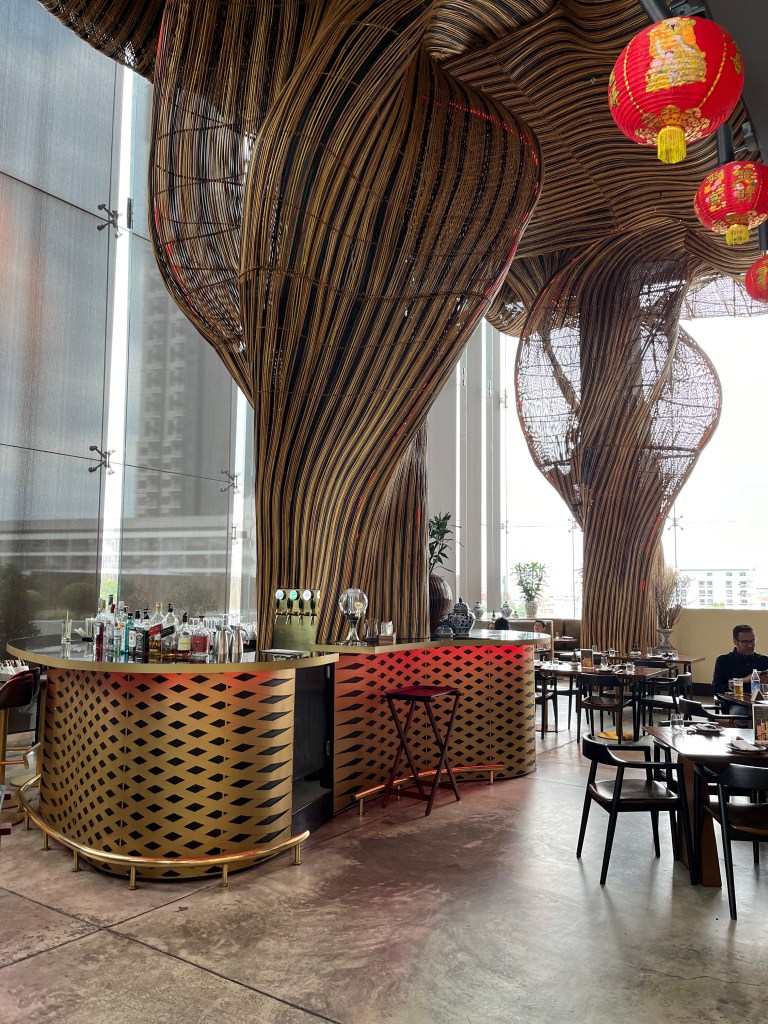
    For lunch, I dined at the Spice & Barley restaurant. Avani+’s Chinese restaurant was awarded best-designed restaurant in the brasserie category at the LIV Design Hospitality Awards. The Patrick Keane and Enter Projects Asia space uses swirling floor-to-ceiling rattan sculptures, a giant mural of an imperial concubine, and a gold-tinted color scheme to communicate a luxurious visual embrace. My chicken clay pot lived up to the high expectations of the setting.

    After lunch, I had a pastry pick-up at The Pantry. The tarty lemon tart with coffee in the light, airy space was a chilled way to spend part of an afternoon and gather steam for what promised to be a long evening ahead.

    On Bangkok’s Thon Buri side

    The Avani+ Riverside Bangkok Hotel is located on the Thon Buri side of the Chao Praya River. Getting to the main part of Bangkok is easy: an hourly ferry runs from the next-door Anantara Riverside Hotel to the Saphan Taksin Skytrain station, where all of the city is accessible. On the Thon Buri side is the ICONSIAM mall — massive with literally all you could ever want. There’s also Wat Arun, the Royal Barges National Museum, and the Thonburi Canals that give a glimpse into an all-but-vanished traditional Bangkok life.

    Experiencing SIN was sublime

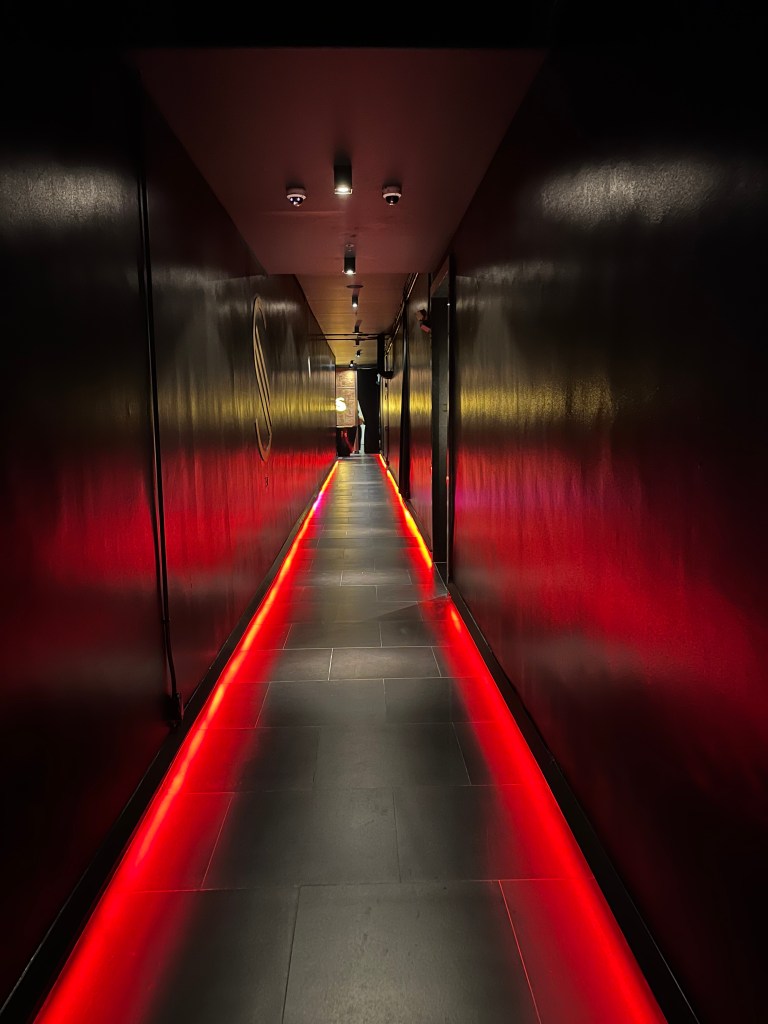
    In the evening, I strolled down a long, narrow corridor flanked by ribbons of red light to be greeted by a hostess who escorted me into the theatrically expansive 27th-floor rooftop bar and club, SIN. The effect of emerging from the narrow corridor into the outdoor area gave me a sense of “Wow.” I found out later that was the design intention. As someone who loves Frank Lloyd Wright’s architecture, it’s a technique he frequently used in the homes he designed. I may have dined at SEEN the evening before, but now it was time to experience SIN.

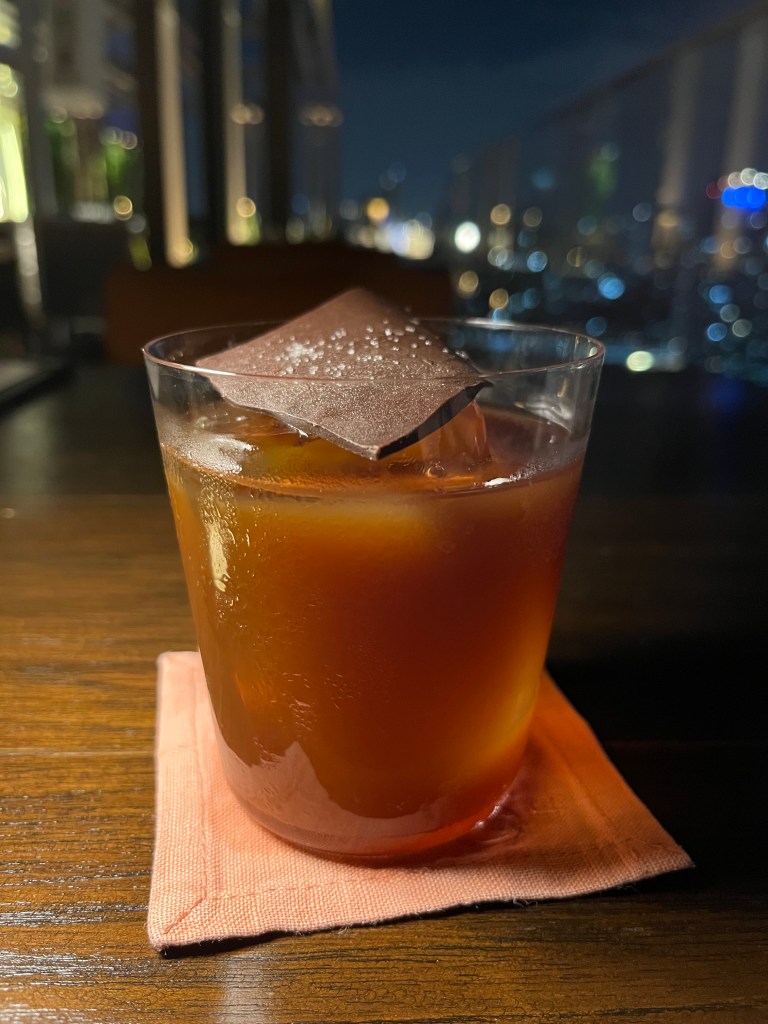
    With a table overlooking the river but not far from the bar, I was able to savor the view and experience the bar. For a kick-off, I had the Forbidden Nectar cocktail: Michter’s Kentucky Straight Bourbon, miso, caramel yogurt, carrot, and creamy bourbon. The drink was so complicated I imagined that the mixologist needed a chemistry degree to make it. With a cocktail that sublime I didn’t need rose-colored glasses to see the world in a more optimistic light.

    Sinfully good dishes at SIN

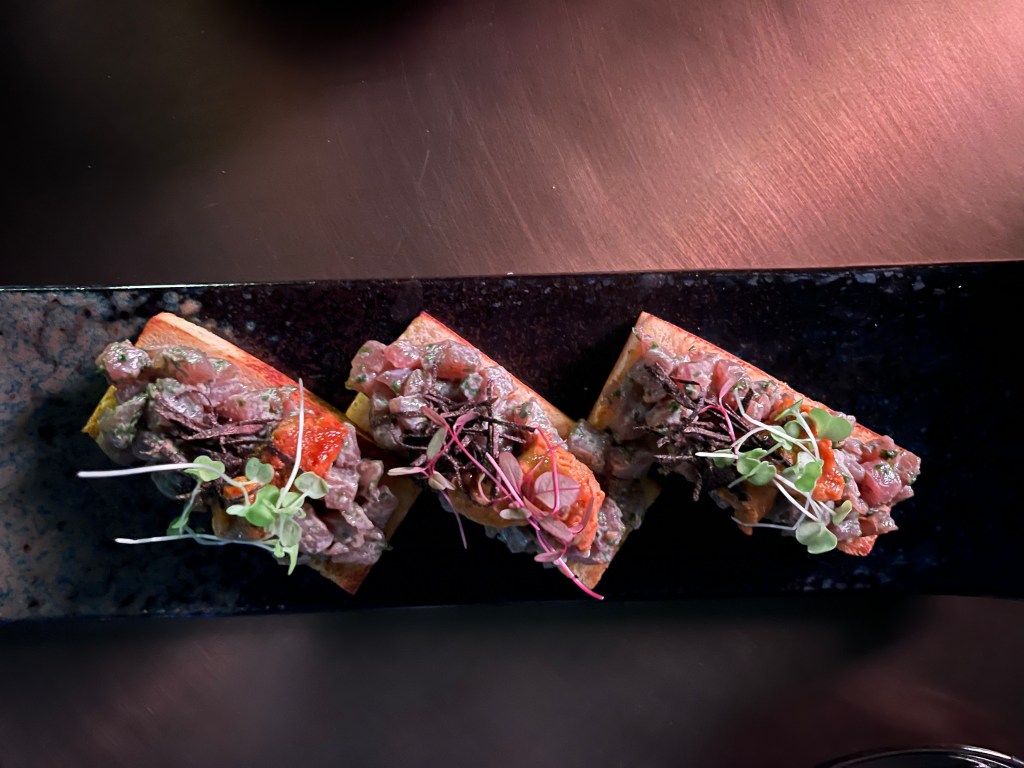
    My dishes soon followed. The starter piqued my tastebuds: scallop crudo with yuzu vinaigrette, yuzu gel, coriander oil, and Kaluga caviar. Following that was a more substantial open-faced sandwich — bluefin tuna, smoked tuna, fresh summer truffle mayonnaise, shaved truffle, and Uni from Hokkaido on a crispy brioche. Just one more dish to round out the meal: wagyu Miyazaki beef A5 grade, bulldog sauce, and a sprinkling of Kaluga caviar on a brioche. No exaggeration: the best food I’ve had in a bar ever. It’s not only the view that is stellar at SIN.

    SIN’s atmosphere is somewhat otherworldly. Overlooking the elliptical-shaped bar and expansive terrace in an immense oval-shaped alcove with a giant golden “S,” a headphone-wearing DJ in a sleeveless purple gown presided over the eclectic, pulsating music and stylish crowd like a Mount Olympus goddess.

    Sip to savor cocktails at SIN

    Which brought me to my evening’s second cocktail. Given the bar’s name, the Midnight Sin was that moment’s go-to cocktail: Remy Martin 1738, Jameson Black Barrel, cacao nibs, cacao husk, coconut cold brew, PX. I like to sip to savor my cocktails, and this was a drink that I hoped would never end.

    Bangkok is a hot and humid city. But at that hour and that elevation, I was cooling down fast. A few sips from a cocktail at SIN and Bangkok is transformed into a serendipitous and serene place. A cocktail bar doesn’t get better than that. And neither does a hotel stay like the one I had at Avani+ Riverside Bangkok Hotel.

    Published in February/March issue of Asian Journeys magazine