Tag: asia

  • The Journey to Laos’ Plain of Mysteries

    The road to the Plain of Jars revealed ancient mysteries, recent horrors, and an uncertain future.

    The Gallic joie de vivre of Laos’ capital, Vientiane, was an out of sync start for our trip to the unknowable Plain of Jars. Anchored around Buddhist temples, colossal communist edifices, and elegant remnants of French colonial rule, the city was a mélange of the sometimes stylish, occasionally dour past, and a promising present built on tourism and foreign investment.

    Defined by the Vietnam War period

    Every city has its defining era. The Vietnam War period is the historical fulcrum for Vientiane. The 19th century certainly left its mark:  evocative Buddhist temples such as Wat Si Saket near the Presidential Palace, and the shimmering golden Pha That Luang, which is featured on Laotian money, sit beside colonial-era French villas, many of which are now hotels and restaurants.

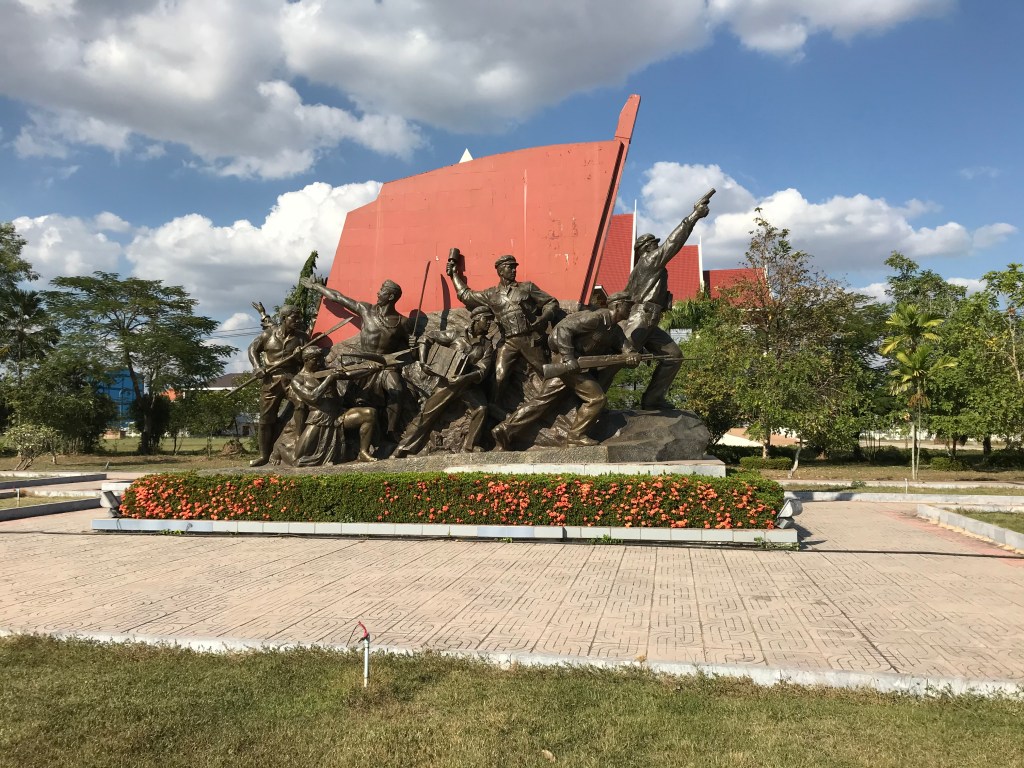
    But it’s during the Vietnam War where modern Laos got its stumbling start. The founders of the current government gained power then as the leaders of the Pathet Lao guerilla movement. The colossal Kaysone Phomvihane Memorial is devoted to the first prime minister who headed the Pathet Lao when it took over the country in 1975. The museum has an enormous monolithic statue of him out front and exhibits inside that include a mock-up of his childhood home and the cave where he operated from during the war. Nearby, a mid-century French villa with a lush garden was the home of the late President Souphanouvong, aka The Red Prince, who fled his royal life to co-lead the Pathet Lao. Both are close to the former CIA headquarters compound. The area is heavily guarded and closed to tourists.
    Laotian Har Paw Villa and Arc de Triomphe

    Buddha Park, Xieng Khouvan, is 20 kilometers from downtown. Started in 1958 by Luang Pu, a maverick monk, it is a physical representation of his religious philosophy where he had merged Buddhism and Hinduism. With over 200 concrete statues of Buddhist and Hindu figures it reminded me of a Laotian Haw Par Villa, a quirky perspective on religion, that educated as well as entertained.

    The Patuxai, Vientiane’s version of the Arc de Triomphe, was built in 1969 to commemorate those who died in pre-independence wars against the French. Concrete from the US that was meant to construct a new airport was used for the memorial. That was how it earned its sobriquet, “the vertical runway.” It straddles the Th Lan Xang boulevard that leads to the Presidential Palace near the Mekong River. You can take stairs to the top for a panoramic view of the city.

    A past that bites again and again

    Our last stop in Vientiane before heading north was COPE, a meaningful acronym that stands for Cooperative Orthotic and Prosthetic Enterprise. Sobering exhibits explained the prosthetics that they create for the victims of UXO (unexploded ordnance) from the Secret War in Laos. The Secret War was a theatre of the Vietnam War where the US supported the Royal Lao government against the Pathet Lao and attacked the Ho Chi Minh trail.

    According to a Russian saying, “it is better to be slapped with the truth than kissed by a lie.” At COPE, I was slapped a lot. Laos was the most heavily bombed country in the world per capita in history. During the Secret War 580,000 bombing missions were flown by the US, working out to one every 8 minutes, 24 hours a day from 1964 to 1973. More than 2 million tons of ordnance were dropped. Cluster bombs containing 270 million bombies (tennis ball sized mini-bombs) were dropped on the country. 30% failed to detonate. Approximately 25% of villages in Laos have UXO. More than 20,000 people, 40% of them children, have been killed and wounded by UXO since the war’s end in 1975. The individual tragedies I read about were so wrenching I wanted to stop but couldn’t, I wanted to leave but stayed. One of the most heavily bombed areas was the Plain of Jars.

    Cluster bomb with bombies

    Listen to the rice grow

    The French had a saying during their colonization of Indochina. “The Vietnamese plant the rice; the Cambodians tend the rice; the Lao listen to it grow.”

    In a culture that considers avoiding stress a virtue, our driver of the Avis rental car was so chilled he could make a California surfer envious. He drove us north from Vientiane through landscape that transformed from flat rice paddies three hours later to the stunning karst formations that erupted around Vang Vieng. We stood on a shaky wooden pedestrian bridge over the Nam Song River and watched motorboats ferrying tourists and people in canoes navigating the currents with paddles. Looming behind them was the backdrop of mountains shaped like vertically stretched camel humps.  

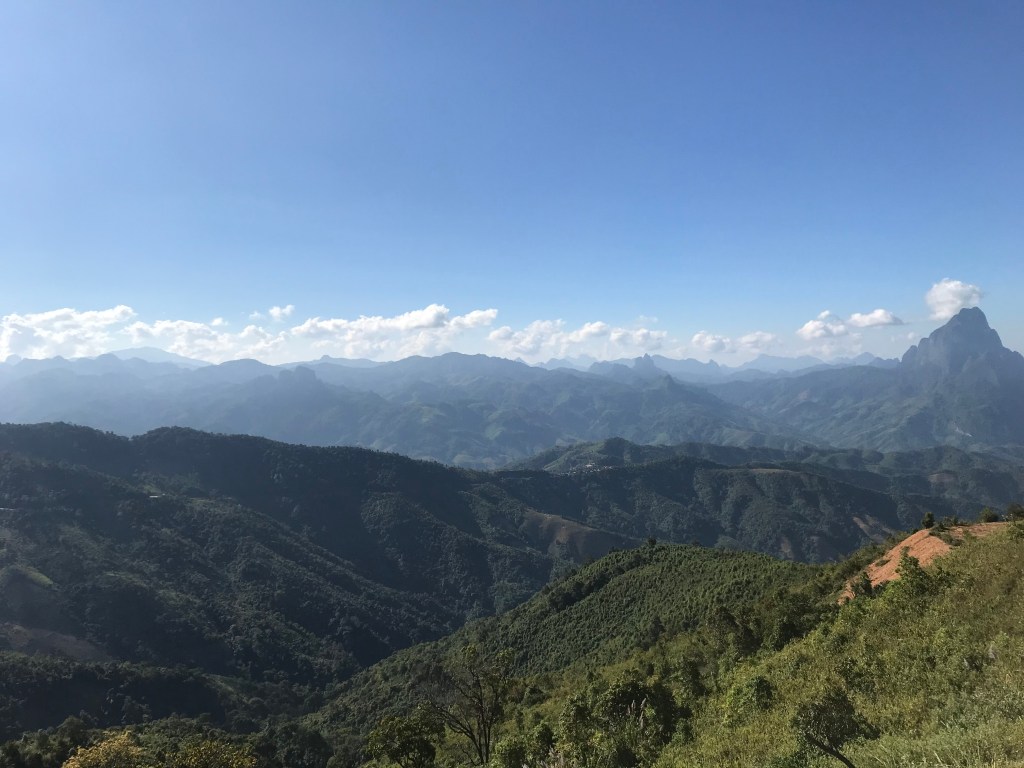
    As we left Vang Vieng at dawn the next day we glimpsed the future. Half-built overpasses of a new China-financed highway were cutting into the landscape. Soon we were in the Annamite Mountains, shades of gold from the rising sun and green from the forest entrancing us as we imagined what creature a particular karst formation resembled. Along a road more coiled than a cobra the driver dodged potholes, oncoming cars and trucks and weaved around villagers going about their chores. He did it with elan and a smile that emulated Mona Lisa’s. At a mountain pass an evanescent cape of clouds was gently draped over peaks and ridges that stretched north to the borders of Vietnam and China.

    Southeast Asian Stonehenge

    Located 400 kilometers north of Vientiane in the province of Xieng Khouang, near the nondescript town of Phonsavan, the Plain of Jars has perplexed foreigners since the visit of Comte Francois Pierre de Barthelemy in 1896. The French archaeologist Madeleine Colani studied the various Jars’ sites from 1931 to 1933. Nothing is known about the civilization that created the Jars between 500 BC and 500 AD. The Jars’ range in size up to 3 meters in height and up to 14 tons in weight. How this early civilization transported these extremely heavy stone items from quarries kilometers away is still a mystery.  Because Madame Colani found bones in the Jars and a cave at Site 1 she believed the Jars were used for funerary purposes. Her hypothesis was that corpses were placed in the Jars and left to decompose until only the bones remained. Then the family collected the bones and buried them. She also believed the cave at Site 1 was used for cremation. But were the Jars originally used for funerary purposes? After all, the Plain of Jars is located on ancient trade routes. Did the Jars play a role in trade? In one legend, when King Kung Jeang defeated the tyrant, Chao Ankha, the people supposedly celebrated the victory by making the Jars and filling them with rice wine.
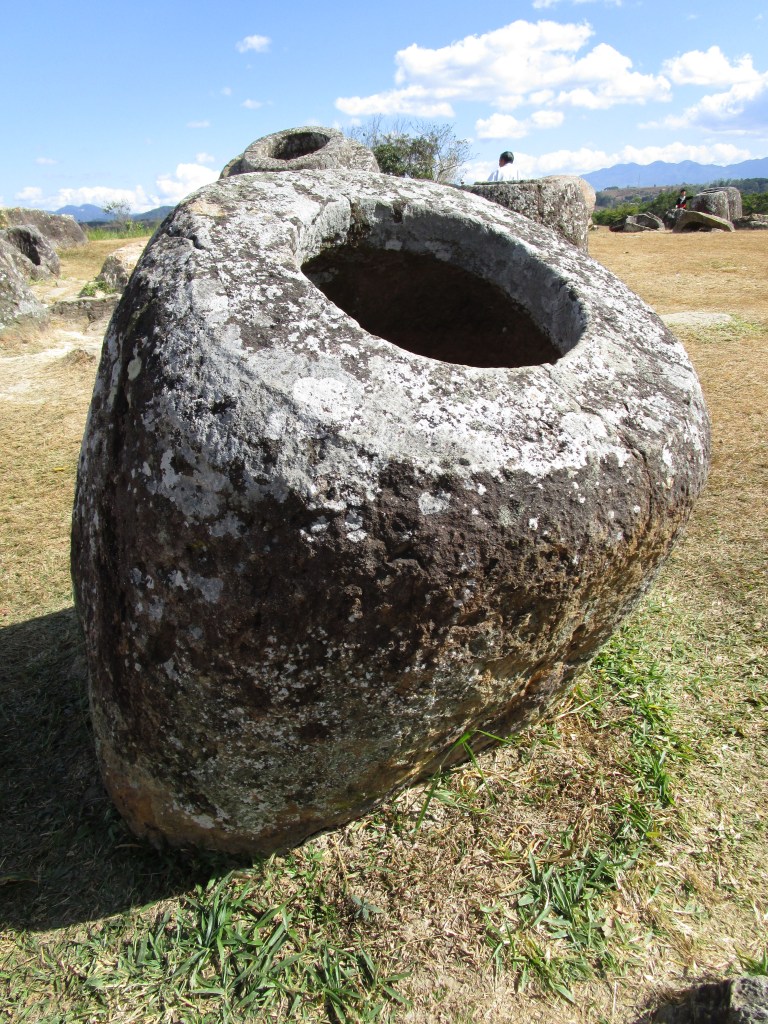
    Jars Site 1

    The Plain of Jars has been called a Southeast Asian Stonehenge because of the enduring mysteries surrounding the Jars. The unknowability of the who, what, and why of the Jars makes a journey here more of a pilgrimage than an Instagram moment.

    UNESCO World Heritage Site

    Modern Hmong, ancient Jar

    In July 2019, UNESCO made the Plain of Jars a World Heritage Site. The designation should protect the area and attract tourists who can help fund the Jars’ preservation and the opening of new sites. As one of the most heavily bombed areas during the Secret War, craters dot the landscape like smallpox scars. Bombies still need to be cleared from Jars’ sites that are currently closed. To visit the sites that are open you need to stay on clearly marked trails and scan the ground for barely visible bi-colored pieces of concrete. To stay safe, avoid the side that is painted red while remaining on the side that is painted white.

    Bomb craters, Plain of Jars

    Mysteries like a fog that won’t ever lift

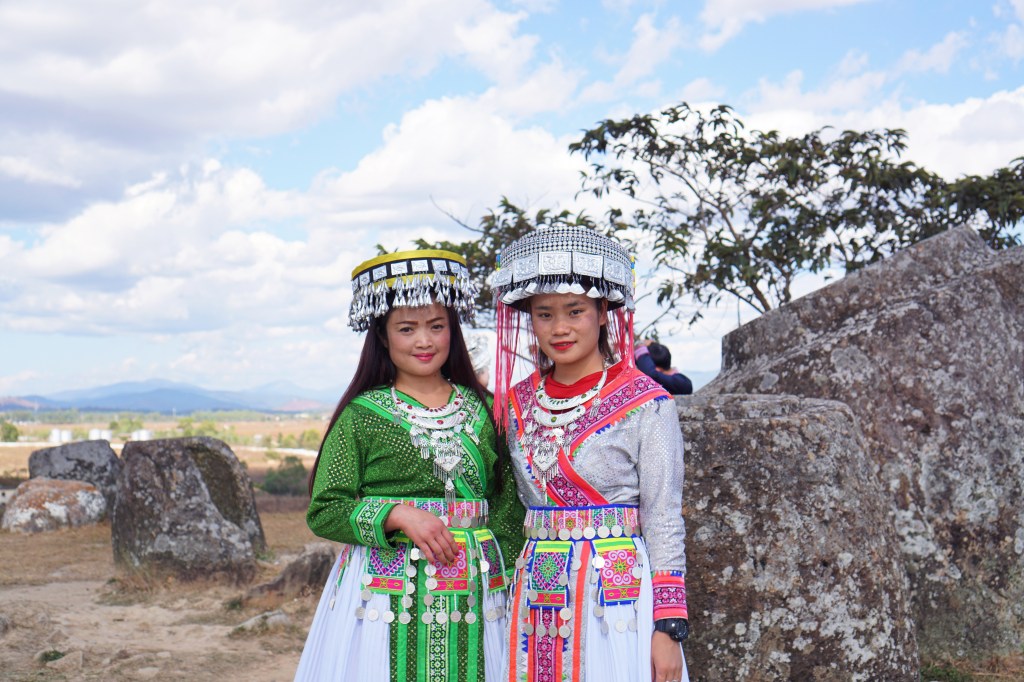
    We visited three Jars’ sites. At Site 1, the largest, was a sign from the NGO Mines Advisory Group (MAG), stating that the area had been cleared of mines in a joint effort between UNESCO and the government of Laos. With that sobering thought we climbed a short hill. Huge stone Jars, the patina of time creating blemishes on their eroded surfaces, were scattered haphazardly around a large area. They were for the most part devoid of decoration. Hmong tribesmen, celebrating their new year in their finest clothes, resplendent with colorful sashes, headdresses and newly polished silver jewelry, picnicked underneath lonely gnarly trees. Bomb craters served as reminders of a recent violent past whose ghosts, in the form of unexploded bombies, haunt the soil of the surrounding countryside. Phukeng Mountain was the only elevated point on the flat horizon. Despite the groups of Hmong, an eery silence hung over the area that was punctuated by a light intermittent breeze, as if the funerary past of the Jars was a reminder to visitors that this was a place to pray, not play.
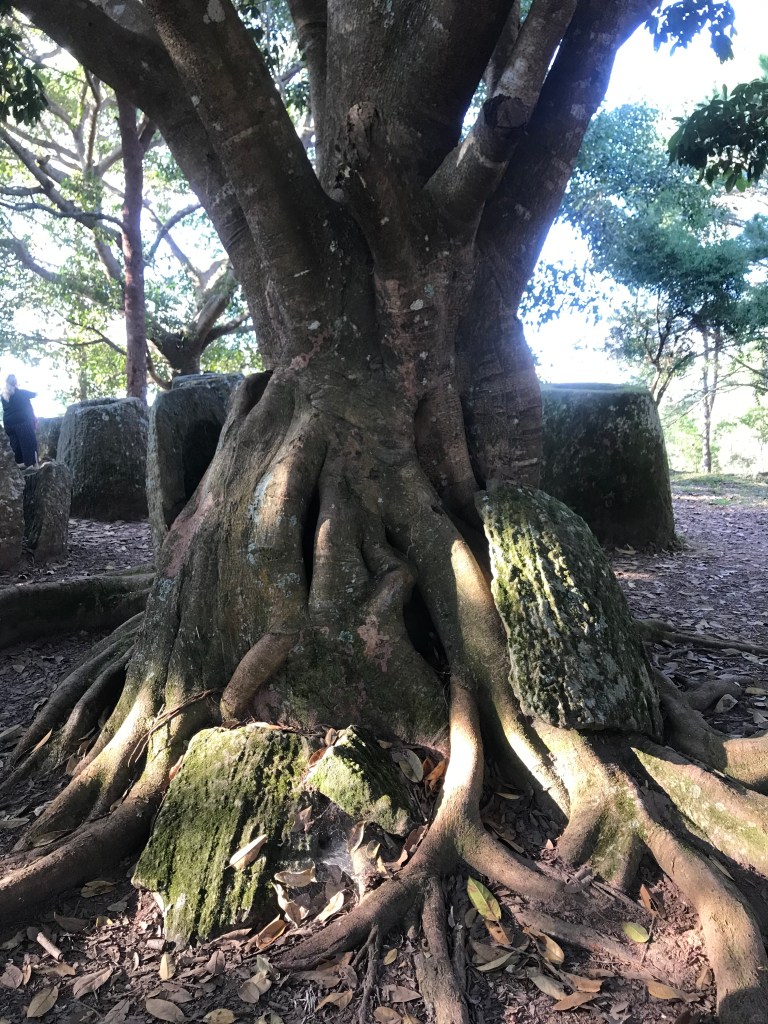
    Tree destroying a Jar

    At the top of the nearby cave where Madame Colani hypothesized that cremations took place were two anti-aircraft positions used during the Vietnam War by the Pathet Lao. The Jars were silent witnesses and survivors of the war, late 19th century Chinese raiders, and even the occasional careless, callous tourist.
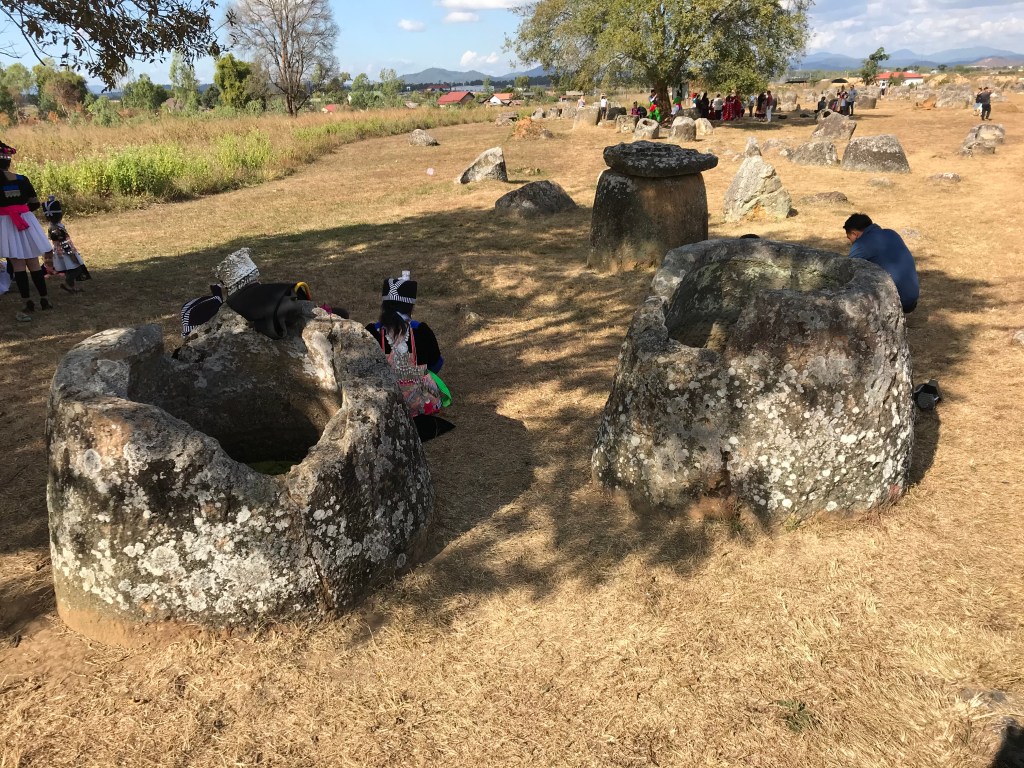
    Hmong picnicking among Jars

    Hints of Angkor Wat

    Hmong at Plain of Jars

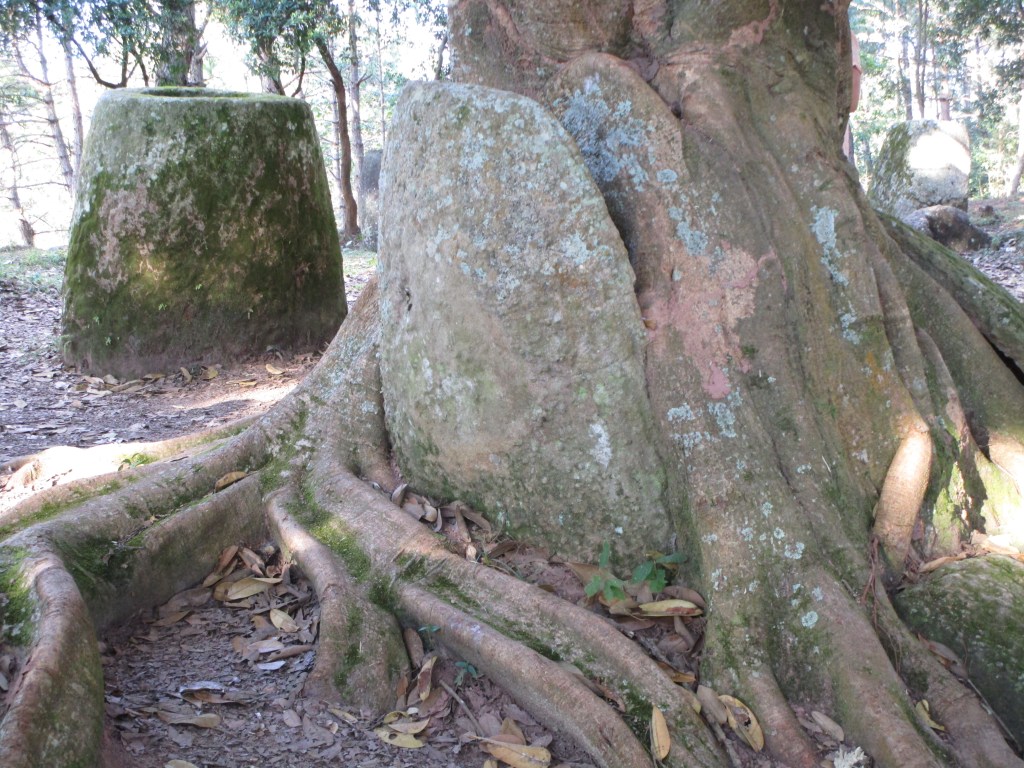
    At Site 2 we took a path to a heavily forested area where the Jars sheltered beneath the cover and protection of trees. As with the Angkor Wat temple of Ta Prohm, the trees surrounded and cracked open jars, a reminder that nature always has the last word.
    At the end of the day we visited Site 3. The area hadn’t been completely cleared of mines. The sign from MAG informed visitors how to see the Jars and return in one piece by referencing the markers in the ground: “White indicates the areas where sub-surface UXO clearance has occurred. Red indicates where UXO has only been removed from the surface. YOU ARE ADVISED TO STAY BETWEEN THE WHITE MARKERS.” 
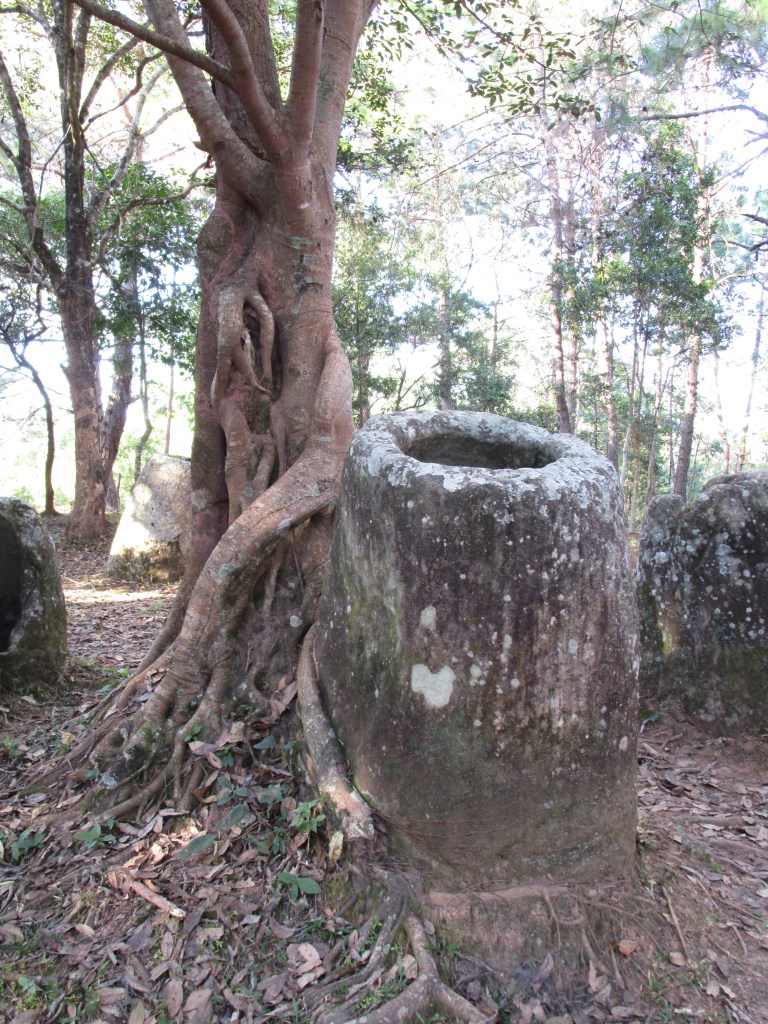
    Tree embracing a Jar

    After crossing a rickety bridge, we followed the instructions, walking through muddy paddy fields to a patch of forest that shielded several dozen Jars. Speckled light from the declining day imbued the site with a mysterious aura, more Rousseau than reality. The Jars weight caused them to partially sink into the soil, obscuring their individual stories beneath a blanket of dirt and time.

    Jars at Site 2

    That night in Phonsavan we visited the Xieng Khoueng UXO Survivor Information Centre where we bought crafts made by UXO survivors. On the way to dinner afterwards we passed a guest house where artillery shells and bombs were displayed in glass cabinets and on the floor. Dozens of shells and bombs of all sizes. When I tried to take a photo, the guest house owner told me to go away. It left me with a feeling that a cult of death still permeated the area. It was my wish that it be replaced by a cult of life.
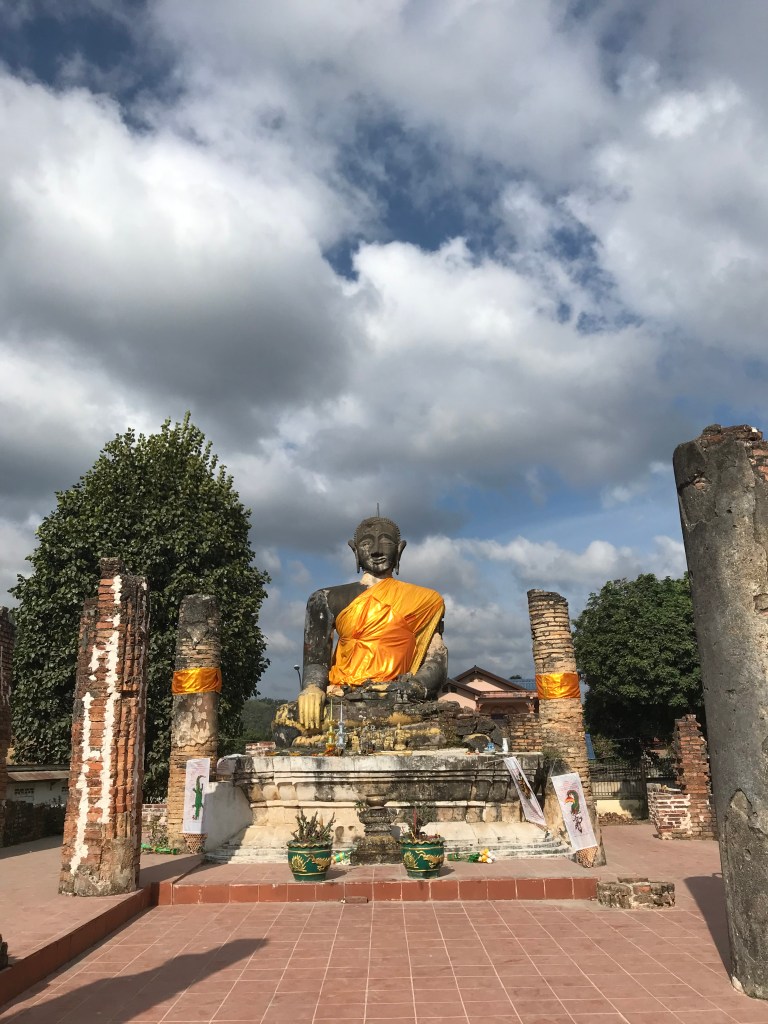
    Buddha that survived Vietnam War bombing raid
    Jars Site 2

    Travel Tips:

    -Dining:

    Doi Ka Noi restaurant’s Laotian cuisine was so good it’s practically worth a trip to Vientiane to eat here. Lemongrass stuffed with pork and herbs plus Luang Prabang river weed with tomato chili dip was as good as it sounds. The Blood Plum and Gin ice cream was an inspiring finish to the meal. Try Butterfly Tea, which turns from blue to purple with the squeeze of a lime. Although they participate in the slow food movement you will be tempted to eat fast here.

    Butterfly tea
    Street food, Vientiane

    -Places to stay:

    Booking.com was a great source of affordable and excellent places to stay. Our Vientiane hotel was the comfortable VKO Guest House near the Mekong River and the night market.

    -Rental car:

    We rented a car and booked an excellent driver from Avis.

    -What to buy:

    The Lao Textile Museum sells intricately designed textiles.  Crafts from COPE help fund their efforts. From Bombs to Beans from the Lone Buffalo Student Coffee Company is excellent coffee.

    Hmong celebrating New Year’s

    Published in Asian Journeys magazine, February-March 2020
  • The Road to Myanmar’s Golden Heart

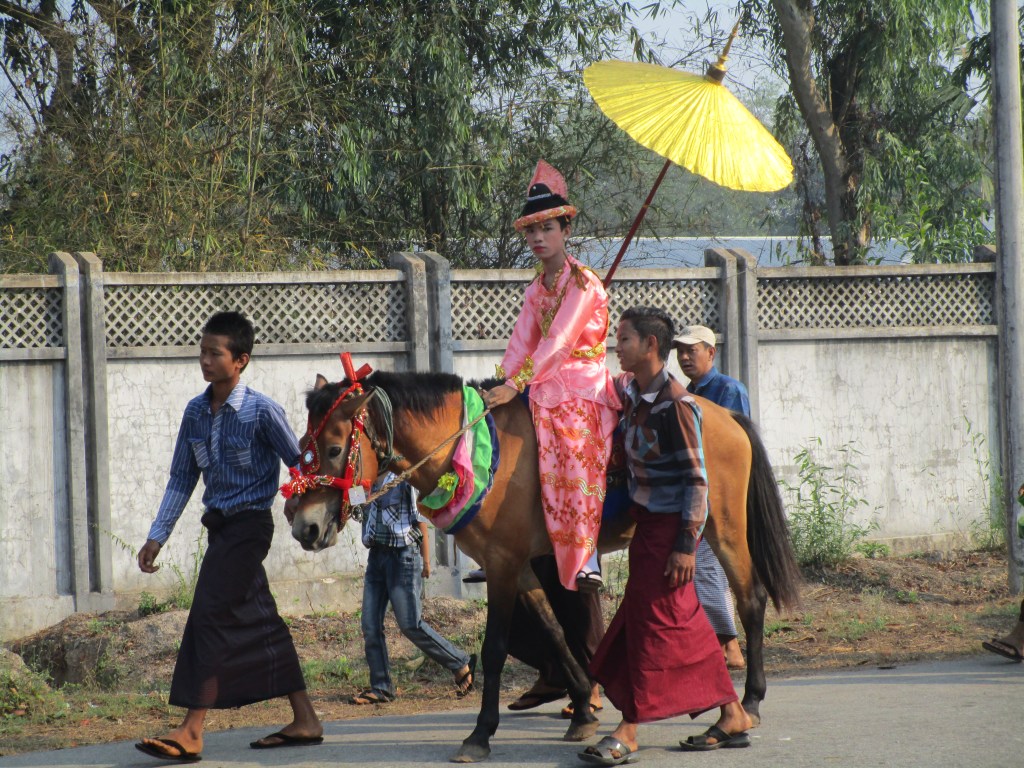
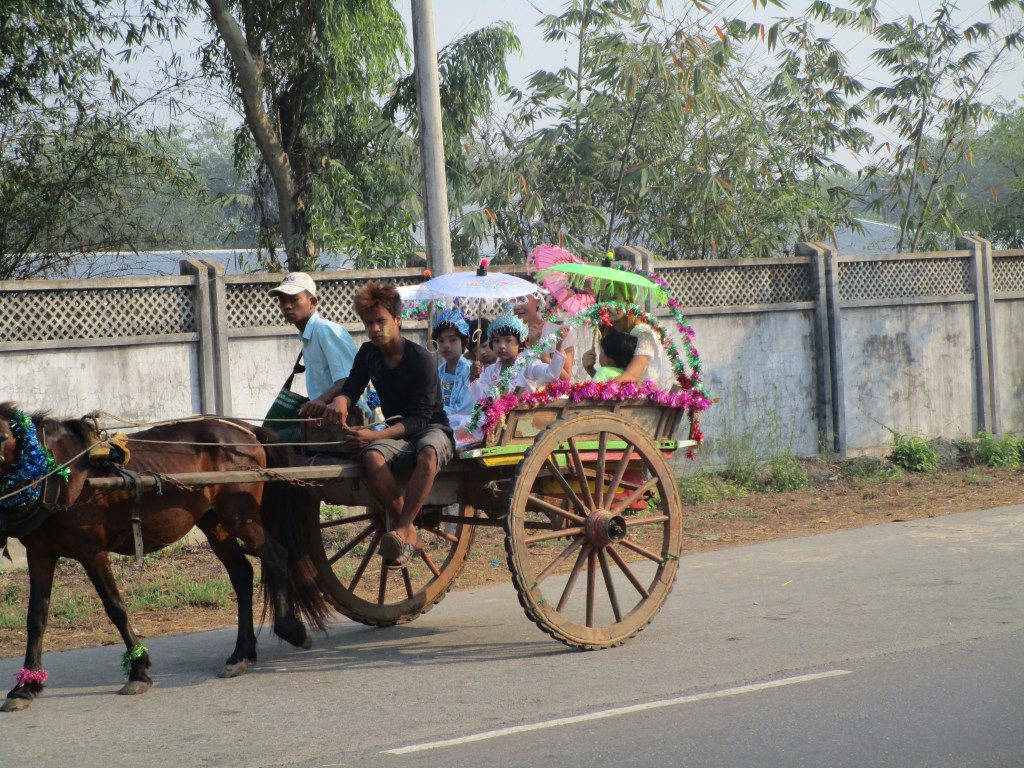
    I’ve been travelling to Myanmar since 1981 and it was quite unlike any procession I had ever seen: groups of men surrounding boys atop richly adorned horses and kept comfortable under the shade of golden parasols. The men, retainers more like, walked beside them in the baking March sun.  The boys wore lush embroidered silk outfits of pale pink or golden yellow, with headgear befitting a prince, while the men wore simple shirts and dark-patterned longyi.  Behind the boys were flower-bedecked horse carts carrying young girls under frilly parasols of pink, white, pale green. The procession stretched for hundreds of meters followed by a travelling band playing on a flatbed truck.

    BUDDHIST INITIATION RITES

    What my wife and I witnessed was part of the shinbyu, the initiation ceremony for monks that is a rite of passage for Buddhist boys in Myanmar. The first step is to re-enact the privileges of the Buddha as prince before he rejects the royal life in exchange for one of self-denial.

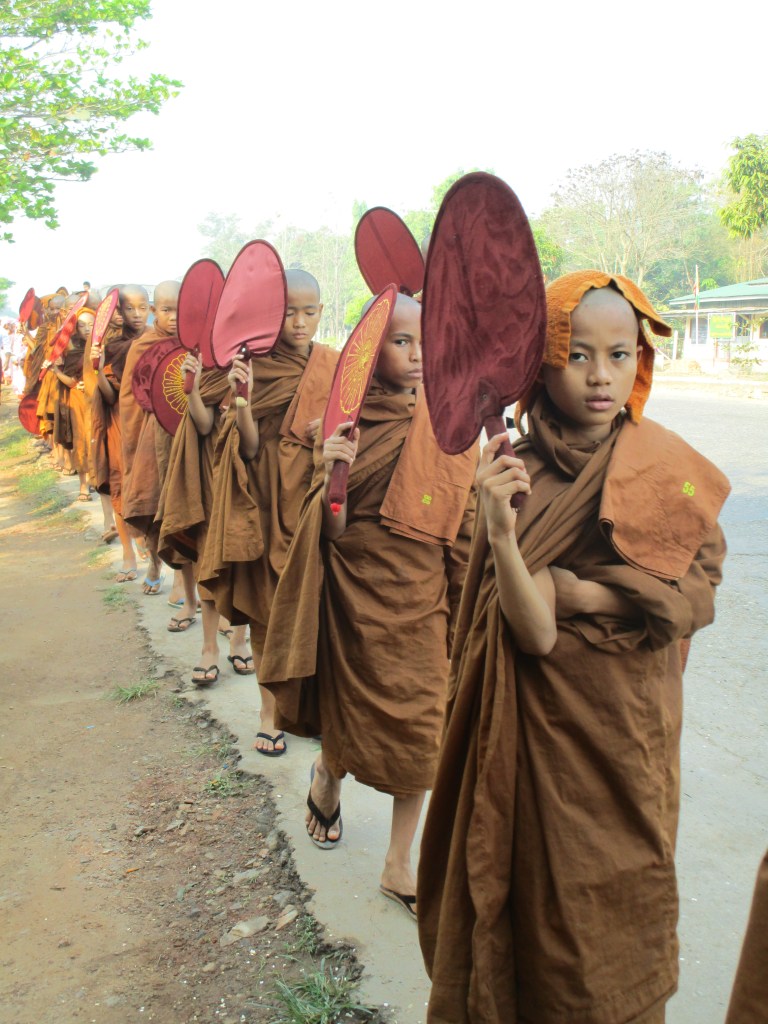
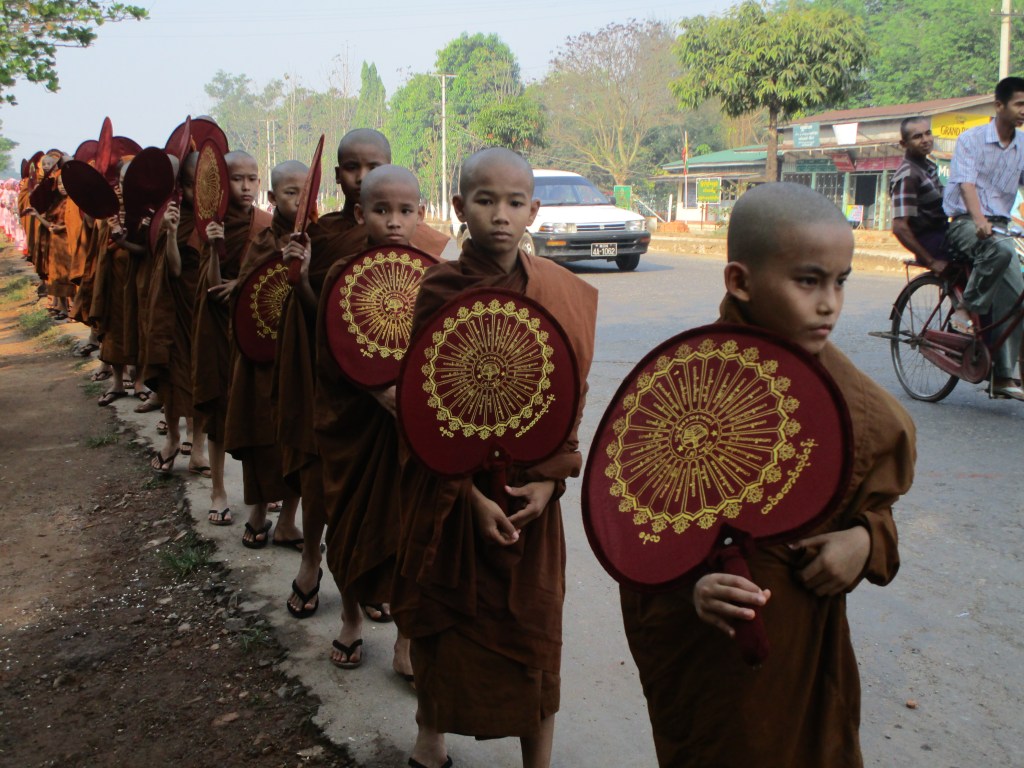
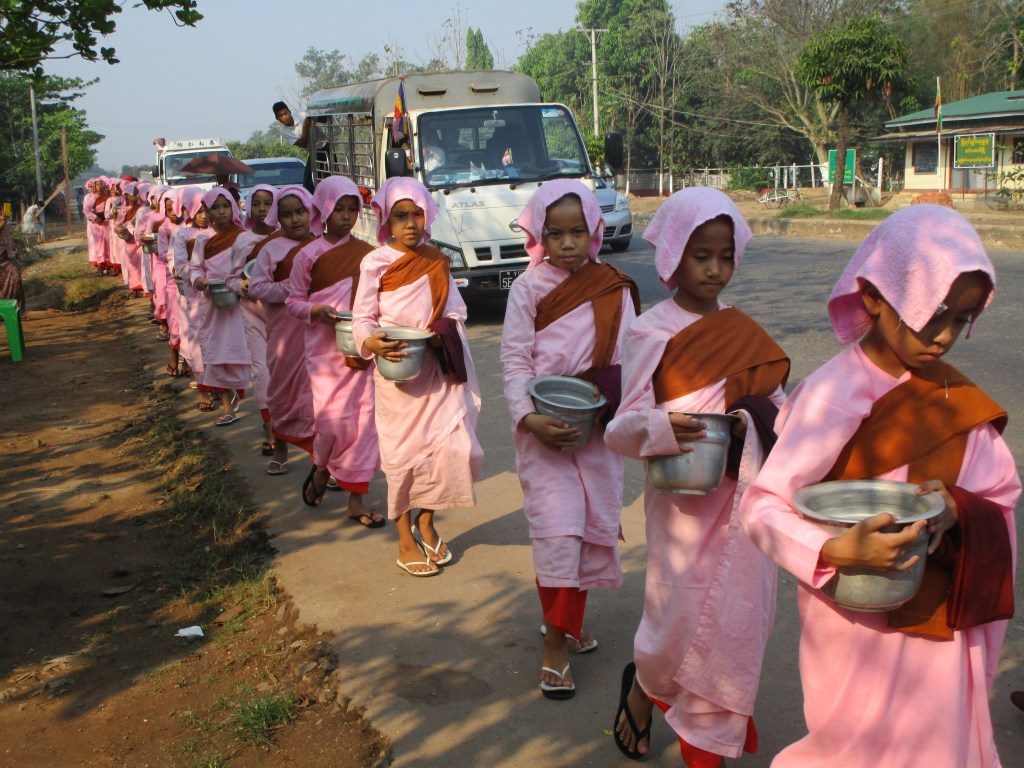
    Further down the road we saw boys who had already rejected their princely lives in favor of the simple existence of monks, their heads shaven, wearing plain brown robes and simple sandals, waving fans to cool themselves from the heat, temperatures above 30 C the day we saw them. Following them were dozens of girls in pale pink robes, carrying tin alms bowls, cloths draped over their heads to keep themselves cool.

    There were hundreds of boys and girls, all in a line, all along the road that stretched from the capital Yangon to the Golden Rock temple in the south of the country.

    The 210 kilometers from the traffic-clogged colonial-era city of Yangon to Golden Rock temple, also known as Kyaiktiyo Pagoda, is a journey to the golden heart of the country. Along the road I witnessed a microcosm of its spiritual side.

    HIGHEST PAGODA IN MYANMAR

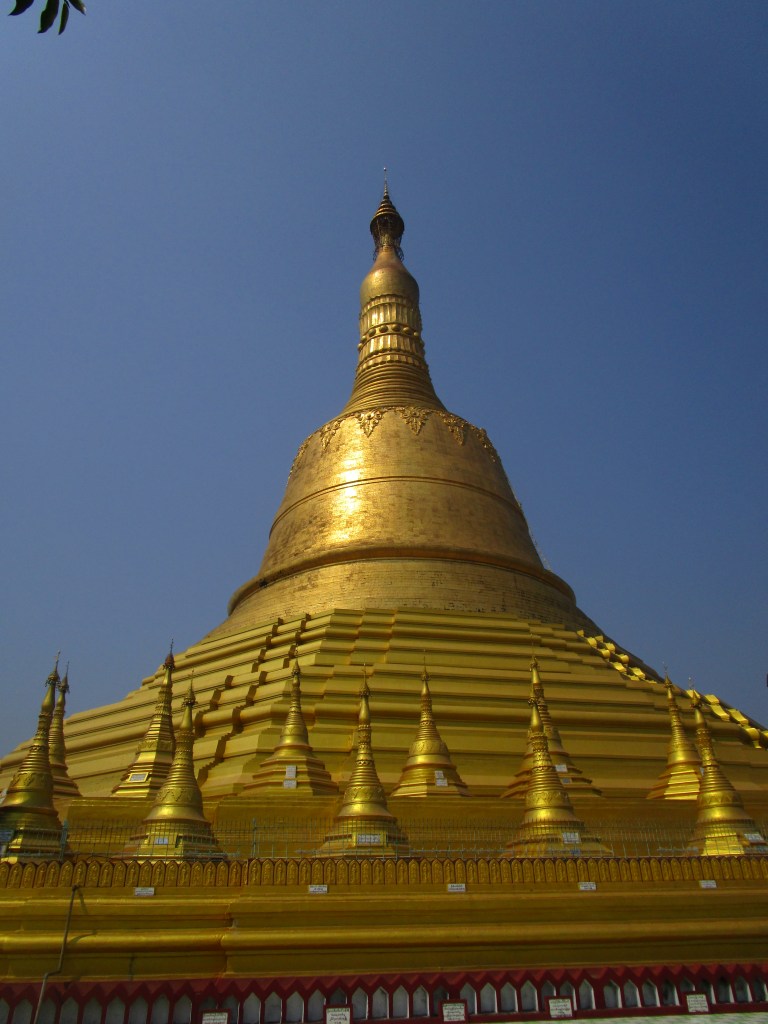
    At Bago, the midway point, we visited the Shwemawdaw pagoda, the highest pagoda in Myanmar at 114 meters, higher even than the Shwedagon pagoda in Yangon. Also known as the Golden God pagoda it is over a thousand years old, and reportedly contains hair and tooth relics of the Buddha. The pagoda dominates Bago and the surrounding plains with its golden spire contrasting against an impossibly blue sky the day I saw it. A young monk struck an enormous bell with a large wooden stick. Worshippers spent time in contemplation near the pagoda, staying in the shade.

    One of the challenges of visiting Myanmar temples is enjoying them while walking barefoot on ground that can sometimes be achingly hot. During the March April hot season we employed a strategy of lingering in the shade, and moving fast when not.

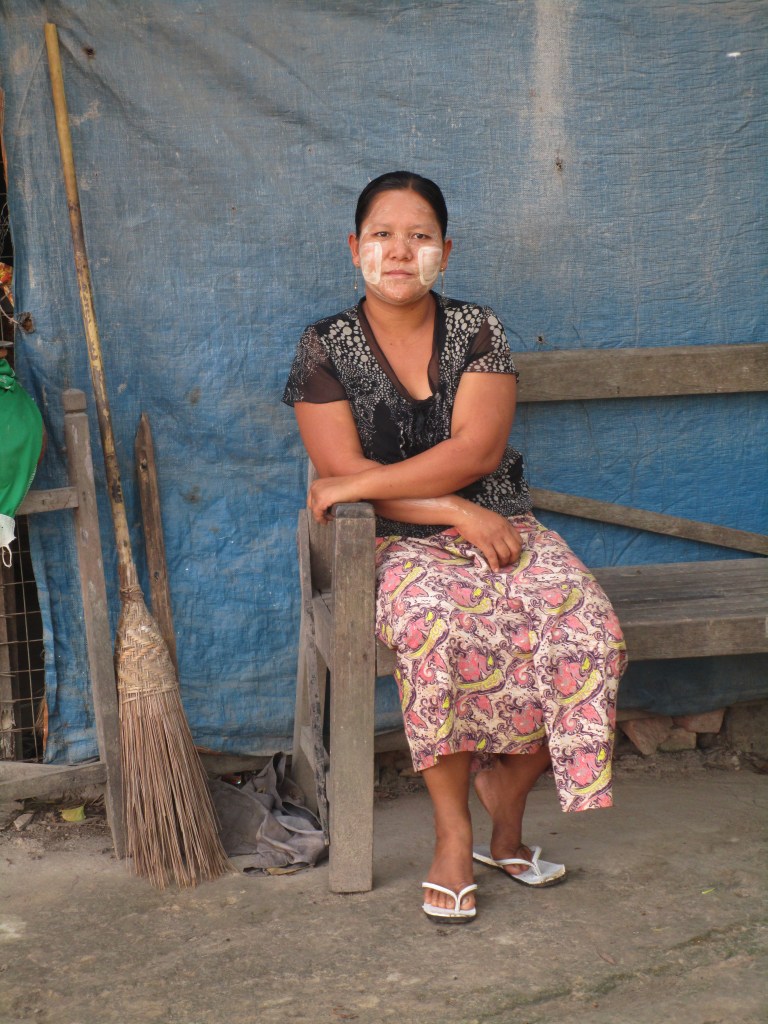
    As we left the pagoda via the covered walkway steps we saw iridescent green rice cakes for sale by a girl with a face thickly covered by thanaka, a yellowish sunscreen created by ground bark that looks somewhat like kabuki make-up.  There were hundreds of red bags of rice stacked on tables as donations to the temple. Just outside the pagoda I stopped by a woman with a cage of twittering sparrows. For less than a dollar, I bought three to release into the air. According to Buddhist belief, each bird you release earns you merit and symbolizes the letting go of your troubles. I’m not sure anyone’s troubles can so easily disappear but it did feel good letting the birds fly from my palms into freedom.

    SECOND LARGEST BUDDHA IN THE WORLD

    Nearby was the Shwethalyaung Buddha, which at a length of 55 meters and a height of 18 meters is the second largest Buddha in the world. Built in 994, its colossal size with an almost unreal serenity makes it a stop you want to spend time in. I wasn’t alone in feeling that way. Hundreds were there not just to look and move on but to stay and pray. Beneath the Buddha and along the temple’s wire enclosure were plaques with the names and amounts from donors all around the world.

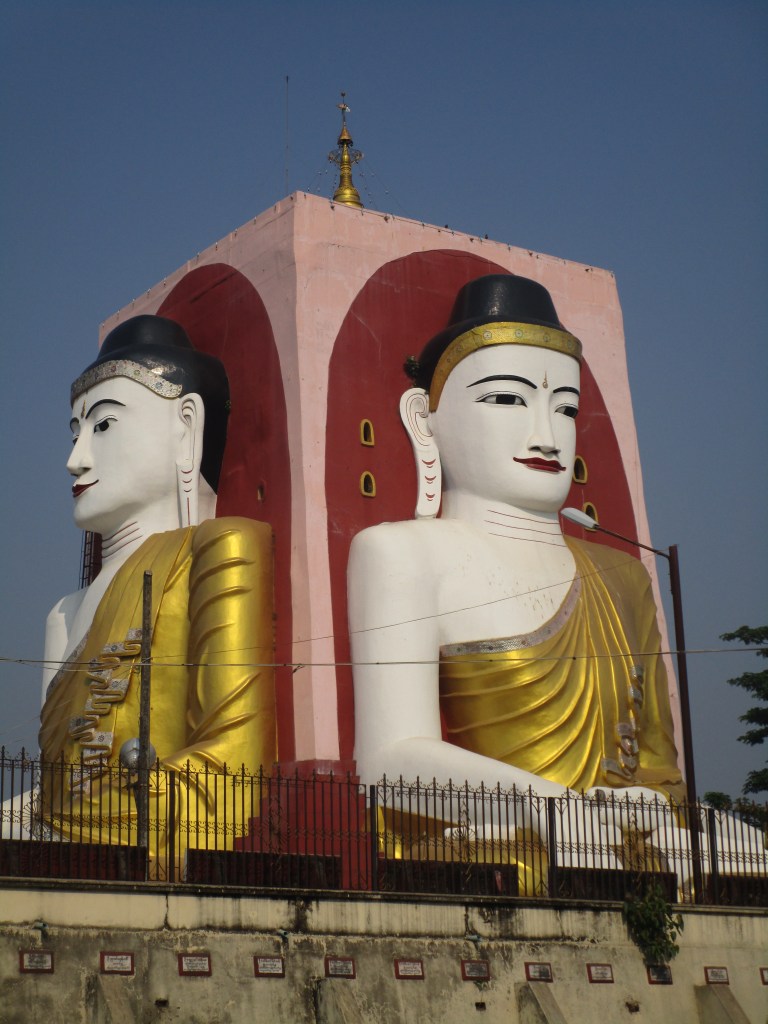
    Before leaving Bago, we stopped at the 27 meter high Kyaik Pun pagoda, where four gargantuan Buddha images sat ramrod straight against a massive square-shaped brick pillar. The pagoda was reportedly built by King Migadippa of Bago in the 7th century and renovated by King Dhammazedi in 1476. However, a folk story has it that it was originally built by four sisters vowing to be single. But the youngest one broke her vow. The statue of that sister is on the southwest corner where monsoon winds and rain regularly lash it. With alabaster white skin, glinting gold robes set against the ochre and faded pink of the pillar the four Buddhas looked like sentinels and must have conveyed how powerful the Mon kingdom was at its apex.

    LAST LEG TO GOLDEN ROCK

    To reach the Golden Rock temple we transferred at the town of Kim Pun from our van to a packed open-backed truck with seats in the back. For a little bit more you can ride up front with the driver. We decided to splurge! Each of the trucks had their own name. Ours was called Fuso Fighter.

    During the eleven-kilometer drive up on a steep, single lane road to an elevation of about 1,000 meters the drivers were quick to punch the accelerator or hit the brake! Lurching wildly from side to side I realized that having a bit of faith helped on this last leg of the journey.

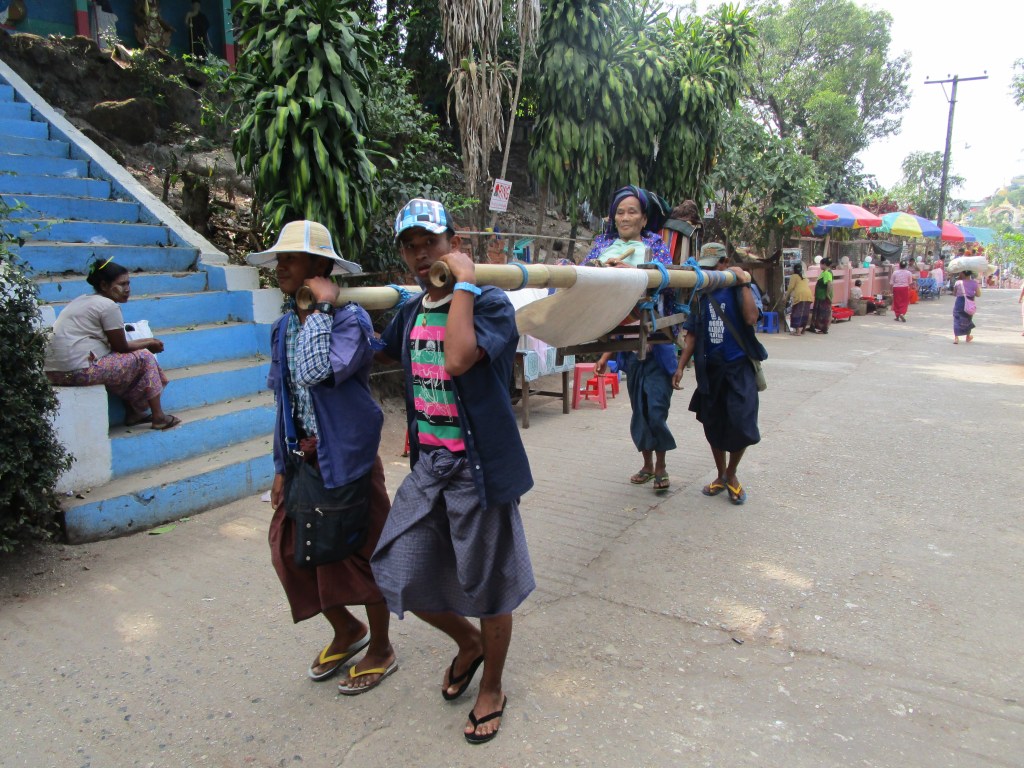
    At the top, we felt the buzz of anticipation from pilgrims and monks. Young men with baskets offered to carry the pilgrims’ belongings. For those in very poor shape, four young men would carry the pilgrims themselves on makeshift sedan chairs, a concoction of cloth with bamboo poles. The people in those certainly seemed comfortable. Most pilgrims just joined the quiet crowd making their way to the pagoda. Monks walked in a line with their alms bowls.

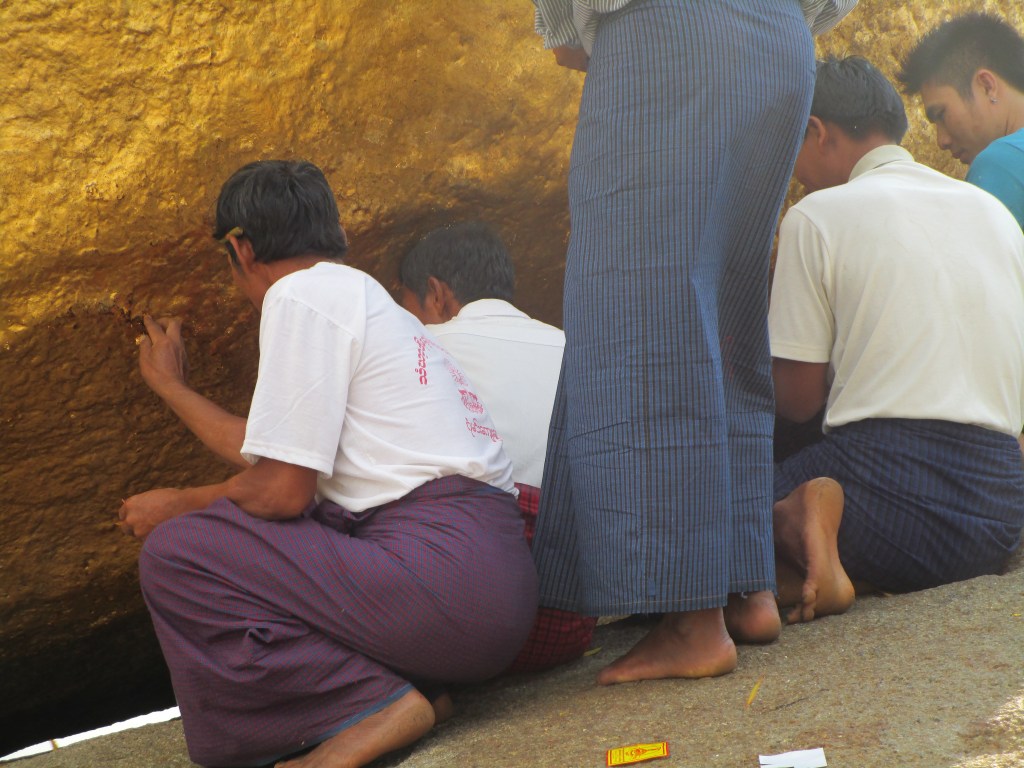
    Along the kilometer long path shops sold everything from bottles of herbal concoctions to freshly cooked dishes to musical instruments to amulets to gold leaf to paste on the Golden Rock itself.  For a thin filament of gold it’s about a dollar fifty.

    THIRD MOST IMPORTANT BUDDHIST PILGRIMAGE SITE IN MYANMAR

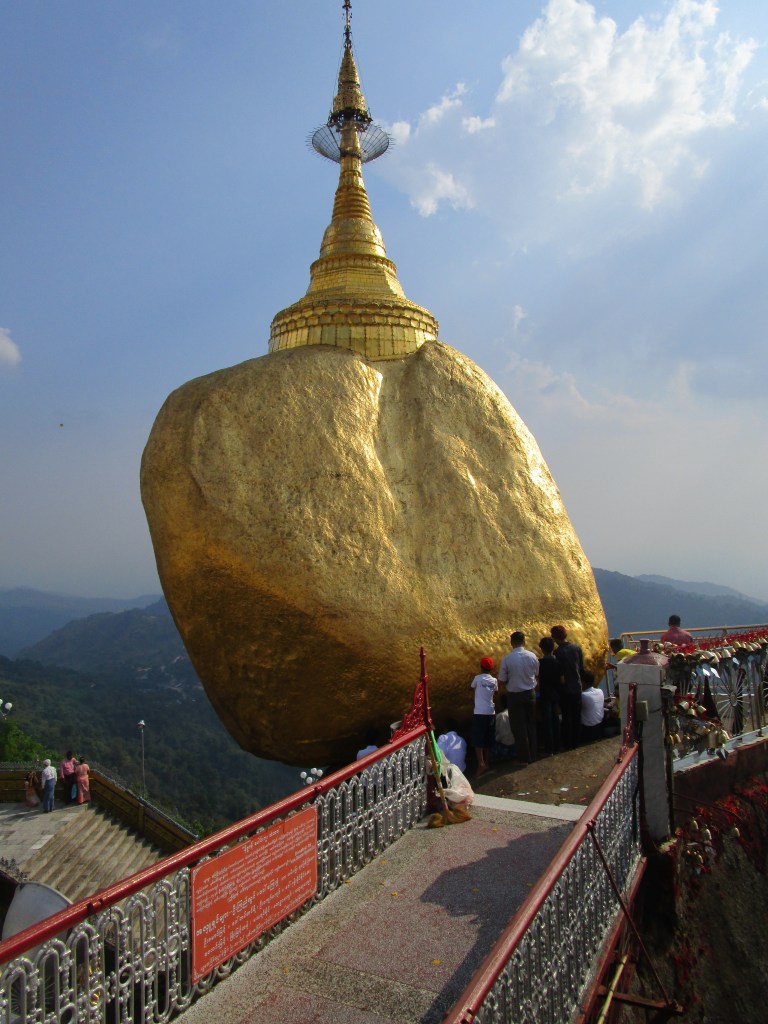
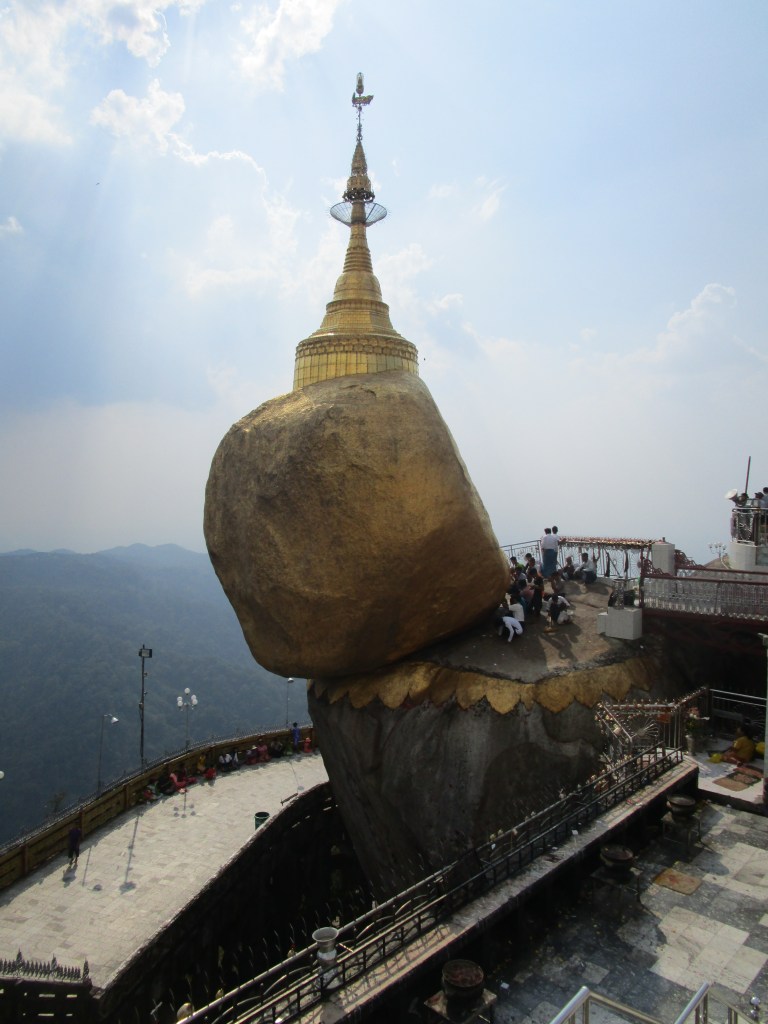
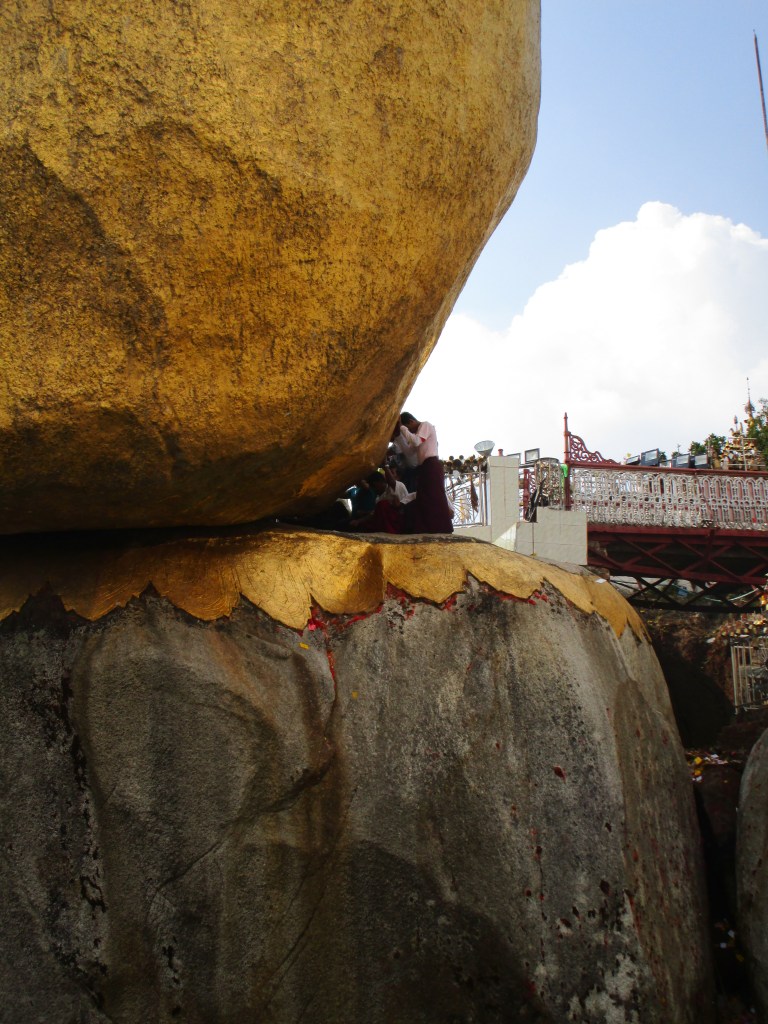
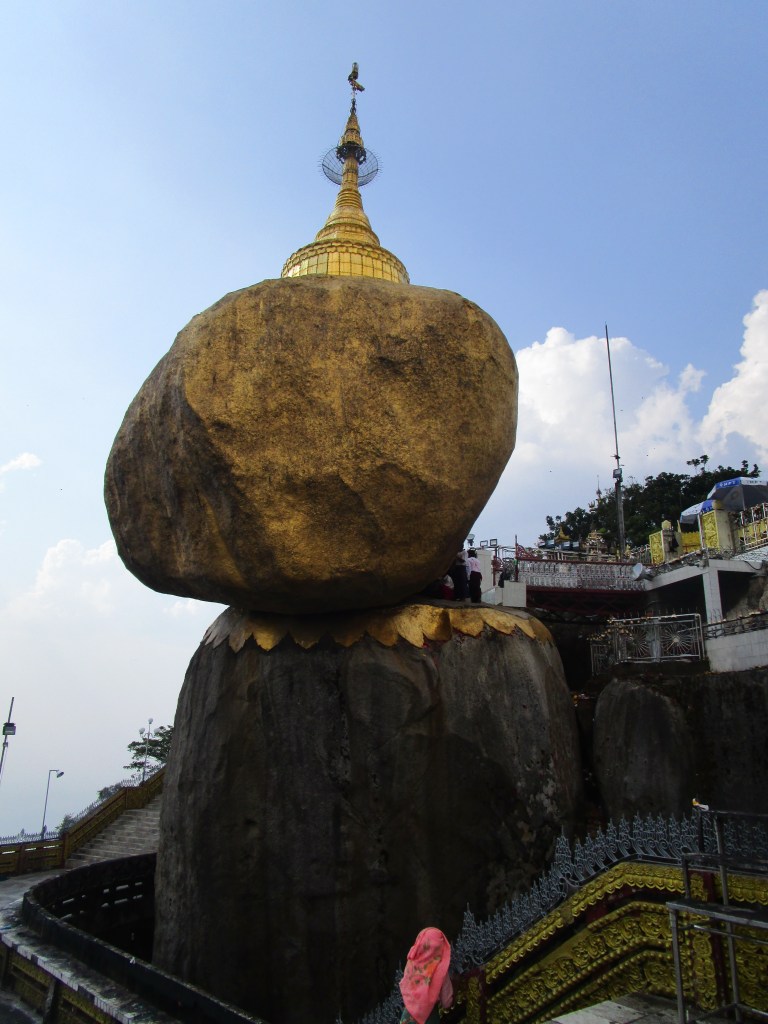
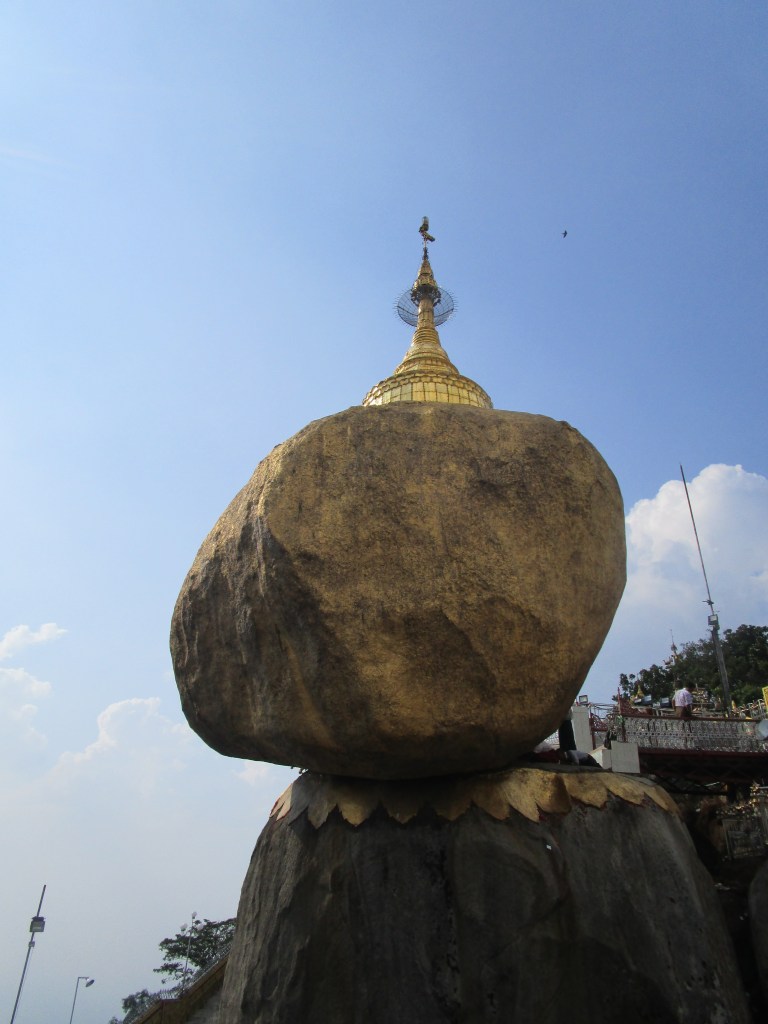
    The pagoda itself is small, about 6 meters in height. It sits on top of an enormous gold-covered granite boulder that looks like it’s just about to tip over and roll down the mountain. But it doesn’t fall, even though it’s nearly halfway off the ledge it has been on for eons and is some eight meters in height and 611 tons in weight. Legend has it that a hermit kept strands of the Buddha’s hair and then when he was dying, looked for a suitable place to hide it. He saw the loose boulder, Golden Rock, and built the small stupa on top where the strands of hair are kept inside. The pagoda was built in 574 BC.

    It is the third most important Buddhist pilgrimage site in Myanmar, after Shwe Dagon pagoda and Mahamuni pagoda in Mandalay.

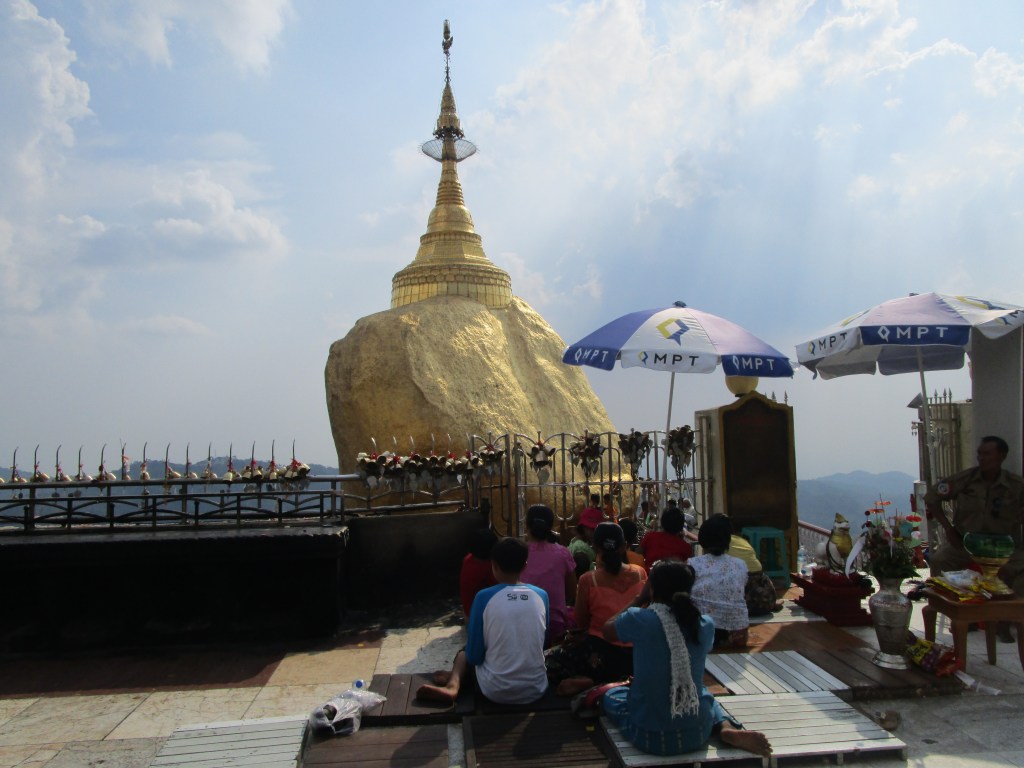
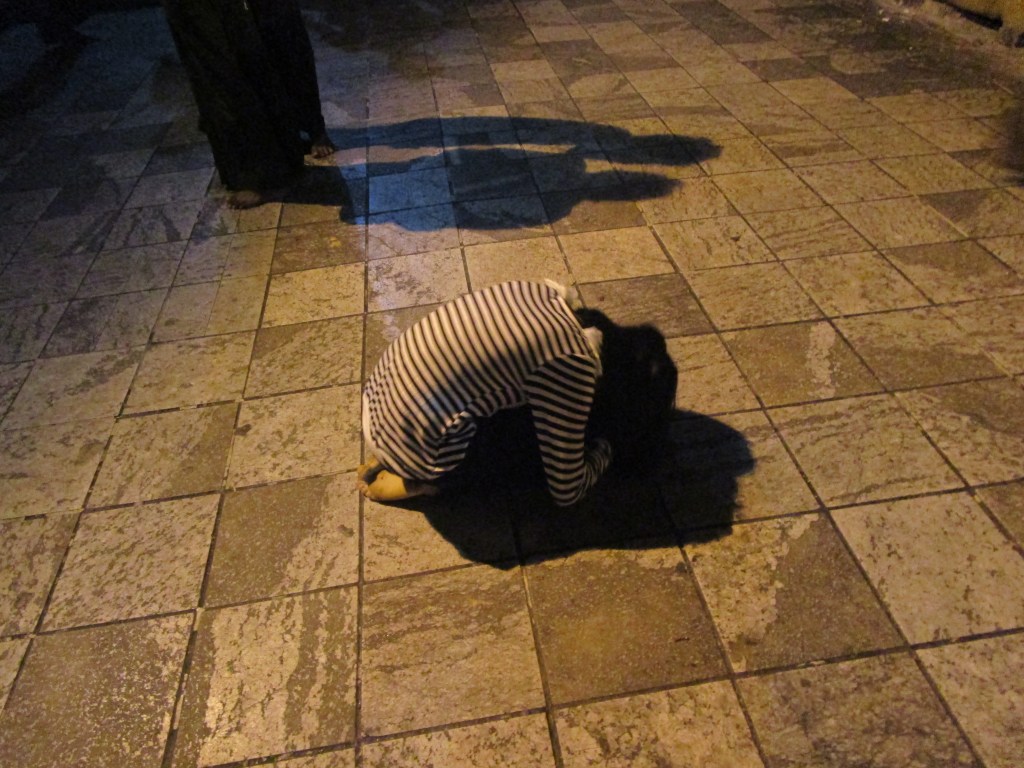
    The energy around the Golden Rock was palpable. Worshippers — and only men were allowed — pasted gold leaf at the base of the boulder.  Fragments frequently floated away on the breeze, catching the sun’s light as they did so. There was no fence or barrier of any kind between the base of the rock and a drop of easily ten meters. I asked our guide if anyone had ever fallen and she said no.  Yet, as men’s feet were literally inches from the ledge it certainly looked risky, even if you didn’t suffer from vertigo.

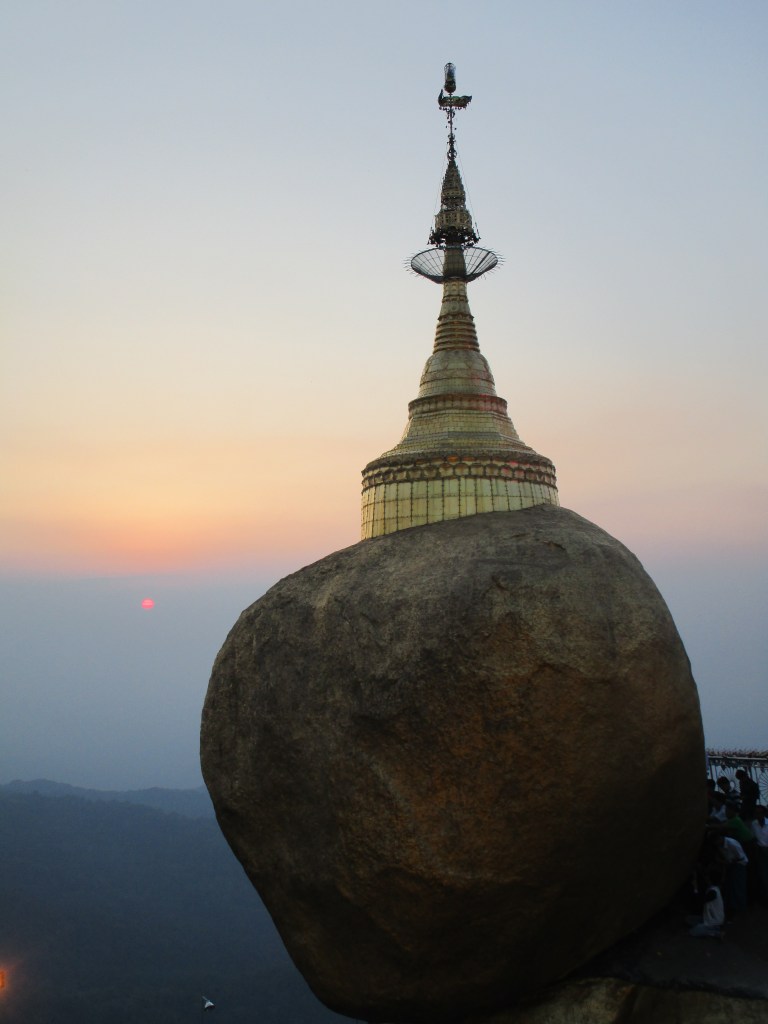
    I took steps down and soon I was looking up at the rock in more ways than one. The sense was that the rock was going to do something, take some action, yet it stayed absolutely still. It’s easy to understand why people are quickly mesmerized by it.  Some worshippers bowed to it. Others quietly put their hands together, closed their eyes and meditated. I watched as the sun set behind it, the valley glowing beneath it. Soon, the area was lit with hundreds of candles, casting a flickering glow on the Golden Rock that animated it, giving it a life of its own.

    Near the approach to the Golden Rock temple were numerous glass cases filled with bills, donations to the temple. Women sat and prayed under bare bulbs. Still further back people laid out mats and even set up tents, preparing to sleep there for the night so that they could worship at the Golden Rock at dawn.

    I had not seen this level of religious intensity in my previous visits to Myanmar. The Golden Rock temple struck me as truly Myanmar’s golden heart, combining electric engagement with worshippers with an unnerving stillness. It was both timeless and in step with the times.

    HOW TO GET HERE FROM YANGON

    From Yangon you can take a bus but I recommend renting a van and guide and taking your time.  Not only are there the temples in Bago but there is the Allied War Cemetery near Htauk Kyant where you can read the poignant epitaphs   families had engraved on their loved ones gravestones.

    If you go straight from Yangon — and happen to miss the city’s traffic — it will take between three to four hours to get there.

    CULINARY HEART TOO

    And of course, don’t miss the food. This part of Myanmar is its culinary heart too. Myanmar food takes hours to cook, bringing out the sometimes pungent flavours of the ingredients. At the roadside restaurants people would quickly eat dishes that had taken a morning to prepare. Among others, there’s mohinga, a rice noodle fish soup, stone pumpkin soup with chicken, and fermented bamboo shoot soup. It’s not a well-known cuisine so your chance to experience at its best is here.

    Mark Twain once said, “Twenty years from now you will be more disappointed by the things you didn’t do than by the ones you did do.” As remote as it was, a visit to the Golden Rock temple was well the effort to get there. It wasn’t just a journey to Myanmar’s golden heart, but a glimpse into the spiritual heart of the nation.

    Published in Asian Journeys magazine, October-November 2015

  • Mulu’s Many Mighty Wonders: the UNESCO World Heritage Area Impresses with Above and Below Ground Sites

    The World’s Largest Canopy Walk

    I was staring at a green viper while perched some thirty meters above the jungle floor on a suspension bridge the width of two narrow planks of wood and with the stability of a trampoline that a five year old had just jumped on. Luckily, the viper didn’t stare back. My son, just behind me, hurriedly me along so he could have a stare too. At 480 metres, the Mulu Canopy Skywalk in the Gunung Mulu National Park is the longest tree-based walkway in the world. With its bouncy suspension bridges fastened to tropical hardwoods you experience sheer drops over the jungle floor and a snaking river while walking – bouncing more like – at the same level as the tree tops and the birdlife while in the occasional shadow of steep limestone cliffs. The day we went there was only me, my son and our guide — and all that jungle.

    I first visited the Malaysian state of Sarawak in Borneo in 1981. It was an island enveloped with mystique then, with mist-covered limitless jungle wrapped around isolated longhouse communities. I’ve been back to Borneo a number of times since then and watched cities grow, roads cut through dense rainforest and plantations expand. So imagine my delight when the MAS Wings flight flew low over a landscape of mist-covered rainforest and mountains before landing at Mulu’s tiny airport. I told my son, who at nineteen is just a few years younger than I was in 1981, that this was the way I remembered Borneo.

    PARK OF SUPERLATIVES

    Gunung Mulu is a 529 square kilometre park which was listed as a UNESCO World Heritage Area in 2000. There’s only 160 in the world and two nature sites in Malaysia, the other one being Mt. Kinabalu. Mulu was selected because of its concentration of caves, river canyons, limestone pinnacles. It is a park of superlatives: the biggest limestone cave system in the world; the largest cave passage in the world; the largest underground river; the largest underground space in the world, Sarawak Chambers, where even St. Paul’s Cathedral can easily fit; a 180 million year old rainforest. The British naturalist and explorer Robin Hanbury-Tenison wrote of the area in his book “Mulu: The Rain Forest”: “all sense of time and direction is lost.”

    And yet it is relatively untouristed with approximately 12,000 tourists a year. When my son and I walked to the Deer Cave on the well-maintained jungle boardwalk it was just us, our Iban guide from the Marriott hotel and another hotel employee. We had the forest to ourselves. The Deer Cave loomed above us like a cathedral whose architect was nature itself. It is not only the world’s largest cave passage but has the world’s biggest cave mouth and is 220 meters at its highest point. Limestone cliffs opened up to reveal the majesty of the cave. The path through the cave – it’s 2.2 kilometres from one end to the other – allowed us to see the frequent pulsating dark patches on the ceiling, where an estimated 2 to 3 million Wrinkle-Lipped and Horseshoe bats hang upside during the day before flying out en masse at sunset. We also passed mini-mountains of guano. If you put your hand on the path’s rail it is soon covered in, well, guano. At the far end of the Deer Cave is the site known as The Garden of Eden, a sun dappled malachite green paradise encroaching on stony darkness.

    SUNSET BATS

    Outside the entrance of the cave we joined the rest of the tourists, maybe only fifty in total, to watch the sunset show. At about 5:30pm the bats started to fly out in spiralling flocks and for the next hour they kept on coming, floating up from the Deer Cave’s entrance like twisting DNA strands until they became black floating clouds. Bats make echolocation sounds to help them navigate. From the ground the sound of tens of thousands of bats creating that noise was like the low rumble of waves washing against a distant seashore, rhythmic yet hushed.

    We stayed for an hour until it was dark and we were the last ones there. The walk back to the park entrance was never dull as the nocturnal creatures revealed themselves: a four-inch male walking stick piggybacking on a female walking stick that was easily double its size; frogs, fireflies, giant snails climbing up trees.

    AN IN-BETWEEN WONDER

    After a day that full we retreated to one of the in-between wonders, the new Marriott Hotel, which was designed to look like a series of native long houses on elevated walkways. It reminded me of the safari lodges in Africa. You may be in a remote place where you don’t expect comfort at all but the lodgings are surprisingly luxurious. And the hotel certainly spent a lot of effort to get it right: over USD16 million on renovating 101 rooms over three and a half years. Everything had to be shipped in.

    The next morning we took a long boat from the hotel’s pier down the Melinau River. As with the forest walk there was only my son and I and our guide and a boatman. We had the tranquil, cliff-and jungle-lined river to ourselves.

    ORIGINAL FOREST DWELLERS

    We stopped first at Batu Bangan, a Penan village. While the Penan were originally hunter and gatherers, only about 200 of them live that nomadic life now. The remaining 16,000 have been settled into villages. The Penan are noted for “molong”, the practice of not taking more than necessary.  The greatest violation in their society is “see hun”, which is “a failure to share.” They have no word for thief and six words for varying levels of “we.” And even though they have a word for every plant and animal in the forest, they have no word to describe the forest itself. They refer to the forest as “tongtana”, the only world they know. With our over-competitive, overconsuming society I felt we could learn a lot from them.

    WORLD’S LARGEST CAVE SYSTEM

    Further down the river, we walked along a narrow cliff clinging boardwalk from Cave of the Winds to Clearwater Cave where we were greeted by dozens of Rajah Brooke butterflies with their iridescent green and black wings. The final ascent from a tranquil pond was 200 steps but well worth the effort. In addition to having the world’s longest underground river at 170 kilometres – only 75 kilometres of which have been explored – the Clearwater Cave is known to be the largest interconnected cave system in the world. The crystalline water racing through the mountain was one of the highlights of the park. The bridge over the water was a great place for meditation or reflection.

    IMAGINATION RUNS WILD

    The stalagmites and stalactites at all of the caves create shapes that bring to mind all sorts of things. The most obvious was the Abraham Lincoln profile near the entrance of Deer Cave but there were wilder interpretations at some of the other caves. The King’s Chamber at the Cave of the Winds looked like a futuristic city from a sci-fi flick. The statue of the lady at the Clearwater Cave. The tropical forest at Lang’s Cave. The caves bring out the best of your imagination.

    ON THE WAY TO NOWHERE ELSE

    Getting to the park is something of a challenge. It’s right below Brunei and not on the way to anywhere else. The closest city to the park is Miri but you can also get there from Kuching and Kota Kinabalu on MAS Wings, the only airline that flies there. Of course, the difficulty of getting there means not fighting the crowds when you do get there.

    GREAT FOR FAMILIES…COUPLES TOO

    The park facilities from the museum to the boardwalk paths through the forest and the caves to the motion sensor lights in the caves were all first rate. I saw families with small children enjoying the park. The kids especially loved the bats and caves. Another park attraction is its internet connection — it’s very weak! Which means you may have to talk to the person you’re travelling with — whether it’s your family or significant other. Despite the ruggedness and remoteness of the park, the focus on safety is high. Guides are there to show you the fauna and flora and to make sure you’re safe from them — and of course that they’re safe from you. For the long unguided walks, you’re supposed to register with the park office.

    As a UNESCO World Heritage Area Mulu is one of the rare natural wonders of the world. Not as famous perhaps as some of the other sites such as the Grand Canyon, Mount Kilimanjaro, the Great Barrier Reef and Ayers Rock. But much more special because far fewer people visit it.  As Robin Hanbury-Tenison said: “There is nowhere in the world like the Mulu National Park.”

    Published in Asian Journeys magazine, August-September 2015

  • Bangkok’s Serene Haven in Art-shopping Heaven: Drop After You Shop at the Plush Art-filled Anantara Siam Hotel

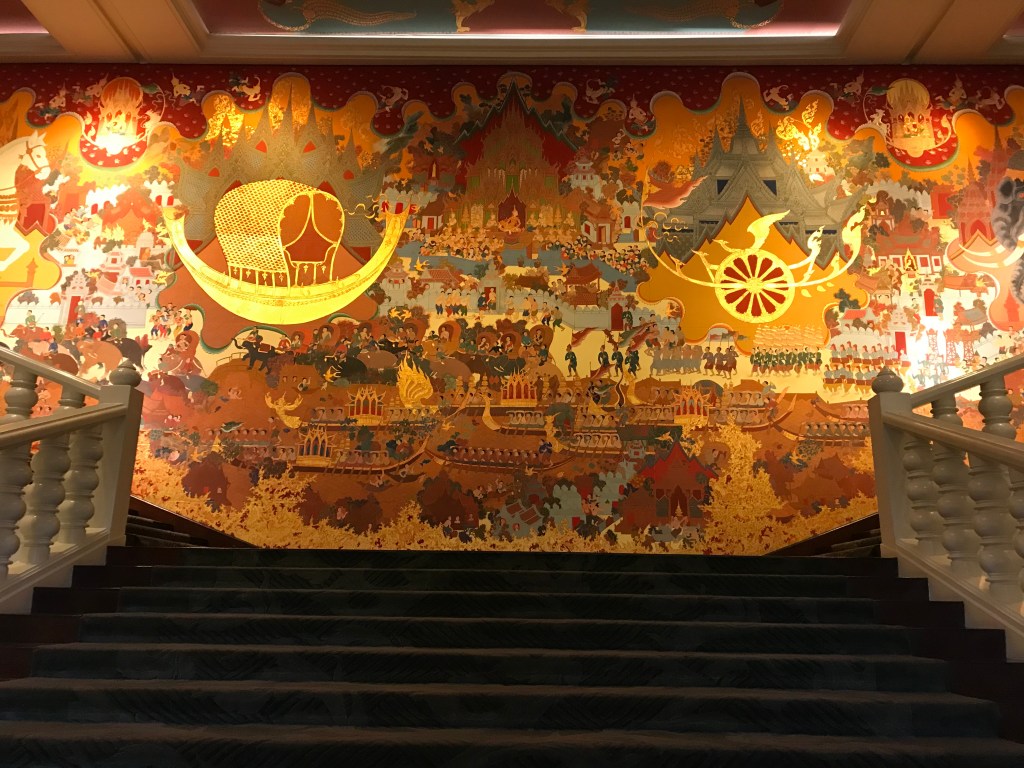
    Mural, Anantara Siam Hotel lobby

    Bangkok’s reputation as a shop till you drop destination is so well known it’s practically a meme. From Siam Paragon and Central World in Ratchadamri to Chatuchak weekend market to the newish Icon Siam on the Chao Praya river, listing them all would dwarf a Yellow Pages directory; visiting them all would be more tiring than sprinting up the side of the Grand Canyon.

    Inspiring art to inspire shopping for art

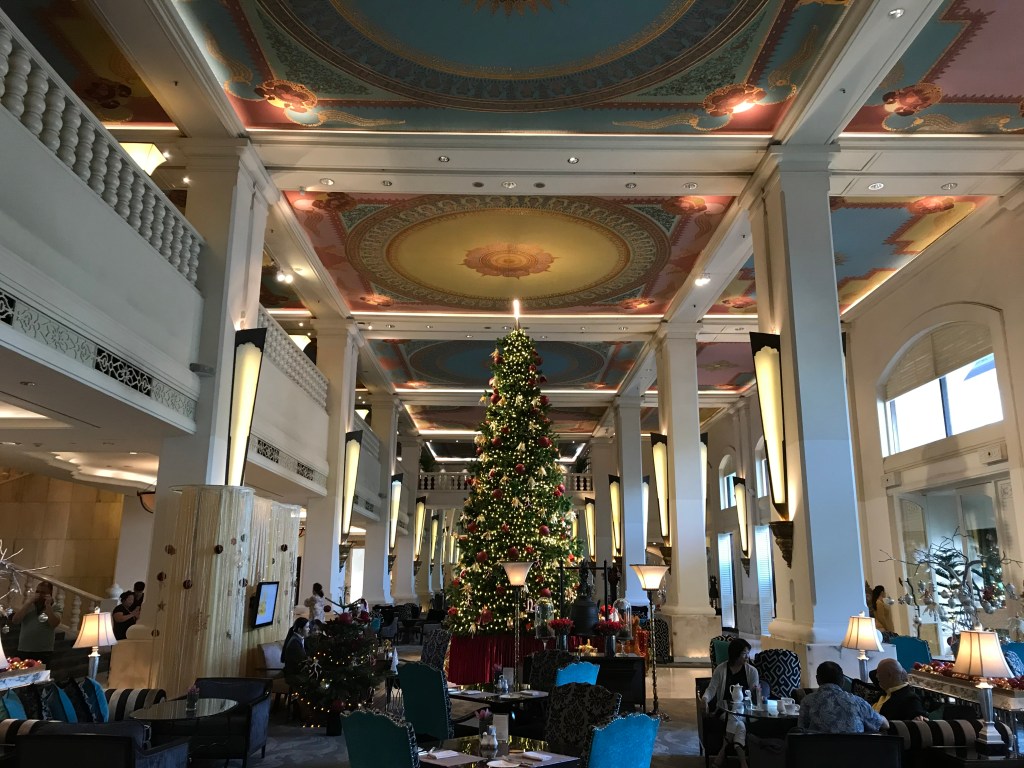
    What is less well known is that Bangkok is a destination for art lovers who love to shop for art. That shouldn’t be too surprising since Bangkok is a center of art from the traditional to contemporary. If art is your focus – and it is mine – then starting it from a hotel with expertly curated artwork gets your mind in the right space before deciding what will occupy a space in your home. The Anantara Siam, designed by leading Thai architect Dan Wongprasat, has a jaw dropping palatial lobby. The mural on the grand staircase landing of a traditional royal scene in hues of gold and red and the mandala painting on the sweeping ceiling by the late artist Arjarn Palboon Suwannakudt, gives the expansive space the feeling of a living, breathing palace that you want to linger in. And would certainly like to stay at.

    Artful champagne brunch fuels my search

    The Sunday champagne brunch to fuel my search for art was so rich – and enriching –  I almost called off the search. After the lobster thermidor, foie gras, fresh scallops, raw oysters, dessert bar and glass after glass of champagne I was feeling a little too comfortable to brave the rigors of art appreciation. But a cup of espresso finally got me off the all too comfortable dining room chair.

    Contemplate life while contemplating traditional art

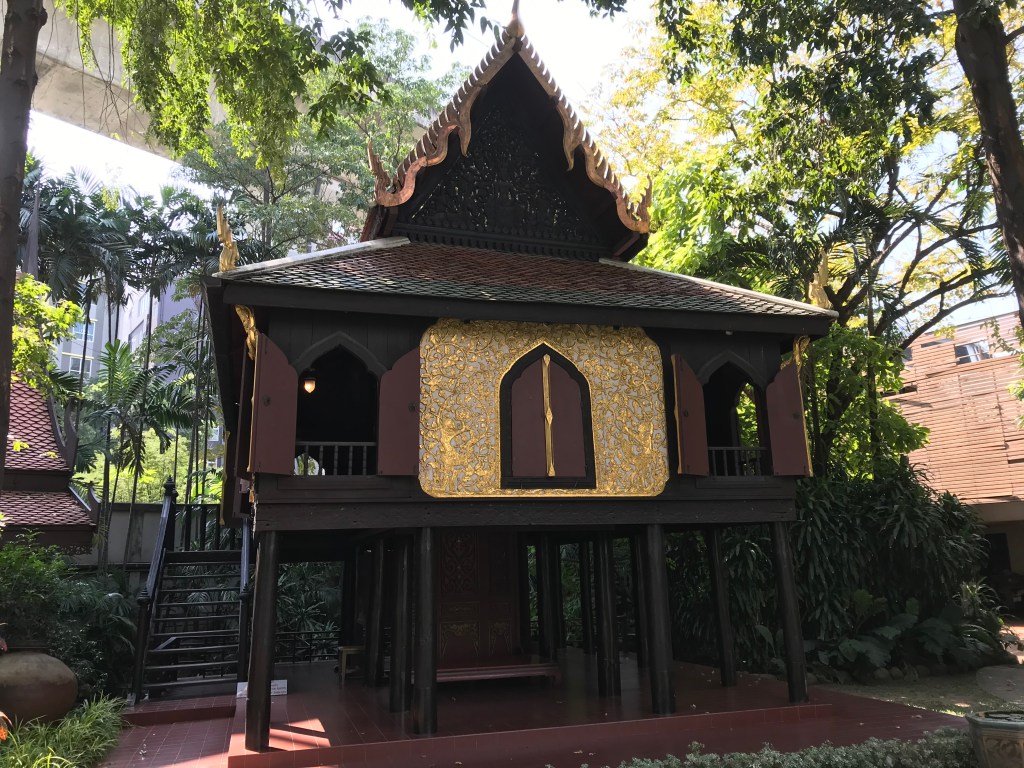
    Armed with a Bangkok Art Map that I got from the Anantara Siam’s concierge I started my art shopping excursion at Suan Pakkad Palace on nearby Sri Ayutthaya Road. There was nothing to buy at this museum but plenty to inspire me. The palace, once the home of Prince Chumbhot of Nagara Svarga and his consort, features a collection of artwork and antiques in eight houses that are some of the best examples of traditional Thai architecture in the city. The murals, sculptures, and art you see while sliding in your socks across polished wooden floors started the process of deciding what would work best in my home. What I saw there gave me ideas as to what antiques I would like to get. And I know that one of the most renowned centers for antique shopping in Asia is The River City Bangkok mall on the Chao Praya River.

    Echoes of Frank Lloyd Wright

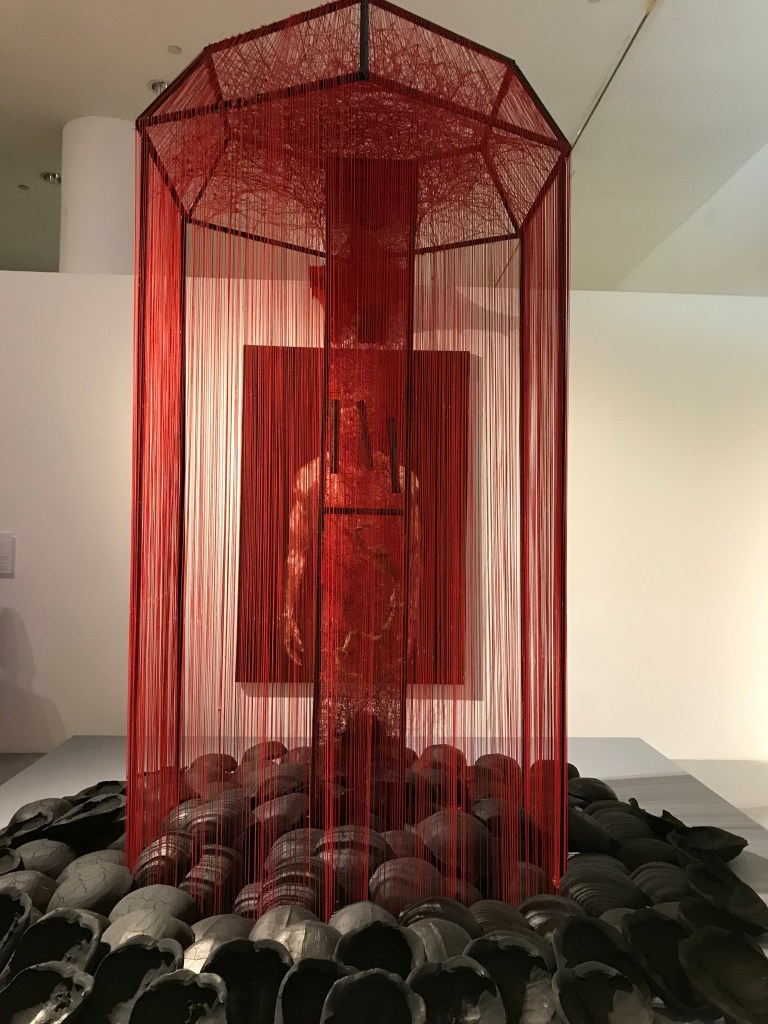
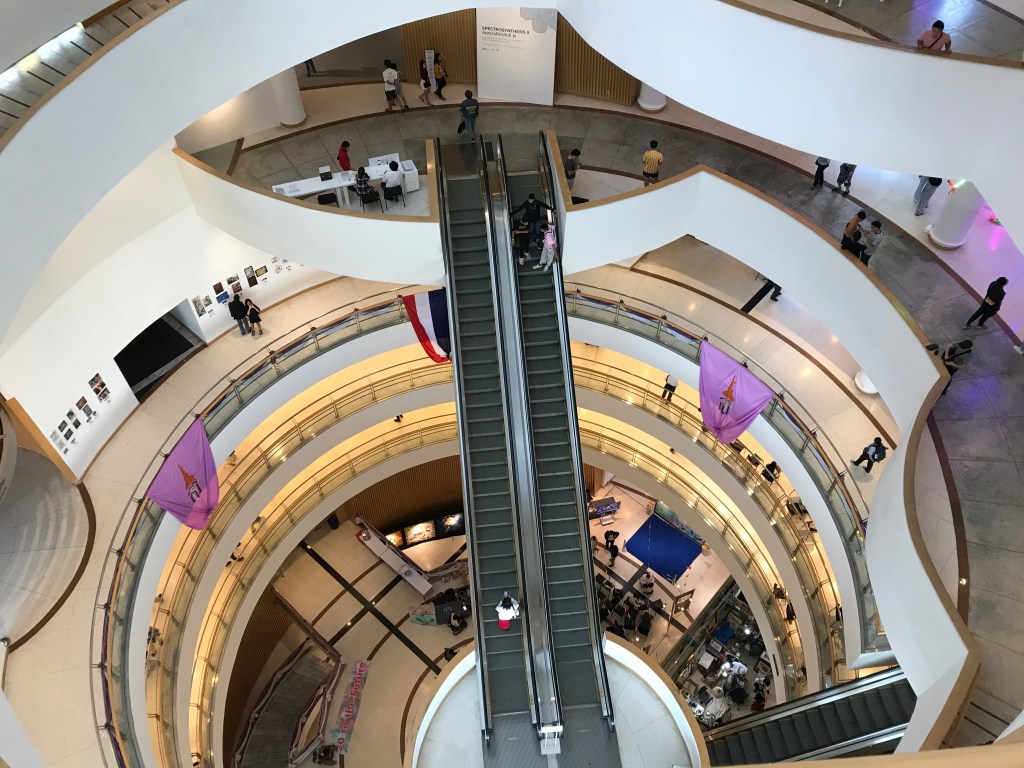
    My next stop was the Bangkok Art and Culture Center. It’s on the opposite end of the art spectrum from the Suan Pakkad Palace. An eight-story venue for contemporary art and shops selling hip crafts and gifts it attracts a crowd poked and provoked by its art. I went to the top floor to see the wonderful Royal Photo Exhibition, “Photos Wonderland,” and then worked my way down the spiral walkway that took me from one floor to the next for further art contemplation. It reminded me a bit of Frank Lloyd Wright’s Guggenheim Museum in New York with its top down spiral walkway. One of the shops, BKK Graff, sells cans of spray paint so that you can graffiti a space. Hopefully, not your home.

    Talked about art for your walls

    A short walk from the Anantara Siam are three galleries that are among Bangkok’s best for contemporary art. Le Link Gallery, Tonson Gallery, and Nova Contemporary all feature contemporary artists whose art can dominate a wall and become a talking piece for visitors. Or yourself. Displayed at the Le Link Gallery were the brightly coloured Magenta Blues Artwork by German artist Ingeborg Zu Schleswig-Holstein.

    Before returning to the hotel I had a drink at the nearby Smalls Bar, chockablock with art. It’s rated by CNN Travel as one of the top bars to visit in Bangkok. All the art displayed in the three-story quirky bar is for sale.

    From fine arts to culinary arts at The Spice Market

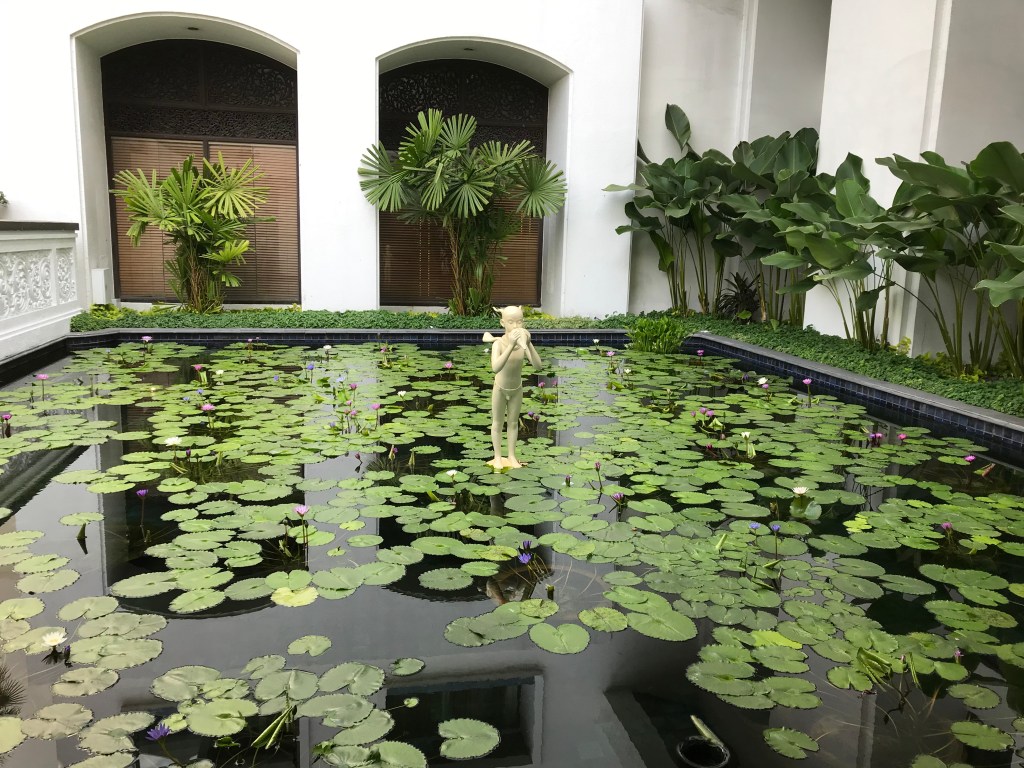
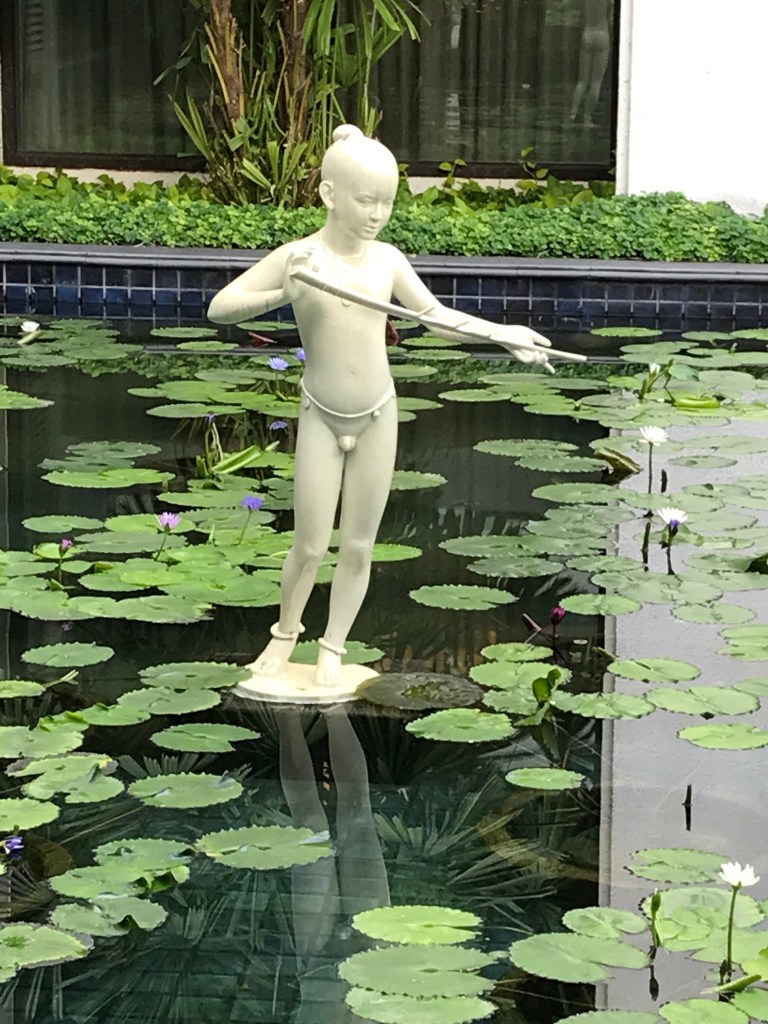
    After a day launched with a great meal it was time to end it with one. On the way into the hotel lobby I passed statues of water sprites surrounded by water lilies. Their presence is a reminder that you are entering a special world.

    The Anantara Siam’s The Spice Market is one of the finest Thai restaurants in Bangkok, helmed by award-winning Chef Warinthorn Sumrthlphon.

    The ambience of the restaurant puts you in the right mood to savor the food. With a polished teak wood décor, tables topped by Carrera marble, and cotton napkins and pillowcase coverings by Jim Thompson, it is a luxurious setting.

    And the food lives up to the décor. The ingredients are sourced locally to ensure freshness. The fruits and vegetables are all organic. The curry pastes are from the kitchen of M.L. Thor Kridakorn, whose recipes are so famous that they grace the dining table of the Royal Family.

    Some of the dishes I tried were the Tom Yam Goong, a spicy prawn soup perfectly flavoured with lemongrass; Larb Nua Pu Gab Goong Mae Nam Yam, crab meat salad and grilled river prawn; Pu Nim Phad Prig Thai Orn, crispy soft shell crab in peppercorn sauce; Kai Soe Rua Nua, northern style egg noodles in curry with chicken; and, Gaeng Kiew Warn Nua Toon Cab Roti, green curry with braised beef in coconut sauce.

    No amount of description can do them justice. More chamber music than symphony with their focused and nuanced flavours each dish was a distinctive delight. The meal was so filling I couldn’t tackle dessert, much as I wanted too. Next time I’ll pace myself better. I have my eye on the Tubtim Krob, the ruby water chestnuts.

    Only hotel in Thailand to offer sacred tattoo sessions

    Anantara Siam’s commitment to art is more than skin deep. It is the only hotel in Thailand to offer private sacred tattoo sessions by Bangkok’s most famous Sak Yant master, Ajarn Neng Onnut. He has inked Hong Kong star Alex Fong and Hollywood ones Ryan Philippe, Jessica Bradford, and Brooke Shields.

    As one of the world’s most ancient, sacred traditions, to master Sak Yant means learning how to do the artwork for almost a thousand different images. To become a master Ajarn Neng learned how to read and write ancient Khmer and Pali scripts and memorise unique prayers and secret spells, chants and mantras that relate to the sacred tattoos.

    His tattoo sessions at the Anantara Siam are private, either in a guest’s room or a private treatment room. The day before the tattoo he has a consultation with the guest where he learns about their life and goals before deciding on the correct Yant. Prior to the session and afterwards, Ajarn Neng performs a ceremony where the guest’s body and the art are blessed. That gives the wearer of the tattoo an emotional reminder of the experience that links the ink on their body to what it means to their life.

    Leaving an indelible mark in more ways than one

    A session with Ajarn Neng will leave an indelible mark on your spirit and your body. The Anantara Siam offers this unique experience so that you can get beneath the skin of Thailand for a richer appreciation of its culture.

    The same is true of a stay at the Anantara Siam hotel. The culinary art of its kitchens, the prompt, warm service, and the art that embraces you in visual splendor when you enter the hotel will also leave an indelible mark; the kind of indelible mark we all want to experience and take with us wherever we go.

    Published in Asian Journeys magazine, February-March 2020
  • Balancing Breathless Bangkok’s Ying with Yang: At the Anantara Siam Even the Fighting Fish are Relaxed

    Bangkok leaves you breathless. A pulsating, mega hive of frenetic activity, shopping is in malls wall to wall with branded goods and one of a kind items from one of the world’s most creative societies. Nightlife ranges from the pinnacle of high life in Sathorn and Thonglor — sky bars on rooftops to restaurants and clubs with sky high prices — to tawdry dens of iniquity that operate in dingy, neon lit alleys in Patpong and Soi Cowboy.

    All that activity can sometimes grate like a chainsaw tasting the bark of a tree before it’s cut down. Which is where Anantara Siam comes in. Just a few minutes’ walk from the Ratchprasong shopping district, it’s as tranquil as a posh private club in London. Its Thai design style from leading architect Dan Wongprasat gives you a sense of place and differentiates it from other hotels which have by the numbers luxury. More treat than retreat, you can take a breather here from this breathless city. From its palatial lobby, you view the soaring celling filled with mandala paintings from plush chairs you sink deeper and deeper into. The wall sized painting at the grand staircase’s landing by one of Thailand’s most famous painters, the late Arjarn Palboon Suwannakudt, is worth taking the stairs for to have a closer look. While he didn’t live to finish the work, his children, also artists, helped complete it as well the ceiling paintings in the lobby and mezzanine. It’s an enormous artistic achievement, 700 square meters of work.
    From “Well well” to wellness

    My wife and I had dinner at Anantara Siam’s Biscotti Restaurant, rated one of Bangkok’s best, according to Thailand Tatler and the Bangkok Restaurant Awards. It also received recognition from Michelin. I had a starter of creamy burrata cheese with tomatoes, ciabatta bread, basil dressing and shavings of truffles, while my wife had sea scallops, cream of buffalo mozzarella, cherry tomatoes confit and olives pate. Following our main courses of risotto black truffle with porcini, and grana Padano cheese and black ink angel hair pasta with king crab, prawns, and sundried tomato basil, we were stuffed. But we figured we would diet another day. Dessert was carmello spuma with layered dolce di latte foam, coffee granite, arabica crumbs and cocoa crackers and the Mascarpone Berry Salad with mixed berries, raspberry coulis, mascarpone cheese and pistachio sponge. The theatre of the dessert almost overwhelmed the taste. It was delivered to our table complete with trailing wisps of dry ice like something a sorcerer would prepare.

    “Well, well,” we thought. Not a meal we’d soon forget. Nor our scale. Just describing the meal was a mouthful.

    In the morning, we went from an indulgence ying to a wellness yang. We joined Anantara Siam’s new signature wellness program, “Morning Wellness at Siam.” It’s a program designed for travelers like my wife and I, who have come a long way, are a bit weary yet are eager to immerse ourselves in the culture of Bangkok. The program mirrors what for many Bangkokians, is an everyday routine.

     At 6am my wife and I were in the lobby providing alms to a monk on his early morning rounds. Anantara Siam is the only hotel in Bangkok which offers this unique local experience on a daily basis with staff who explain to guests how to appreciate and participate in this morning ritual. Our offerings were in pink and blue tiffin boxes. One box had curry, another an apple and Danish, a third fruits. Along with another hotel guest we did a Wai Pra, which is the appropriate way to bow to a monk to show respect. The chief concierge taught us: first, you place your palms together, then raise your hands in front of your face – your index finger tips must touch the hairline as your thumbs are placed between your eyebrows.  You need to bend the upper half of your body at an approximately 45-degree angle and bow for a couple of seconds before returning to your standing position. 

    Our alms, along with rice and bottles of water, were delivered direct to the temple the monk was from, Wat Pathum Wanaram Temple, between Siam Paragon and CentralWorld.

    From all twisted up to laid out flat

    The walk on Rajadamri Road to Lumpini park was a sensory feast, the crackling, chopping, cutting, dicing, slicing and munching of breakfast dishes being prepared and enjoyed at a food centre at the park’s edge. Like New York’s Central Park, Lumpini is the green, wellness lungs of the city with people trying to do right by their bodies. We passed a group doing tai chi to find our own spot at the lake’s edge. Two mats were laid down for us and a member of the hotel’s staff tried to teach us basic yoga. Our complete inability to execute the moves we were being taught certainly amused our instructor as well as a couple of monitor lizards who felt it was worth the climb from the water to have a stare at us.

    Once the yoga session was over it was our turn to feast. A huge, healthy spread was laid out for us on a picnic table overlooking the park’s lake. Cold pressed juices, prawns and salad with quinoa, cereal and milk — and handcrafted chocolates. Too much of a good thing, we simply couldn’t finish. It was a relief to have a tuk tuk carry us back to the hotel where we truly zoned out to a Chakra Crystal Balancing massage. In a room as chilled as they come our feet were bathed in a bowl of warm water. Like rare porcelain vases (which we’re far from being) we were gently lowered onto the massage tables, with our faces staring through to a bowl of petals floating in a water-filled brass urn. The masseuses surrounded us with rose quartz for our hearts, amethyst for our minds, tiger’s eye for harmonizing energy, and lapis lazuli for our throats. The throat is, apparently, a centre for spiritual energy. I’m not sure about the science of being surrounded by all of those stones but we were definitely beyond relaxed when it was over. And supposedly detoxed too. No small feat for a person like myself.

    In a single morning, we went from being spiritually centred to being all twisted up like pasta to being laid out flat on our stomachs then backs. We were knocked out — and Muay Thai star Tony Jaa wasn’t anywhere near us.

    Creativity flows by the river

    Energized, we continued our pursuit of Bangkok’s ying by visiting the Creative District.  It runs from Saphan Taksin BTS station along the Chao Phraya river to Chinatown. If you can handle the heat and humidity, it’s a great way to explore on foot what was once Bangkok’s commercial heart.

    The concierge at the Oriental Hotel gave us a map to the district. At the first stop, Assumption Cathedral, a Filipino priest was giving a Sunday sermon. Next to it, abutting the river, was the dilapidated East Asiatic headquarters building from the late 19th century. After strolling by the antique stores and boutiques of the plush OP Place past the modernist French embassy, we explored down a narrow alley to see the old Haroon Mosque with a silent green garden behind it. The pulsing intensity of Bangkok was an alternative universe, light years away.

    Bangkok meets Miami

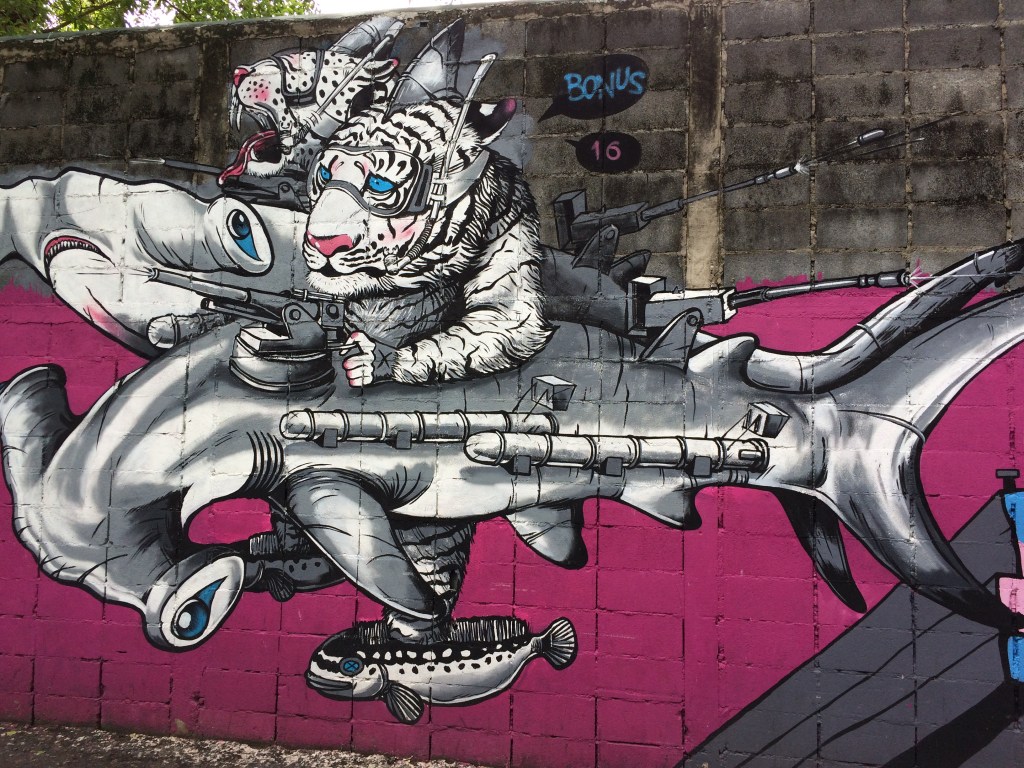
    A little further on, down another narrow alley, we saw the 19th century Customs House, a once grand building now in disrepair overlooking the river. We walked past the imposing Grand Central Postal building. Built in art deco style in 1940 it had huge pinkish Garudas garlanded with yellow flowers at the top of the central facade. Legend has it that when the Allies bombed Bangkok in World War II, they took flight to protect the building. Soon we were at the Thai Artists Wall. The huge murals reminded me of Miami’s trendy Wynwood district, both in terms of the art and the galleries and cafes nearby. Warehouse 30 was a collection of local fashion boutiques, a café and a restaurant occupying World War II-era military storage buildings. It was founded a little over a year ago by Duangrit Bunnag, one of Thailand’s most famous architects. Given the heat and humidity it was an ideal place to press the pause button on our stroll and have a couple of glasses of ice coffee. My wife bought slippers there from the brand called Other Leathers.

    Bangkok meets George Town meets Mad Max

    After Warehouse 30, we entered Talad Noi, a neighborhood whose architecture reminded me of George Town in Malaysia, where Pernankan meets European – but this time in a Thai setting. We stopped to see the towering spire of the cream-coloured Kalawar Church, completed during King Rama V’s reign. Down a zigzag of alleys we found Sol Heng Tai, a 200-year old Hokkien-Teochew mansion near the Chao Phraya, which serves drinks in a decidedly quirky environment. complete with a swimming pool that no one was using. Apparently, it is used for a scuba diving school. The 7th and 8th generations of the Posayajinda family still live here.

    We passed banyan spirit trees which sometimes had images of former Thai kings hanging from them, other times were festooned with multi-coloured ribbons. Shop after shop had immense piles of auto parts in front of them, making the area look like both a hoarders’ paradise and a back lot for a Mad Max movie.

    Soon we were in Chinatown, where the throbbing mania of the megalopolis returned, like a feverish dream. We chilled – literally – over a coffee and dessert at Chata Speciality Coffee, a café with creatively named brews and dainty cakes to complement them.

    The Siamese Fighting Fish aren’t in a Fighting Mood

    In front of the Anantara Siam is a statue of a water sprite blowing a conch shell atop water lilies – a harmonious greeting for our return. Our room overlooked the Royal Bangkok Sports Club. two panes of glass giving us the view without the street noise. On the desk, a Siamese Fighting Fish was swimming alone in a fishbowl without a care in the world. One of the world’s most aggressive species — agitation so much a part of its DNA that it immediately fights when it sees another fish — it was utterly at peace. The Anantara Siam was so tranquil even the Siamese Fighting fish doesn’t feel like fighting anymore. Now that’s the right kind of ying to balance Bangkok’s breathless yang.

    Anantara Siam Hotel address:

    155 Rajadamri Road

    Bangkok 10330 Thailand

    http://www.anantara.com

    Published in Asian Journeys magazine, August-September 2018

  • Prince Jefri’s Xanadu: A Palace of Your Own at Brunei’s Empire Hotel

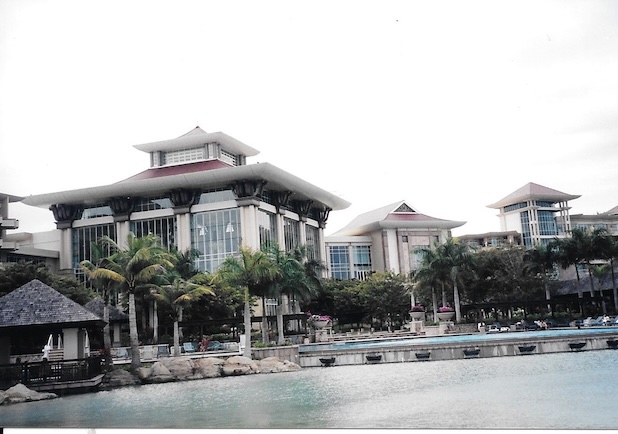
    The Empire, Brunei

    “In Xanadu, did Kublai Khan

    A stately pleasure-dome decree:

    Where Alph, the sacred river, ran

    Through caverns measureless to man

    Down to a sunless sea

    So twice five miles of fertile ground

    With walls and towers girdled round:

    And there were gardens bright with sinuous rills,

    Where blossomed many an incensed-bearing tree;

    And here were forests ancient as the hills,

    Enfolding sunny spots of greenery.”

    When Samuel Taylor Coleridge envisioned Kublai Khan’s palace in Xanadu he imagined a place of over-the-top luxury, of unimaginable wealth. We’ll probably never know if Prince Jefri, the Sultan of Brunei’s wayward younger brother, had this poem in mind when he dreamt up, then built the Empire Hotel and Country Club through the Amadeo Development Corporation. But he could have.

    Or maybe he was thinking of that Kevin Costner hit film, “Field of Dreams,” where Mr. Costner’s Iowa farmer character heard voices that said, “Build it and they will come.” In the film, ghosts from baseball’s past such as Shoeless Joe Jackson do come – to play baseball on the field the obsessed hero built against all odds.

    In Prince Jefri’s case, he has built his Xanadu but almost no one has come, giving the hotel a ghostly silence. Though maybe they should, as the Empire Hotel is a place of almost unparalleled splendor on the sunny north coast of Borneo. Imagine a hotel that combines the immensity of the huge Hawaiian resorts with the Arabic touches of the Omani and Dubai beach hotels with the luxury of posh London establishments with the wacky fantasy touches – and emptiness – of Hearst Castle.

    The domed lobby of Brunei’s Empire Hotel is supported by six-story-high Italian marble pillars crowned by Corinthian flourishes and trimmed with gold leaf. And that’s not gold-colored paint: that’s real gold. The gold leaf is used generously around the edges of the lobby’s walls as well as the ceilings, giving the whole massive open space a glittering look when the sun hits. In the lobby are generous displays of Baccarat crystal, including a crystal camel with a solid gold saddle. Not to mention the enormous crystal chandelier that hangs over the front entrance.

    The marble floors are inlaid with bright decorations of tropical flora. And there’s a huge mural of one of the sultan’s ancestors welcoming British ships of war at an earlier palace that was far less imposing than the hotel. Just so the vastness of the lobby – and not the empty retail area nearby – doesn’t overcome you, there are a couple of Fazioli player pianos endlessly tinkling out lonely tunes.

    The walk to the rooms is no less imposing, through bouncy thick-carpeted hallways surrounded by a forest of Italian marble pillars. The décor inside the rooms is lavish, with furniture and linen by Meritalia and prints of ancient maps of Borneo in gilded frames. The china and silverware in the guestrooms is all Asprey – as they are throughout the hotel. The bathroom is the size of a typical Hong Kong apartment, with toiletries from Molton Brown. (If you take a suite or villa you get Bulgari.) The plushness of the room might remind you of somewhere in Europe except when you open the drapes to see a huge balcony and further off the crashing waves of the South China Sea.

    To relax you have choices fit for, well, a prince – or a sultan. To get to the clubhouse you ride a golf cart that the staff called a “buggy” past an on-site waterfall and a lake. There’s an eight-lane bowling alley with stylish, aqua-colored furniture – no hard plastic chairs like nearly every bowling alley on earth. My family and I were the only ones playing with a staff of four to cater to our every need. At the club there are two badminton courts. And two squash courts. And a two-story pool and snooker hall. But one thing is missing: players.

    In case racket and stick sports aren’t your game, there’s a golf course and clubhouse with day and night golfing. And tennis. And a Jacuzzi and sauna. And row after row of unused polished wooden lockers in the men’s room, each one containing a fresh, folded terrycloth bathrobe, towel, razor, comb and toothbrush. And even though it is in the tropics, there is a heated indoor swimming pool with lanes on the bottom of the pool covered in gold tiles. Again, that’s real gold. When I used the pool and sauna I was the only one doing so. I never saw anyone using the rest of the facilities either. Friendly staff just hung around, waiting for someone, anyone, to show up and give them something to do.

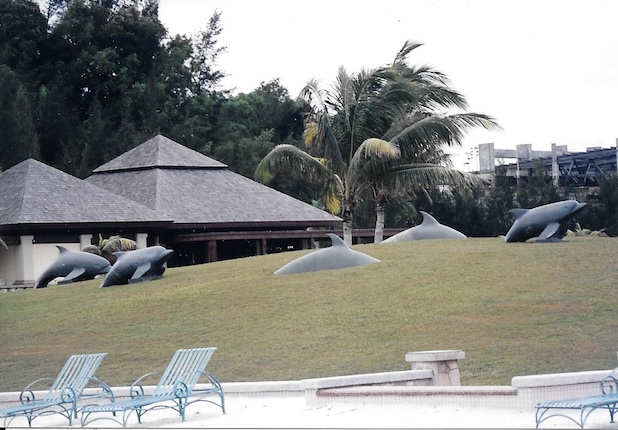
    There are also the outdoor pools, four of them. The freeform one is the size of a lake with flooring covered in sand to give it that beach feel. There is also a school of stone sculpture dolphins swimming up a grassy hill towards the sea on the other side. My children loved those. They also loved the freeform pool – especially since we were usually the only ones using it.

    Stone dolphins at The Empire, Brunei

    At the Arabic-Mediterranean restaurant called “Falafel,” you can admire the world’s only titanium cutlery and dinnerware collection. The prince had it especially designed in the U.S. and produced in France at a cost of several million dollars. It’s the same metal that is used in fighter planes.

    After dinner, you can visit one of three cinemas on the hotel grounds. Again, the ghost town nature of the place has its advantages. Unlike other hotels, guests here are not limited to small-screen entertainment in private guestrooms because the empty theaters guarantee a big screen practically all to oneself.

    Nearby the hotel is Jerodong Park, another favorite project of the price. This is Disneyland and Coney Island wrapped into one, with everything from kiddy rides to roller coasters for the teenagers or the adults who don’t mind losing their dinner. (Strangely, the park doesn’t open until 5 pm, so your lunch will have been digested by then.) For a mere $3 my children could ride on all the rides they wanted – all night long until 2 am. But as with the hotel, the prince may have built but “they” didn’t come. As for lines, forget about those. My children were almost always the only ones on any of the rides, randomly selected. Whether it was the bumper cars, the merry-go-round or the flying swings, they were all empty. Same for the adult rides. It wasn’t exactly like being in a Twilight Zone episode, but at times the complete desertion of having one’s own private palace got close.

    Finally, not to be outdone, Prince Jefri’s Xanadu has a musical fountain. Near an imposing gate flanked by ancient cannons, there is an immense fountain with water sprouts that dance and sway to the music. Again, on the beautiful, starry night of our visit, my family and I were the only ones watching the spectacular light show. While it might have started off with the cheesy “Eye of the Tiger” it soon moved into hotter tunes. My favorites were those by Tina Turner. With the balmy breeze off the South China Sea and the sense of being in a kingdom – a real kingdom, not a fantastical Xanadu – where everything seemed to be done just for you, sometimes literally, the big, colorfully lit droplets hanging magically in mid-air suddenly made Brunei seem like a really cool place to be.

    Published in The Asian Wall Street Journal, June 21, 2002

  • If You Have One Night in Bangkok

    Since my first visit to Bangkok in 1981, I’ve been back dozens of times. For a few years I even commuted to a job that was based here. I’ve seen the city transform again and again from a seedy backwater with a “reputation” to a glittering, glamorous metropolis with some gritty corners.  But there’s one label that no one has ever put on Bangkok and that is boring.

    So imagine the challenge I set for myself on my last trip: if I only had one night in the city what would I do?

    For inspiration I used the lyrics from the Murray Head song, One Night in Bangkok:

    One night in Bangkok makes a hard man humble

    Not much between despair and ecstasy

    One night in Bangkok and the tough guys tumble

    Can’t be too careful with your company

    I can feel the Devil walking next to me

    With those alarmist lyrics I decided I needed a really good meal to fuel the long evening ahead.

    SPOILED BY BANGKOK’S BEST STEAKHOUSE

    For fortification I started with a perfectly executed Citrus Martini, shaken not stirred, at the lushly appointed “Manhattan Lounge” at the JW Marriott Hotel. I followed this with dinner at the “New York Steakhouse” next door, consistently rated as Bangkok’s best. That’s a tough accolade to get year after year in a food-centered city like this. I couldn’t help but compare the experience here with a famous steakhouse in Palm Springs, California earlier this year where a grumpy, BMI-challenged waiter gave my family and I a Tomahawk-steak on a large platter where we all tucked in forks and sharp knives at the ready. The “New York Steakhouse’s” version of the Tomahawk-steak was altogether a different, much more elevated experience.  When the waitresses with model-like looks and killer smiles draped the elegantly cut slices of meat on the Tomahawk bone I knew it was going to be tough to dine at an American steakhouse again. I’ve now been spoiled.

    ASIA’S MOST HAPPENING STREET

    Properly nourished, I headed out with a friend to explore nearby Soi 11, in my opinion Asia’s most happening street.  When you think of nightlife areas in Asia, Hong Kong’s raucous Lan Kwai Fong springs to mind, or its more trendy, edgier sister Soho, or the upscale Xintiandi district in Shanghai or Singapore’s tony Club Street or Seoul’s fashionista Gangham district. But whereas those other nightlife areas

    give you a non-representative slice of those cities’ lives, on Soi 11 you feel the entire human spectrum and kinetic energy of the city, Bangkok on full display and in your face.

    Soi 11 is where I was going to spend my one night in Bangkok.

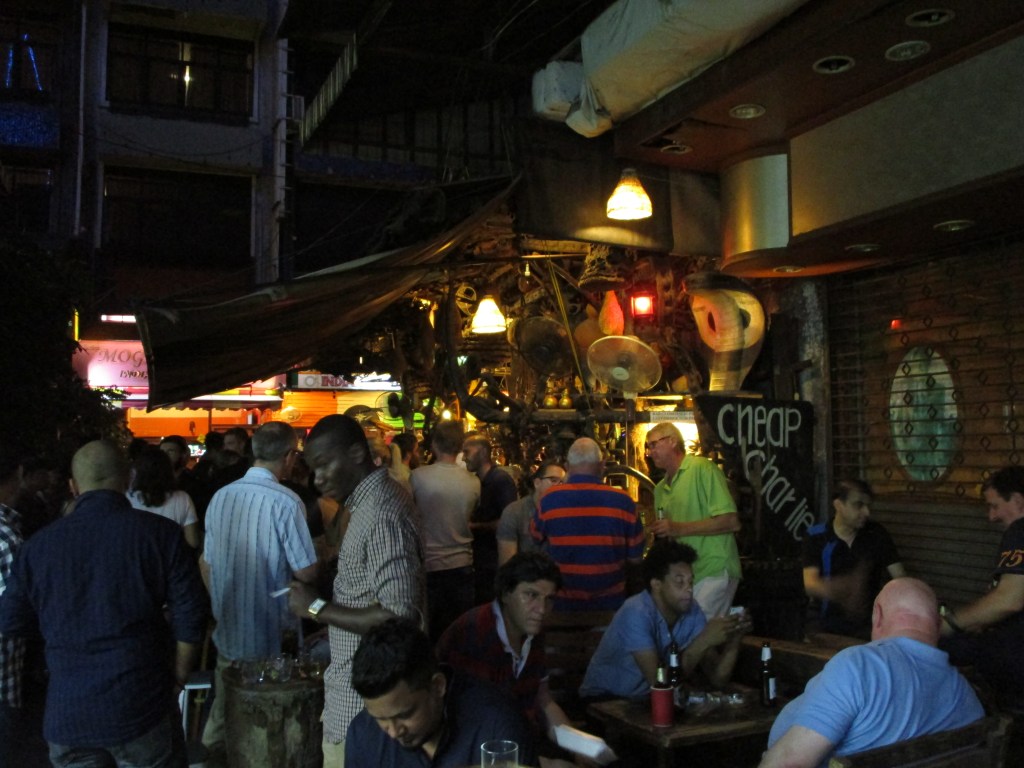
    Our journey up and down and from ground-level to high above the Soi was a both a trek across broken sidewalk pavements and a peek into the aspirations of the people there that make the Soi a place of unyielding buzz. From “Cheap Charlie’s” with its outside pavement seating and a reputation for the cheapest beers in Bangkok to “Above 11” for a contemplative view of the city that looks a lot tamer 33 floors up, away from the stumbling crowds and the cruising pink and yellow and green taxis that always seem to barely miss hitting someone. The skyline’s supercharged sparkle was borderline surreal. Emerald City on steroids.

    PEOPLE-WATCHING PERCH

    We found a central perch at “Oskar’s”, which gave us a panorama view of the Soi in action. With a counter seat, you can see the denizens of the street marching purposely towards a destination or lurching from one bar to the next. Usually packed after 9pm, it becomes the Soi’s defacto people watching fulcrum: inside the bar everyone is rubbing elbows with everyone else, in a hurry to meet or make friends. It is not a place for a solitary drink. Or soulful chats for that matter. Meaningful encounters just isn’t on the menu in this place.

    Having a tough time hearing each other, my friend and I made our way to the quieter “Wolff’s”, owned by former private investigator Malcolm Schaverien who writes thriller novels under the pseudonym of Harlan Wolff. Mr. Schaverien provided a bit of oral history of the Soi and its rise up Bangkok’s neon rankings: “Soi 11 became the local…nightspot when Q Bar first offered the option of trendy nightlife for those living on Sukhumvit. Before that we had pubs, gogo bars, cocktail lounges, restaurants and hotel bars – that was about it. So we would mostly make the trek to Silom or Siam Square for nightlife. After Q Bar came Bed Supper Club and others making Soi 11 a ‘trendy’ destination.”

    Sadly, both Bed Supper Club and Q Bar are now closed. A hotel is now being built where Bed Supper Club was. Q Bar is being transformed in a new venue called The District. The Soi’s reinvention continues.

    When I asked Mr. Schaverien why he created “Wolff’s” he said: “I was nostalgic for the classic bar I remember from my early days. The sort of place where people meet and talk over cocktails or a glass of wine. I couldn’t find one in my area so I built one with bricks and a copper top bar.”

    A few steps away we visited Brew, for a stylish beer-focused experience. Owner Chris Foo said the bar was “based on a space under a Trappist…Monastery in the mountains where monks produced beer. The water coming down the mountain would

    be collected and used to make the Trappist Beers and then they would store the beer

    in oak casks for fermentation.” With “the largest selection of beers and ciders in Asia,” Mr. Foo’s aims to make his bar a destination for beer-lovers. The menu was amazingly long. I could imagine drinking a different beer there almost every day of the year. Not a bad goal to set yourself.

    MUSIC YOU DON’T USUALLY GET ELSEWHERE

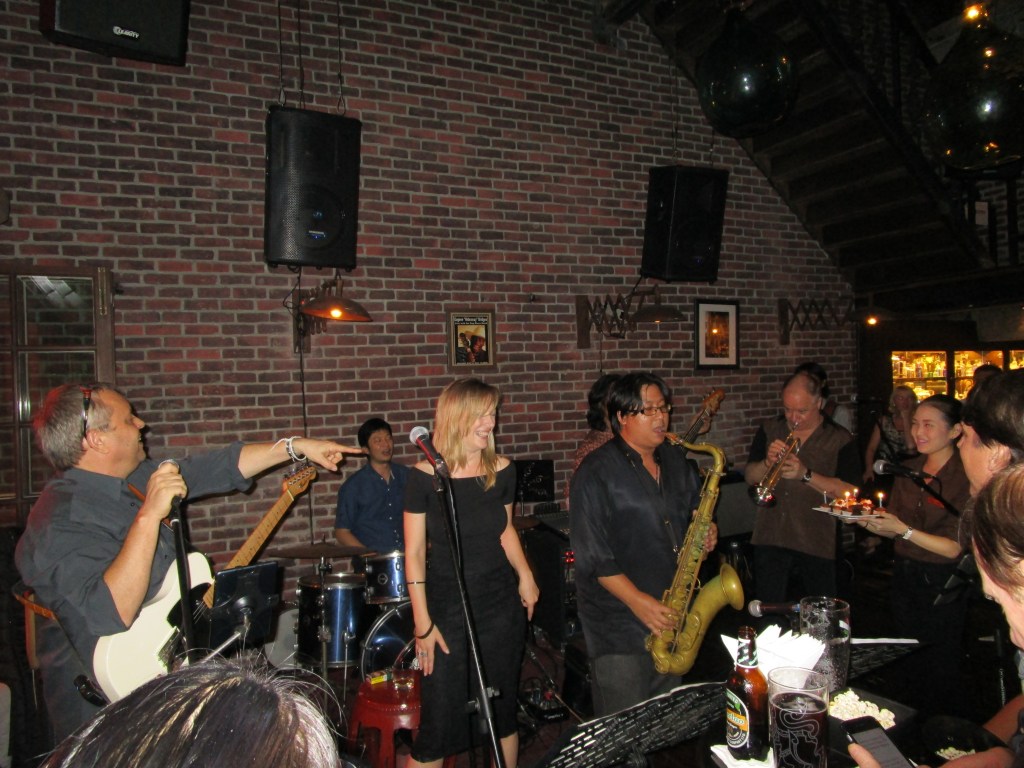
    At some point in any long evening music is as good a reason as any other to visit a bar. And Soi 11 is one of the best destinations in Bangkok for the more unusual types of music. At “Apotheka”, blues is played every evening except Sunday, when it’s jazz. With its dark wood interior the bar could be in Chicago or New York, only it isn’t. It’s completely open in the tropical heat and we briefly lingered on the sidewalk before being sucked into the bar for a better view of the band leader playing the trombone with aplomb while coaxing his fellow musicians. Munching on popcorn while sipping a craft beer was a great way to pass the time.

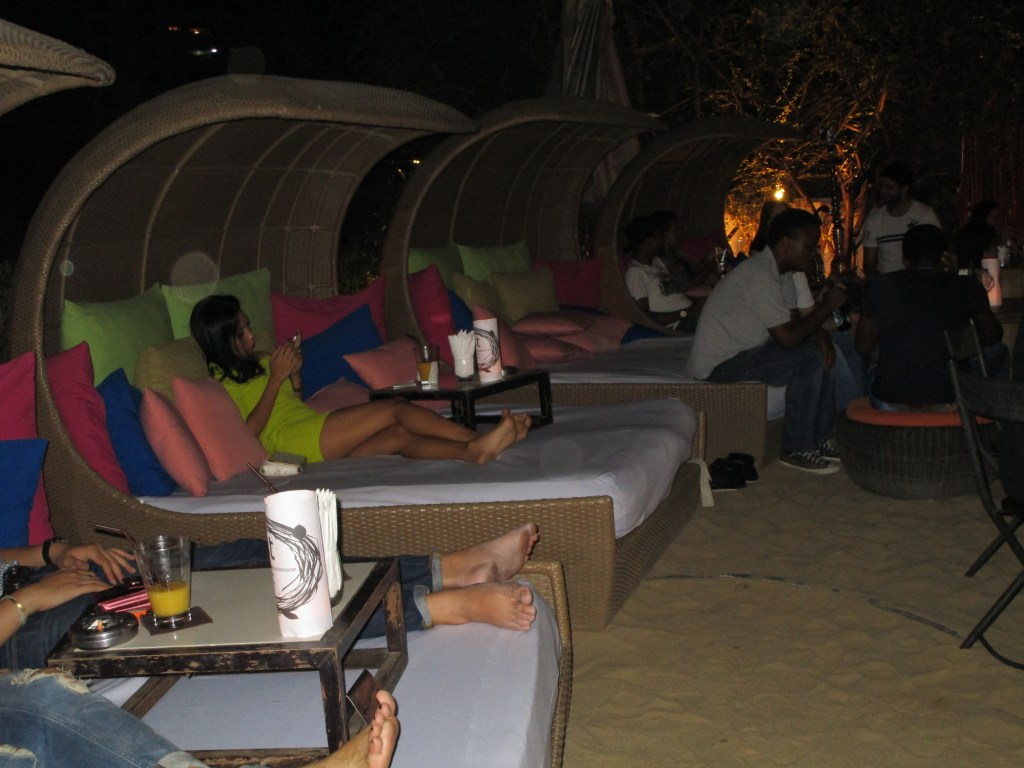
    Above “Apotheka” is yet another refuge from the Soi, “Nest”, where we sought temporary solace. With plants and alcoves and a floor covered in sand in places to reinforce the you’re-in-the-tropics feel, a guitarist provided the music to make it a chill place to hang.

    SINGLE-DIGIT TIME

    There comes a point in any evening where the drinks start to hit the double-digit point and the hour hand single digits. That’s when noisier, more primal venues hold greater appeal. “Levels”, on the 9th floor of the Aloft Hotel, fit that bill. It too had a view, of Soi 11 as it marched through the chaotic tide of humanity to not-so-distant Sukhumvit. With a more aggressive but more snappily dressed crowd, it was an ideal place to see the Soi from a different vantage point. It has a gigantic curving bar with a colossal sparkling chandelier above it, like a fountain of descending glass that never quite splashes down.

    After a drink there I too started my transformation into one of the lurching zombies of the late night Soi. Not quite an extra from the movie World War Z but in a few more hours I might have passed for one. I walked past brightly-lit drink and food carts that lined the streets selling pad thai, seafood of all kinds packed in ice, stacks of coconuts. There was even a shiny yellow van with seats out front called Taco Taxi. I thought of some more lyrics from Murray Head’s song:

    “One night in Bangkok and the world’s your oyster.

    The bars are temples but the pearls ain’t free.”

    ONE NIGHT ISN’T ENOUGH

    The Soi has startling variety of venues: from an Indian nightclub called “Daawat” in the Ambassador Hotel, to a German bar called “Old German Beerhouse”, from an Italian pizzeria called “Limoncello” to a bar called “The Alchemist” tucked away on an alcove just off the main Soi, to a wine bar called “Zaks” to a Thai restaurant, “Suk 11”, set in a traditional wooden building. That doesn’t begin to describe the diversity of choices on the Soi. One night in Bangkok isn’t enough to explore this street.

    I landed with a delightful thud in a basement after hours club named “Climax.” Given the way I was feeling, the long night clearly tugging on me, it certainly wasn’t the climax of my evening but with a glazed view of the revelers it seemed to have lived up to its name for some people.

    No night in Bangkok is complete unless you have a place to R & R (rest and recover) afterwards. The nearby JW Marriott certainly provided that for me. In the morning, I sweated out the previous evening’s indulgences with a lengthy session in the steambath and sauna at the hotel’s state-of-the-art spa. With a swim afterwards I was practically as good as new.

    Relaxing on a lounge chair by the soothing aquamarine pool, I considered with a clear head the challenge I had set for myself. What was I thinking? Who wants to spend just one night in Bangkok?

    Published in Asian Journeys magazine, December 2015-January 2016

  • Under Tibet’s Breathtaking Cobalt Sky

    The highest point of my trip to Tibet is the Kharola glacier on the road from Lhasa to the province’s second largest city, Shigatse. At 5,500 meters, the air is thin – a short jog winding me – but the scenery rich. Poles topped by yak hair and wrapped with flapping prayer flags flank a simple white stupa that has as its backdrop the glacier draped over a craggy mountain while outlined by a sky of such an extraordinary cobalt blue that you want to lick it. Literally.

    OUT OF THIS WORLD YET WITHIN IN

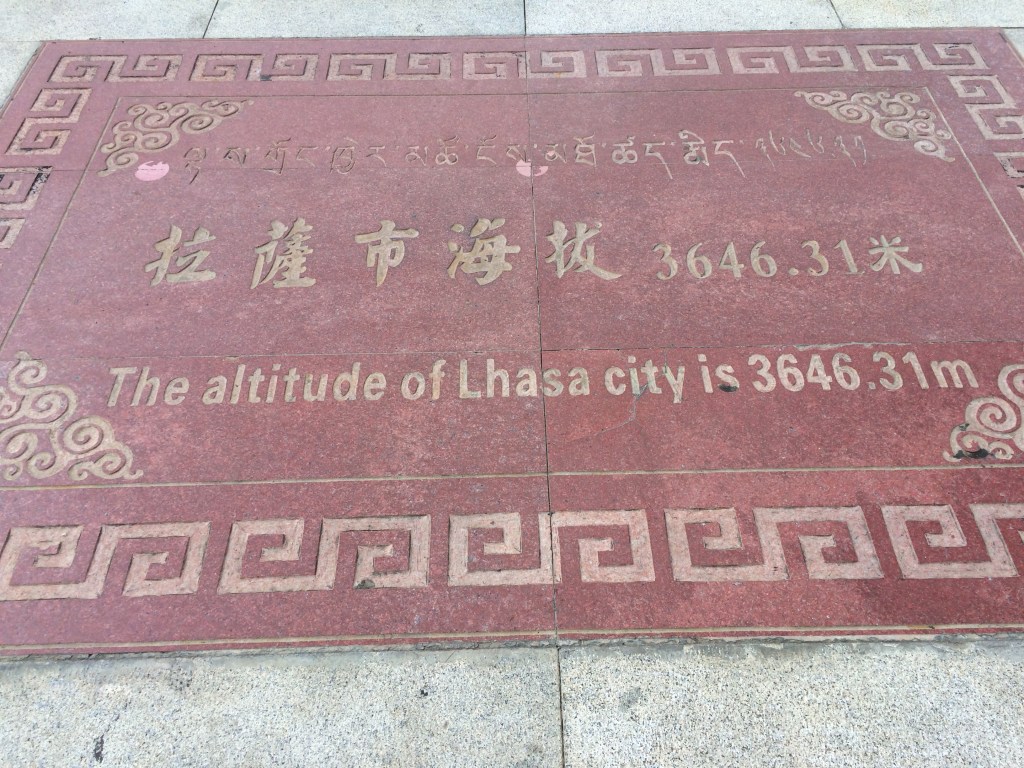
    Tibet is a place that feels out-of-kilter both with the country it sits within as well as the earth it sits upon. The flight to Tibet teases you as it soars over the Himalayas, icy peaks defiantly punching through cloud cover while far below remote, deserted roads struggle to find a path in the barren plateau. When the Air China flight lands in Lhasa, the disembodied voice on the intercom says to be careful of altitude sickness. At 3,656 meters that warning resonates with me.

    THE ALTITUDE CAN BRING YOU DOWN

    While I didn’t experience altitude sickness on trips to Bhutan, Nepal or the altiplano of Peru and Bolivia, I realized it is a risk. It seems to strike at whim. Diamox, a medication effective at preventing it, works for me. While I vowed to take it very easy on my first day, Lhasa’s kinetic energy and otherworldliness, pulls me forward. Fortified by a lunch at the atmospheric House of Shambala restaurant I walk more than 20,000 steps. I experience sunset on the rooftop of the Tibetan Family restaurant over a dinner of fried yak-filled momos. The diminishing light of day illuminates the nearby golden canopies of Johkang Temple. Upon my return to the Gang-Gyan hotel, people in the clinic off the hotel’s lobby suck on oxygen from tarnished tanks while a nurse with crossed arms stands nearby.

    LHASA’S SPIRITUAL AND COMMERCIAL HEART

    The spiritual and commercial heart of Lhasa is the Johkang Temple and the adjacent Barkhor Square, ten minutes stroll from my hotel through twisting, narrow alleyways. A hive of religious fervor, to get onto the square requires passing through a gauntlet of very tight security. Omnipresent cameras on rooftops and along the eaves of buildings watch everyone. The security checkpoints have metal detectors, X-ray machines and card readers that capture locals’ identity information. Elite SWAT squads control these checkpoints while scattered around the square small squads of police in full riot gear stand at the ready. Their presence provides an ominous sense of the Chinese government’s heavy hand and a recognition that the surface calm is perhaps superficial.

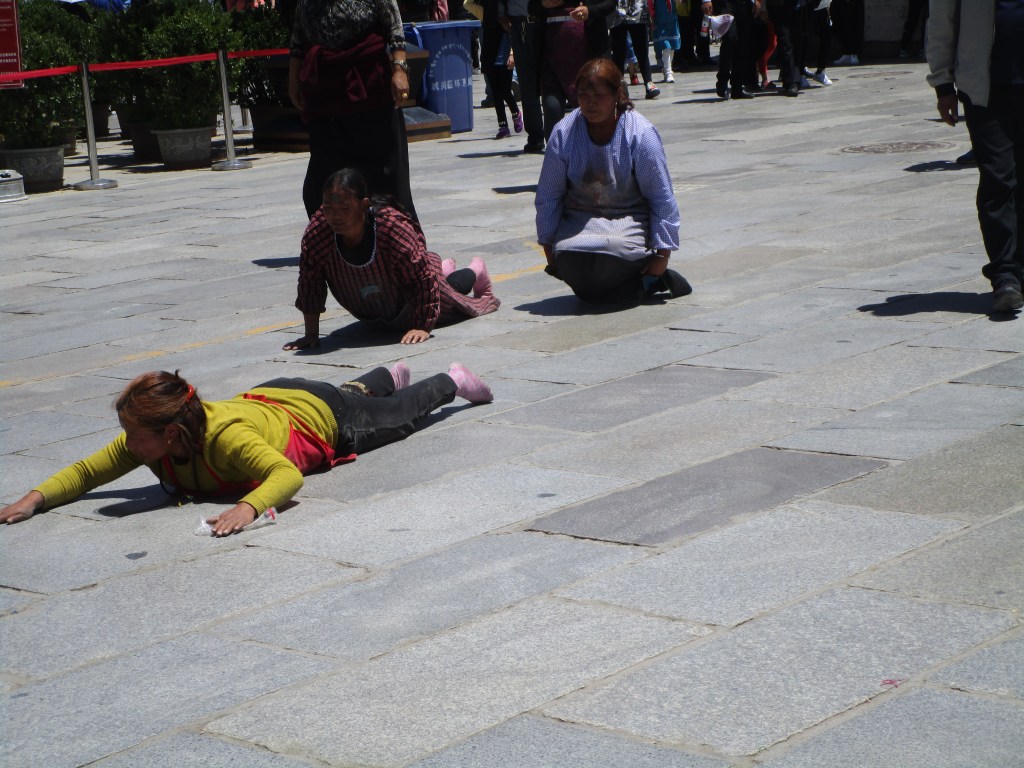
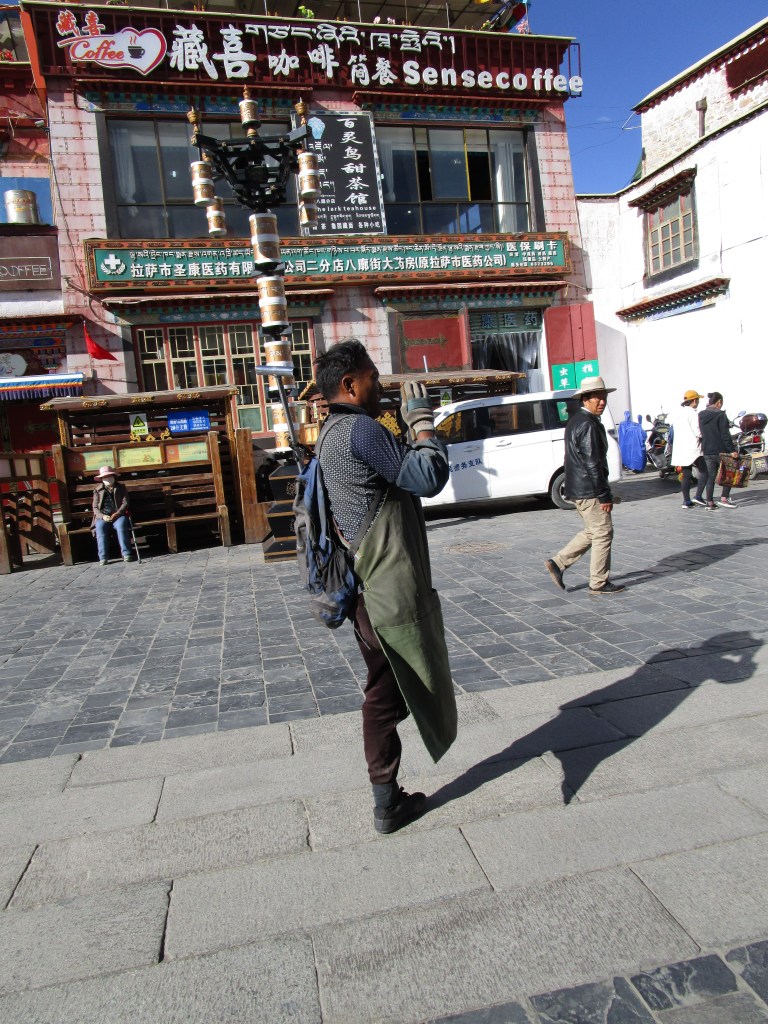
    On Barkhor Square I follow the pilgrims’ circumambulation around the Johkang Temple, passing restaurants, tea houses offering Tibetan butter and sweet tea, shops selling prayer flags, beads and other religious items, and antiques of various authenticity. The effect is an ever-moving, ever changing kaleidoscope of people with different poses, emotions, hopes, prayers, despair, physical conditions, and triumphs of sorts moving like a human tide clockwise around the temple and wondering if their life’s lots might change en route – or ever. It’s as turbulent as a Tibetan sky. A scrum of people surrounds a one-legged pilgrim who slams metal bricks together before prostrating himself on the ground. Then he lifts himself up and repeats the process again a few steps further on. It’s easy to hook onto the devotees’ tide and get pulled into their mania. Maybe the thin air helped —oxygen deprivation giving a light-headed perspective on the scene, like lining up a shot through fisheye lens for a distorted view of the world.

    MAGNETIC “HOUSE OF MYSTERIES”

    King Songtsen Gampo started building the Johkang Temple in 652 to honor his Chinese and Nepalese wives. Known in ancient times as the House of Mysteries it was finished nearly a thousand years later in 1610 during the reign of the 5th Dalai Lama. Two giant incense burners in the front and rear of the temple help give Lhasa its distinctive aroma.

    Just outside and within the temple the fervor approaches fever pitch, dozens of people prostrating themselves then lifting themselves up in hope before throwing themselves down again in repetitive demonstrations of piety. The crush inside is driven by the determination that their prayers be heard. Blessings by monks are seemingly cursory as they try to move the crowd through. I don’t understand what people are asking for but I do recognize hope as a universal need. The temple’s magnetism keeps me close to it and the square during my Lhasa visit. That evening I dine on grilled mushrooms and ginger carrot soup at the packed Makye Ame restaurant overlooking the rear of the temple. The yellow-painted building it is in was the 6th Dalai Lama’s palace and named after his mistress. He wrote a poem about her here.

    ONE OF THE WORLD’S GREAT PALACES

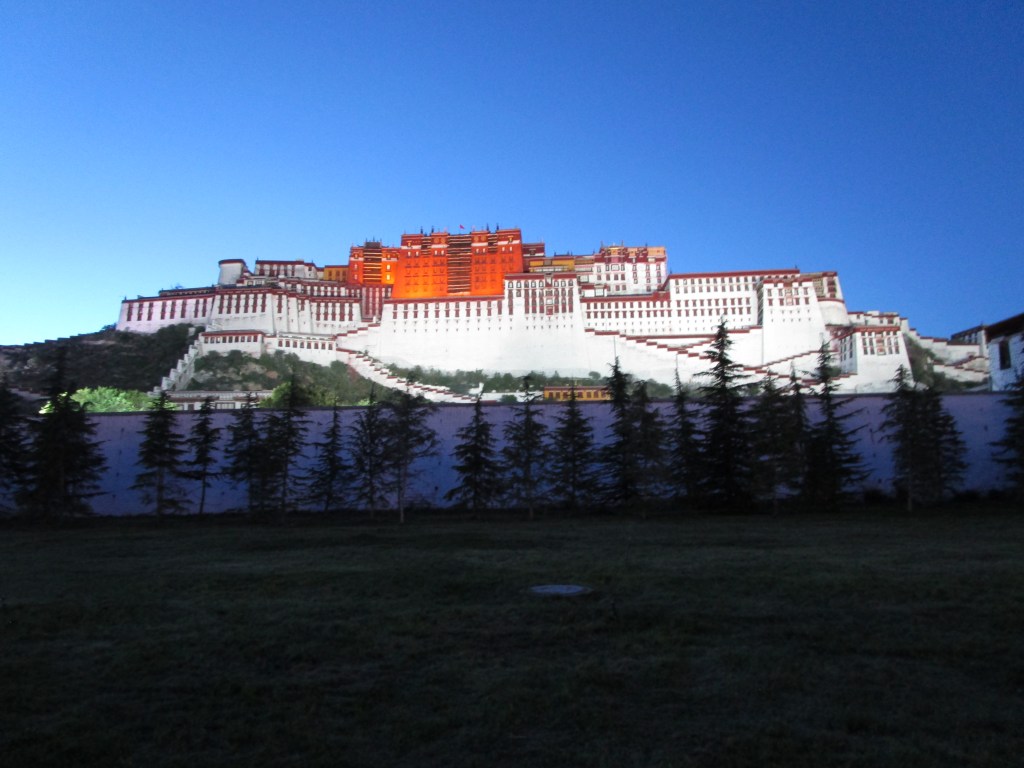
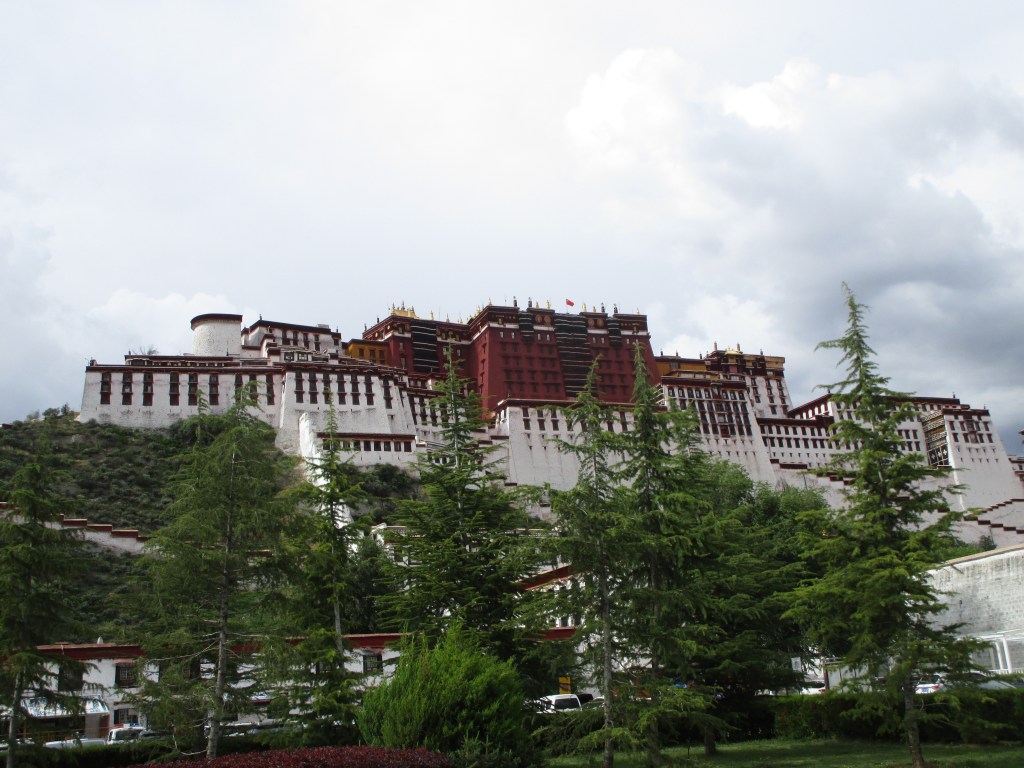
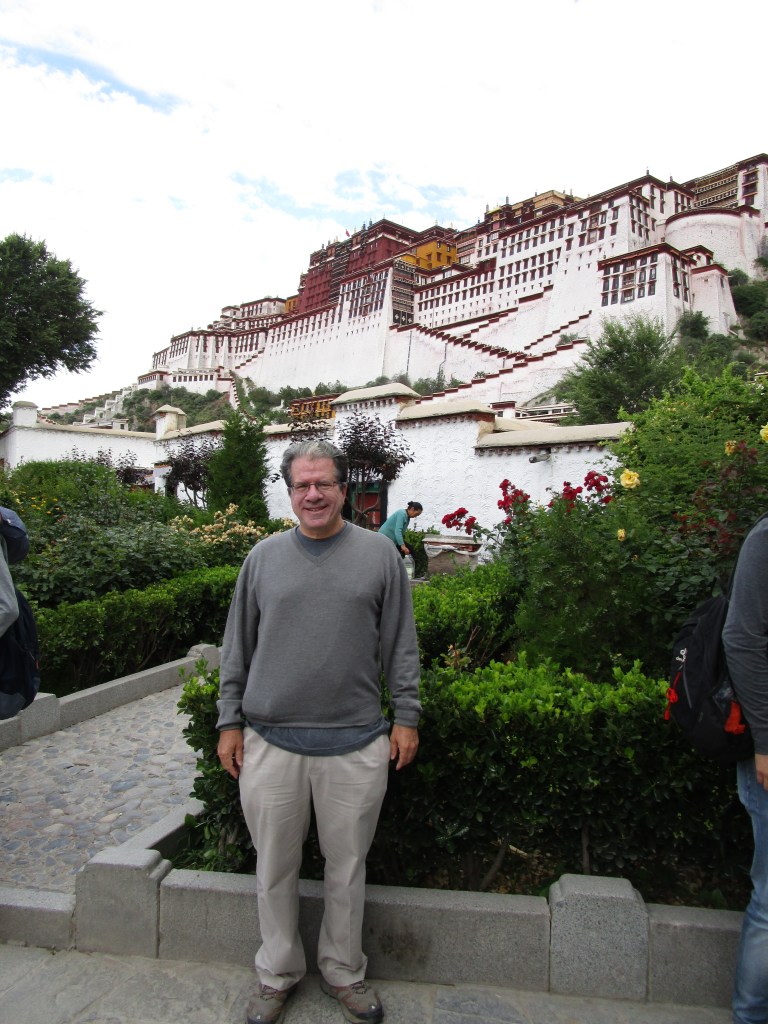
    About 1,000 meters away is the administrative heart of Tibetan Buddhism, Potala Palace, the residence of Dalai Lamas until the 1959 Chinese invasion ended the Tibetan uprising and forced the 14th Dalai Lama into exile. The 5th Daiai Lama started building it in 1645 on the remains of an earlier one from 637 by King Songtsen Gampo. Its location is strategic: between the influential Drepung and Sera monasteries, and Lhasa’s old city. It took three years to build and another forty-five before the interior’s completion in 1694.

    It’s a massive edifice: 400 meters from east to west and 350 meters north to south with stone walls around 3 meters thick in most places and 5 meters thick at the base. It’s more than 117 meters high on top of Red Mountain and rises more than 300 meters above the Lhasa Valley floor. It has over 1,000 rooms and some 200,000 statues. The areas painted white are the administrative parts of the palace, while the red painted ones are where the Dalai Lamas resided and ruled. Assembly halls, shrines and thrones of the past Dalai Lamas are located here, including the cave where King Songtsen Gampo meditated. Gilt-covered roofs reflect the intermittent sparkling sunlight giving an unusual sense of lightness to such a sturdy structure. It was lightly damaged during the Cultural Revolution, Mao’s premier Chou En-Lai having protected it.

    One of the world’s great palaces, perhaps France’s Versailles or Russia’s Winter Palace come close to matching its splendor. I pass through a number of security gauntlets before entering. At the palace’s base, flowers are in full bloom — Tibetan summer and spring converging into a single, very short season of vibrant colors in a landscape that is dour and forbidding most of the year. Potala Palace tickets are timed and visitors move quickly up the stairs in the thin air to meet the various deadlines. Unlike other museum-like grand palaces, it is a place of devotion. Tibetans prostrate themselves in front of shrines and religious relics. Security brusquely moves them along.

    SPINNING PRAYER WHEELS TO WIN AT LIFE’S LOTTERY

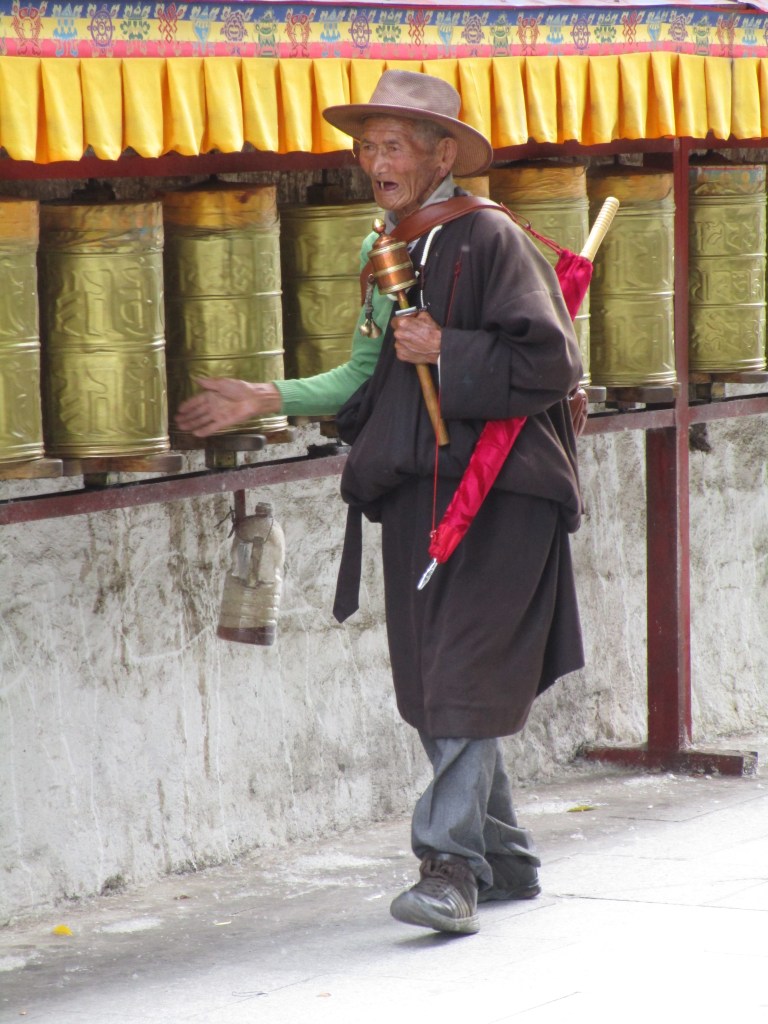
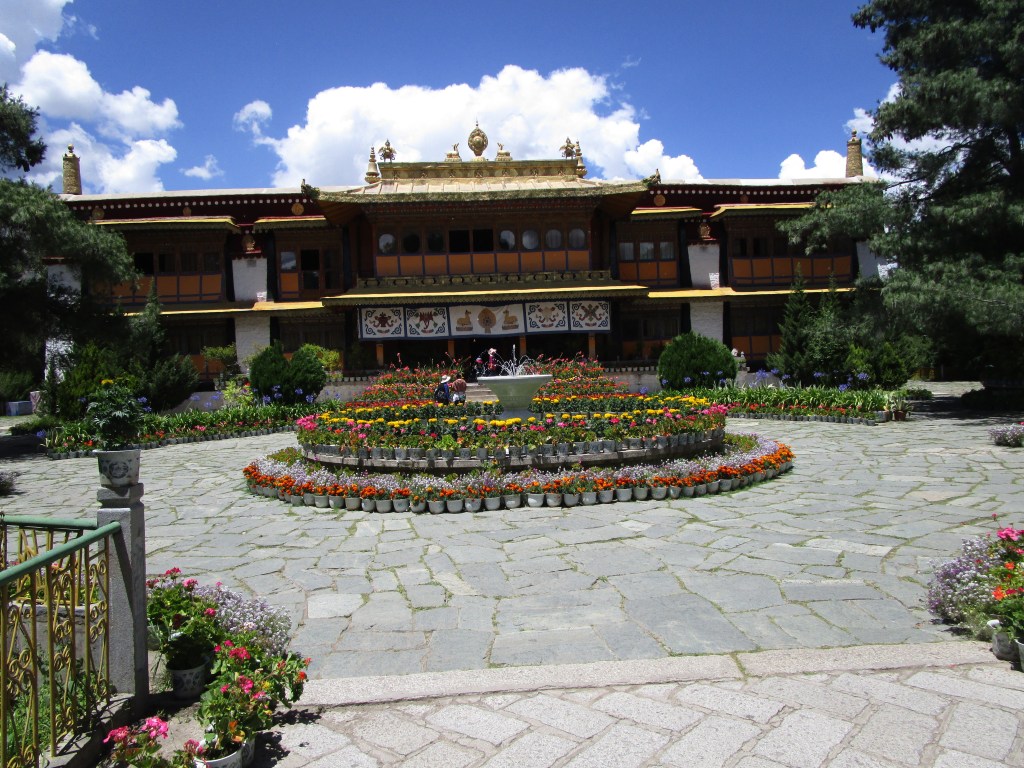
    The various Dalai Lama thrones give an indication of their personalities and styles of ruling. Many are modest elevated platforms to preside cross-legged over subjects. The 6th Dalai Lama was probably the most controversial because of his notorious lifestyle as a womanizer and magician. He has by far the largest throne. The second largest throne belongs to the current Dalai Lama. I also notice the size of his throne at Norbulingka Palace, known as the summer palace. His throne of gold with silver steps is the largest of the Dalai Lamas with residences there. After exiting Potala Palace down steep steps in the back I come to an endless line of prayer wheels which devotees spin — for luck or health — to help win in the lottery that is life. The sound of the spinning wheels rubbing against aging wood creates a humming that rises in the air to create another dimension of etherealness to the palace.

    PROTECTION AGAINST NIGHTMARES

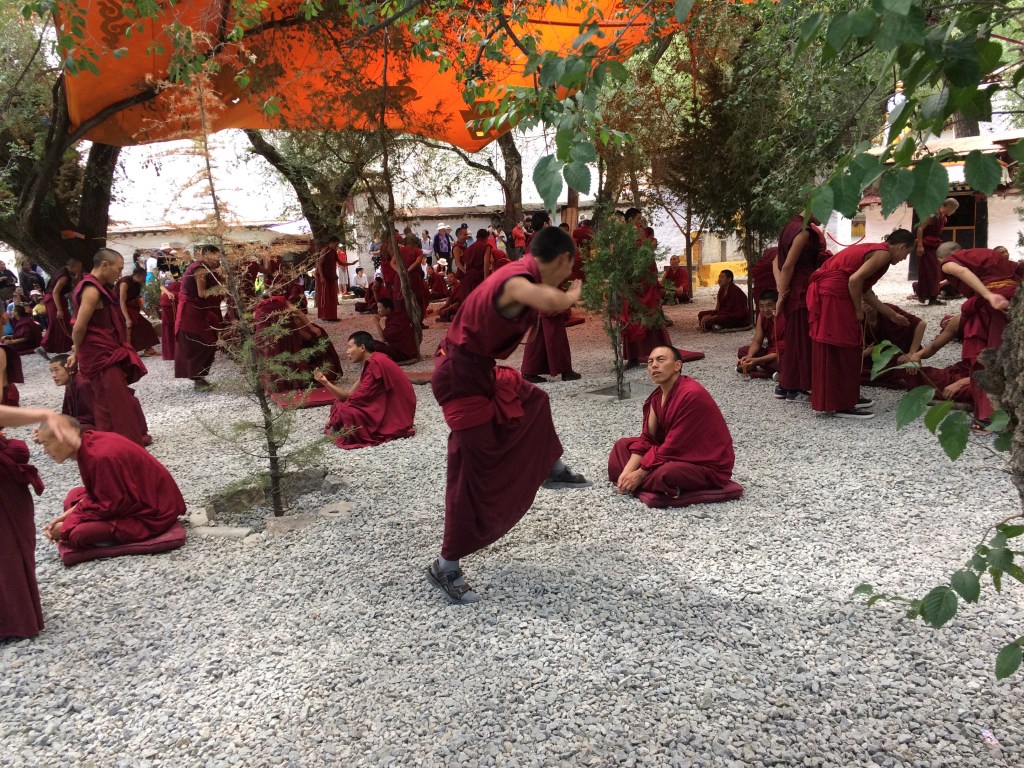
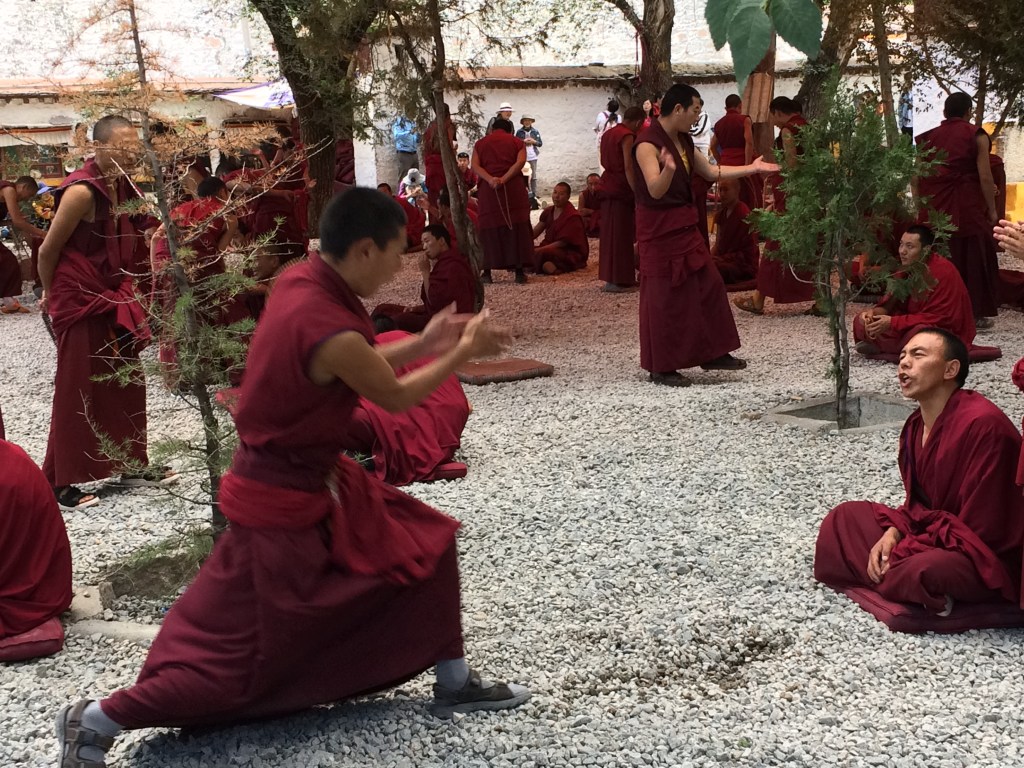
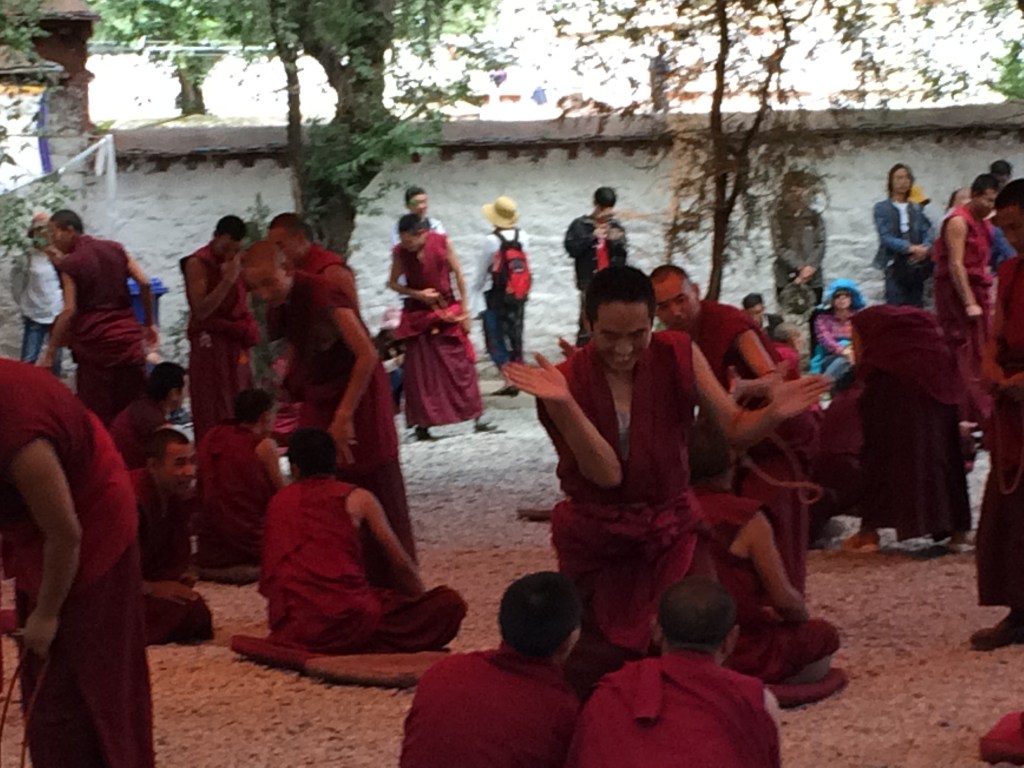
    If the Potala Palace and Johkang Temple are the administrative and spiritual hearts of Tibet, Sera Monastery is the intellectual heart. Founded in 1419 the sprawling monastery sits at the foot of the mountains at Lhasa’s edge, a remote nunnery high on a hill above it. Parents take their children here to inoculate them against nightmares. After a monk’s blessing ashes are smeared on their noses and they walk away with smiling faces — safe in the knowledge that sleep will be just blissful dreams. In a sun-dappled courtyard nearby dozens of monks in pairs, one standing and one sitting, debate with vigor. The standing monks, fiddling with prayer beads and stamping their feet and clapping their hands, hurl Buddhist doctrine questions from the Five Major Texts at the sitting monks. The questions are theological ones with rhetorical twists and the gift of constructing eloquent responses prove the intellectual rigor of the monks. Eventually, they switch places. This sparring is mesmerizing to watch, like mental martial arts. The voices rising in challenging tones create a strangely melodious sound like binaural beats from a Haight-Ashbury hippy store. During the 1959 revolt, hundreds of monks were killed here and survivors set up a parallel monastery in exile in Sera, India.

    BREATHTAKING’S DOUBLE MEANING

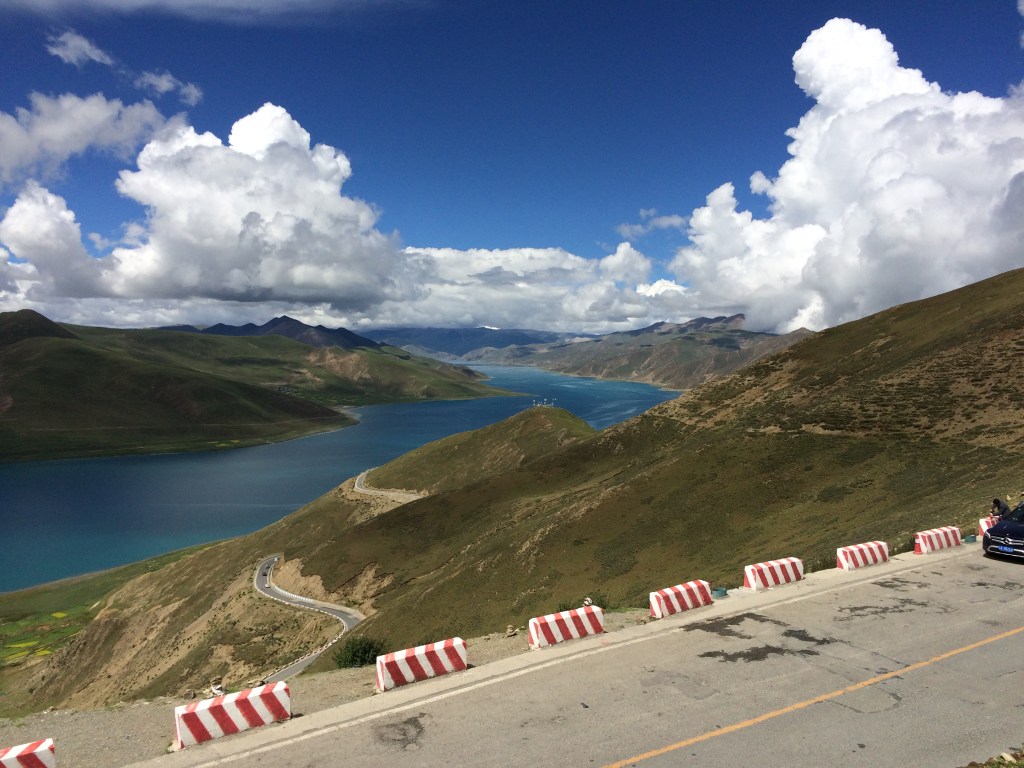
    The Lhasa to Shigatse road gives an indication of Tibet’s magical landscape and breathtaking vastness. Just outside Lhasa a tunnel reveals the Yellow River, one of China’s and the world’s longest, beginning an over 5,000 kilometer journey to the sea.  As the van climbs switchbacks, proud owners display regal Tibetan Mastiffs at scenic turnoffs and charge 10 yuan to have a photo taken of them. The Khamba La pass at an elevation of 4,998 meters overlooks Yamdrok lake. The scimitar-shaped lake has a turquoise colour transforming chameleon-like in front of you as if reflective of volatile moods. Such a sacred sight at such an elevation brings a double meaning to the word breathtaking. It’s forbidden to eat the abundant fish from its crystalline, holy waters. At the shore Tibetans charge for sitting on decorated yaks with stoic demeanors.

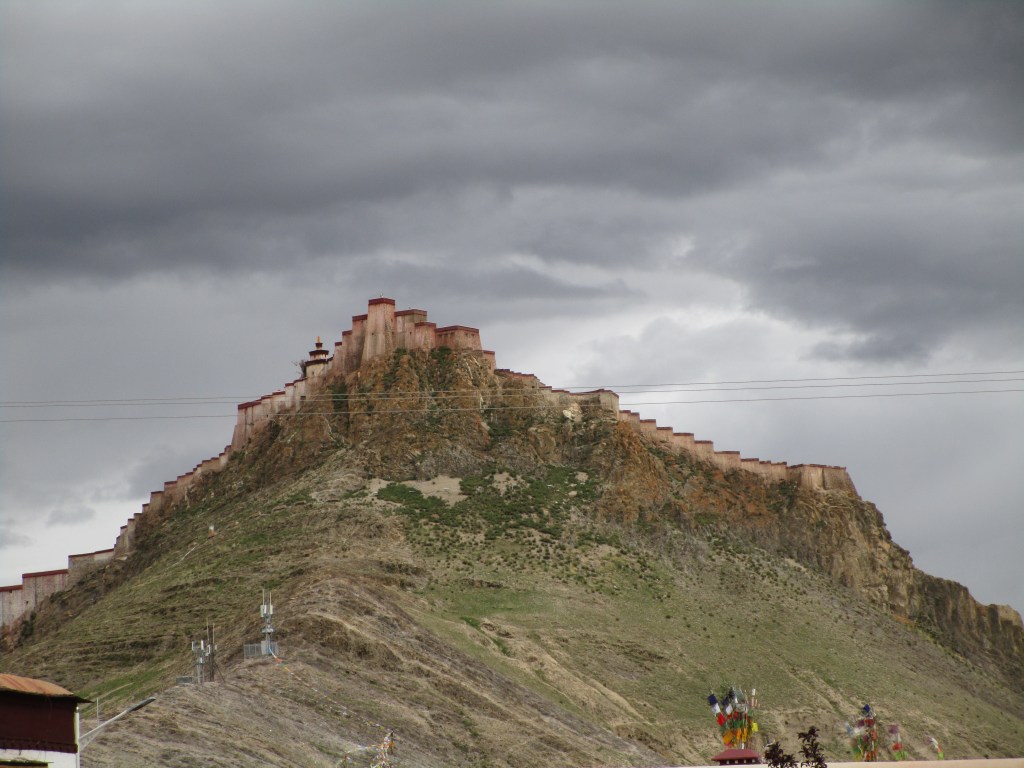
    In a few hours, past the Kharola glacier, is the city of Gyantse. The Dzong, fortress, lords over the city. I visit the Penchor Chode monastery, guarded by red, parapet-topped walls. The monastery’s main building, built between 1418 to 1425, is closed that day as the monks are engaged in a secret chanting ceremony. Having watched burly monks from the Yellow Hat sect chant at Ramoche temple in Lhasa I can imagine the intense, rumbling sound as the prayers emerge deep from their chests.

    WHERE THE BRITISH INVADED TIBET

    The Kumbum, a type of pagoda, next door was founded in 1497 by a Gyantse prince. It has nine levels, 108 gates and rises 35 meters. It has 76 chapels and is filled with entrancing Buddhist religious paintings that remind me of the legendary Mogao caves in Dunhuang. The Gyantse Kumbum is the most famous in Tibetan Buddhism. I climb ladders to reach the highest level, heavily lidded, all-seeing eyes painted at the top. The fortified red walls of the monastery seem to reach out finger-like to the forbidding heights of the nearby Dzong that protects it. The Dzong was the site in 1903 of a fierce battle between Tibet’s best troops and a colonial British invasion force known as the Younghusband expedition after Colonel Francis Younghusband. The battle was overseen by Brigadier General James Macdonald under the auspices of the Tibet Frontier Commission. Sent by the Viceroy of India Lord Curzon, the invasion was part of the 19th century “Great Game” between Great Britain and Russia for influence in Central Asia. Great Britain preemptively invaded Tibet to keep it out of Russia’s hands. After Gyantse fell, the British went on to seize Lhasa and dictate the terms of the 1904 Treaty of Lhasa where the Chinese government agreed to not let any other country interfere in Tibet.

    PANCHEN LAMA’S HOME

    After a night at the garishly decorated Gesar Hotel in Shigatse, I visit the Tashi Lhunpo Monastery. Founded in 1447 by the 1st Dalai Lama, this is the home of the Panchen Lamas, Tibetan Buddhism’s second highest rank. The current Panchen Lama is only 28 years old. The Gorkha Kingdom sacked the monastery when they invaded in 1791 but they were quickly pushed out by a combined Tibetan and Chinese army. It was also damaged during the Cultural Revolution. The monastery climbs up the mountain and is protected by a nearby Dzong. Inside there is a vast assembly hall, now empty, that I can imagine being filled with chanting monks sitting cross-legged. At a temple, the guide points out what looks like a gold-covered statue of the previous Panchen Lama with a yak hair wig and a golden bell in his uplifted hand. Only it isn’t a statue but the mummified body of the lama, deceased since 1989.

    The train back to Lhasa follows the Yarlung Tsapo River Valley. When the river leaves the Tibetan Plateau, it carves a canyon deeper and longer than the Grand Canyon — one of the world’s great sights few people get to see.

    FROM SUMMER SUN TO STORMY SKIES

    On my last night, I join a couple at Po Ba Tsang restaurant, featuring Tibetan dancing. The dancing strikes me as something from one of the Central Asian stans — aggressive leg thumps creating mini earth tremors on the wooden floor. Dinner is momos floating in a broth with fried yak cheese on the side. Crisp Lhasa beer helps down it.

    That night I see Potala Palace perched high above the vast Potala Square on the opposite side of Beijing Middle Road. Potala Square has dancing musical fountains, a billboard featuring past and present Chinese leaders and the angular Tibet Peaceful Liberation monument guarded by soldiers. Lit against the blackest of nights, thick clouds obscuring stars, Potala Palace is revelatory, apparition-like. While my Tibet visit is in the midst of the summer rainy season I experience warm, mostly sunny days during my stay. It is ironic then that on my walk back to the hotel a nightmarish thunder and lightning storm sky splits the sky and spits hail. I wish that a Sera Monastery monk had put some nightmare inoculating ash on my nose too.

    A few weeks later during an Uber ride to New York’s LaGuardia airport, I ask the driver where he is from. “Tibet,” he says. I tell him what a coincidence that I got him for my driver as I had recently been there. He smiles at me in the rearview mirror and says, “Karma.”

    TRAVEL TIPS:

    Restaurants:

    -Tibetan Family Kitchen

    -Makye Ame Tibetan restaurant

    -Po Ba Tsang restaurant

    -House of Shambala restaurant

    Hotels:

    -The Gang-Gyan Hotel in Lhasa’s old city has quirky touches: a humidifier that looks like a character from an animated cartoon and motion sensor activated hallway lights that provide light where you are and pitch darkness everywhere else.

    -The Gesar Hotel in Shigatse is garishly decorated like a Disney-fied version of yurt fit for a khan.

    Tibetan Travel Permit:

    A China visa gets you into the country, but not Tibet. You’re not allowed to travel alone or even visit a temple without an official guide. A tour company can get you a Tibet Travel Permit. Mine is checked four times before I enter Tibet. It has a holographic-like stamp stapled to a paper with my details.

    Altitude Sickness:

    Consider how to prevent altitude sickness before your trip. Diamox, a well-known medication, works. The supplement Ginkgo Biloba supposedly helps. Going to a high elevation in phases allows the body to adjust. I stay two nights in Chengdu at 1,640 meters before travelling to Lhasa. My uncle, a doctor with high altitude climbing experience, notes that going straight from sea-level to Tibet will almost certainly get you sick.

    Photography:

    In Lhasa, photography isn’t allowed at the temples and monasteries. Outside Lhasa it is allowed but sometimes at a very high cost. At Shigatse’s Tashi Lhunpo monastery, some of the temples requested a 150 RMB photography fee.

    Getting there:

    Flights to Lhasa leave from a number of Chinese cities. My round trip airfare on Air China from Chengdu during the peak summer season is a pricey US$577. The flight is 2 hours.

    Published in Asian Journeys magazine, October-November 2018

  • Vietnam: Producing Smiles the Local Way at Suoi Tien Theme Park

    Suoi Tien Theme Park

    We have heard the news about Hong Kong Disneyland’s missteps in trying to connect with its Chinese target audience. To have shark’s fin or not on its menu? Trying to get the park Feng Shui right. Alledgedly, rude staff. First, too few visitors. Then, over Chinese New Year too many. To the point where they had to lock the gates to hundreds of ticket holding visitors. Photos showed tourists scaling Disneyland’s fences to get inside. The managing director of Hong Kong Disneyland, Bill Ernest, apologized to the people of Hong Kong and China. “We are still learning in this market,” he said. “This is our very first Chinese New Year, frankly.” Hong Kong Chief Executive Donald Tsang said, “We feel disconsolate, but we have learnt a lesson.” Legislators in the territory feel the incident has damaged Hong Kong’s international image.

    Yet, in Asia, there are very successful local theme parks who connect culturally with their target audience and produce smiles instead of headlines.

    One such theme park is Suoi Tien, outside of Saigon. Its attractions are decidedly un-Disney in their make-up but their appeal is unmistakable.

    For example, at their “Kingdom of Crocodiles” attraction, I went “crocodile fishing”. For 15 cents I rented a bamboo pole with lump of raw meat tied to a string at one end of it and dangled it over a group of hungry crocs, mouths wide open in anticipation. They snapped. I pulled it away. They snapped again. I pulled it away again – until inevitably they won “the game” and ate. Thankfully, not my fingers and hands as well.

    Crocodile fishing at Suoi Tien

    In Western terms, “Crocodile fishing” may not be politically correct – but based on the excited crowd I saw, it’s certainly spot on in Vietnam. Hong Kong Disneyland might not have an attraction like this one – but they could certainly learn from a park like Suoi Tien on how to bond with its target.  

    Crocodile fishing

    At nearly the same size as Hong Kong Disneyland, Suoi Tien’s appeal lies in offering attractions that are culturally unique to Vietnam. Like the massive public swimming pool called Tien Dong Beach. Surrounding it are mythical hills and palaces, a massive mist-spewing dragon and dominating the pool, park, and flat surrounding countryside a mountainous likeness of King Lac Long Quan, the mythological founder, with his wife Au Co, of the Vietnamese people. Yet this indigenous version of Mount Rushmore is a kind of Matterhorn ride – I hopped on a yellow raft and slipped and slided through the emperor’s head until I emerged wet and happy from a giant fish’s mouth.

    But my Vietnamese history and cultural lesson didn’t end there. There is a giant statue of the Trung sisters, riding elephants on their way to defeat the Chinese in the 1st century. There is the Phoenix Palace where I visited the 12 levels of hell, a local version of Pirates of the Caribbean – after the pirates had passed to the “other side”. I descended into a dungeon where I saw some neat tortures: somebody getting sawed in half and put back together again; another being eaten alive by a hairy monster; a body squeezed into a large wooden basin and pummeled like a bunch of grapes being turned into wine.

    Then I tried the Palace of Heaven nearby. The re-creation of an emperor’s court had it all: a stern emperor and court officials; beautiful ladies-in-waiting and in one tableaux, mannequins dressed as ghost princesses, swinging angelically from wires.

    The adventures all have a Vietnamese theme that is relevant to its target as, say, the “The Haunted Mansion” or “Space Mountain” rides are to the visitors of Disneyland.

    At Suoi Tien there was a more participatory attraction where I went down a small dingy elevator and “attacked” the “Citadel” in the ancient capital of Hue through a hidden fortress tunnel. “Defenders” of the palace “slapped” my legs as I passed deeper into the fortress.

    There were also prosaic attractions like a rollercoaster, ferris wheel, paddle-boating, aquarium, small zoo and bonsai “forest”.

    And less prosaic ones like the tent with the “freaks” exhibit. Some of the wonders preserved in alcohol were Siamese pigs; a two-headed calf; a calf with six legs; a chicken with a very, very long neck.

    Everywhere there were crowds and long lines – and lots of happy faces. Like Hong Kong Disneyland, Suoi Tien is a big favorite of out-of-towners, coming to Saigon for a visit. Near the end of my visit I came upon the Heavenly Palace. I’ve never been a big fan of “dressing up” in costumes and having my photo taken. But in this Hue meets Las Vegas meets Anaheim attraction I couldn’t resist. So, for a few minutes I wore the headgear and robes of a Vietnamese emperor and had my photo taken on a mock-up of a throne.

    While I certainly didn’t feel like a king, I took away from my day at Suoi Tien rich and culturally unique memories. Not repackaged ones sent from distant shores. Now Hong Kong Disneyland could certainly learn from that.

    Published in South China Morning Post, September 13, 2006

  • Iconic Buildings Live Up to Hype as Billboards

    SINGAPORE: There was symmetry to the moment: I was standing on the balcony of Singapore’s colonial-era iconic building, the Supreme Court, while taking a photo of its 21st century one: the Marina Bay Sands. The meanings of the two buildings couldn’t be more different yet more appropriate for their respective eras. The Supreme Court stood for rule of law in an unruly part of the world in the 1930s. And the triple-towered Marina Bay Sands, designed by Moshe Safdie, with its colossal boat-shaped SkyPark, stands for fun in a country that recognizes the economic value of “the pursuit of happiness.” As “billboards” advertising their respective messages, they work. The Marina Bay Sands, for example, just brought in a record-breaking profit of $314 million for its corporate parent, Las Vegas Sands.

    Iconic buildings have been central to humanity since Stonehenge. Architecture has always been about context. This is what Moshe Safdie calls on his website, “Responding to the Essence of Place”. And also content, or “Shaping the Public Realm”, also from his website. Their purpose in ancient times was either to foster religion or generate fear and respect for the governing body. Whether it was the Parthenon on the Acropolis or the pyramids of Egypt, rulers created iconic buildings to secure their hold on the populace.

    But now it is different. Culture and business, today’s soft power drivers, are the reason these buildings are created. Government involvement is more backseat: from encouraging the development through zoning laws, approvals or tax and other incentives.

    It is perhaps Frank Gehry’s Guggenheim Museum in Bilbao that started the latest wave of iconic buildings as billboards. Although Asia and the Middle East were already approving plans and laying foundations for their own monumental billboards before the Guggenheim was opened in 1997.

    The Petronas Towers in Kuala Lumpur, opened in 1998, signaled the emergence of Malaysia as more than a country of rubber and palm oil plantations. Architect Cesar Antonio Pelli said, “I tried to express what I thought were the essences of Malaysia, its richness in culture and extraordinary vision for the future.” And Taipei 101, from 2003 until this year the world’s tallest building, reminded people that Taiwan still mattered as a business hub and wasn’t overshadowed – yet— by China.

    Iconic buildings can create a buzz that translates to perceptual and economic benefits over time. When the Burj-al-Arab opened in 1999, it put Dubai on the map as the ultimate luxury destination. Like the Marina Bay Sands, it communicated fun in a part of the world that is usually more associated with oil and the occasional war. The term “seven star” hotel was invented to describe the hotel. Looking like a colossal chrysalis from which a butterfly is about to emerge it has attracted celebrity guests and incalculable positive PR.

    Dubai followed up this year with the can’t top this Burj-al-Khaifa. As Christopher Davidson, a University of Durham professor said, “The tower was conceived as a monument to Dubai’s place on the international stage.” The world’s tallest building by far it is a litany of superlatives: 828 meters high, 160 floors, world’s fastest elevators at 64 kilometers per hour, 12,000 workers and contractors involved in the building of it. When compared to the rest of the Dubai skyline it looks like it is nearly double the height of the next highest building. It is truly a Great Pyramid of Giza for our time. But its opening earlier this year was colored by the collapse of Dubai’s economy. Still, I believe that over time it will deliver on its promise to transform the city’s image. Scenes from Tom Cruise’s next “Mission Impossible” movie will feature the building, creating buzz for Dubai that it needs in its economic recovery stage.    

    Not that Qatar will allow its sister gulf state to grab all the attention easily. Doha, the capital of Qatar, now has its own iconic building: the Museum of Islamic Art, which opened in 2008. The I.M. Pei designed building showcases a stunning collection of Islamic Art to remind the international community of the richness — not just riches – of the Arab world. Like the Guggenheim museum in Bilbao, it’s a transformative culturally-oriented building, making Doha a destination in its own right. Perched pyramid-like on the edge of Doha Bay, it is a visual anchor of the city. As the Qatar Museums Authority website says: “It will bring the world to Doha, but it will also connect Doha to the world.”

    And of course China is building a number of iconic buildings to flesh out its progressive 21st century image. I remember standing on the Oriental Pearl building in Shanghai, that 1990s Flash Gordon inspired image of the future with its spheres and pointy spire and looking down on the iconic buildings of the 1920s on the Bund with their colonial-era stolidness, projecting wealth and power with fluted columns and granite. And I looked up at the iconic building of the 21st   building, the Shanghai World Financial Center building, opened in 2008, which at one angle looks like a giant bottle opener overshadowing the nearby Jin Miao tower. Shanghai, like the New York it seeks to emulate, and Hong Kong, which it is overtaking, is a city of iconic buildings.

    When will this latest wave of building competition end? Not anytime soon. If you want to understand the power of iconic buildings to attract attention to a city trying to compete in this globalized economy, then think of the cities that don’t have them. Bangkok perhaps. Or Mumbai. Or Jakarta. Or Manila. You’ll discover that the negative clichés about these metropolises tend to define them. In a world where a positive image translates to economic advantage, iconic buildings give just that more of a winning edge. You only need to take another look at the Marina Bay Sands and its recent profits to see that the gamble to build it has paid off. As British archaeologist, Jacquetta Hawkes, said, “every generation gets the Stonehenge it deserves – and desires.”

    Published in The Straits Times, November 2, 2010